Tesla Q2 2026: Record Revenue, Big Profit Miss
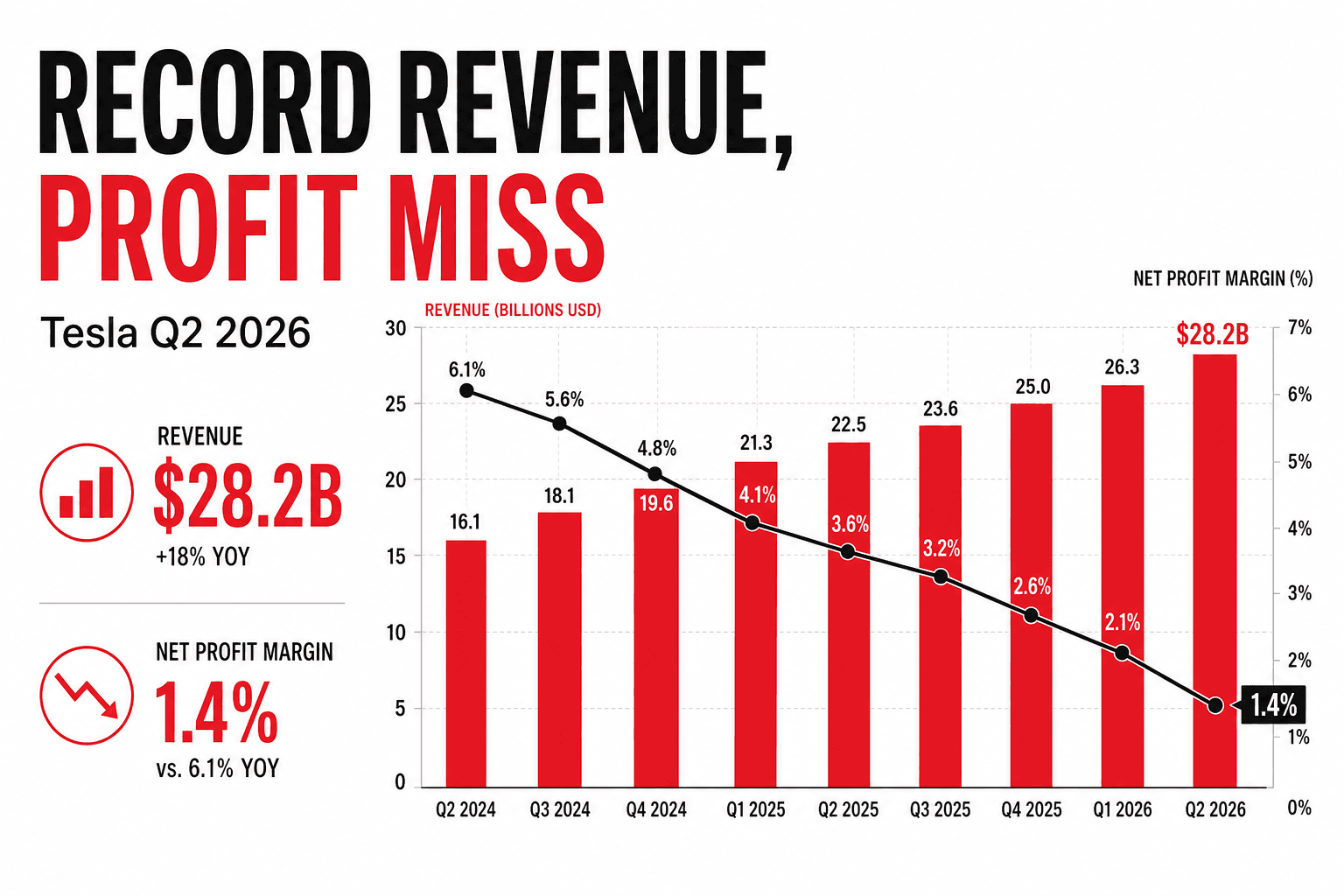
A record top line the market could not celebrate
Tesla booked the biggest quarter in its history and its stock fell anyway. For the three months ended June 30, revenue rose 25.5% from a year earlier to $28.24B, a company record, on a record second-quarter haul of 480,126 vehicle deliveries. The company also crossed $100B in trailing-twelve-month revenue for the first time. On the headline number, this was a strong quarter.
Almost everything below the top line told a different story. Operating income fell 57% to $398M, gross margin dropped to 16.8%, and adjusted earnings of $0.33 per share missed consensus of roughly $0.51 by a wide margin. Then, on the call, management guided to a capital-spending surge that turned free cash flow negative. The shares, already down about 17% for the year going into the print, slipped around 3% after hours and then extended toward a 5% decline, sliding into the $360s. The reaction was about spend and margins, not demand.
The setup: revenue keeps climbing
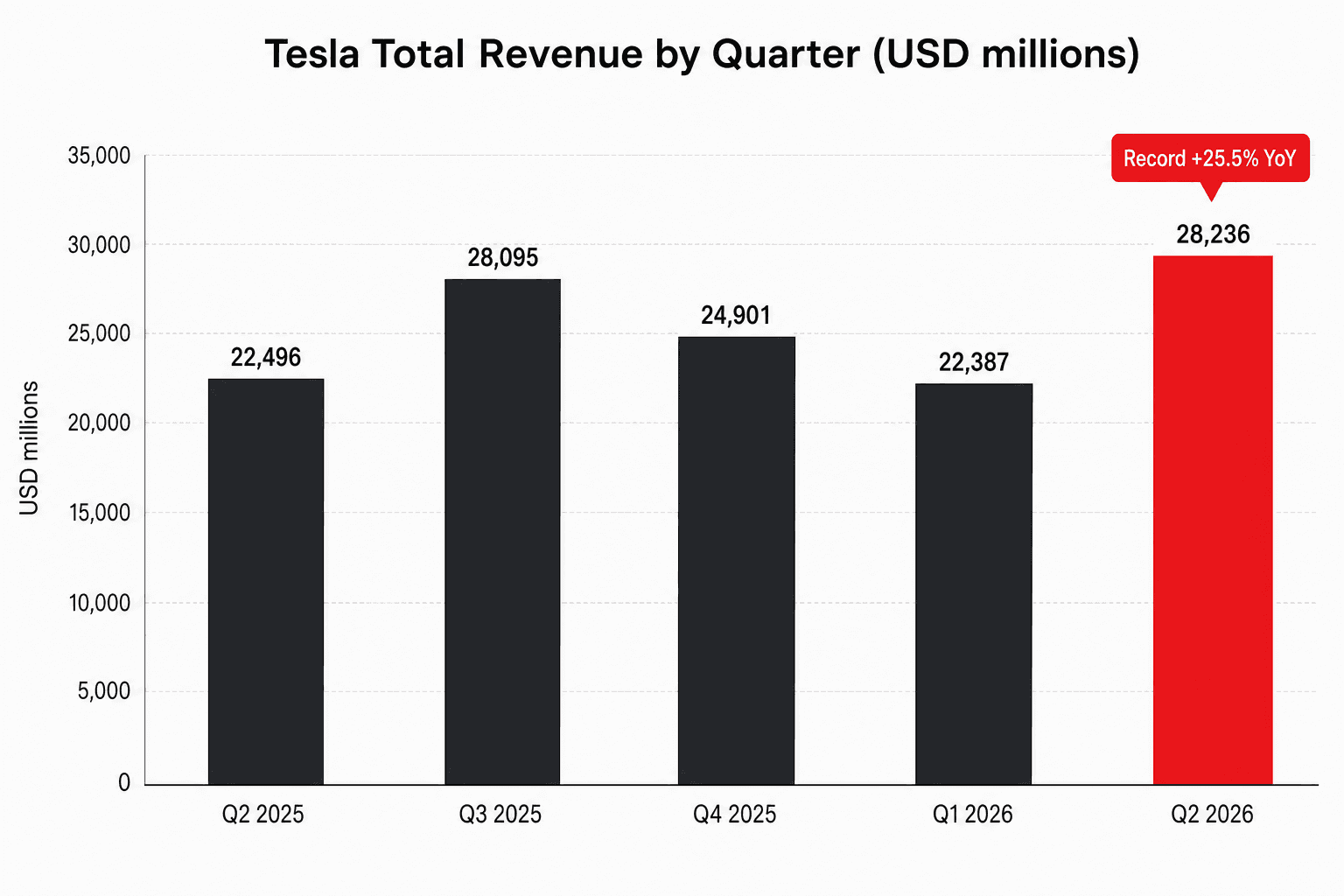
The revenue line is genuinely impressive. A year ago Tesla did $22.5B in the same quarter; this time it did $28.2B. Automotive revenue, still the biggest piece, rose 23% to $20.52B, with core vehicle sales up 27% to $20.01B on the record delivery count. Energy generation and storage climbed 12.5% to $3.14B, and Services and Other jumped 50% to $4.58B. Growth was broad, and it was real.
That breadth is what makes the profit miss so jarring. The business is selling more of nearly everything, yet it is keeping far less of each dollar than it did a year ago. To see why, you have to look at the mix beneath the headline.
Where the profit leaked out
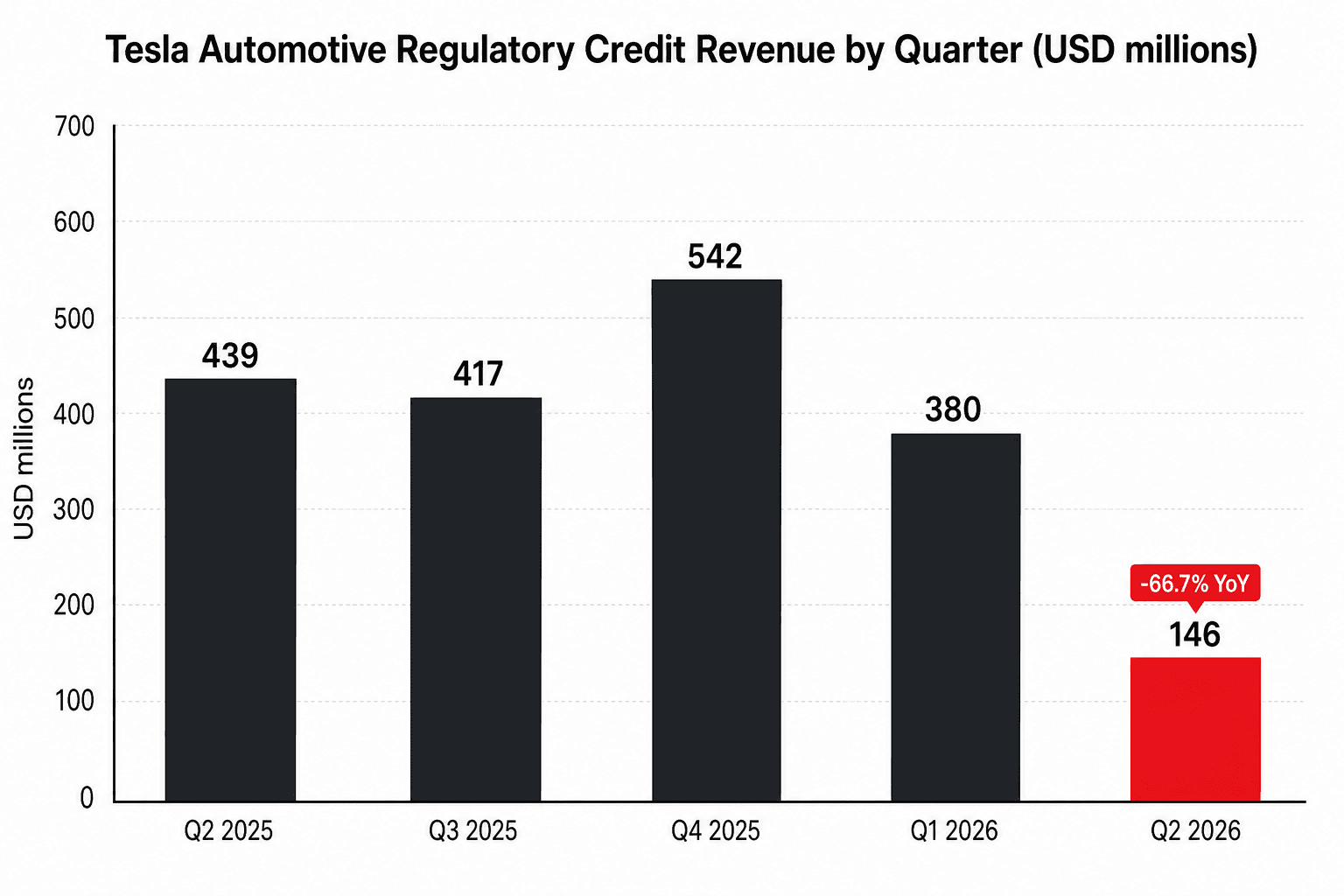
The single cleanest culprit is regulatory credits. These are payments rival automakers make to Tesla so they can meet emissions rules, and because they cost Tesla almost nothing to generate, they flow through as near-pure profit. That stream collapsed to $146M, down 67% from a year ago and 62% from the prior quarter, as U.S. policy stripped much of the value out of the credits. A year ago they contributed 2.2 percentage points to automotive gross margin; this quarter, just 0.6. Losing that cushion left the underlying car business more exposed.
The rest of the segment picture was mixed. Energy revenue grew, but its gross margin fell sharply to about 20% from 39.5% the prior quarter, dragged down by warranty charges tied to a vendor cell issue. The standout was Services and Other, where a record $648M of gross profit at a 14% margin, the highest that segment has ever posted, showed Tesla's growing installed base of cars, chargers, and software starting to pay off. It was not enough to offset the automotive squeeze.
Margins compress as spending explodes
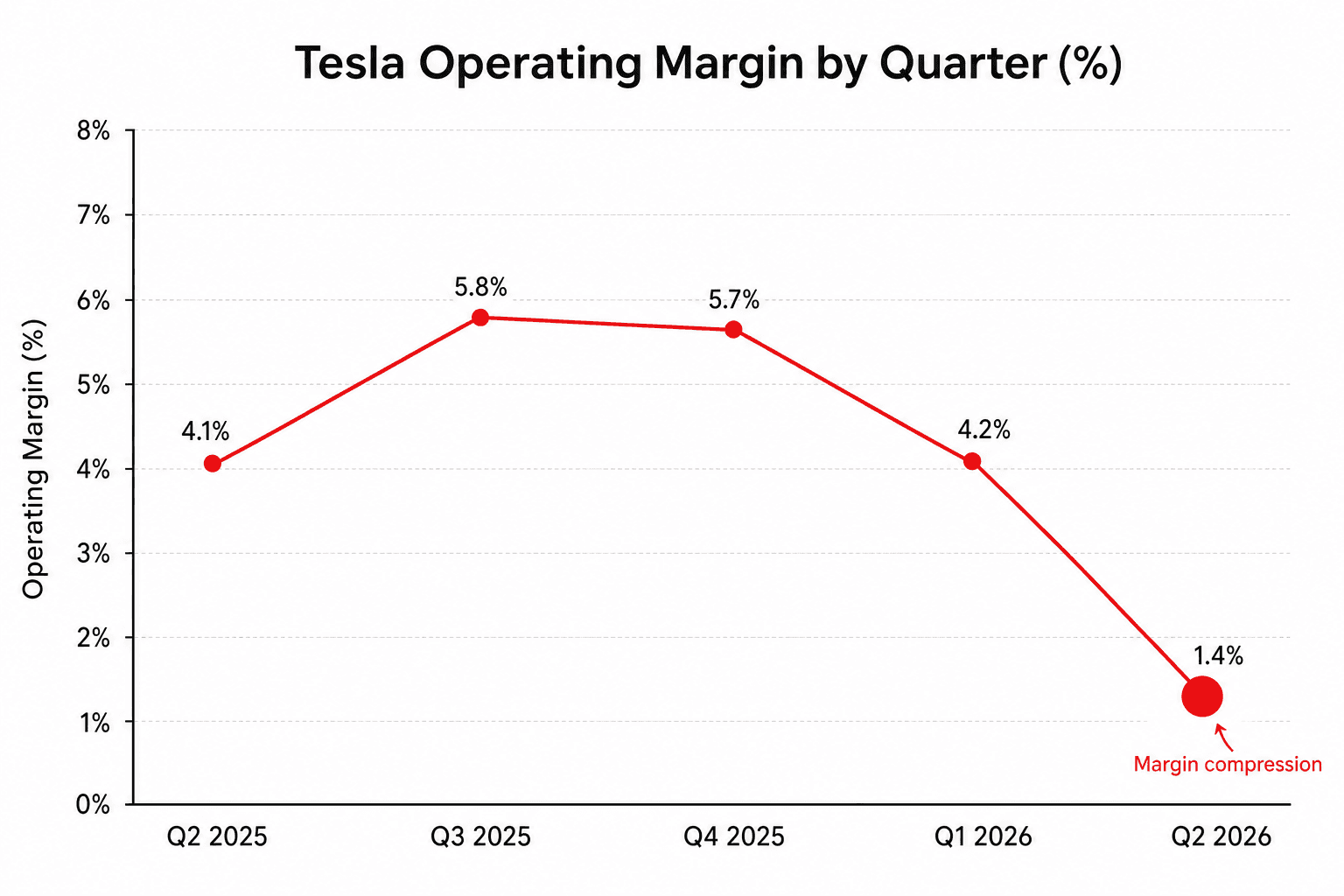
Operating margin, the share of revenue left after the costs of building and selling everything, fell to 1.4% from 4.1% a year ago. The gross-margin erosion explains part of it; the rest is operating expense. Total operating costs rose 47% year over year to $4.35B, led by a 49% jump in research and development to $2.37B as Tesla funds its AI, autonomy, and robotics work. In other words, the company is spending heavily today against products that will not generate revenue for years.
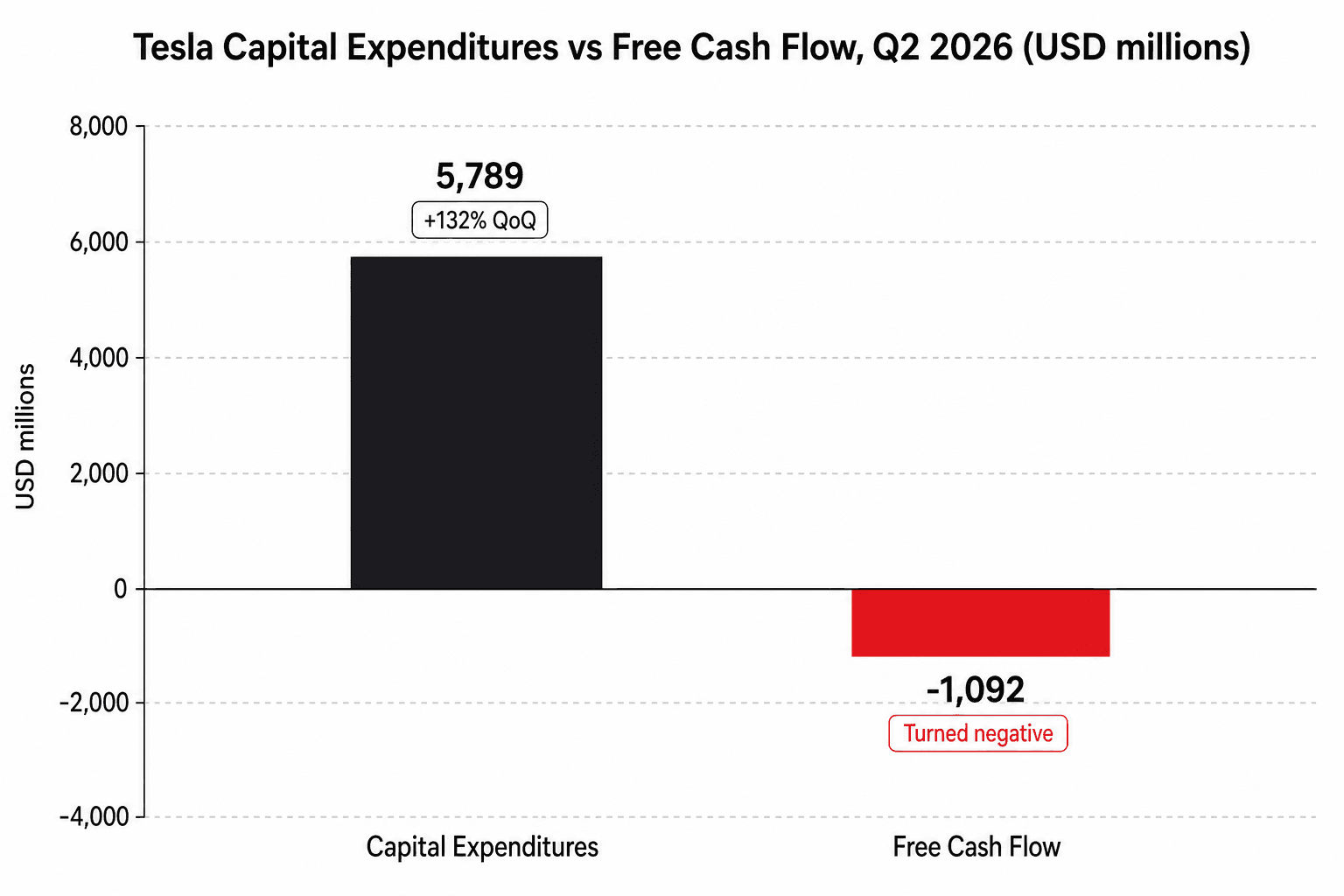
The bigger shock came in cash. Operating cash flow was strong, up 85% to a second-quarter record of $4.7B. But capital expenditures more than doubled to $5.79B, up 142% from a year earlier, sending free cash flow to negative $1.09B, its first negative reading in years. Tesla still holds a large cushion, with $43.5B in cash and short-term investments, but the direction of travel is what caught attention. CFO Vaibhav Taneja said the company is positioning to borrow up to roughly $30B to fund the roadmap.
What management is spending on
The whole quarter is really an argument about that spending. On the call, Elon Musk leaned into it, saying Tesla will accept being "a little less capital efficient" to move faster on autonomy and robots. He framed the priority as scaling as fast as possible without causing harm, and said this year "will be great for investors, and next year will be even better."
The concrete milestones behind the spend: robotaxi service is live in seven metros, with unsupervised rides launched in Miami, Orlando, and Tampa in July, and Musk said mileage is growing more than 10% per week. The purpose-built Cybercab entered production at Gigafactory Texas. On humanoid robots, Tesla cleared out its old Model S and X lines at Fremont to install the first Optimus production lines, targeting output later this year, though Musk cautioned it is "the hardest product to scale manufacturing" the company has ever tried. FSD subscriptions reached about 1.48 million, up 56%, and attach rates on new deliveries topped 55% in North America.
The Street stays split
Analysts came into the print rated Hold on average, and the quarter did not settle the debate so much as sharpen it. The consensus price target sits near $403, but the spread is extraordinary: RBC at $500 and Deutsche Bank at $465 near the top, against Wells Fargo at $130 and GLJ Research at $24.86 at the bottom. Almost every firm names the same swing factor: whether robotaxi and Optimus scale fast enough to justify a spending cycle that roughly triples 2025's capex.
The bears got fresh ammunition in the margin compression and negative cash flow; the bulls kept their optionality on autonomy intact but unproven. It did not help the near-term narrative that BYD retook the global battery-electric sales lead in the quarter, delivering 557,090 vehicles to Tesla's 480,126, a reminder that the core car market is only getting more competitive.
The forward look
The tension in this report is the tension in the stock. One reading is of a company at record scale, still generating strong operating cash and investing aggressively to build the next decade of products. The other is of a business whose profitability has thinned to almost nothing while it bets tens of billions on machines that do not yet earn money. Both are true at once.
For the rest of 2026, three questions decide which reading wins. Can automotive margins hold now that the regulatory-credit cushion is largely gone? Does the capex, guided above $25B for the year against $8.5B in 2025, start to show up as real robotaxi and Optimus revenue rather than just cost? And can the balance sheet absorb a multi-year spending cycle, backed by up to $30B in new debt, without straining? Until those answers arrive, a record-breaking quarter will keep reading, to a wary market, like an expensive one.