Starlink Pays the Bills: SpaceX's S-1 in One Segment Table
The Number That Tells the Whole Story
SpaceX filed its S-1 on May 20, 2026, and the document does exactly what every IPO prospectus is supposed to do: it forces a private company to put numbers on the things it has been telling people verbally for years. For SpaceX, the most-told story has always been Mars. The most-true story turns out to be Starlink.
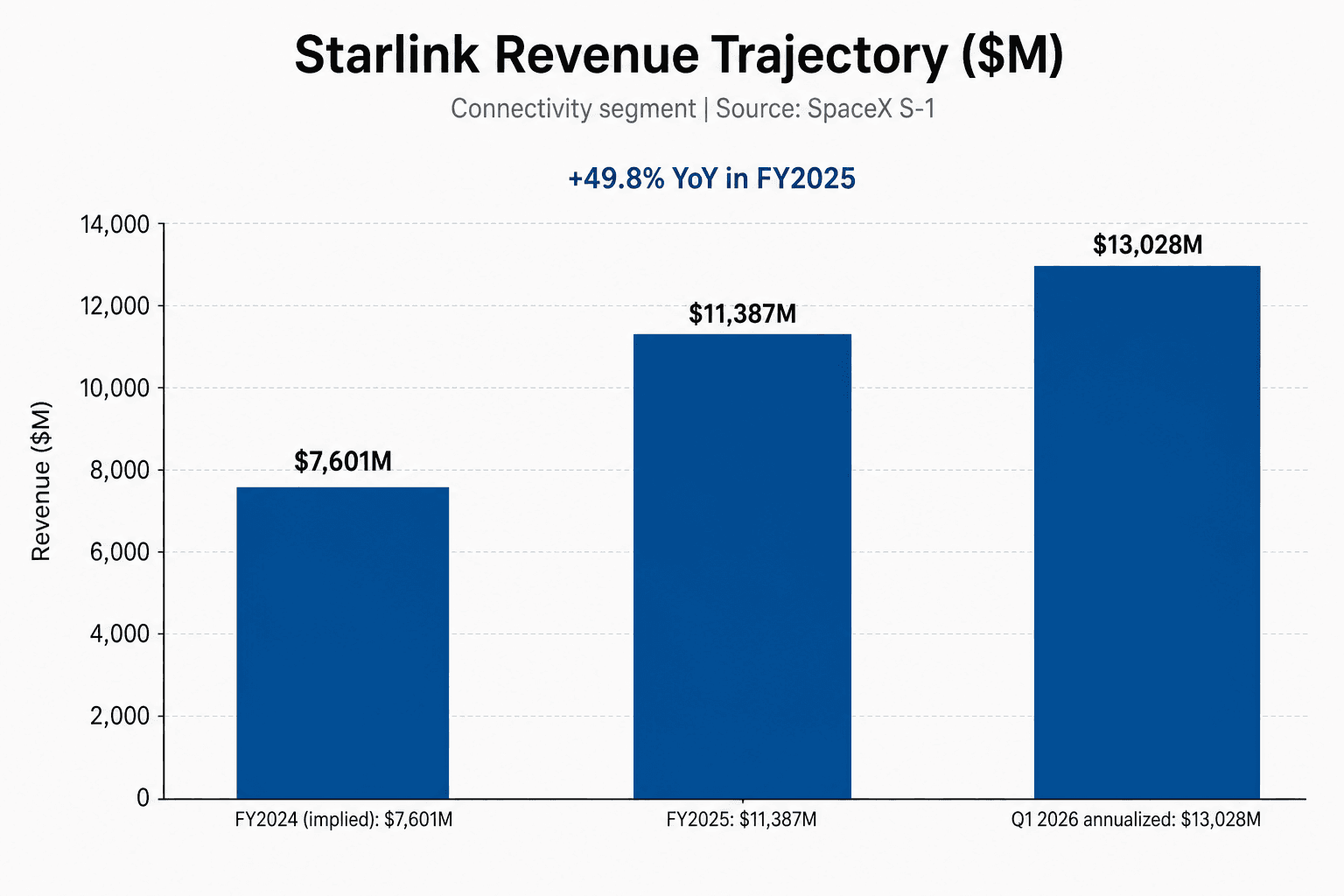
In fiscal 2025, SpaceX's Connectivity segment — broadband Starlink plus Starlink Mobile — generated $11,387 million in revenue and $4,423 million in segment operating income. The Space segment — the actual launching of actual rockets — generated $4,086 million in revenue and lost $657 million. The new AI segment (xAI and X, folded in via a February 2026 common-control combination) generated $3,201 million in revenue and lost $6,355 million.
Connectivity is the only profitable segment. By a lot.
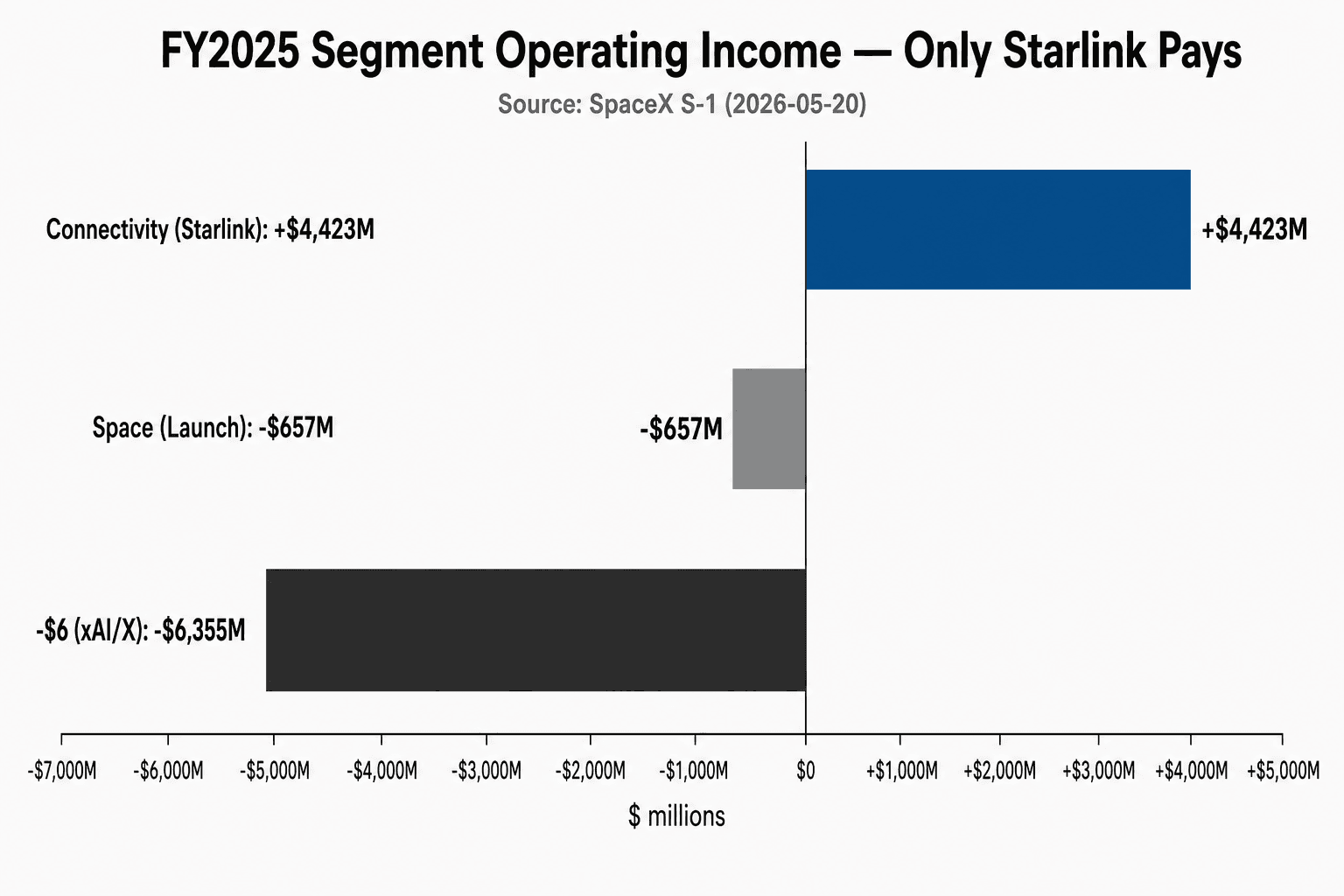
If you net the operating losses, Space and AI together cost SpaceX $7,012M in FY2025. Connectivity's $4.4B covered ~63% of that on an operating basis. On a Segment Adjusted EBITDA basis — which adds back depreciation, the largest line item in a satellite business — Connectivity's $7,168M effectively absorbed the combined losses of the other two segments and still threw off cash. There is exactly one engine inside SpaceX, and it is the one that beams TikToks to airplanes.
The Launch Business Loses Money
This is the part of the prospectus most casual readers will skip past, so let's be explicit about it. The Space segment includes Falcon 9, Falcon Heavy, Dragon, NASA crew and cargo, National Security Space Launch contracts, and the Starship development program. In FY2025, the entire segment booked $4.1B in revenue and posted a $657M operating loss. The first-quarter 2026 print is worse on a run-rate basis: $619M of revenue (which annualizes to $2.5B, well below the $4.1B FY2025 figure) and a $662M operating loss.
The reason is Starship. The prospectus discloses, verbatim, that the Space segment spent $3,004 million on Starship R&D in FY2025 — 74% of its entire revenue. In Q1 2026 alone, Starship R&D was $930M against $619M of Space segment revenue. The launch business is operating at negative gross dollars before any other cost is recognized.
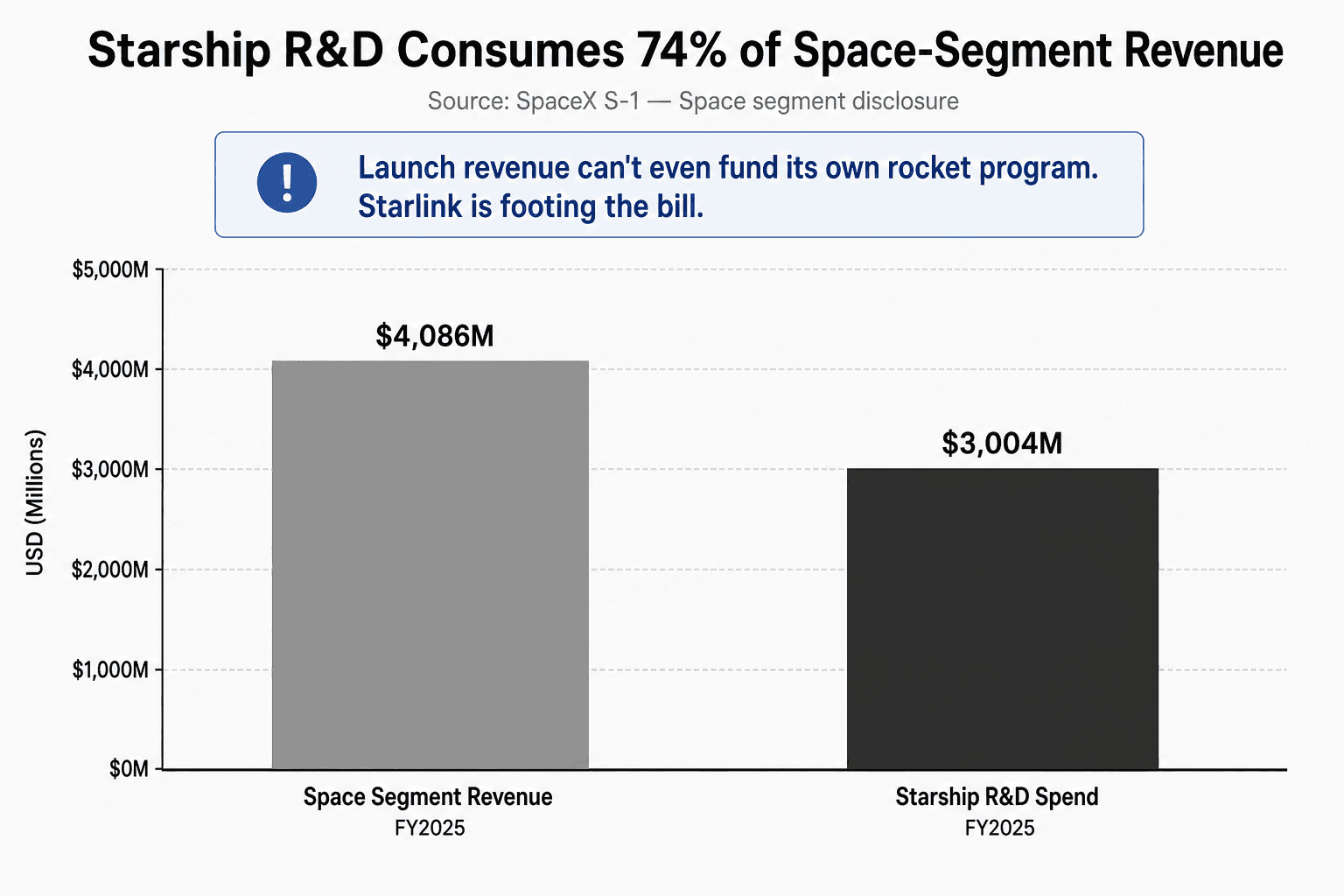
This is the cleanest version of the bear case: SpaceX is a launch company that doesn't make money launching, attached to an internet company that does. Bulls and bears can argue about whether Starship pays off and on what timeline. What's not arguable, after this S-1, is who's covering the bill in the meantime.
Starlink, in Plain Numbers
The Connectivity segment runs on three things: subscribers, satellites, and spectrum. The S-1 puts hard numbers on the first two and dances around the third.
| Metric | As of 2026-03-31 |
|---|---|
| Starlink Subscribers | ~10.3 million |
| Countries served | 164 |
| Satellites in LEO | ~9,600 |
| Share of all active maneuverable satellites in orbit | ~75% |
| FY2025 Connectivity revenue | $11,387M |
| FY2025 Connectivity operating income | $4,423M |
| FY2025 → 2024 Connectivity revenue growth | +49.8% YoY |
| Implied blended ARPU | ~$95–110/month |
The growth rate alone — 50% on an $11B base — explains why bankers can pencil in a $1.75 trillion valuation on a company that loses $2.6B at the operating line. If you isolate the Connectivity segment and apply a generous satellite-internet multiple, you can get most of the way to the headline number without crediting Mars at all.
The 75% share-of-maneuverable-satellites number is the one to sit with for a minute. SpaceX doesn't just dominate satellite broadband; it dominates the operational satellite population, full stop. Every Starlink deployment further entrenches both the asset advantage and the regulatory case — spectrum coordination favors incumbents — which is why management can credibly model 30–50% revenue growth for several more years even as the network grows by orders of magnitude.
The Direct-to-Cell business adds another layer. SpaceX now operates ~650 dedicated V1 Mobile satellites, supports ~7.4 million monthly unique devices across ~30 countries, and has partnerships with ~30 mobile network operators. None of this is monetized at scale yet. None of it shows up in the segment ARPU. All of it becomes upside if Starship ever launches V3 satellites — the prospectus claims a single Starship can deploy up to 60 V3s, representing "a potential twenty-fold increase in Starlink downlink capacity deployed relative to a Falcon 9 launch."
That sentence is the bridge between the two businesses. Starlink's ceiling is gated by launch cadence. Starship is the only way Starlink keeps growing at this rate past 2027. So you arrive at the strangest contradiction in the prospectus: Starlink funds Starship, and Starship is what unlocks Starlink's next leg. Each is the other's exit ramp.
Where the IPO Money Actually Goes
Read the use-of-proceeds language slowly:
"We intend to use the net proceeds from this offering to fund our growth strategy, including the expansion of our AI compute infrastructure, enhancements to our launch infrastructure and launch vehicles, increases in the scale and capacity of our satellite constellations, and any remaining amounts for general corporate purposes."
The ordering is the message. AI compute is first. Launch is second. Satellites are third. SpaceX, the satellite-internet company that funds the rocket company, is going to raise public capital to pay for the AI cluster.
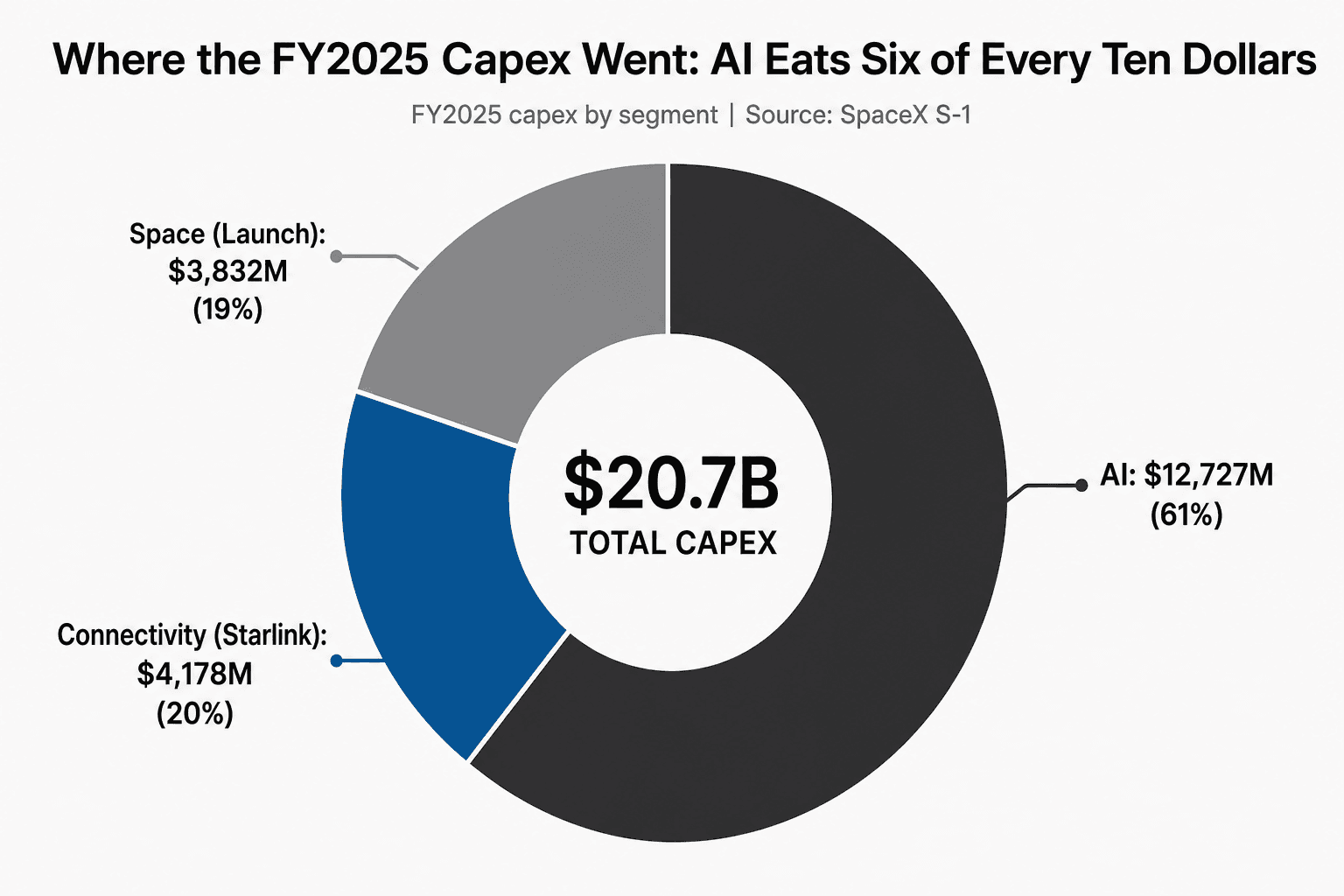
The FY2025 capex breakdown supports this. Of $20,737M in total capex, AI consumed $12,727M — 61% of the total — versus $4,178M for Connectivity and $3,832M for Space. Total capex exceeded total revenue by ~$2B. The Q1 2026 capex pace was $10.1B, an annualized run-rate of $40B that would be operationally impossible without external capital.
The AI capex line connects to the most underdiscussed disclosure in the S-1: the Anthropic deal. Under a Cloud Services Agreement, Anthropic pays SpaceX $1.25 billion per month through May 2029 for GPU compute at the COLOSSUS and COLOSSUS II clusters. That is roughly $45B in committed revenue over the term, terminable on 90 days' notice by either side. It is also the only meaningful customer concentration the AI segment discloses by name, and it explains a lot about why AI capex is what it is. The cluster is being built, in part, against a contracted anchor tenant.
Whether that math works for shareholders is a separate question. A 90-day termination clause on a $45B revenue stream is not the contractual structure a strategic anchor signs when it cannot replace the supplier. It is the structure two parties sign when both want optionality. If Anthropic walks in 2027 because compute prices crash, SpaceX is sitting on $12B+ of recent AI capex with one fewer reason for it.
The Risks Worth Reading
The Summary of Risk Factors leads with what you'd expect — Starship execution, FCC spectrum, Musk key-person, dual-class control. The most thesis-relevant one for the Starlink-pays-the-bills frame is the FCC line:
"Any delays or difficulties in obtaining, maintaining or renewing required communications licenses and spectrum authorizations for our satellite connectivity services … could materially delay or disrupt our operations, harm our business, or limit our ability to execute our business strategy."
Translation: if any major regulator claws back spectrum in any major market, Connectivity's growth curve snaps, and the only thing funding everything else snaps with it.
The Starship risk reads as cadence risk, but is actually capacity risk. Starlink's ability to add 10–20 million more subscribers between now and 2028 is gated by how many satellites it can put up per Falcon and per Starship launch. If Starship slips into 2027 — and the first payload-to-orbit Starship mission is only targeted for H2 2026 — the V3 capacity uplift slips with it, and so does the slope of the Starlink revenue line that the IPO valuation is anchored to.
The Musk concentration risk is structural and unfixable inside the offering. Class B carries 10 votes per share, can elect a majority of the board for as long as it exists, and is concentrated with the CEO who also runs Tesla, xAI, X, Neuralink, and the Boring Company. The "controlled company" designation under Nasdaq rules waives several governance protections. Some shareholders will buy that. Some won't. The prospectus is not pretending otherwise.
One absence is notable: the Summary of Risk Factors does not include a standalone "Starlink concentration risk." Either management does not consider it a top-tier risk or it lives deeper in the full Risk Factors section. Given the segment math above, an investor reading this filing should treat the concentration as the most obvious risk that management is least eager to highlight.
The Cleanest Take
For most of the last decade, "is SpaceX undervalued at $250B?" was the question. The S-1 reframes it. The right question now is: how much of the $1.75T headline valuation should be allocated to a profitable, fast-growing broadband business, and how much should be allocated to a launch business that doesn't make money plus an AI business that loses billions and depends on a 90-day-cancellable anchor tenant?
Most of it should sit on Starlink. Connectivity has the revenue, the growth rate, the operating profit, the regulatory moat, and 75% of all maneuverable satellites in orbit. It would be the largest standalone satellite operator in human history. Apply a reasonable satellite-internet multiple to $13B of run-rate revenue and you arrive at most of the IPO.
The launch business is a strategic asset, not a profit center. It exists because Starlink needs lift capacity. Starship is being underwritten because Starlink needs more lift capacity. Mars is a marketing line item.
The AI business is a separate bet. It might pay off. It might not. The Anthropic contract is large and short-dated. The capex is enormous and front-loaded. Investors should price it conservatively until the second anchor tenant signs, the contract terms lengthen, or the cluster proves unique-enough to extract pricing power.
The most honest one-line summary of the S-1 is the same one Starlink salespeople have been telling private-market investors since 2022: SpaceX is a satellite-internet company with a rocket-launch hobby. The S-1 made that quiet truth a filed-on-EDGAR truth. Now public investors get to decide what to pay for it.