SpaceX's First Earnings: A Big Beat, a Bigger Capex Bill
A landmark quarter with a split verdict
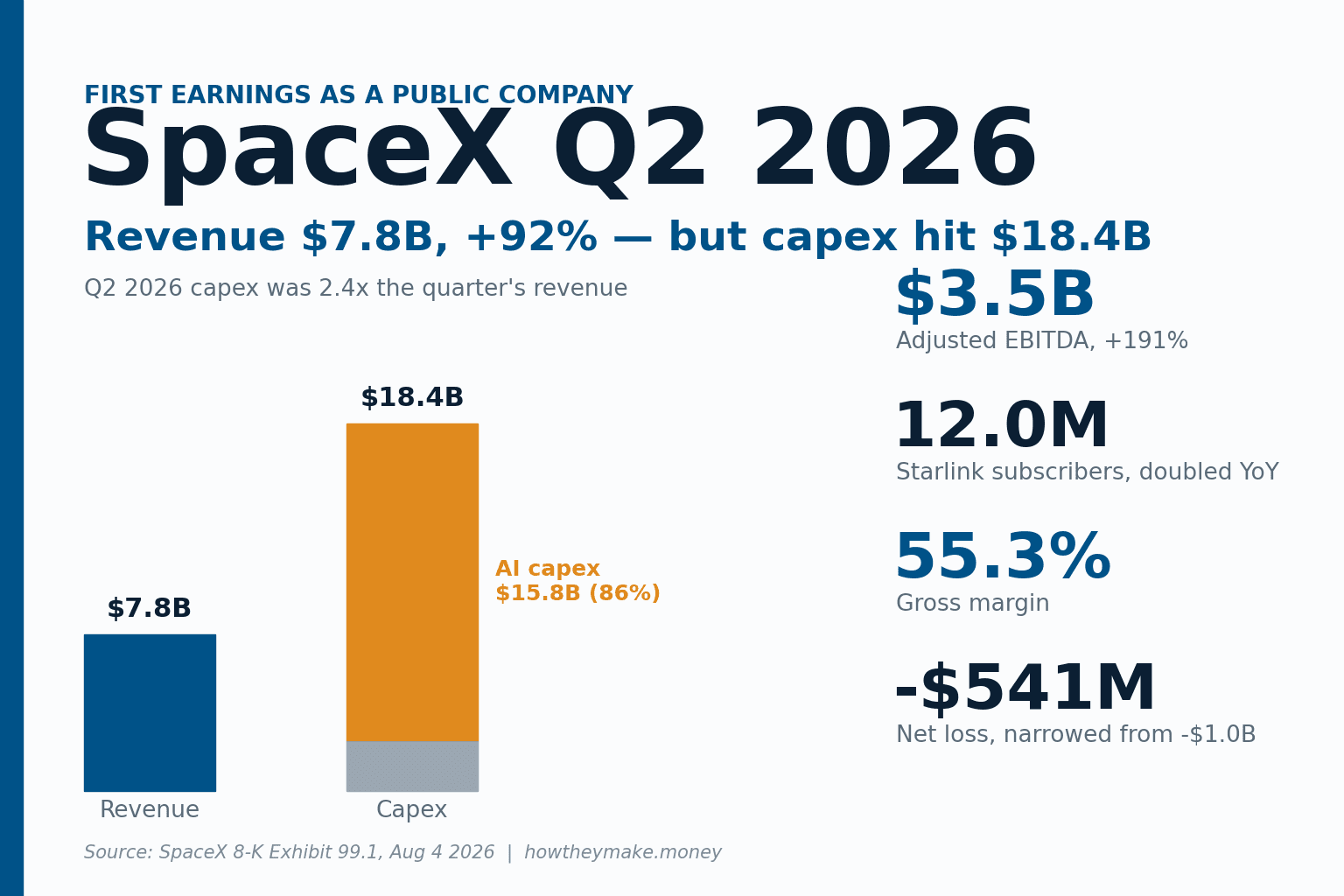
SpaceX just reported earnings for the first time as a public company, and the numbers cut two ways at once. Revenue for the second quarter of 2026 hit $7,814M, up 92% from a year earlier (YoY) and well ahead of the roughly $6.8B analysts expected. The net loss narrowed to $541M from $1,008M. On the operating engine that management wanted investors to notice, Starlink, the business is now clearly profitable. And yet the stock, up 9.43% during the regular session to about $125.33, fell roughly 8% after hours to near $114.60 once the release landed.
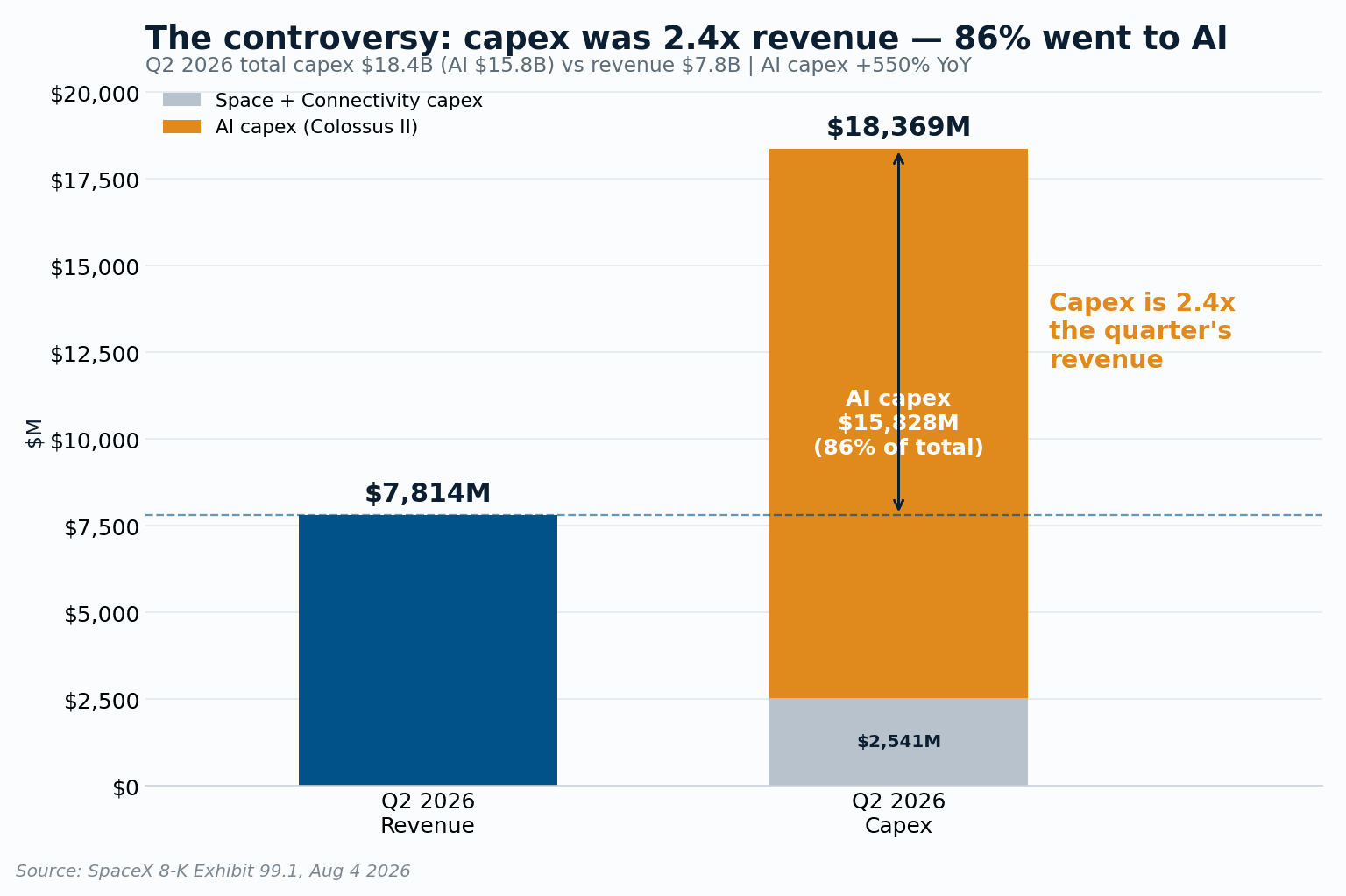
The reason sits in one line of the cash flow statement: capital expenditure, or capex, the money a company sinks into equipment and facilities. SpaceX spent $18,369M of it in the quarter, about 2.4 times the revenue it booked. The company delivered a real beat and, on the same page, the largest single-quarter spending figure in its history. This report is a study in that tension.
The top line: three engines, one clear winner
SpaceX now reports three segments after integrating xAI and X in February 2026. Connectivity (Starlink) is the anchor, with revenue of $4,291M, up 66% YoY. Space, which covers launch, Starship and the Starshield government network, rose to $962M. The swing factor was AI (xAI and X), where revenue tripled from the prior quarter to $2,561M, boosted by $1.6B of incremental infrastructure revenue from newly signed cloud compute agreements.
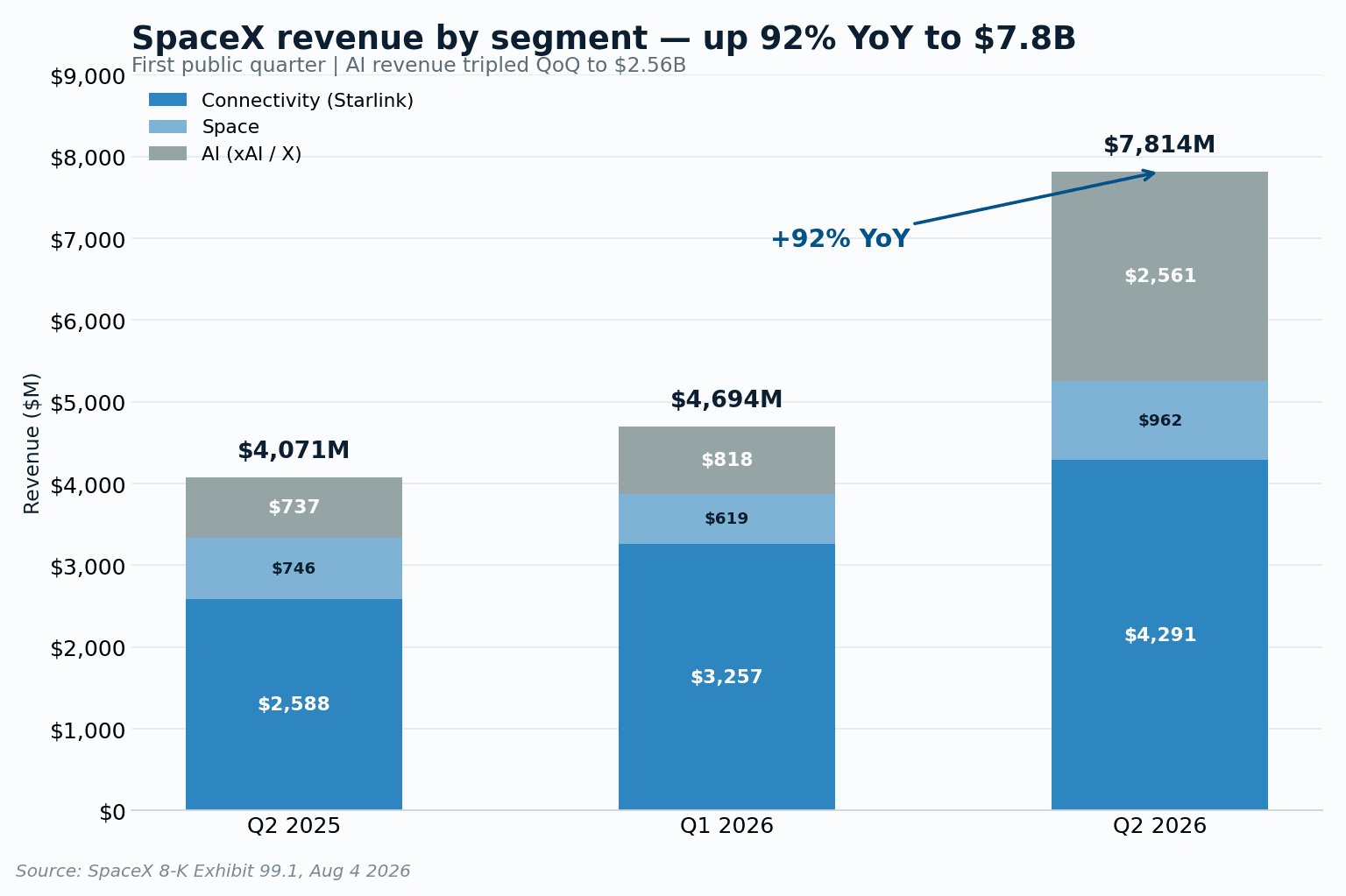
That AI jump reshaped the mix in a single quarter. AI went from about 17% of revenue to roughly 33%, while Connectivity's share fell even as its dollars grew. Gross margin (the share of revenue left after the direct cost of delivering the service) expanded more than 11 points YoY to 55.3%, helped by the high-margin compute contracts and Starlink's operating leverage.
Starlink is the profit engine
Strip away the AI headlines and the quarter's most durable story is Starlink. Connectivity operating income was $1,656M, up 79% YoY, funding the losses in Space and AI. Subscribers doubled YoY to 12.0 million, with 1.7 million net additions in the quarter.
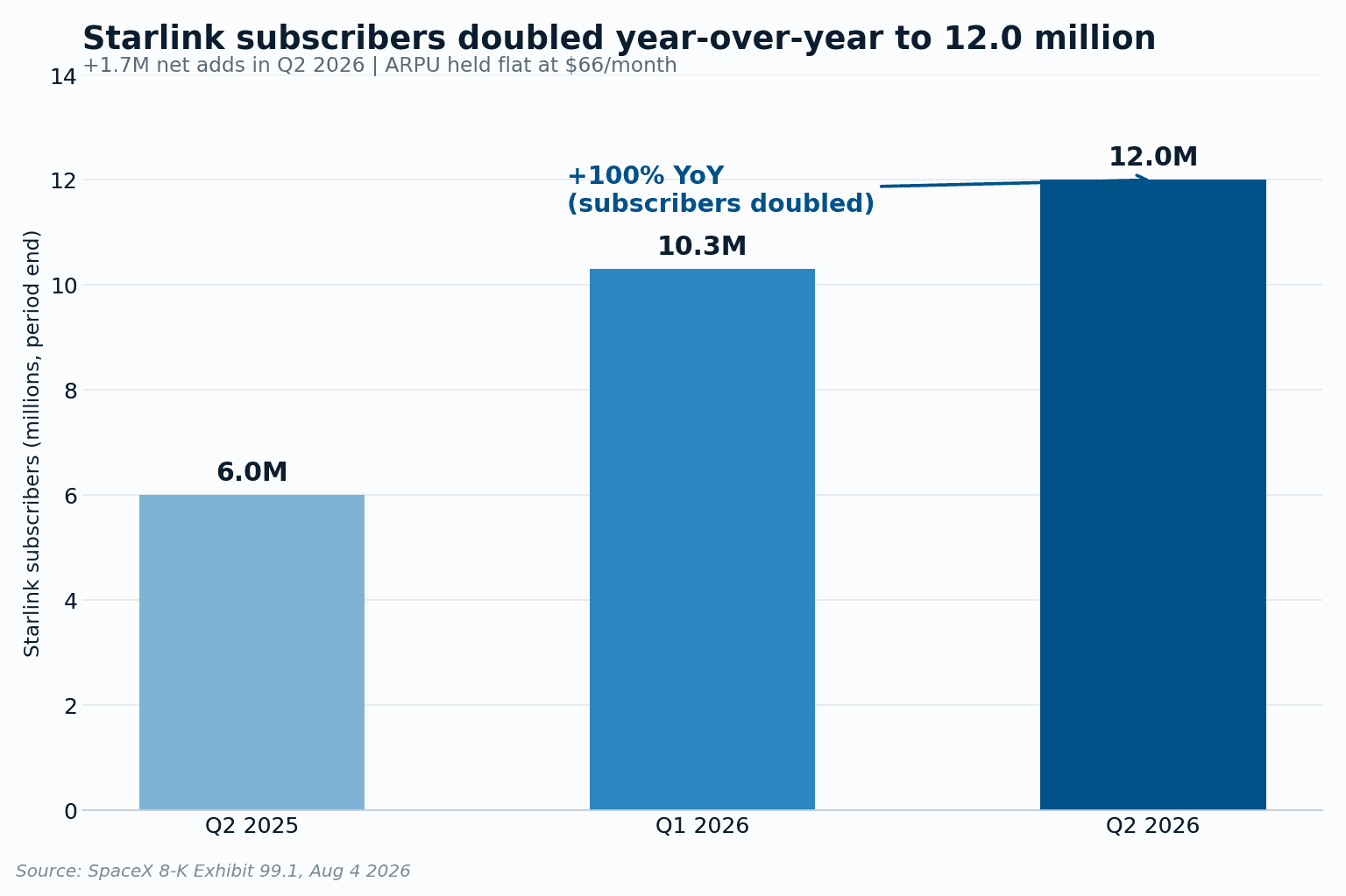
Average revenue per user, or ARPU, the monthly revenue SpaceX collects per subscriber, held flat at about $66. That number is down 22% from a year ago, the price of chasing lower-cost international and consumer markets, but holding it steady while doubling the base is the win. The faster-growing slice is enterprise and government, up 108% YoY to $1,806M, lifted by more than $6B in new Starshield contracts with the U.S. government.
Profitability is arriving, on an adjusted basis
The clearest sign of scale is Adjusted EBITDA, a non-GAAP profit measure that strips out interest, taxes, depreciation, stock compensation and one-time items to approximate cash operating earnings. It nearly tripled YoY to $3,538M, a 45.3% margin.
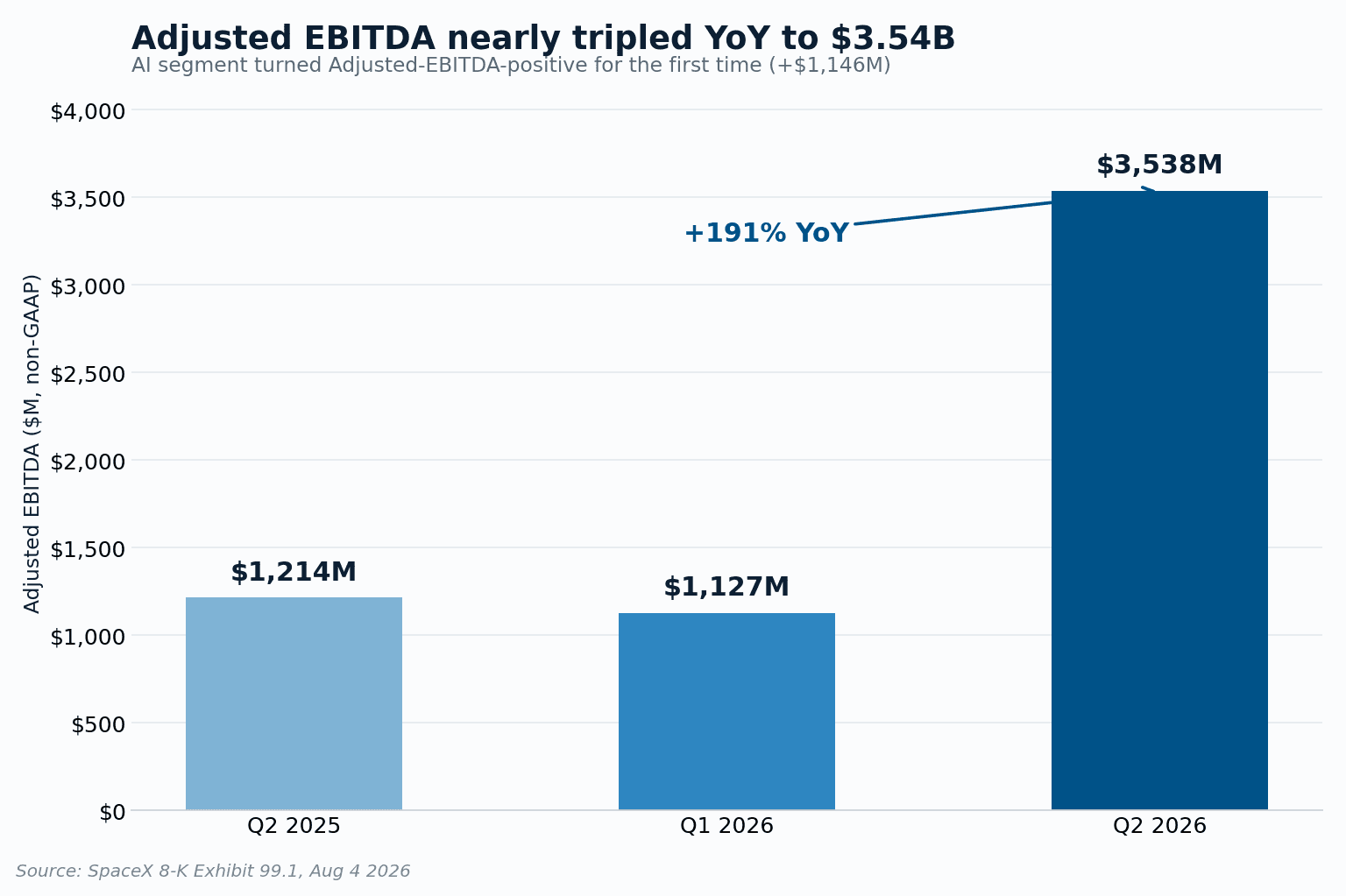
The AI segment turned Adjusted-EBITDA-positive for the first time, at $1,146M, as the compute contracts dropped in. The gap between the near-breakeven operating loss of $143M and the $3,538M of Adjusted EBITDA is mostly depreciation and amortization of $2,848M, a figure that is climbing fast alongside the AI buildout. That is a hint of what the spending will cost in future quarters.
The number that spooked investors
Here is the crux. Total capex of $18,369M was 2.4 times the quarter's revenue, and AI alone accounted for $15,828M, or 86% of it. That AI figure is more than 20 times what it was a year ago, funding the Colossus II compute buildout that pushed nameplate capacity to 1.4 gigawatts.
Management framed the balance sheet as more than able to carry it. SpaceX ended the quarter with about $100B in cash and marketable securities and a $47.5B backlog, the contracted future revenue it has yet to recognize, after raising $85.7B in net IPO proceeds and issuing a $25B bond. It also announced a roughly $60B acquisition of the AI coding company Cursor and signed $14.1B of cloud compute contracts. The bull case is that this is investment, not waste: build the compute, sign the contracts, collect the revenue. The bear case, which the after-hours tape voted for, is simpler. Spending is running far ahead of sales, and no balance sheet is infinite.
What the Street said, and what comes next
Sell-side coverage, almost all of it initiated around the June IPO, stayed broadly positive. Morgan Stanley's Adam Jonas kept an Overweight rating with a $300 target, and Deutsche Bank, Cantor Fitzgerald, Bernstein and Goldman Sachs all held Buy-equivalent calls with targets from $239 to $300. Their shared thesis: Starlink is already a profit engine, and the AI capex buys future optionality. The louder skeptics, mostly independent commentators, flagged the valuation and a looming lockup that could release roughly 911 million shares into the float.
For the numbers themselves, the checklist for next quarter is short. Can AI revenue hold its run-rate once the one-time contract recognition fades, especially with X advertising still down 14% YoY. Can Starlink keep doubling without ARPU slipping further. And most of all, can the AI compute buildout start earning a return before the capex line strains even a $100B cash pile. SpaceX delivered a genuine beat in its debut as a public company. Whether it reads as a bargain or a warning depends entirely on what that $18.4B buys.