Sandisk's NAND Supercycle: Record Margins, Stock Falls
A memory maker's blowout that the market sold anyway
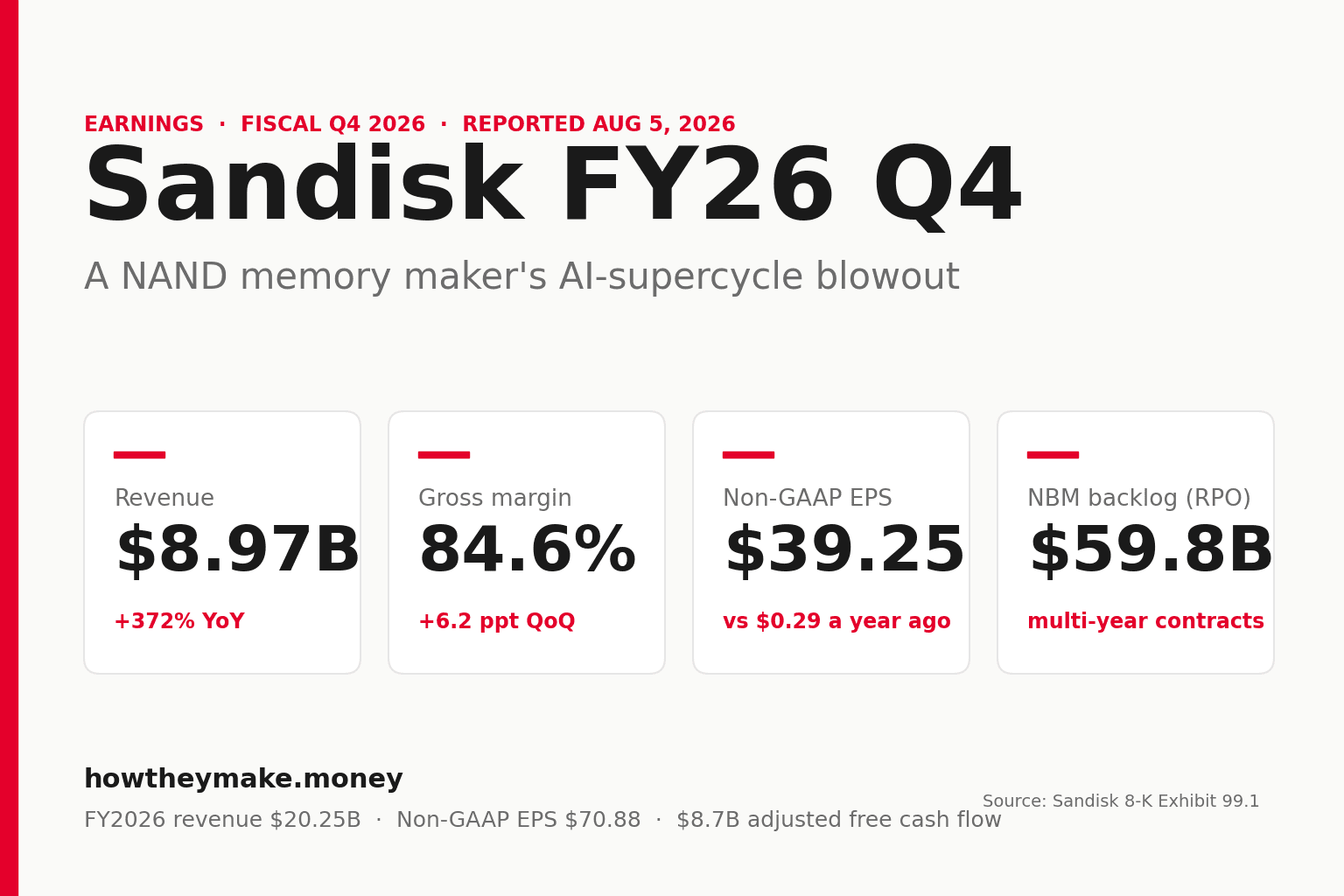
A year ago, Sandisk was a roughly $1.9 billion-a-quarter maker of NAND flash, the non-volatile memory chips inside phones, laptops and data-center drives. It had about three months of demand visibility and a gross margin in the mid-20s. In the quarter ended July 3, 2026, that same company reported $8,965M of revenue, up 372% from a year earlier, a gross margin of 84.6%, and non-GAAP earnings per share of $39.25. This is one of the most violent single-year transformations any large hardware company has posted.
The engine is the AI build-out. Training and running large models consumes enormous amounts of high-capacity storage, and NAND supply has not kept pace with demand. Prices have surged, and Sandisk has locked much of its future output into multi-year contracts. And yet the stock fell 5.40% to $1,350.50 during the regular session on August 5, then dropped another 7.96% to about $1,243 after the release. This report is the study of that gap between a genuine blowout and a market that had already priced in perfection.
The top line went vertical
Revenue of $8,965M was up 50.7% from the prior quarter and 371.6% year-over-year, above the company's own $7,750M to $8,250M guidance. Management split the sequential growth roughly one-third from higher volume, the number of bits shipped, and two-thirds from higher pricing. In a memory up-cycle, price is the dominant lever, and Sandisk is pulling it.
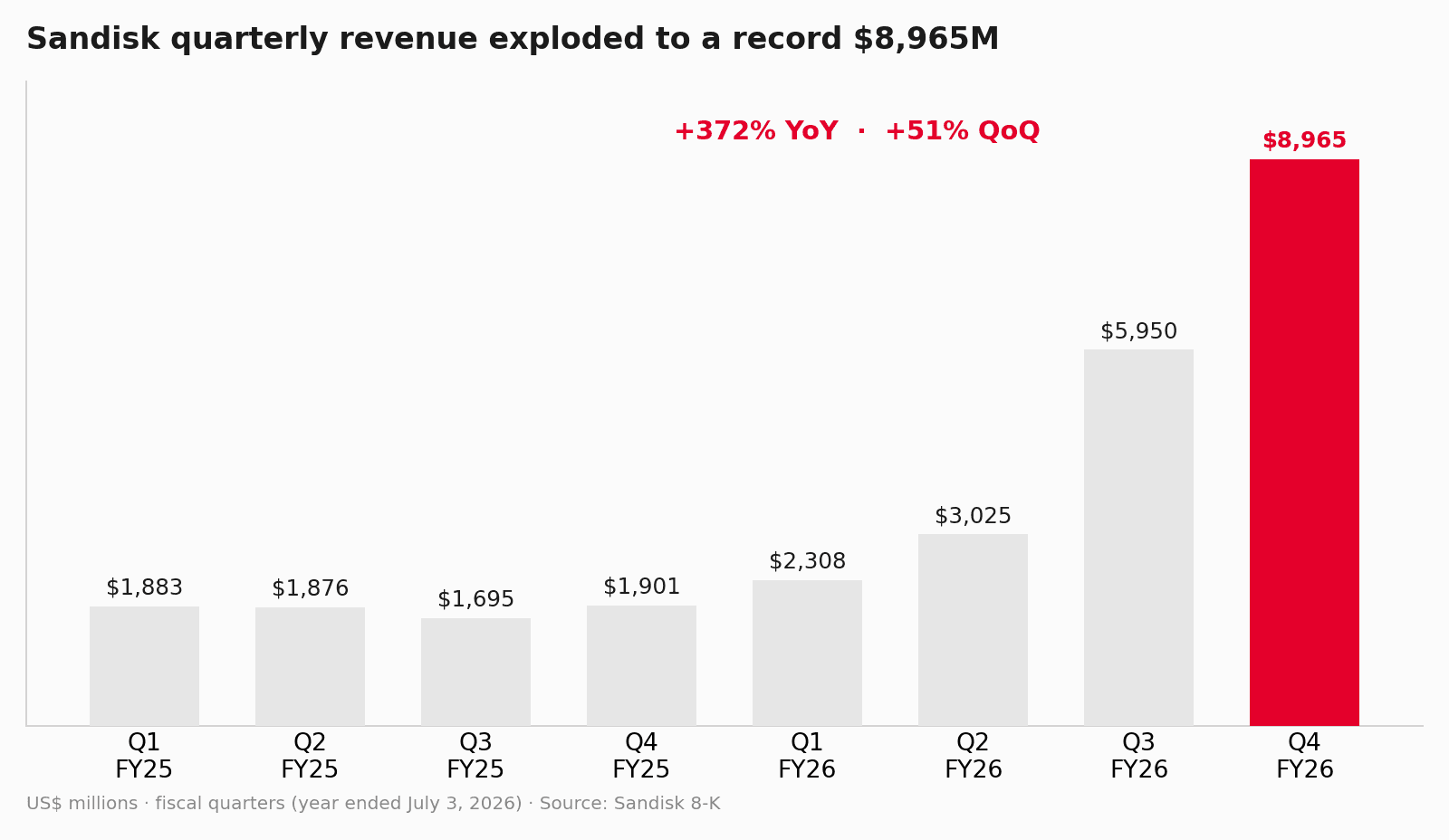
For the full fiscal year, revenue reached $20,248M, up 175% from $7,355M in fiscal 2025, on what management called mid-teens percentage growth in bit shipments. Revenue rising far faster than volume is the whole story: this is a pricing and mix event, not a volume boom.
Datacenter is the fastest-growing engine
Sandisk renamed its segments this quarter, Cloud became Datacenter and Client became Edge, a relabeling that signals where the growth is. Datacenter revenue reached $2,977M, up 103% from the prior quarter and up nearly 1,300% year-over-year. Edge, which covers PCs and smartphones, rose 48% sequentially to $5,432M on AI-driven demand for high-capacity storage. Consumer, the retail cards and drives business, fell 32% to $556M as PCs and phones stayed in a demand and pricing lull.
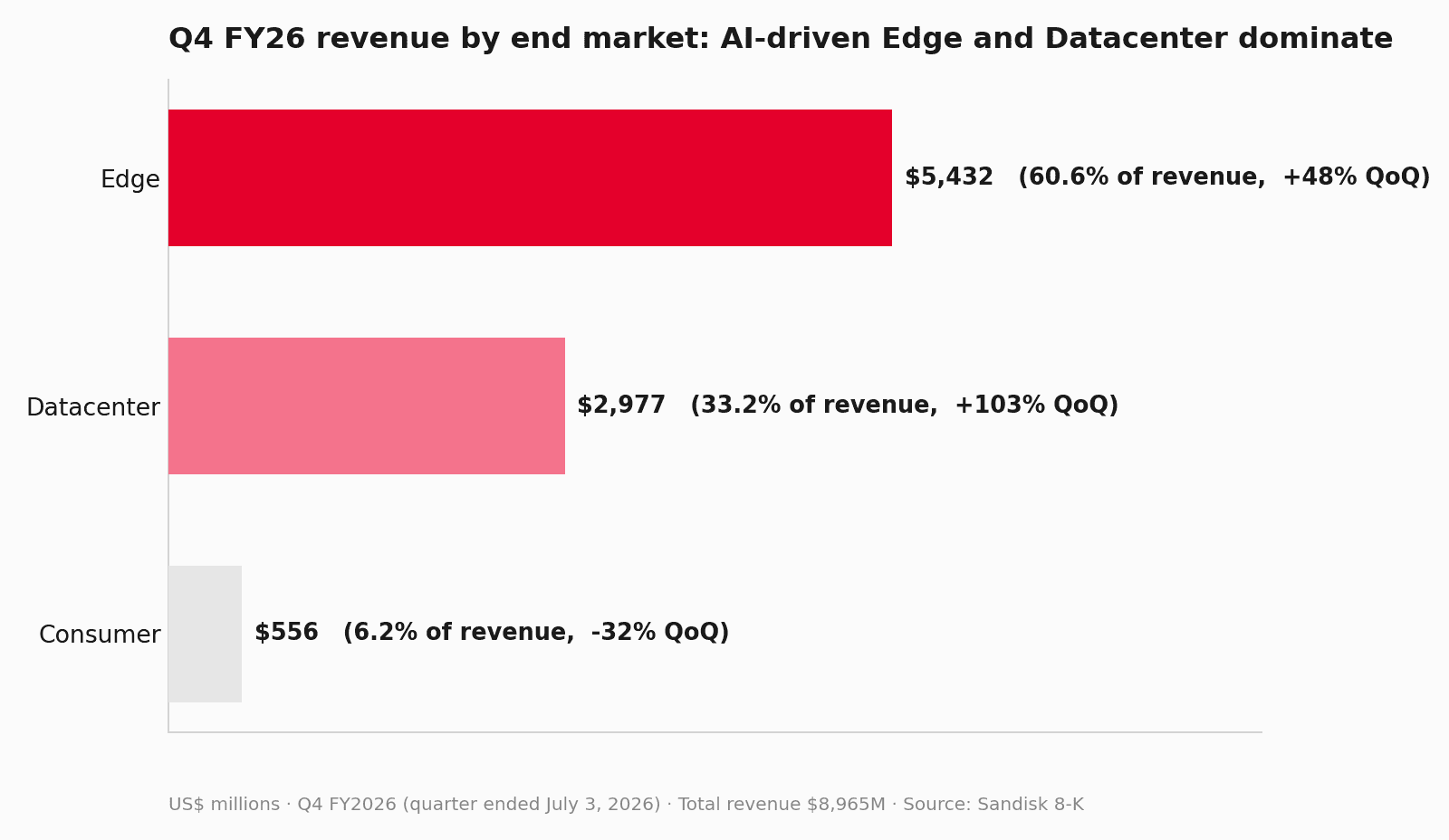
The mix shift is the structural point. Datacenter was about 12% of Sandisk's bit shipments a year ago and reached roughly 38% of the portfolio exiting fiscal 2026. Management framed the coming "era of inference," where every AI query generates data that must be stored and retrieved, as a durable tailwind for enterprise solid-state drives. The company began shipping its QLC "Stargate" platform for AI data lakes during the quarter.
Gross margin near 85%
Gross margin, the share of revenue left after the direct cost of making the product, is where the up-cycle shows up most starkly. Both GAAP and non-GAAP gross margin hit 84.6%, up 6.2 points from the prior quarter and up from 26.4% a year ago. The two figures are identical this quarter because the only adjustment was $6M of stock-based compensation on nearly $9B of revenue.
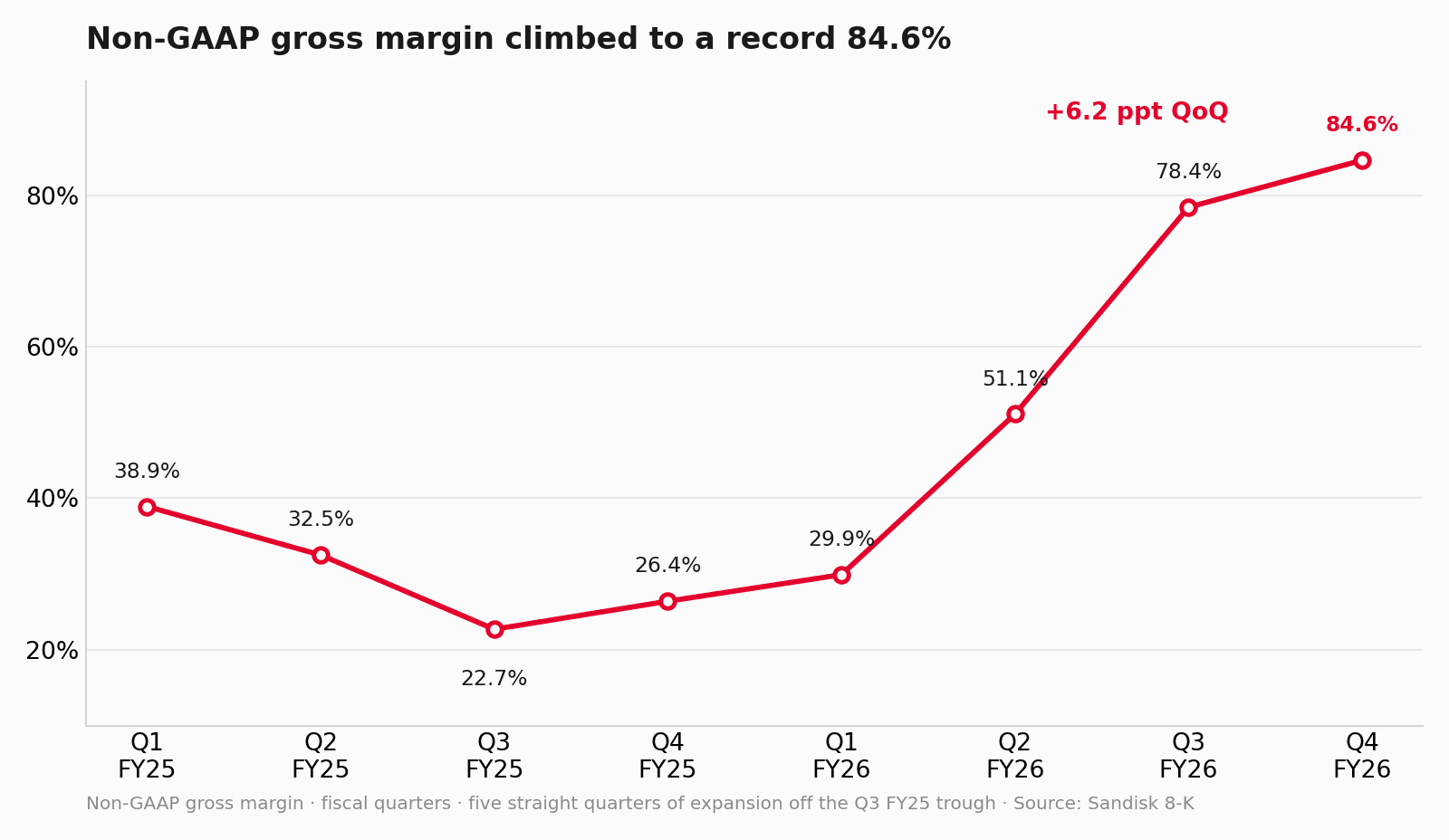
That is a 62-point swing off the low a year earlier, driven almost entirely by pricing. It also frames the central question hanging over the stock: how long can a memory company earn 80%-plus gross margins before new supply from rivals such as Samsung and SK Hynix arrives.
Earnings power, restated
Non-GAAP diluted EPS, which strips out one-time items to show underlying earnings, came in at $39.25, versus $0.29 a year earlier and above the $30 to $33 guide. GAAP EPS was even higher at $43.97, but that figure includes an $804M pre-tax gain on marketable equity securities that non-GAAP excludes, which is why the GAAP number sits above the adjusted one this quarter.
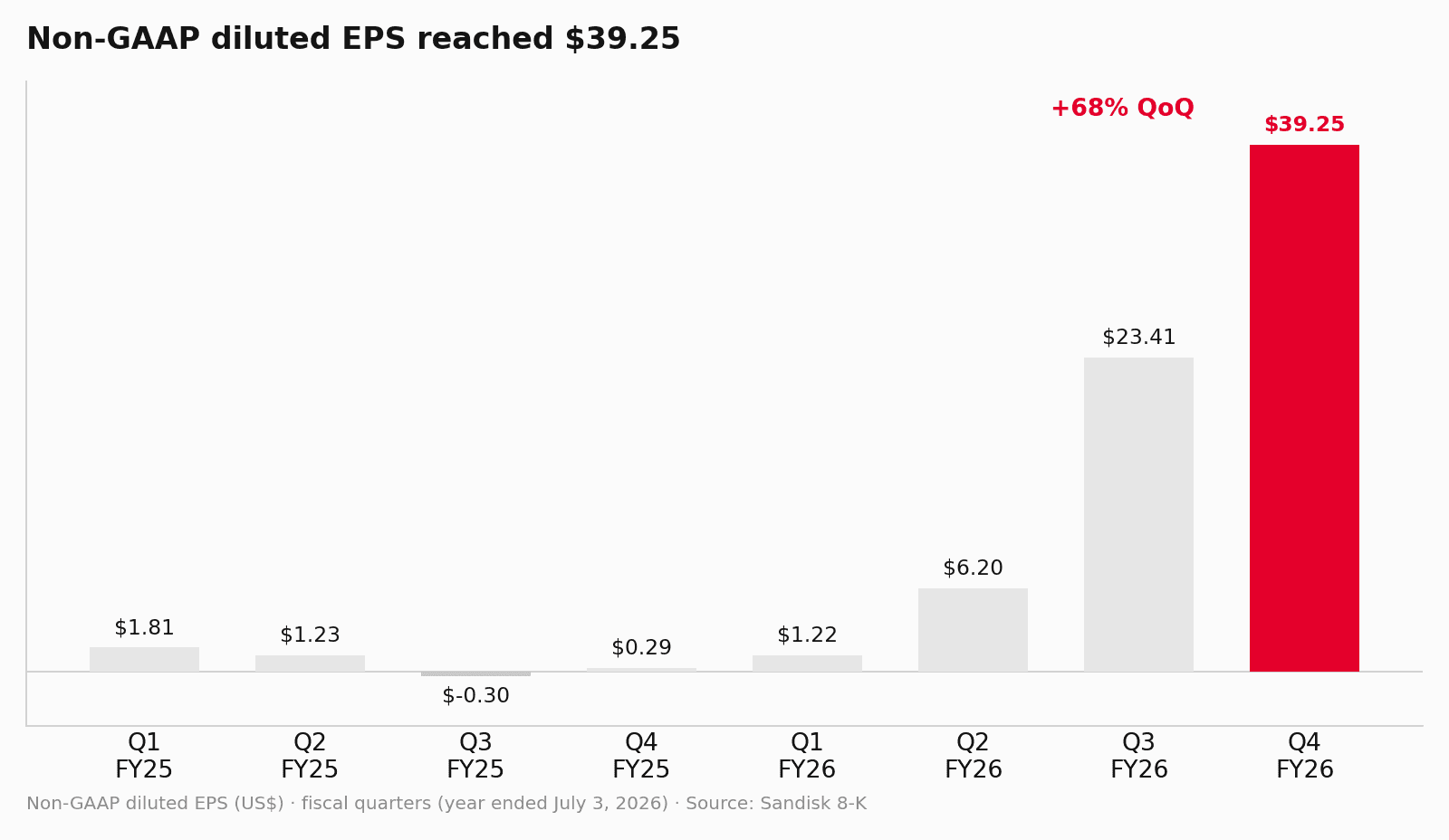
For the year, non-GAAP EPS was $70.88, operating cash flow was $11,671M and adjusted free cash flow was $8,743M. Sandisk grows supply mainly through node transitions rather than building new fabs, so capital spending stays low, near 0.5% of quarterly revenue, and cash conversion is high.
The real story: multi-year contracts
The most consequential number is not the margin, it is the backlog. Sandisk's New Business Model, or NBM, program is a set of long-term supply agreements that fix both volume and price with datacenter and AI customers. The company now has 10 such agreements across 8 customers, five of them signed this quarter. Total expected revenue is at least $93.9B at floor pricing, which management expects to exceed in practice.
Remaining performance obligation, the contracted revenue not yet delivered, stood at $59.8B at quarter-end, rising to $91.1B including two deals signed after the close. Each contract carries financial guarantees, cash deposits and instruments, totaling $16.5B that protect Sandisk if a customer under-purchases. NBMs are expected to cover more than 50% of bit shipments in FY27 and about two-thirds in FY28, at a targeted 80% gross margin. In CEO David Goeckeler's framing, Sandisk moved from three months of visibility to more than four years of committed financials.
Guidance, the selloff, and what comes next
For fiscal Q1 2027, Sandisk guided revenue of $10.3B to $10.8B, non-GAAP gross margin of 83% to 85% and non-GAAP EPS of $44 to $46. Those are strong numbers, but the midpoint sat only modestly above a Street already braced for a monster quarter, and that is the crux of the selloff. The stock had climbed roughly 500 to 700% year-to-date, the top performer in the S&P 500, so anything short of a blowout guide risked a pullback. Peer Western Digital reported the same day, also beat, and also fell.
Analysts stayed mostly bullish while flagging valuation. Goldman Sachs lifted its target to $2,200 from $1,200 and BofA to $2,500 from $2,100, both Buy-rated, on the view that NAND tightness persists into 2027. Morgan Stanley kept an Overweight. Wells Fargo held at $1,620 with a valuation-disciplined Hold, and Morningstar warned that AI and memory names could give back 20% to 30% before becoming buyable. The bear case is not that Sandisk stumbled. It is that a memory company earning 84.6% margins is priced for a cycle to last, and cycles rarely do. The locked-in NBM backlog is Sandisk's answer, converting a volatile commodity business into something closer to contracted revenue. Whether the market believes that reframing is the question the next few quarters will settle.