Rocket Lab Q2 2026: Record Revenue, Iridium Deal
A record quarter the market still sold
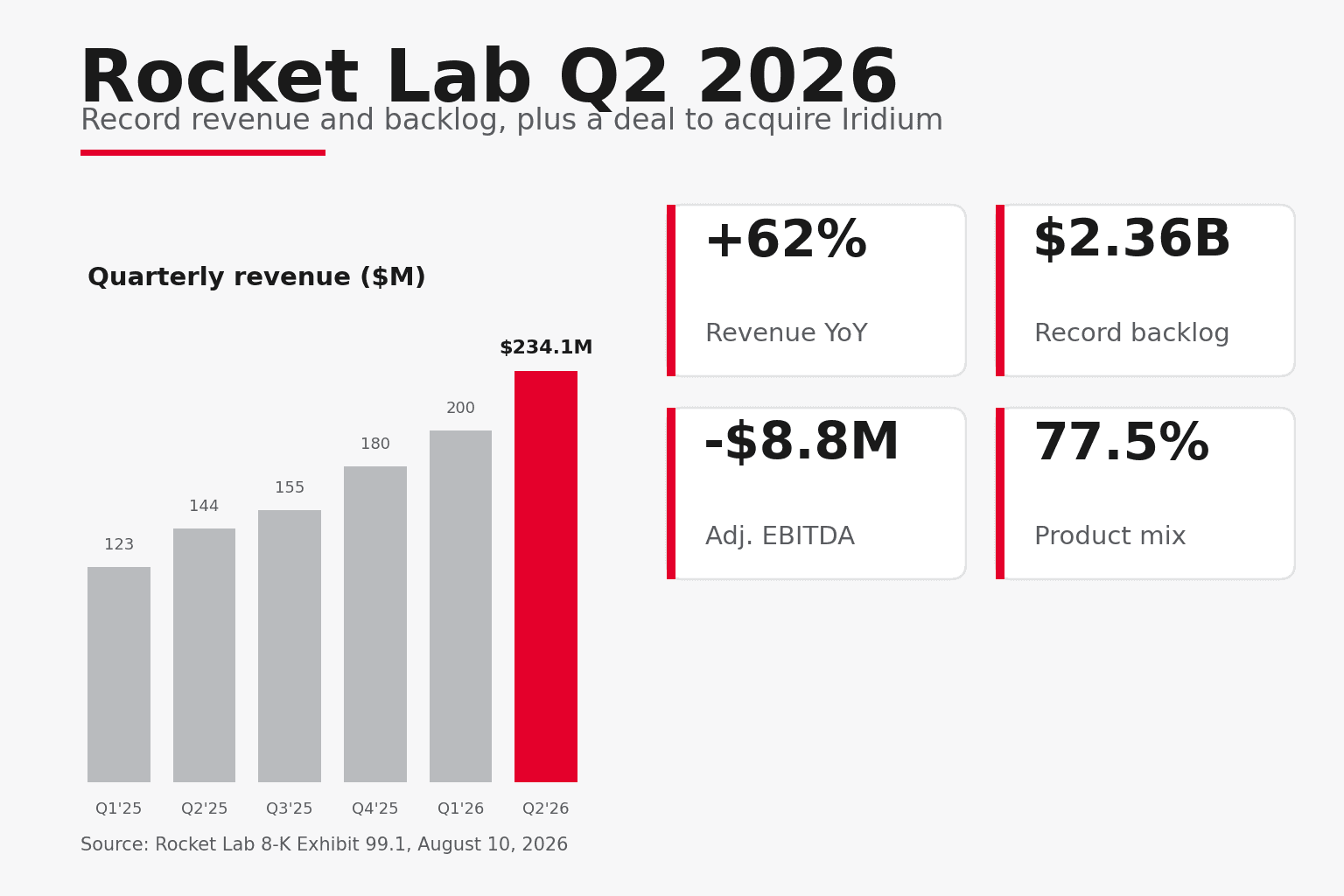
Rocket Lab delivered the biggest quarter in its history and watched its stock fall anyway. Revenue for the second quarter of 2026 reached $234.1M, up 62% from a year earlier and 16.8% higher than the prior quarter's own record. The company announced a landmark deal to acquire satellite operator Iridium, booked a record $2.36 billion backlog, and moved its Neutron rocket closer to the launch pad. Then the shares dropped, closing the regular session down 3.37% and sliding roughly 7% more after hours to about $74.
The split verdict is the story of this print. On the numbers management wants investors to watch, growth and momentum, the quarter was excellent. On the two lines the market fixated on, the bottom-line loss and next quarter's margin guide, it fell short of hopes. Both readings are true at once.
The top line: another record, driven by hardware
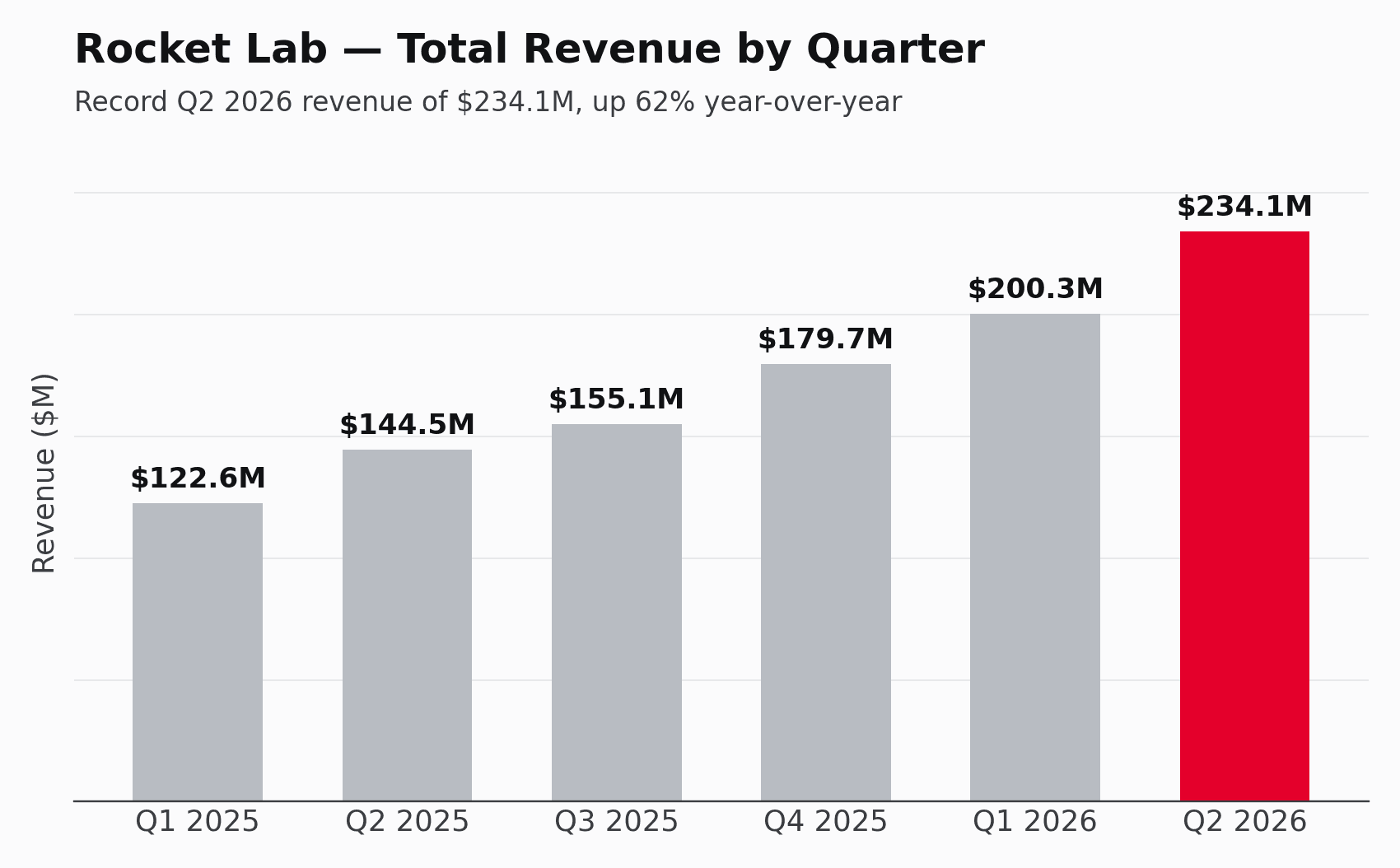
The headline is clean. At $234.1M, revenue set a quarterly record and extended a steady climb that has now roughly doubled in a year and a half.
What powered the jump was hardware, not launches. Rocket Lab reports revenue in two buckets, Product and Service. Product covers the spacecraft and space-systems business, the satellites and components it builds, and it broadly maps to the company's Space Systems segment. Service covers launch, and broadly maps to Launch Services. The mapping is approximate, since the earnings release splits Product versus Service rather than reporting clean segment lines, but the direction is unmistakable.
Product revenue surged 42% from the prior quarter to $181.3M, lifted by spacecraft deliveries. Launch-tied Service revenue fell 27.6% to $52.7M on the timing of missions. The result is the most lopsided mix Rocket Lab has ever posted.
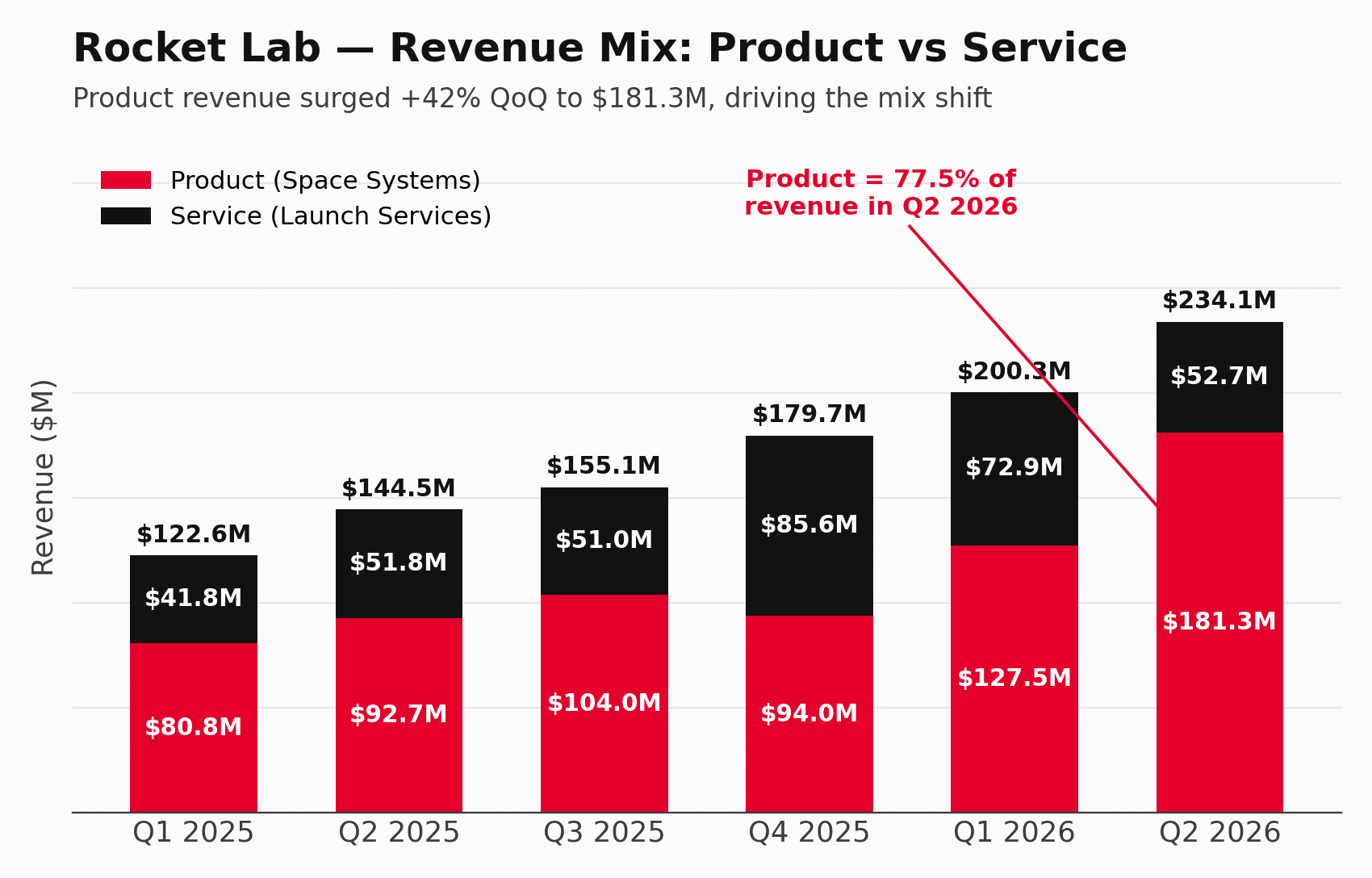
Product now accounts for 77.5% of revenue, the highest share on record. That is the vertical-integration thesis in action: Rocket Lab is increasingly a satellite manufacturer that also launches, rather than a launch company that dabbles in hardware. The catch is margin. Launch has been the higher-margin line, near 39% this quarter, so a mix tilted toward product deliveries pulled GAAP gross margin down 205 basis points to 36.1%, even as gross profit hit a record $84.6M. On a non-GAAP basis, which excludes items like stock compensation and acquisition-related amortization, gross margin was 41.5%. This was a mix story, not a cost blowout.
Backlog, Neutron and the Iridium pivot
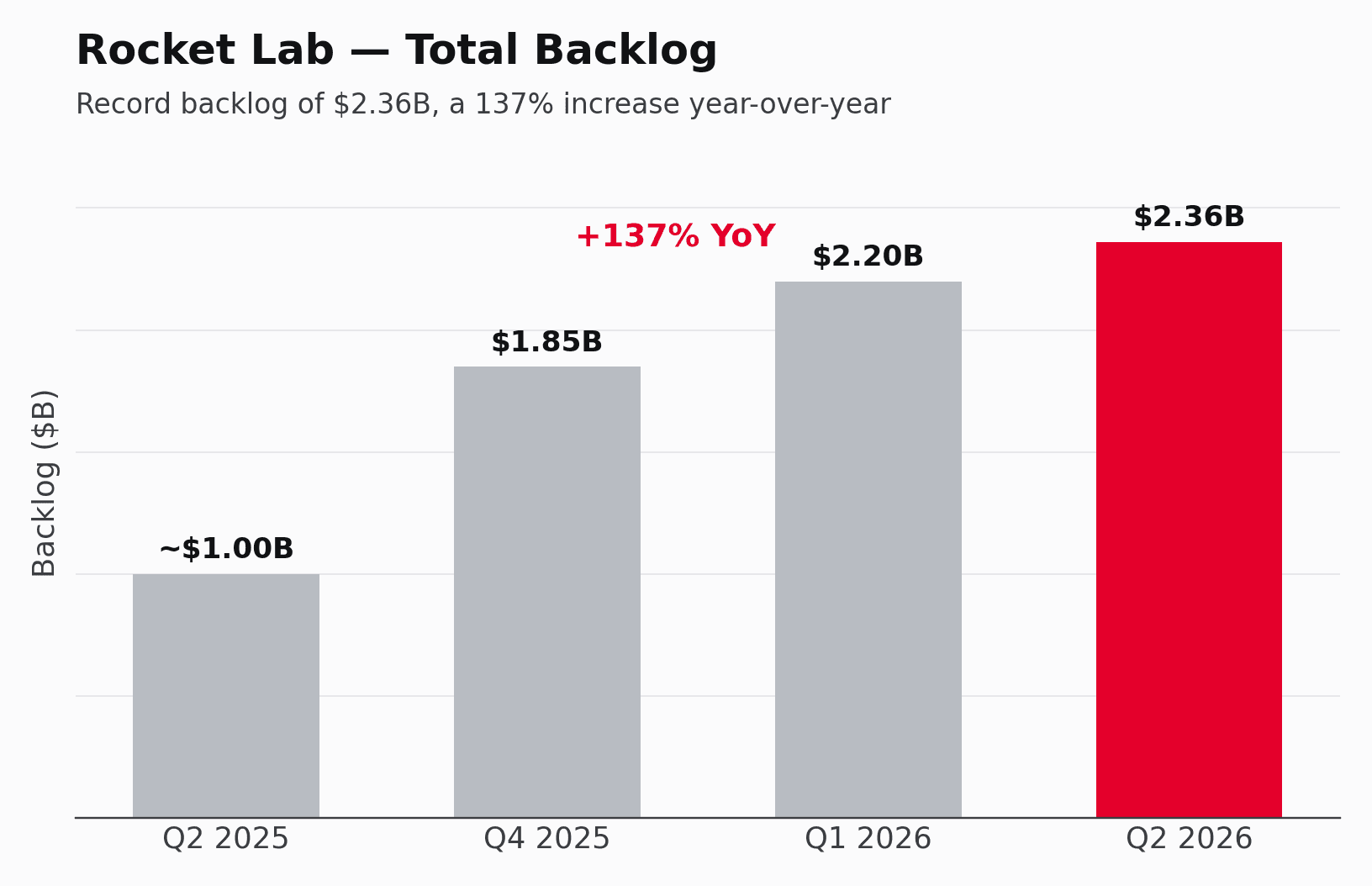
If revenue is the present, backlog is the future, and it looks strong. Signed-but-undelivered contracts reached a record $2.36 billion, up 137% from a year earlier, with more than $1 billion of new launch and space-systems work already signed in the current quarter.
Much of that demand is riding on two catalysts. The first is Neutron, the larger reusable rocket meant to lift heavier payloads than the company's small Electron. Management said first-flight hardware is hitting its milestones and that Stage 1 tank production is aligned with delivering Neutron to the pad in the fourth quarter of 2026. A $397M award to build Flatellite spacecraft for the U.S. Space Force's SB-AMTI program anchors early Neutron demand.
The second, and strategically the larger move, is the announced acquisition of Iridium, which operates a 66-satellite communications network serving millions of users. Buying it would push Rocket Lab beyond building and launching satellites into owning and operating a constellation, adding steady, subscription-like revenue. Alongside the closed purchases of Mynaric and Motiv, management framed the deals as making Rocket Lab a self-launching, tier-1 space power. The roughly $1.53 billion the company raised selling stock in the first half funds this ambition, and left it with about $2.30 billion in cash and short-term investments.
Losses are narrowing, on the measure that counts most
Rocket Lab is not profitable, but it is losing less. GAAP net loss was $49.3M, or $0.08 per share, a touch wider than the prior quarter partly because of acquisition costs and a tax provision. The cleaner read on the trend is Adjusted EBITDA.
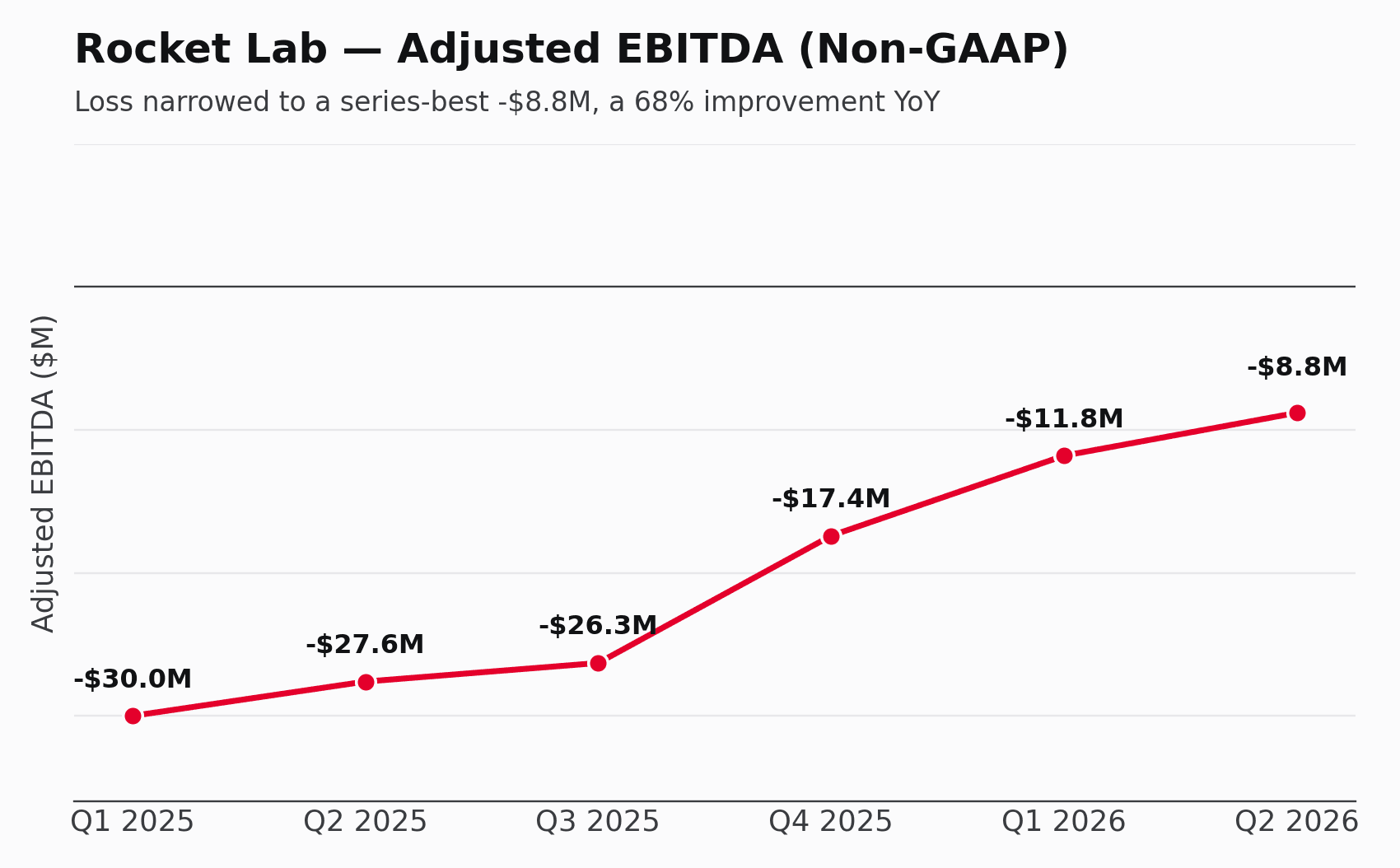
At a loss of $8.8M, Adjusted EBITDA was the narrowest in the recent series and a 68% improvement year-over-year, the payoff from revenue scale and better gross profit. The cost of growth still shows up in cash: free cash flow burn widened to $110.1M as the company built inventory and receivables ahead of the delivery ramp. With $2.30 billion on hand, runway is not the worry. The pace of spending is.
Why the stock fell, and what to watch
The market's reaction was not about the record. Shares closed down 3.37% at $80.04 on August 10, then fell to roughly $74 after hours, a drop of about 7% more. Space peers slipped in sympathy, while diversified defense names held up, so this read as a growth-and-valuation repricing rather than a sector scare. The first named sell-side reaction, from BTIG, held its Neutral rating, praising the backlog and Iridium while flagging cash burn and valuation.
Two things spooked investors. The GAAP loss of $0.08 was wider than the roughly $0.06 the Street expected. And guidance pointed the wrong way on margin: Rocket Lab guided third-quarter revenue to $250 to $265 million, another likely record, but with non-GAAP gross margin stepping down to 35 to 37 percent and a wider Adjusted EBITDA loss of $17 to $23 million as Neutron spending peaks.
That is the tension going forward. Rocket Lab is scaling fast, winning national-security work, and reaching for a much bigger prize with Iridium. It is also spending heavily, diluting shareholders, and running thinner margins in the near term. The next few quarters, and Neutron's first flight, will decide which of those pictures investors choose to price.