Rocket Lab's Government Inflection: When a Launch Services Company Becomes Defense Infrastructure
The Inflection Point No One Saw Coming
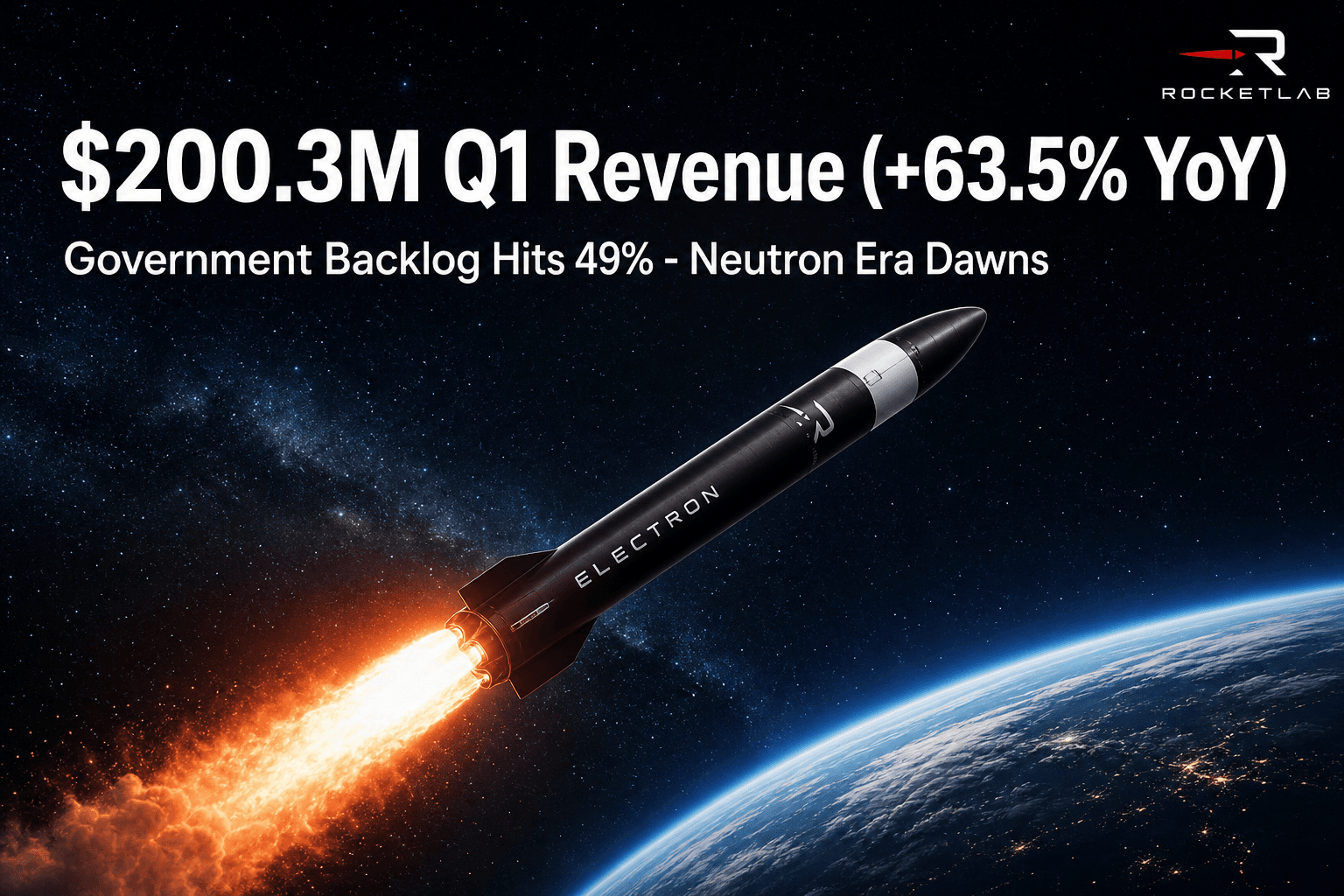
Rocket Lab reported Q1 2026 on May 7 with a headline that sounded like every other space-tech earnings beat: record revenue, margin expansion, backlog growth. But buried in the numbers was a metric that redefines the entire investment thesis for the next three years.
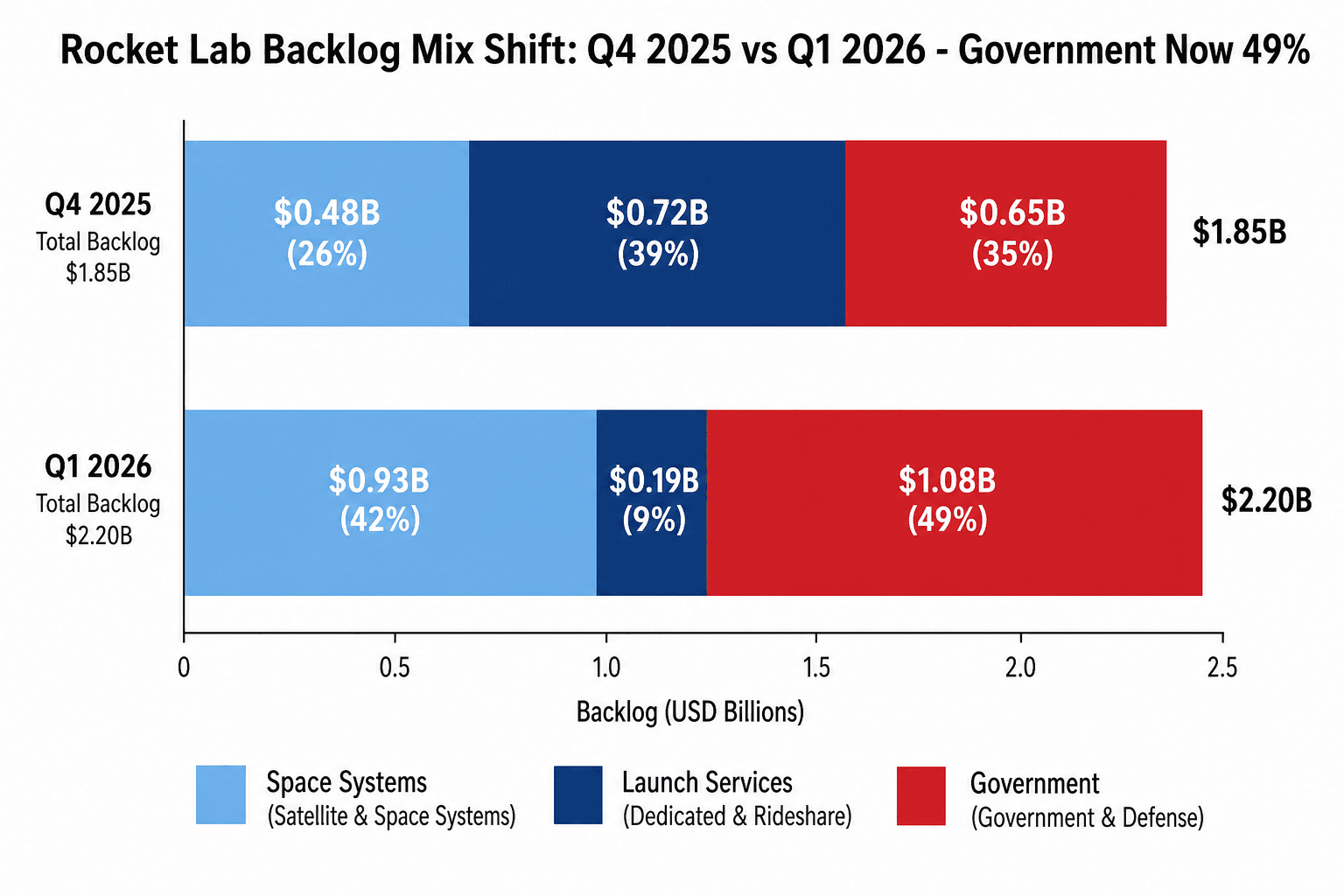
Government backlog went from $0.65B to $1.08B in a single quarter. That is not growth. That is capitulation — commercial spacecraft companies giving up trying to be the only customer and accepting that the U.S. Department of Defense now owns your roadmap.
For Rocket Lab, that's a feature, not a bug. The company has spent the last two years building Neutron (a larger, reusable launch vehicle), signing the Anduril partnership, and acquiring Mynaric (a European laser communications company). All three moves now converge into a single defensible narrative: Rocket Lab is no longer a launch services provider. It is critical infrastructure for the U.S. defense space ecosystem.
The stock reflected that on May 8, rallying 6.6% on the day and 13.1% over two days. But the deeper story is what makes that rally credible.
The Numbers That Matter
| Metric | Q1 2026 | YoY | vs. Guidance |
|---|---|---|---|
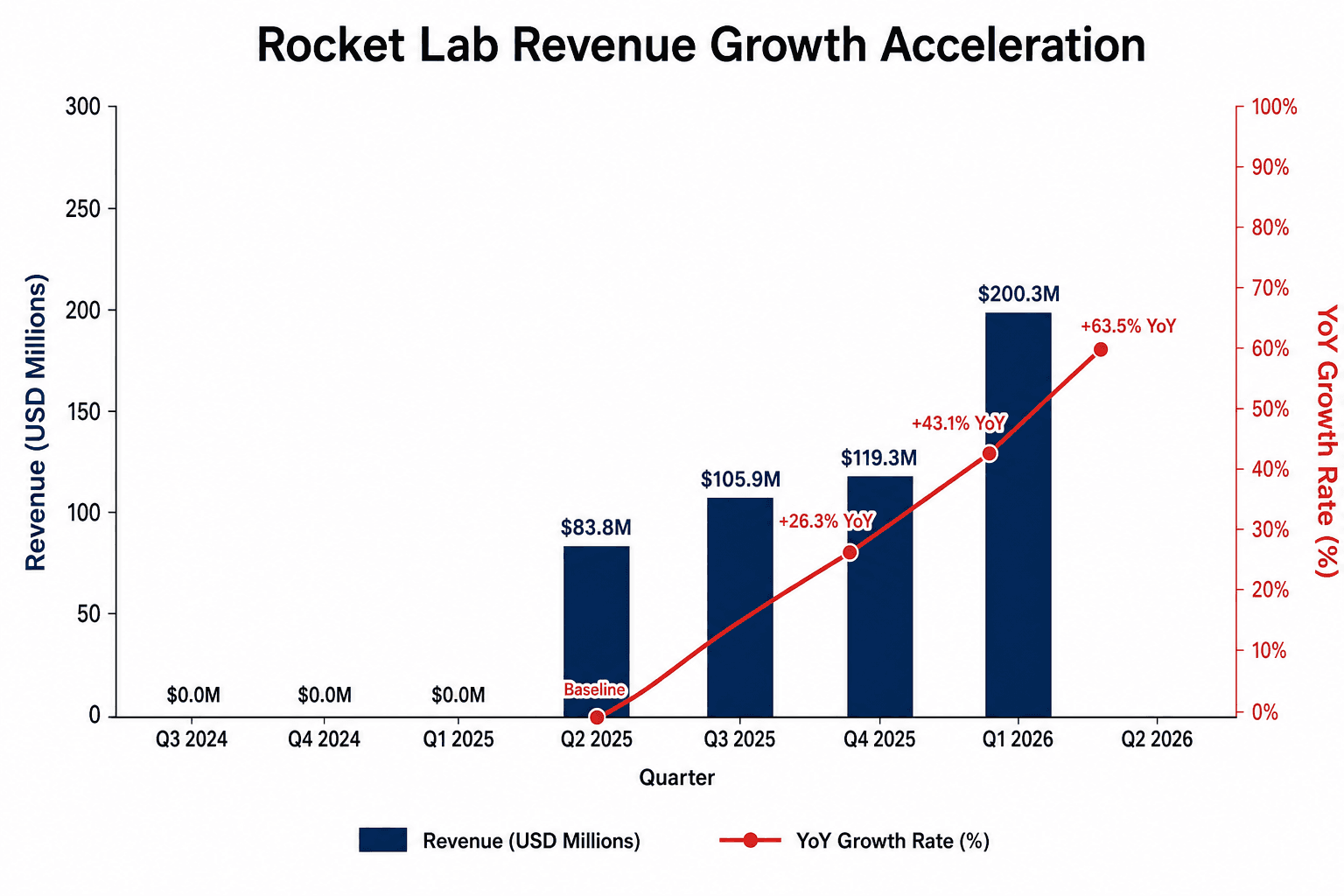
| Revenue | $200.3M | +63.5% | +$10M beat |
| GAAP gross margin | 38.2% | +860 bps | — |
| Launch Services margin | 34.8% | +680 bps | — |
| Operating loss (GAAP) | -$1.6M | +95.8% | Near-zero |
| Backlog | $2.20B | +18.9% QoQ | Record high |
| Government backlog | $1.08B | +65.7% QoQ | 49% of total |
| FCF | -$40.2M | -13.8% YoY | Improving trend |
Revenue of $200.3M crushes the prior record of $119.3M in Q4 2025. But the bigger story is what that revenue looks like underneath:
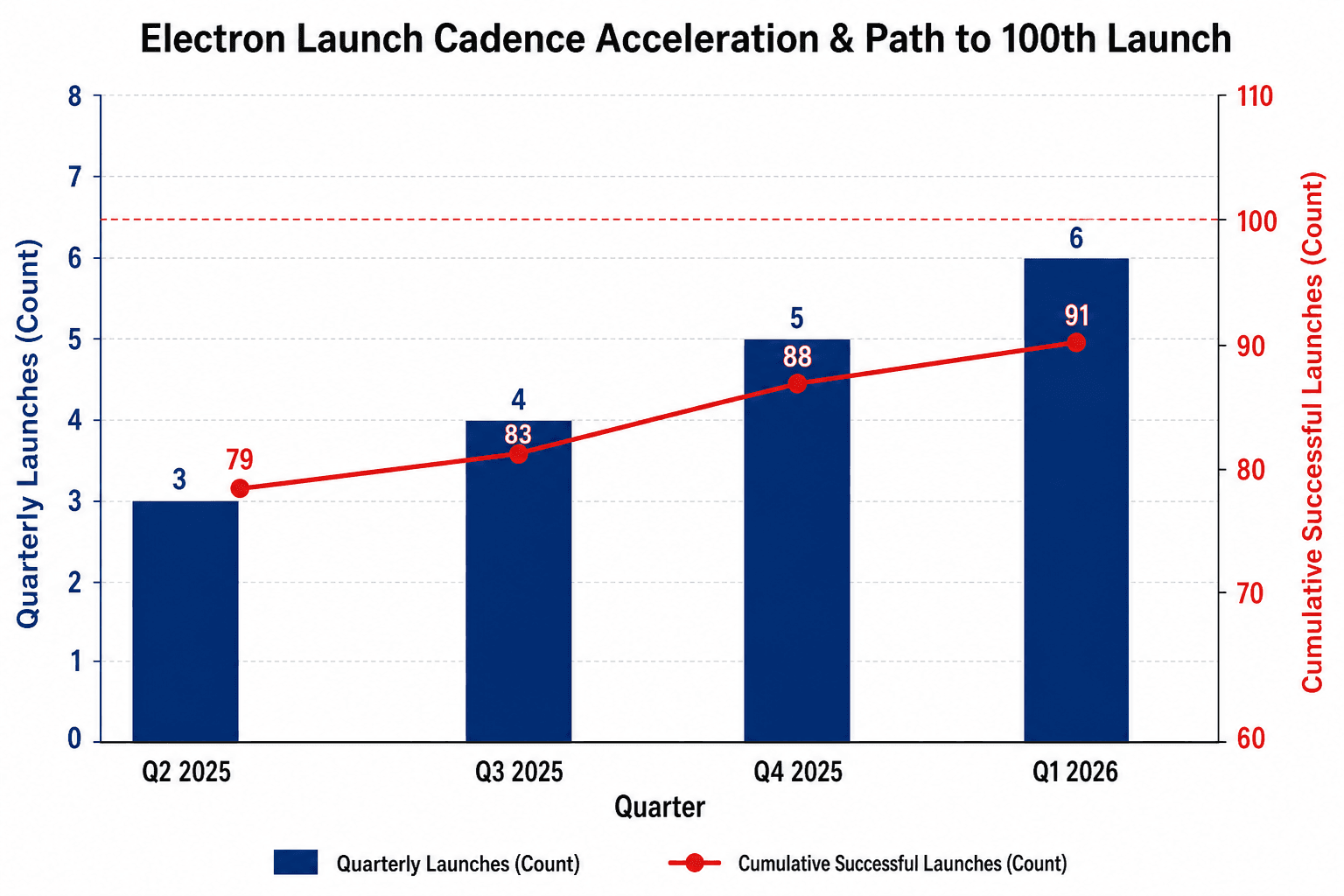
- Launch Services revenue: $84.1M (+73.2% YoY). Electron missions booked at a record 31 in Q1 (including 20 HASTE missions under MACH-TB 2.0). Pricing is holding; Electron margins have expanded to 34.8% GAAP (up from 28% a year ago).
- Space Systems revenue: $84.5M (+149.7% YoY). This segment now exceeds Launch Services for the first time. Photon spacecraft ramping into production, Neutron development contracts kicking in, and the Mynaric acquisition adding licensing revenue.
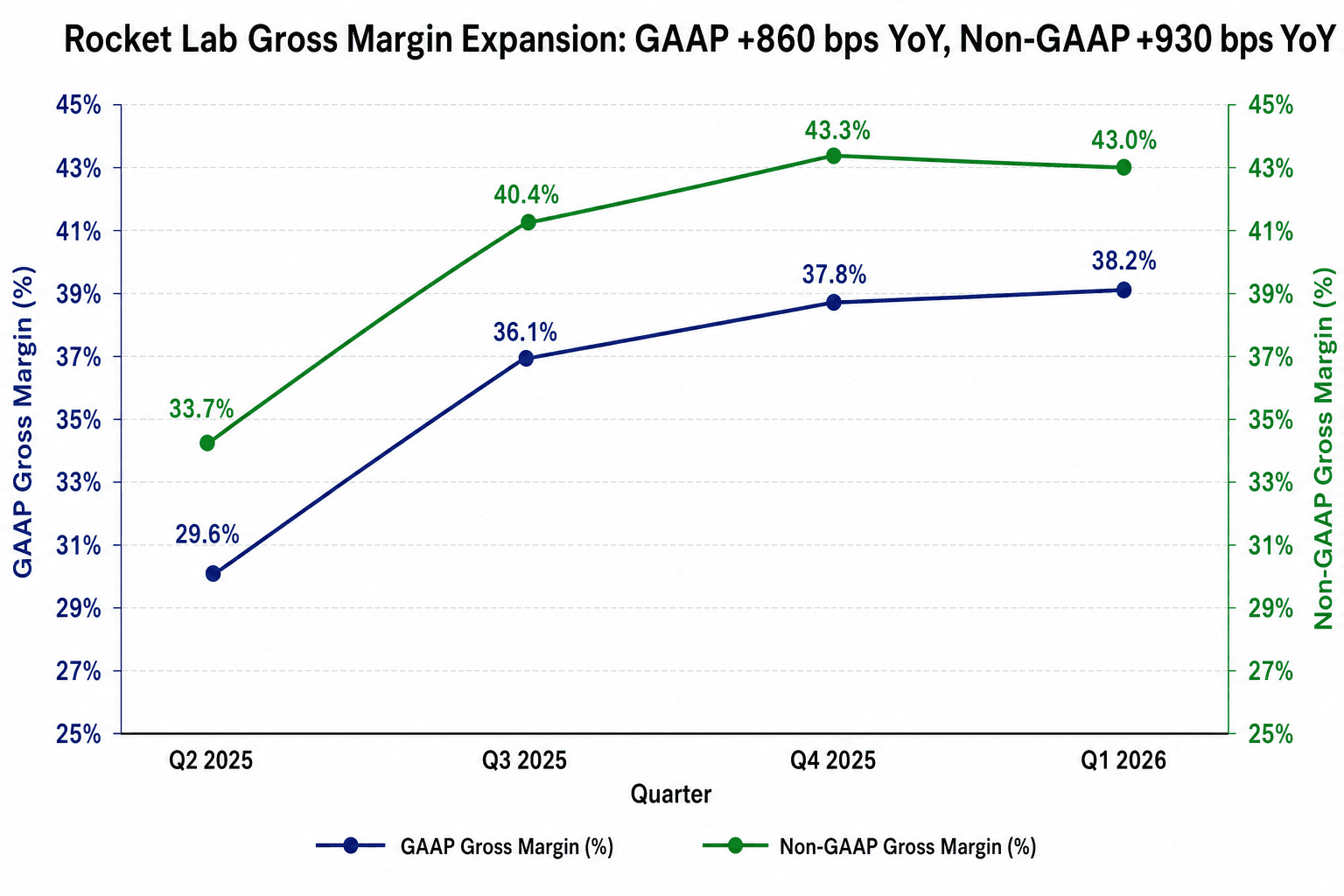
The margin expansion is real. GAAP gross margin at 38.2% (up 860 bps YoY) is not from pricing alone. It reflects favorable mix (government contracts at higher margins), Photon production scale, and Electron's pricing discipline. Non-GAAP gross margin at 43.0% (up 930 bps YoY) is even more impressive.
Yet the company still lost money (GAAP net loss of $45.0M). The difference: R&D. Rocket Lab spent $47.3M on R&D in Q1 — primarily Neutron development, Mynaric integration, and Wallops test-stand build-out. This is peak spending. Management expects R&D intensity to moderate as Neutron transitions from vehicle design to test phase.
The Government Backlog Story: $190M Contract + Anduril Partnership
Here's what happened in Q1 2026 that most investors still don't fully appreciate:
The U.S. Department of War (via DARPA) awarded Rocket Lab a $190M contract for 20 HASTE launch missions over five years. HASTE stands for Hypersonic Air-breathing Scramjet Test Evaluation. These are not your typical commercial satellite launches. These are responsive, high-priority government missions where Rocket Lab is the only vendor qualified to execute.
At the same time, Rocket Lab and Anduril Industries announced a partnership in which Neutron becomes the launch platform for Anduril's Off-World Sourcing Architecture (OSA). Anduril is the world's leading defense AI company (founded by Palmer Luckey, former Oculus founder; backed by $1B+ of government contracts). Their selection of Neutron as the launch foundation is the single most important de-risking event Rocket Lab has had for the vehicle program.
And then, on May 7 (the day of earnings), Mynaric acquisition closed. Mynaric makes laser optical communication terminals — the technology that enables satellite-to-ground and satellite-to-satellite data relay. This closes the final piece of the architecture: Rocket Lab launches the vehicle, Neutron provides lift capacity, Mynaric provides data relay. Together, they become a complete vertical stack for distributed space networks.
These three events compound into a narrative that's nearly impossible for a competitor to replicate:
- Neutron is no longer a science project. It has a pre-sold anchor customer (Anduril) and multi-year government funding ($190M MACH-TB 2.0, additional DARPA programs).
- Rocket Lab's backlog is government-anchored. 49% of the $2.2B backlog is now government-related. This reduces commercial-only concentration risk.
- The entire architecture is now proprietary to Rocket Lab. No other company combines launch capability, vehicle lift, and laser communications in a single system.
The $190M contract is impressive on its own. At $9.5M per mission (rough math on 20 missions), HASTE pricing is premium relative to commercial Electron (~$6M per mission). But the real value is the commitment: the DoD has signed a 5-year agreement with Rocket Lab. That is revenue visibility that SpaceX doesn't have (SpaceX competes on price; Rocket Lab competes on service).
Gross Margin Expansion Signals Pricing Power
The Street often focuses on gross margin as a sign of cost discipline. For Rocket Lab, it's also a sign of pricing power.
Electron's gross margin reached 34.8% in Q1 2026 (up from 28.1% in Q4 2025). This is driven by two things: (a) higher pricing on government missions (HASTE at $9.5M per mission vs. commercial Electron at $6M), and (b) manufacturing efficiency improvements at the Electron production line (Wallops, VA and New Zealand). As launch cadence increases, fixed manufacturing costs are absorbed into more units, improving unit economics.
Space Systems margin held steady at 41.6% (down only 60 bps from Q4), despite Photon production ramp. This is impressive because it signals manufacturing efficiency and favorable mix (Photon at ~42% margin, Neutron R&D contracts at ~30% margin; the company is managing the portfolio to maintain blended margin).
Blended GAAP gross margin of 38.2% (+860 bps YoY) suggests that management's ability to execute on margin targets is real. This is not pricing alone. This is a combination of mix (government at higher margins), scale (Photon production ramp), and pricing discipline.
Path to Profitability: Q3–Q4 2026
The bull case for Rocket Lab has always been: "When will R&D spending moderate and the company flip to profitability?"
Q1 2026 gives us the answer: Q3–Q4 2026 for GAAP operating profitability. Late Q3 2026 for Adjusted EBITDA positive. Late 2026 / Q1 2027 for FCF positive.
This is credible because:
- Operating loss is already near-zero ($1.6M in Q1 2026, down from -$28.8M in Q4 2025). This is a 94% quarter-over-quarter improvement.
- R&D spending is at peak intensity. Q1 2026 included Neutron manufacturing tooling completion, Wallops test-stand acceleration, and Mynaric integration costs. As we move into Q2–Q3, R&D will normalize.
- Backlog provides revenue visibility. 36% of the $2.2B backlog is due within 12 months. That's ~$800M of committed revenue through Q1 2027, far exceeding management's 2026 guidance of $950M–$1.0B.
- Liquidity is substantial. $2.34B in cash + revolver provides 8+ quarters of runway at current burn rate. No capital raise needed.
The company is not betting on profitability. It's backing into it with committed backlog.
The Bear Case (Still Real, But Narrowing)
Two specific risks remain:
-
Neutron execution delay. The vehicle hasn't flown yet. Manufacturing is unproven at scale. If the first test article (targeted for Q3 2026 assembly) slips, the entire test-flight timeline (H2 2027) could push into 2028. That delays commercial service entry by 1+ years.
-
Competitive pressure on Electron margins. SpaceX's Starshield, Blue Origin's New Glenn, and Relativity Space's 3D-printed rockets are all ramping government capabilities. If competitive pricing pressure hits in 2027–2028, Electron's 35% margin could compress to 25%. That would delay profitability inflection by 2–3 quarters.
Both risks are real but manageable. The Anduril partnership significantly de-risks Neutron (world-class validation + co-investment). The government backlog significantly de-risks pricing (contracts are multi-year, not spot-market dependent).
The Cleanest Take
Rocket Lab has executed a strategic inflection that took the market by surprise. Two years ago, it was a commercial launch services company with a long-term bet on Neutron. Today, it's a critical node in U.S. defense space infrastructure, with government contracts pre-selling Neutron capacity and laser-comms integration making the vehicle defensible against competition.
The $200.3M Q1 revenue beat, the 49% government backlog, and the gross margin expansion are not anomalies. They're evidence that the inflection is real. The stock's 13% two-day rally reflects that reality.
Whether the multiple holds will depend on execution in H2 2026 (GAAP profitability inflection) and 2027 (Neutron test flights on schedule). But the inflection point is real. Rocket Lab is no longer a startup trying to disrupt the launch industry. It's infrastructure that the U.S. defense establishment has decided to build around.
That's worth a re-rating.