Qualcomm's Diversification Math Finally Showed Up — Just as Memory Pricing Broke Handsets
A print that should have been bearish, wasn't
On the headline numbers, Qualcomm's Q2 FY26 was the first weak quarter the company has printed since 2023. Total revenue $10.6B, -3% YoY — the first YoY revenue decline in nine quarters. QCT handset revenue $6.0B, -13% YoY — the deepest segment decline since 2023. The Q3 guidance ($9.2-10.0B) was also a sequential step down.
The stock closed up +2.7% the next day.
That gap between fundamentals and price reaction is the entire story. The market was given a choice between two narratives in a single print, and it picked the right one:
The bear story: handsets are bleeding, China is decelerating, Apple modem revenue goes to zero in 18 months.
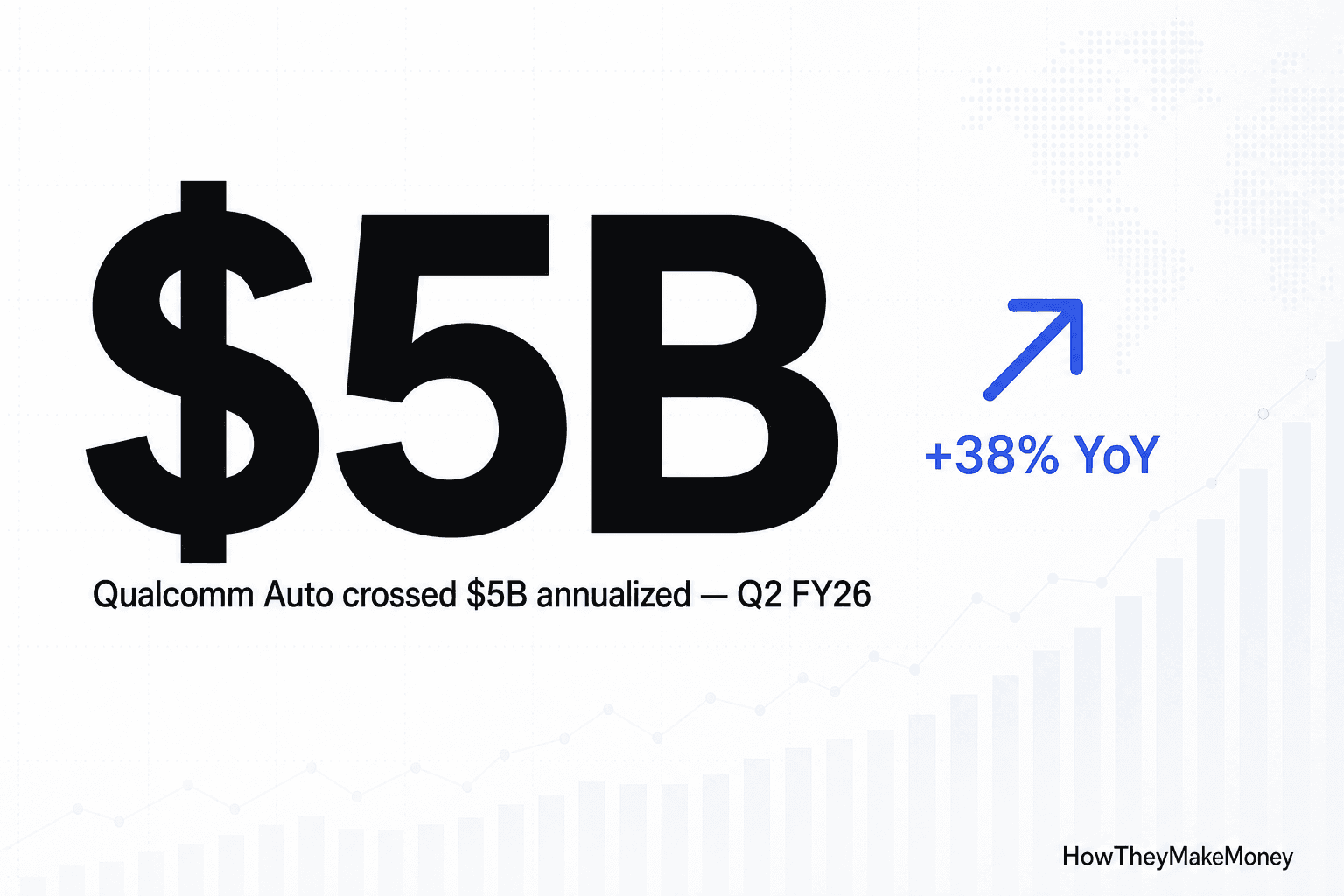
The bull story: automotive just crossed $5B annualized for the first time on a +38% YoY print, IoT recovered to +9% YoY, the Board authorized $20B in new buybacks, and management explicitly named the bottom — Q3 FY26 — for the China handset trough.
Q2 is the first datapoint in two years where the diversification math works fast enough to outrun the handset decline.
Auto: the line that finally became real
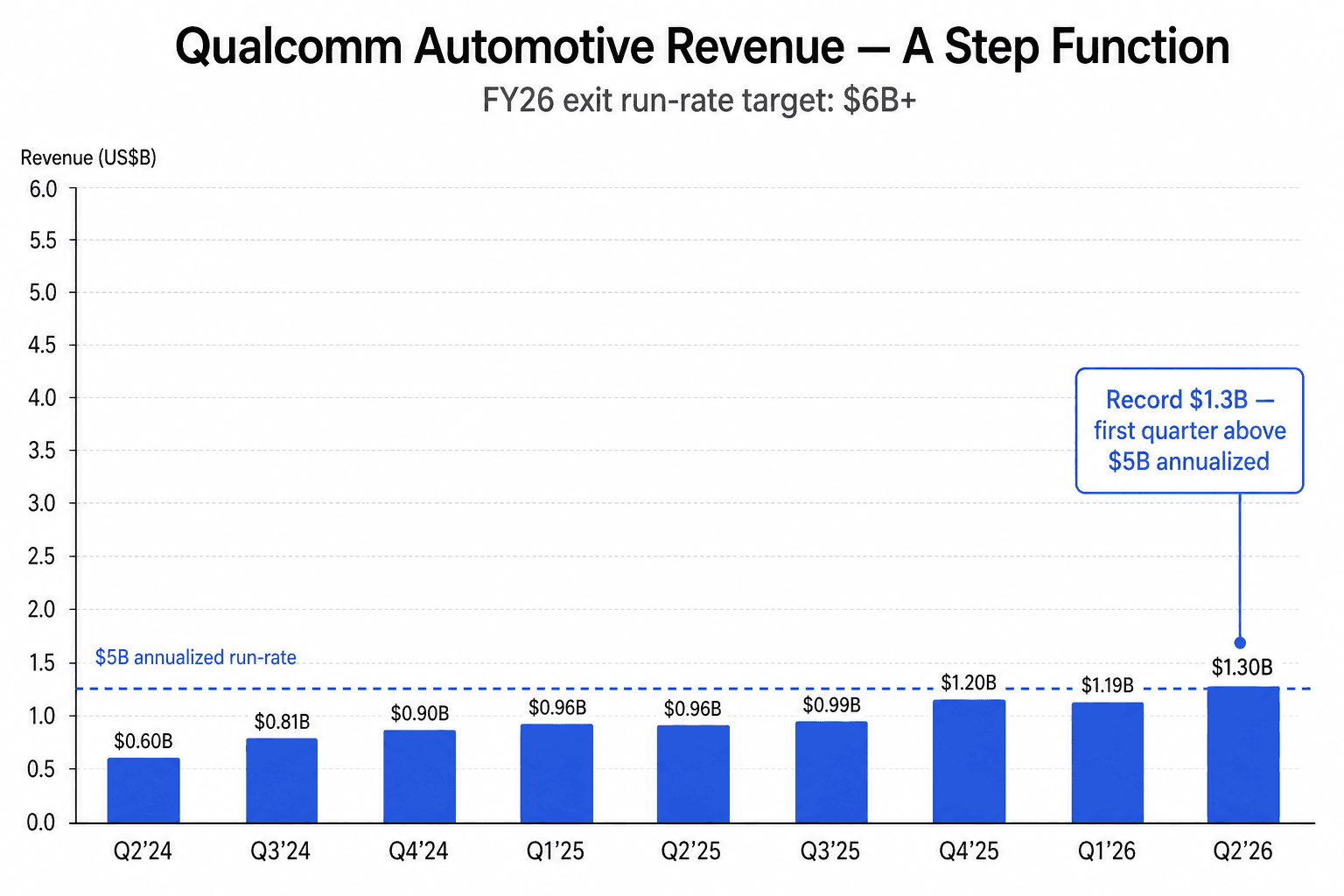
For five years, automotive has been the slide every Qualcomm investor day featured but no single quarter validated. Q2 FY26 is that quarter. $1.3B in revenue. +38% YoY. Annualized run-rate just crossed $5B for the first time ever.
Cristiano Amon reiterated the FY26 exit run-rate target of >$6B — implying Q4 FY26 revenue near $1.5B+. The visibility on this number is mechanical, not aspirational: the volume comes from existing design wins moving into production at known OEMs (BMW, Mercedes, GM, Hyundai, Volvo, Honda, Tata-JLR, plus several Chinese EV makers). Auto SoC design cycles run 5-7 years from win to volume. Q2's print represents wins from 2019-2021 finally hitting the income statement.
The auto segment's gross margin profile is also higher than the rest of QCT — high-50s versus mid-40s for handsets — meaning every dollar of auto revenue contributes more to the bottom line than the handset dollars walking away.
Handsets: the trough finally has a date
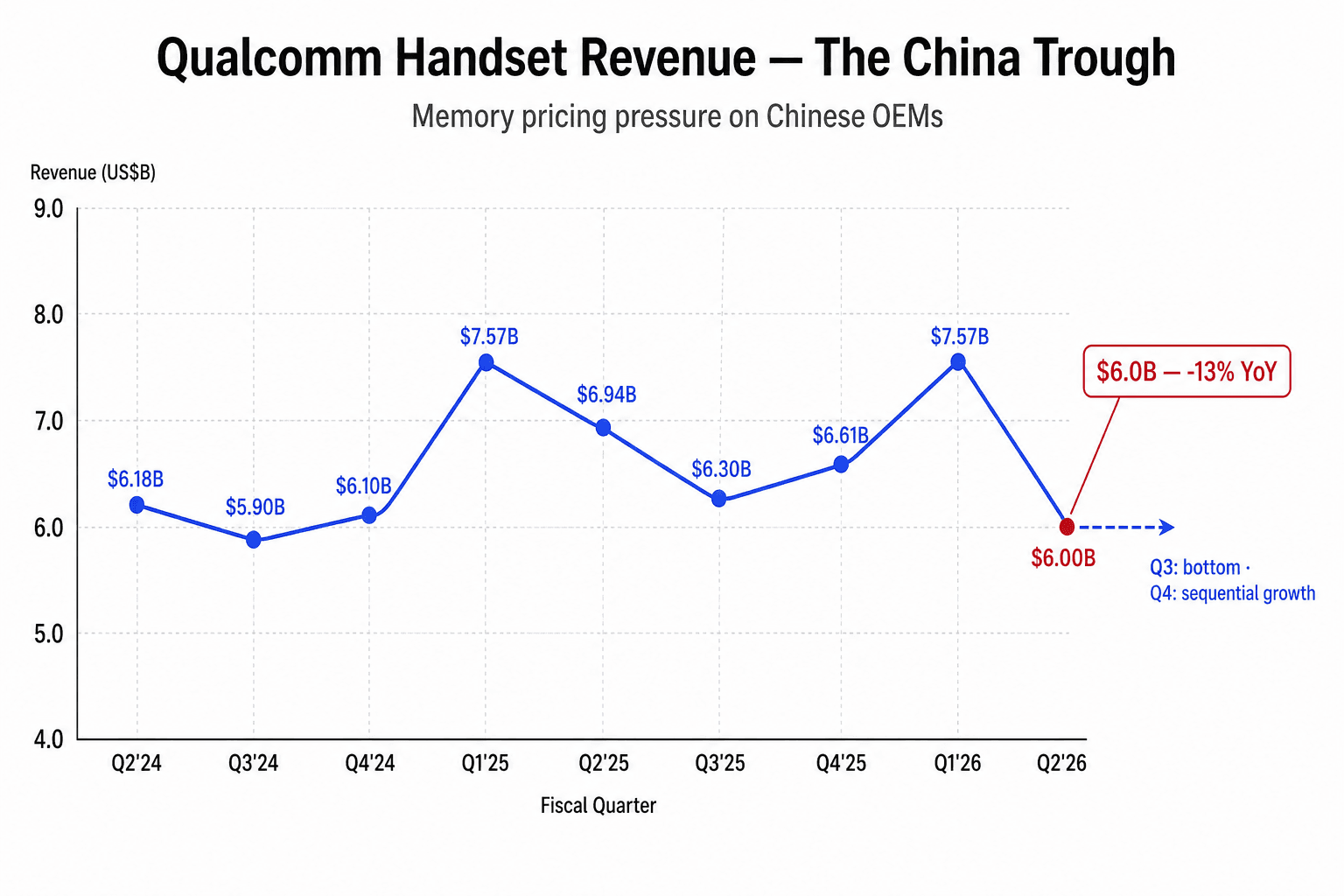
The handset weakness was widely expected. What changed in Q2 was that management was willing to name the bottom.
Akash Palkhiwala's quote on the call:
"QCT handset revenues from Chinese customers will reach a bottom in the third quarter and return to sequential growth in the following quarter."
Two things matter about that sentence. First, it's specific — the bottom is Q3 FY26 (Apr-Jun 2026). Second, it's causal — the cause is identified (memory pricing creating OEM channel-inventory caution), and the resolution path is identified (OEMs only delay so long before catching up to end-demand).
Important context that the Q2 print made explicit: this is not end-consumer demand decline. Cristiano Amon was direct: "Memory market conditions are influencing handset OEM behavior, particularly in China... OEMs are reducing build plans and drawing down channel inventory." When the channel rebuilds — and channels always rebuild eventually — the snap-back is fast.
Akash Palkhiwala added a more interesting nuance: when OEMs are forced to allocate scarce memory, they push it into premium and high-tier SKUs. That is precisely the Snapdragon-attached part of the market. The implication: even at lower unit volumes, Qualcomm's content per device in the surviving high-end market may rise.
The mix shift
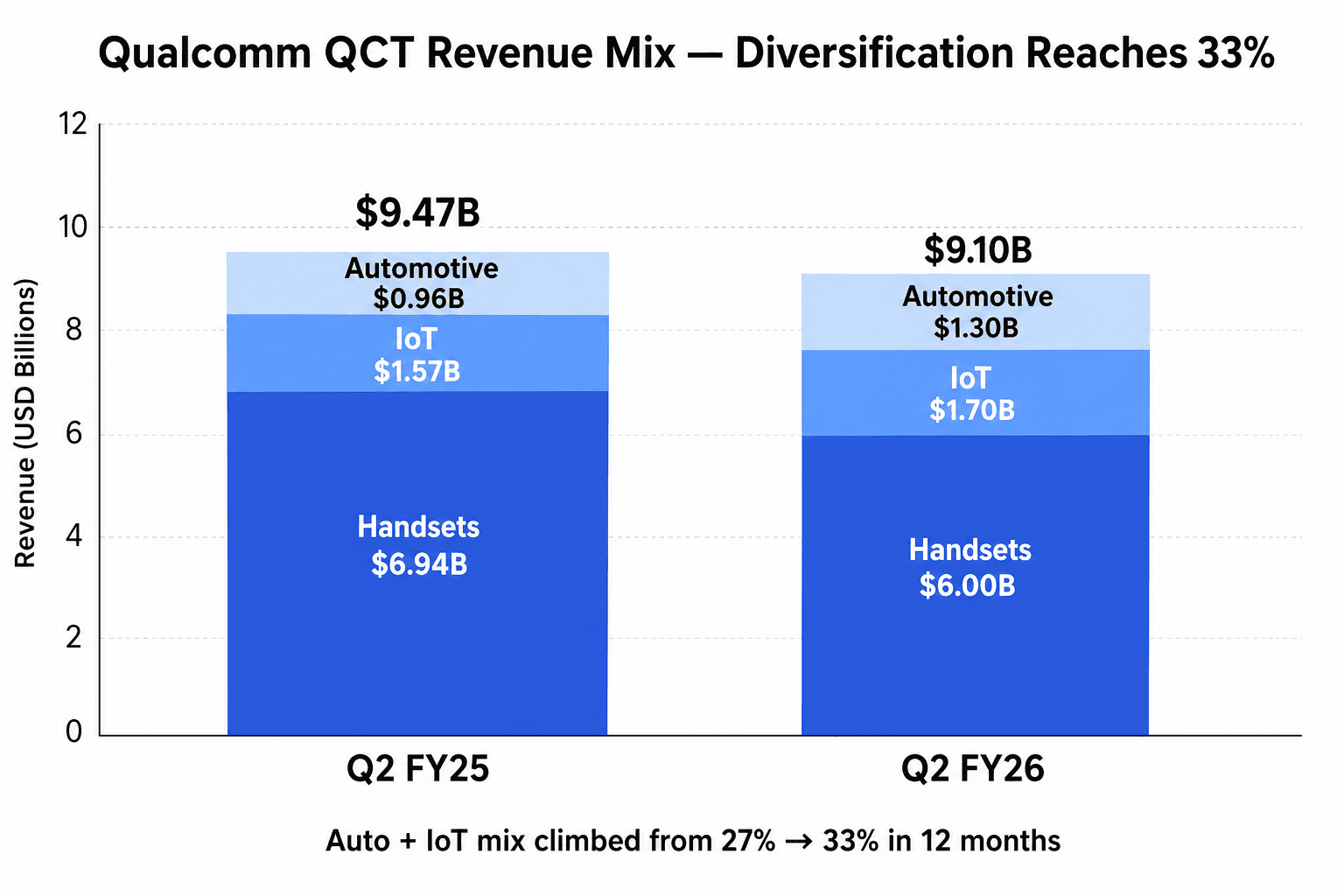
The cleanest way to see what changed in Qualcomm's business model is the Auto + IoT mix. One year ago, those two segments combined were 27% of QCT. In Q2 FY26 they are 33%. That shift happened while handsets were declining — meaning Auto + IoT growth is fast enough to outrun handset compression on a portfolio basis.
Why this matters more than it looks:
The bear thesis on Qualcomm has been mechanical for two years: Apple modem revenue goes to zero in fiscal 2027 (currently ~20% of iPhone in FY26, moving to 0% in FY27). That equates to roughly $3-4B in annualized revenue going away in 12-18 months. The bull defense has been "Auto + IoT will fill the gap" — but the math only works if the diversification compounds at >25% YoY for two more years.
Q2 FY26 just printed Auto +38% / IoT +9% / combined +20%. At that compound, the Apple cliff math works.
QTL: the resilient floor
Easy to miss in the segment noise: QTL (licensing) printed +6% YoY revenue and 72% EBT margin — the second-best margin in 12 quarters.
QTL is structurally insulated from the handset cycle because the licensing royalties are paid on every device shipped globally (with a few non-licensee exceptions), not just on Qualcomm-chip devices. Even if Snapdragon volumes drop in China, MediaTek-powered devices still pay QTL. The Samsung agreement at ">70% Snapdragon share" was reaffirmed.
QTL is the gravity well. As long as it prints 70%+ EBT margins on $5-6B annual revenue, Qualcomm has roughly $3.5-4.0B/year in non-cyclical operating income that doesn't depend on handset volume. That is the cushion that makes the FY27 trough math survivable.
Capital return: the confidence signal
The Board's decision to authorize $20B in new repurchases plus raise the dividend from $0.89 to $0.92 is the loudest non-verbal communication management has made in two years. Why now, with revenue declining and Apple cliff approaching?
Akash Palkhiwala framed it directly:
"Our balance sheet is over-capitalized for our investment opportunity set. The new $20 billion authorization gives us flexibility to return capital while preserving the ability to do strategic M&A."
Read between the lines: management is signaling that (1) the FY27 trough is survivable on the existing cash position, (2) Auto + IoT capex is contained relative to the cash flow generation, and (3) buybacks are the highest-ROI use of incremental capital at the current valuation. The $20B is roughly 12% of Qualcomm's market cap. Executed over 2-3 years, that is meaningful per-share accretion through the trough.
What the bulls and bears still fight about
Bull case: Q2 is the inflection point. Auto crossed $5B/annualized on a +38% YoY trajectory, with mechanical visibility to >$6B by FY26 exit. China handsets bottom in Q3. The OpenAI partnership opens an "AI PC + on-device AI smartphone" platform-monetization narrative that didn't exist 90 days ago. The $20B buyback at -13% YTD valuation is highly accretive.
Bear case: the Apple FY27 cliff is still uncovered. Auto + IoT growing at +20% YoY closes only ~half of the $3-4B Apple gap on a 12-18 month timeline. Handset macro pressure may persist if memory pricing doesn't ease in calendar H2 2026. Snapdragon X Gen 2 PCs remain a "show me" platform until they win share from Intel/AMD x86.
The print did not resolve the debate. It simply gave the bulls one quarter of math they can point at.
Forward look — what Q3 FY26 will turn on
Three datapoints to track between now and the end-July Q3 print:
- China handset bottoming confirmation. Q3 guide of $9.2-10.0B implies handset revenue near $5.6-6.0B. A Q3 print meeting the low end (which is itself a sequential decline) and Q4 confirming sequential growth is the validation point. If Q3 misses the low end, the bottom call gets pushed out.
- Auto sequential growth. $1.3B in Q2 to >$1.5B by Q4 implies ~$1.4B in Q3. Anything materially below $1.35B raises questions about the >$6B FY26 exit run-rate.
- Memory pricing easing. Watch DRAM/NAND spot pricing into July. If memory pricing flattens, the handset trough resolves on schedule. If memory tightens further, Q3 could undershoot.
All financial figures sourced from Qualcomm's Q2 FY2026 Earnings Release and Q2 FY2026 Earnings Presentation (filed 2026-04-29) and the Q2 FY2026 earnings call transcript. Analyst quotes and price-target moves sourced from Marketbeat, TipRanks, and Public.com coverage.