Qualcomm FY26 Q3: Soft Guidance Amid Memory Crunch
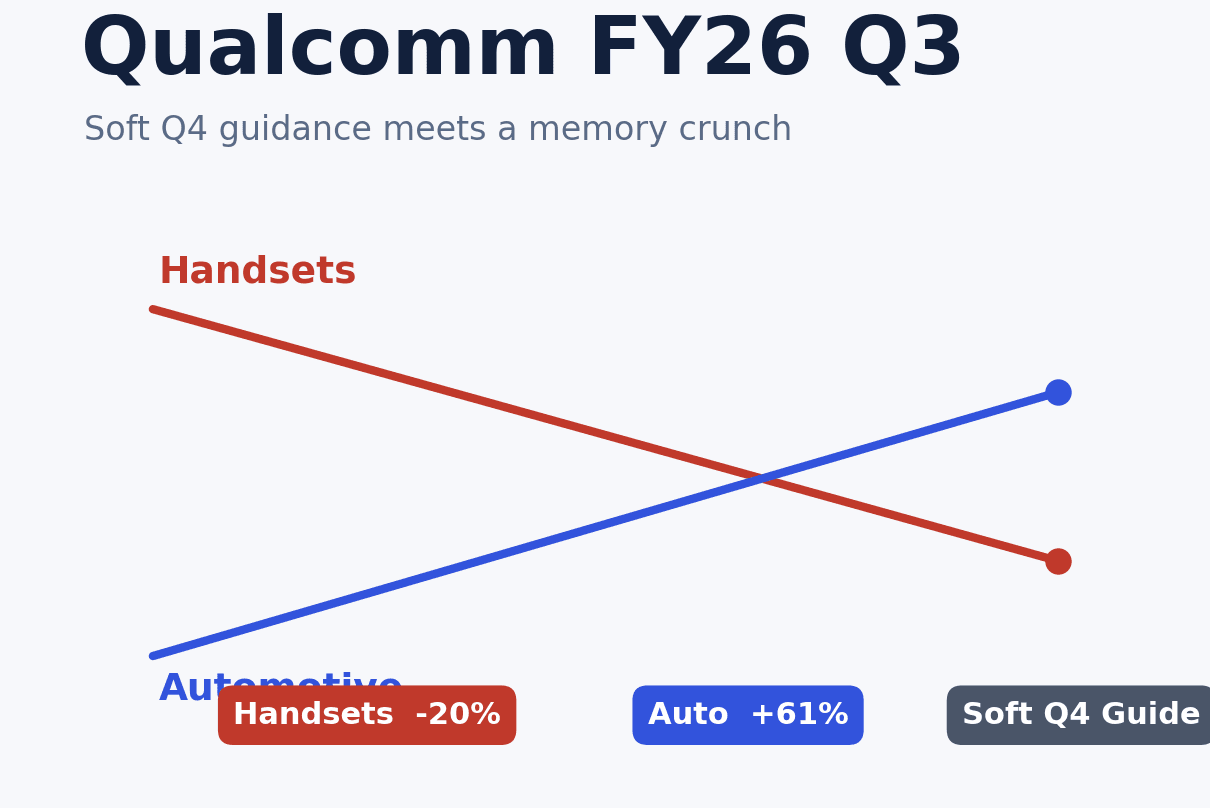
An in-line quarter that the market read as a warning
Qualcomm delivered a fiscal third quarter that was, on the headline numbers, about what Wall Street expected, and watched its stock fall anyway. For the three months ended June 28, 2026, revenue came in at $9.95 billion, down roughly 4% from a year earlier but at the high end of the company's own guidance. GAAP earnings were $1.87 a share and non-GAAP earnings, the adjusted figure management prefers because it strips out items like acquisition costs, were $2.21. Neither number was a disaster.
Then the outlook landed. For the current quarter, Qualcomm guided non-GAAP earnings to a range of $2.05 to $2.25, a midpoint below the $2.21 it had just reported, and pointed to a memory and component supply crunch, broad cost inflation and a faster-than-planned loss of Apple's business as the reasons. The stock, which had already closed the regular session down about 4.5% at $155.57, dropped about 7% in after-hours trading to around $144.53. The reaction was less a verdict on the quarter than on the year ahead.
The split screen: phones down, everything else up
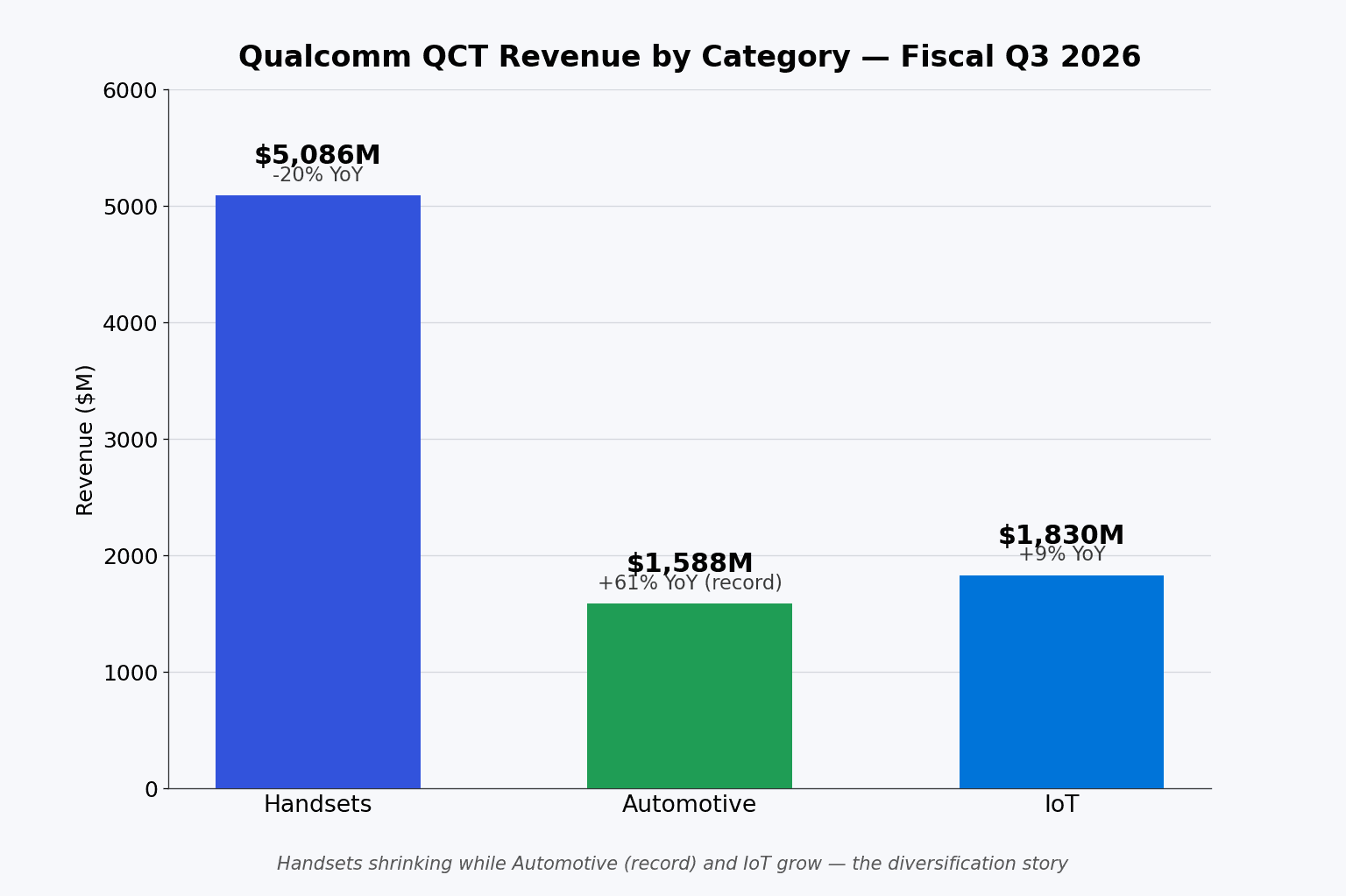
Almost the entire story sits inside QCT, Qualcomm's chip business, which spans phones, cars and connected devices. Handset chips, still the largest single line, brought in $5.09 billion, down about 20% from a year earlier and the weakest quarter in the last two years. The culprit was the memory crunch: a spike in DRAM prices has made cheaper phones costlier to build, cooling demand at the low and mid tiers where Qualcomm ships the most units. Management expects the overall phone market to shrink at a low-teens percentage rate this year and pegged the hit to its Android chip revenue at more than $1.50 a share, a number it frames as a coiled spring for when memory prices ease.
Against that, the other two lines are doing exactly what the diversification pitch promised. Automotive revenue hit a record $1.59 billion, up 61% and the 23rd straight quarter of double-digit growth. IoT, which covers industrial gear, PCs and headsets, rose 9% to $1.83 billion, its best quarter in the eight-quarter window. QTL, Qualcomm's patent-licensing arm and its highest-margin business, collected $1.28 billion, down 3% as softer phone volumes trimmed royalties, but still throwing off the kind of margins, near 69% before tax, that fund the rest of the company.
Automotive is the proof, and Qualcomm raised the bar
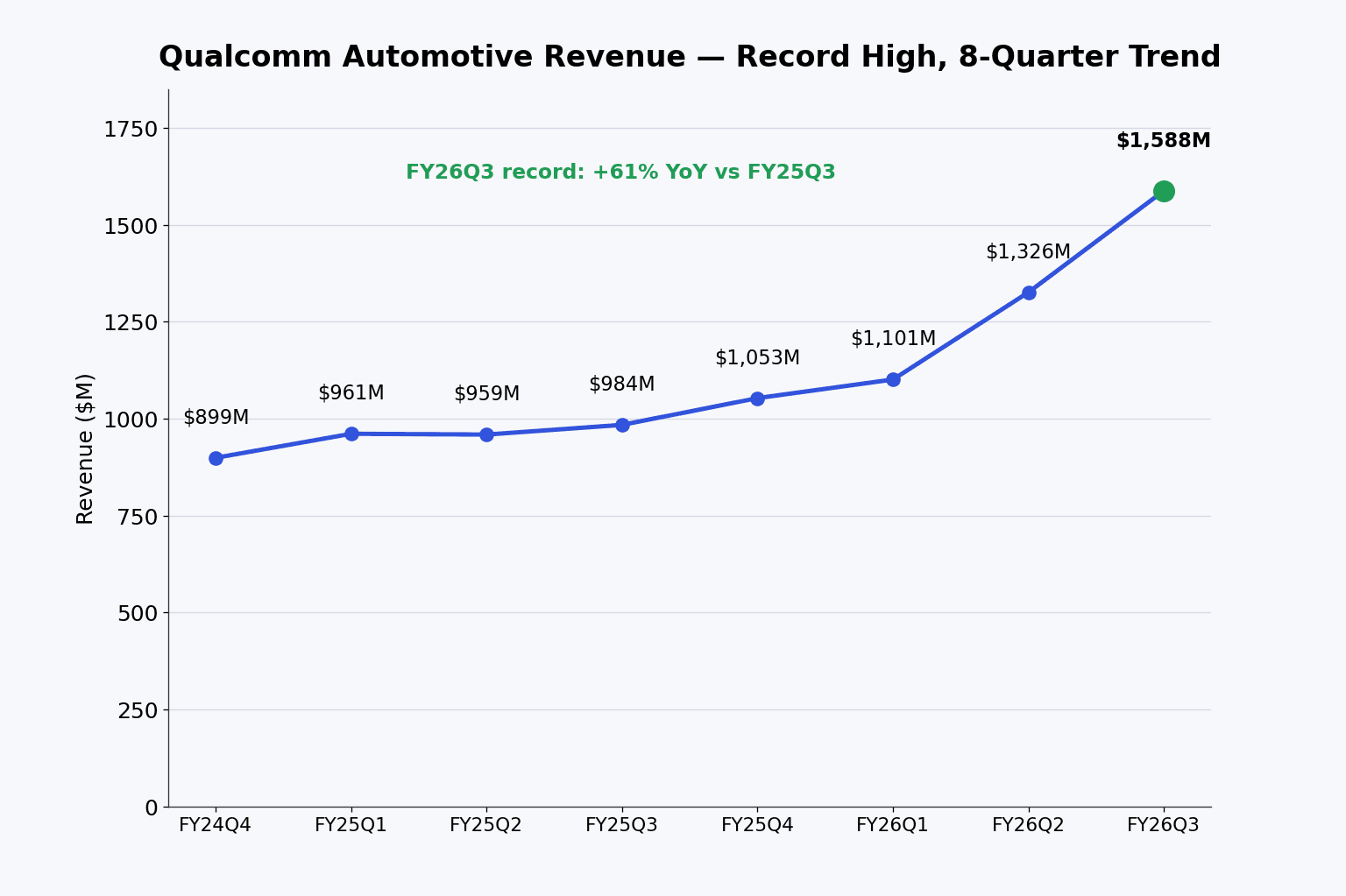
The automotive line is the clearest evidence that Qualcomm can grow somewhere other than phones. CEO Cristiano Amon described a step-change in how much silicon goes into each car, an order-of-magnitude jump in on-board computing as carmakers adopt next-generation Snapdragon chips. Just as important, Qualcomm is winning entire platforms, the digital cockpit and the driver-assistance system together, rather than a single socket at a time. On the strength of that, management raised its target for the automotive run rate to about $7 billion a year exiting fiscal 2026, up from roughly $6 billion.
Combine automotive with IoT and the non-handset side of the chip business grew about 28% year over year. Qualcomm now wants $40 billion in total non-handset revenue, including a brand-new data-center business, by fiscal 2029, nearly double the goal it set in late 2024. It expects non-handset growth to accelerate from about 24% this year to more than 60% next year, as two custom-chip deals with large cloud providers begin shipping in the December quarter. Wafers are already in production and purchase orders are in hand, which is why management sounded confident about the ramp even as it warned the new business will initially dent chip margins slightly.
The handset break and the Apple clock
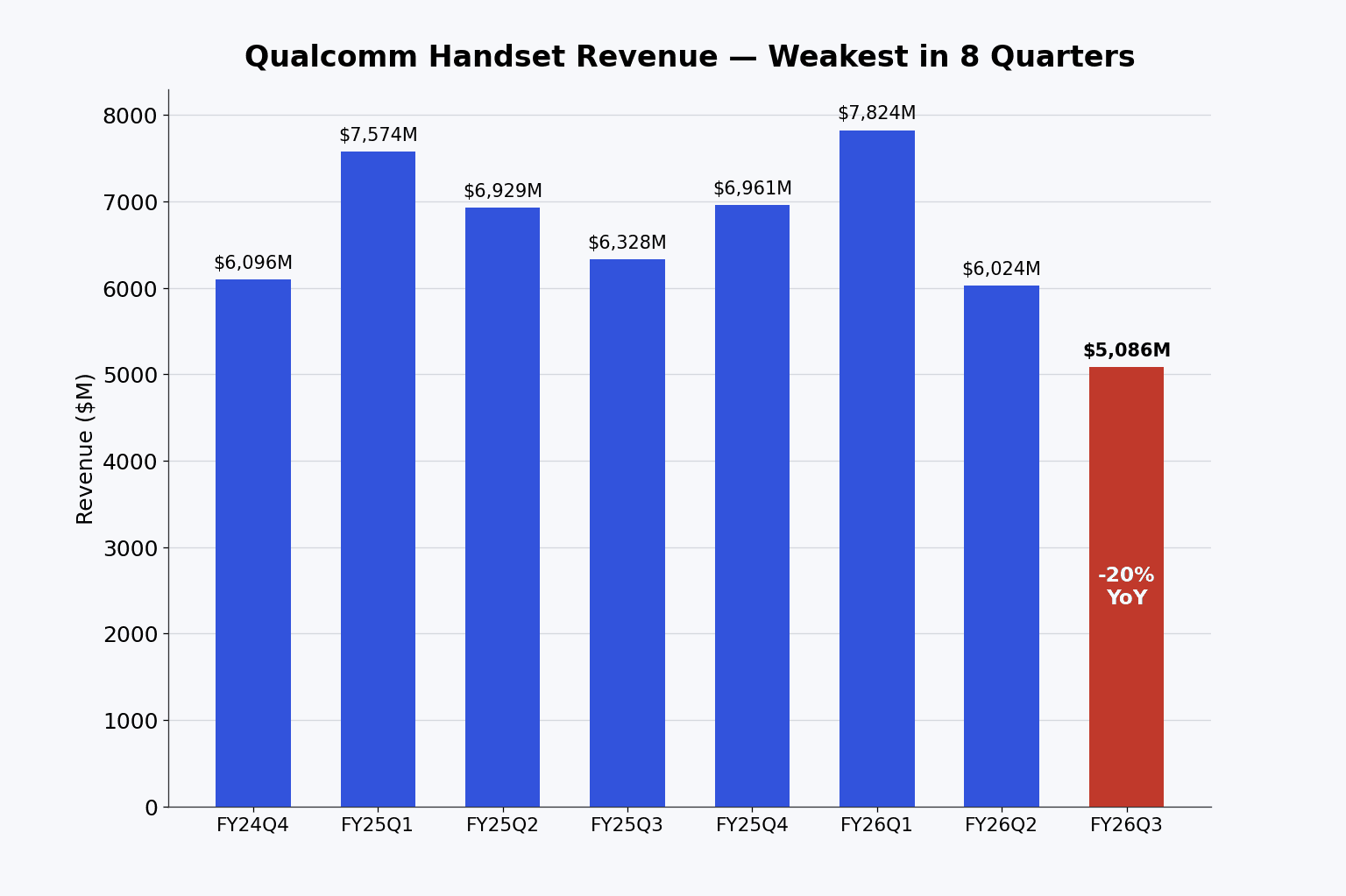
The handset chart shows the break clearly: after holding in a $6.0 to $7.8 billion band for seven quarters, revenue dropped to $5.09 billion. Part of that is the memory-driven demand softness, and part is Apple. The iPhone maker has been building its own modem to stop buying Qualcomm's, and this quarter management said that transition is running ahead of schedule. Qualcomm now expects its share of the modem in upcoming iPhones to be materially below the roughly 20% it had guided before, with Apple revenue falling about 50% from the September to the December quarter and slipping under $2 billion in fiscal 2027 on the way to nothing.
Losing Apple was always coming. The surprise was the pace, and it sharpened the question the whole report hangs on: can the new businesses grow fast enough to fill the hole before it opens? Amon's answer was that more than 60% non-handset growth next year should replace all of the lost Apple revenue within the year. To defend margins against the cost inflation in the meantime, Qualcomm is pushing through double-digit price increases across its end markets starting September 1, which it says are small relative to the memory-cost jump and should not dent premium-phone volumes.
Why the guidance stung
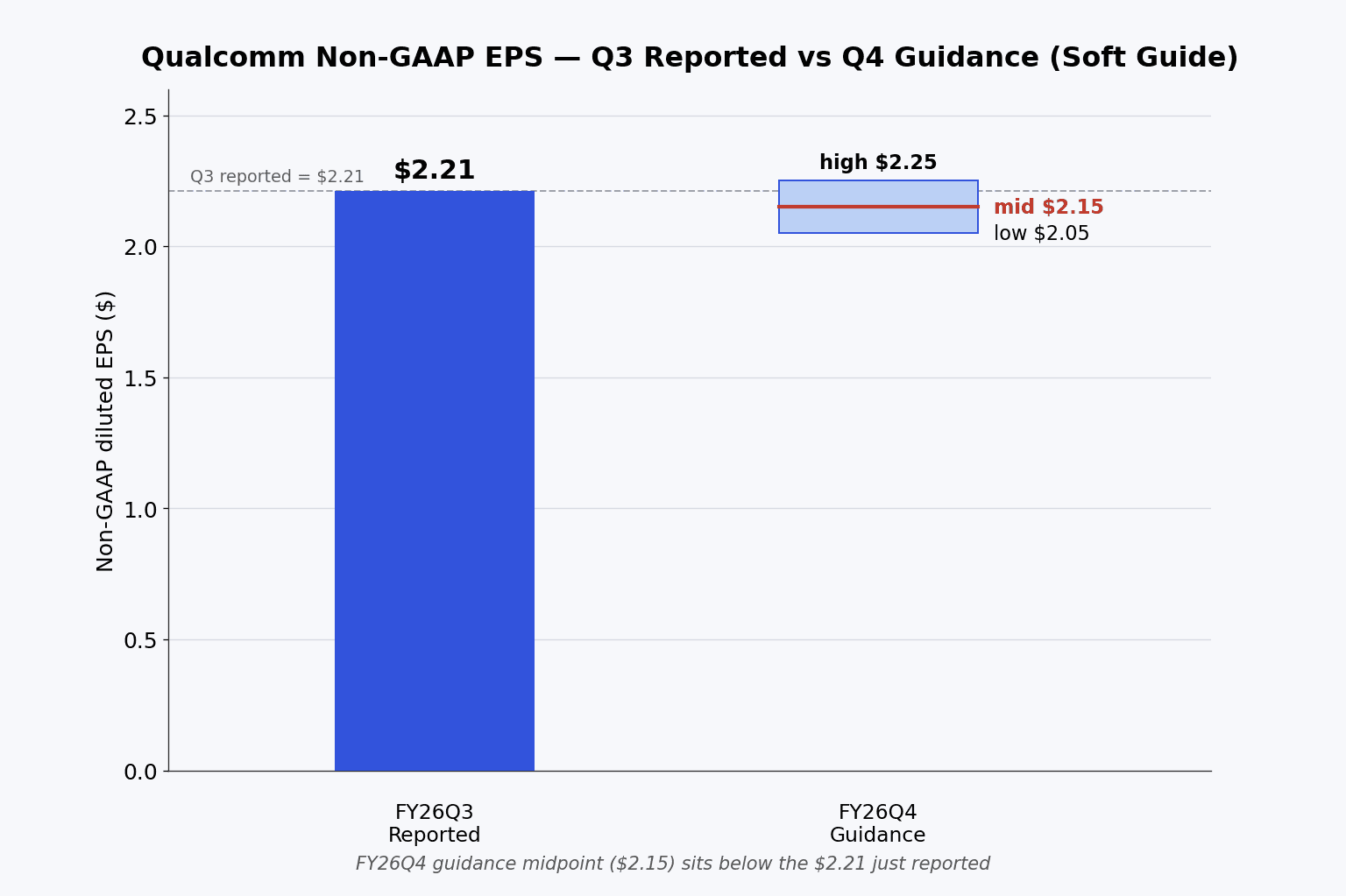
Guidance, the company's own forecast, is what moved the stock, and the picture above is why. Management set fiscal Q4 non-GAAP EPS at $2.05 to $2.25 on revenue of $9.7 to $10.5 billion. The midpoint of that earnings range, about $2.15, comes in under the $2.21 the company just delivered, so the forecast points to profit going sideways-to-down rather than recovering. Set against a Street that had penciled in something closer to $2.36, it read as a clear cut. The message investors took away was that the memory crunch, cost inflation and the accelerating Apple roll-off will all weigh on the next quarter before the data-center and pricing offsets fully kick in.
None of this changed Qualcomm's capital returns. It sent $2.3 billion back to shareholders in the quarter, split between $1.4 billion of buybacks and $973 million in dividends. But cash generation slowed hard, with free cash flow of $495 million down sharply as spending rose and profits compressed, a reminder that a transition year costs money even when the long-term plan is intact.
The Street can't agree, and that's the point
Analysts left the print more divided than usual. Baird trimmed its target to $177 while staying constructive, calling fiscal 2026 a transition year. At the other extreme, Benchmark holds a Street-high $300, underwriting the data-center pivot on the strength of signed orders and chips already in production. In between sits a wall of neutral ratings, from Goldman Sachs, JPMorgan, UBS and Citi, with targets scattered from roughly $180 to $265. Several had lifted their numbers before the report on the diversification story, but few were willing to upgrade to a buy, treating the cloud opportunity as an option worth holding rather than a certainty.
That $177-to-$300 spread is the honest summary of where Qualcomm stands. The bull case is that automotive's record quarter, a fast-growing IoT line and two hyperscaler data-center deals prove the company can thrive without leaning on smartphones. The bear case is simpler: the handset base is shrinking now, from Apple and from softer Chinese demand, while the replacement revenue arrives later. This quarter did nothing to settle that argument. It just raised the stakes on the next few, when the data-center ramp either shows up on schedule or does not.