Palantir's U.S. commercial revenue jumps 149% in Q2 2026
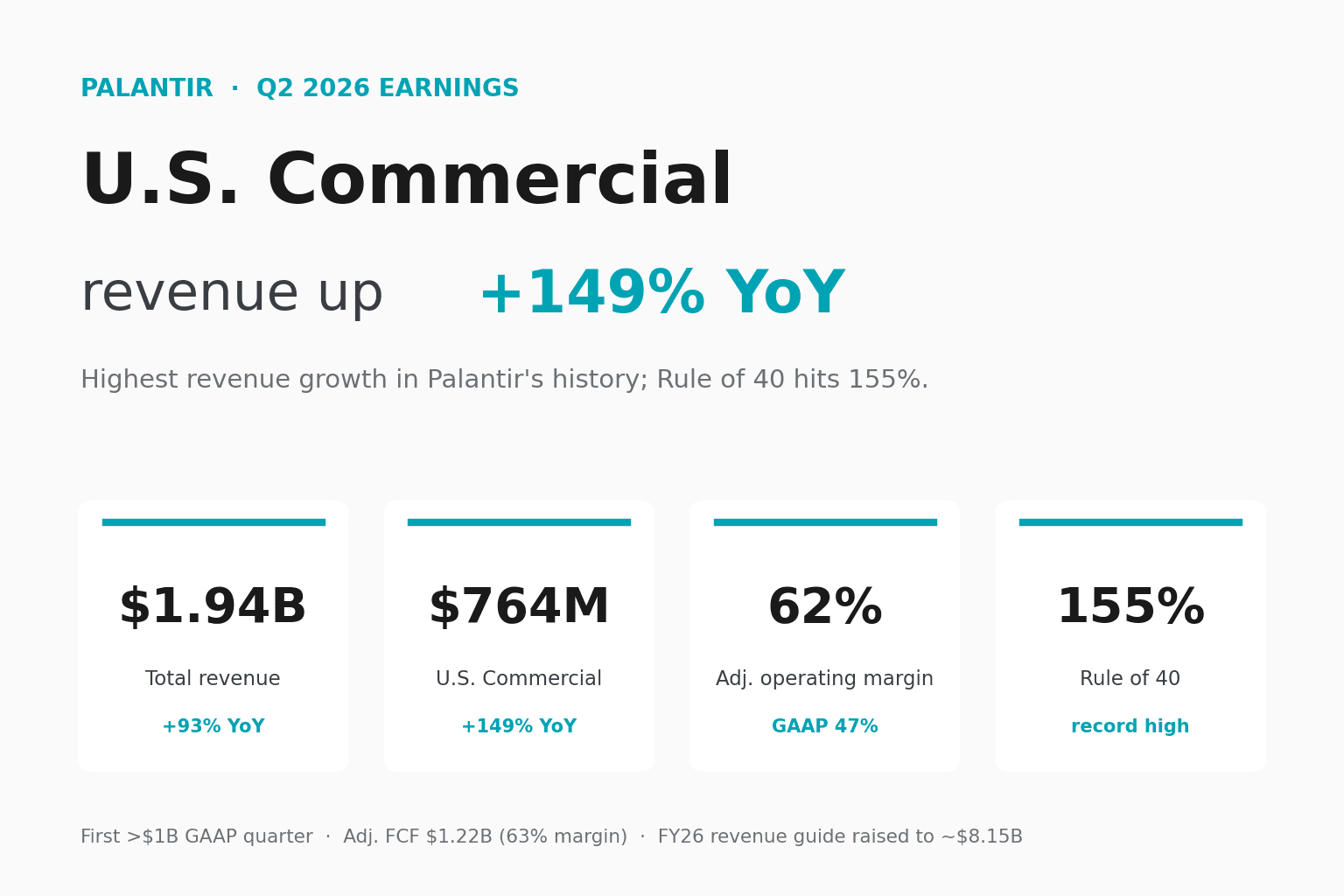
Palantir has spent years telling investors that its software would turn the artificial-intelligence hype into real revenue. In the quarter ended June 30, 2026, the numbers finally matched the rhetoric. Total revenue grew 93% year over year to $1.94 billion, the fastest growth rate in the company's history, and the U.S. commercial business, the segment Wall Street watches most closely, jumped 149%. Chief executive Alex Karp called the quarter "otherworldly," and for once the stock agreed, climbing about 15% after hours.
The report did more than clear expectations. Palantir booked its first-ever billion-dollar GAAP profit, raised full-year guidance by roughly half a billion dollars, and posted a Rule of 40 score of 155%. That last figure is a common software yardstick that adds a company's revenue growth rate to its profit margin; anything above 40 is considered healthy, so 155 is in a different league.
The fastest growth in company history
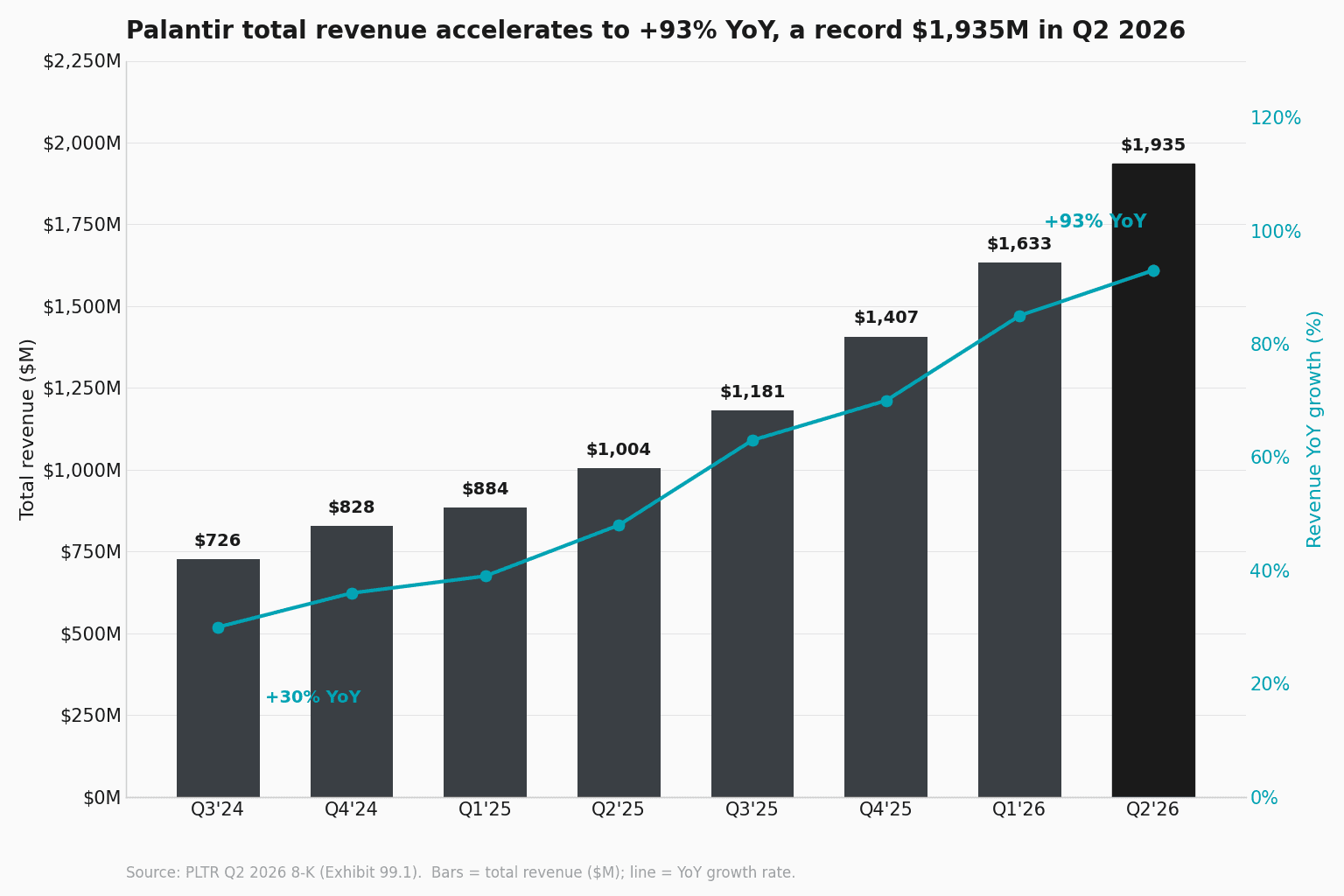
Revenue of $1,935 million was up 19% from the prior quarter and 93% from a year earlier. What makes that unusual is the direction of travel: most companies decelerate as they get bigger, but Palantir's growth rate has now accelerated for seven consecutive quarters, from 30% to 93%. The engine is domestic. U.S. revenue grew 115% to $1,573 million and now makes up 81% of the company, up from 73% a year ago. International revenue rose a more modest 34% to $362 million, with international commercial the weakest sub-segment at 26%.
U.S. commercial is the whole story
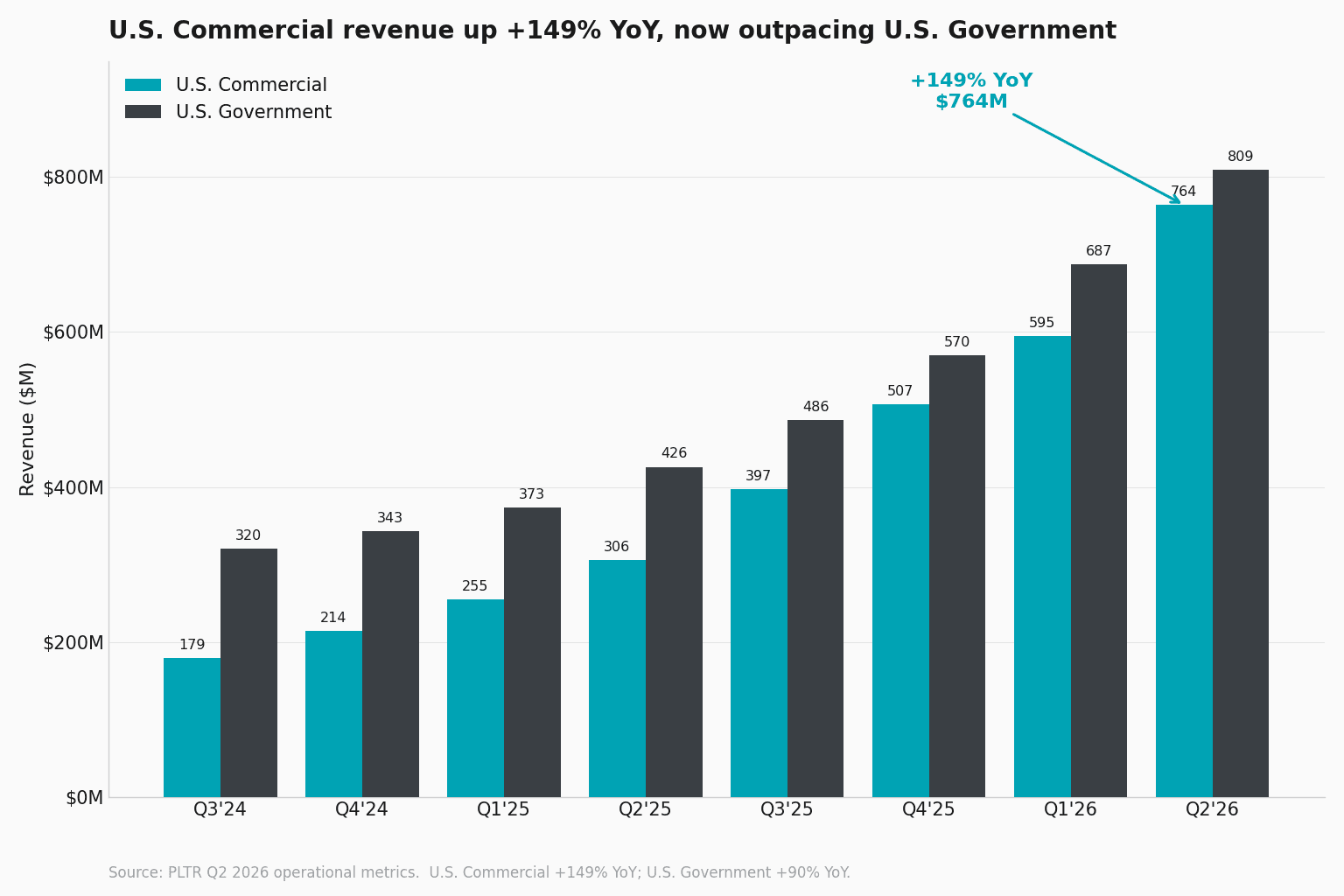
"The story of this quarter is, once again, our U.S. business," said president and revenue chief Ryan Taylor. U.S. commercial revenue of $764 million grew 149% year over year and 28% sequentially, the sixth straight quarter as Palantir's fastest-growing segment. U.S. government revenue was still larger at $809 million and grew a respectable 90%, but the commercial line is closing the gap quickly.
The forward indicators are even stronger than the revenue. Total contract value, or TCV, which is the full dollar amount of deals signed in the period, reached $2.132 billion in U.S. commercial alone, up 153% and nearly $800 million above the previous record quarter. Remaining deal value, or RDV, which measures signed business not yet recognized as revenue, rose to $6.238 billion in U.S. commercial and $13.1 billion company-wide. Net dollar retention, a gauge of how much more existing customers spend year over year, climbed to 157%, up 700 basis points in a single quarter. In plain terms, Palantir's existing customers are expanding fast, and it is signing new ones faster than it can recognize the revenue.
Profit is scaling faster than revenue
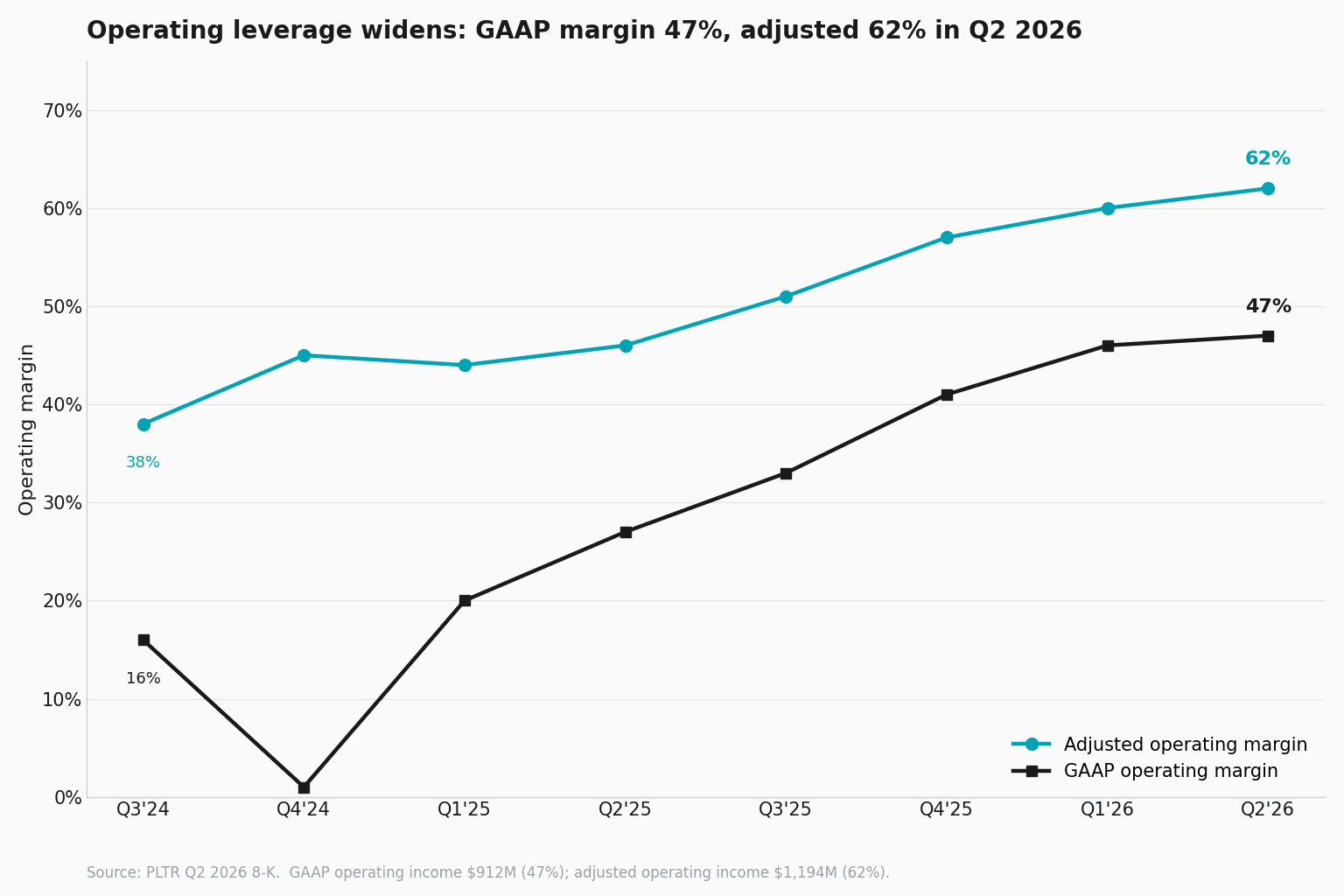
The rare part of this story is that margins are expanding at the same time. GAAP operating income was $912 million, a 47% margin, up from 27% a year ago. On an adjusted basis, which strips out stock-based compensation, operating income was $1,194 million, a 62% margin. GAAP net income crossed $1 billion for the first time, landing at $1,062 million, though the CFO noted that unrealized gains on the company's SpaceX holdings added about $0.03 to GAAP earnings per share of $0.41. Adjusted EPS was also $0.41.
Cash generation is the cleanest read on the business. Operating cash flow was $1,216 million and adjusted free cash flow was $1,220 million, a 63% margin, on capital spending of just $14.6 million. Palantir ended the quarter with $9.2 billion in cash and U.S. Treasuries and no debt. This was the first quarter with more than $1 billion in each of GAAP net income, adjusted operating income and adjusted free cash flow.
Record deal flow and where demand comes from
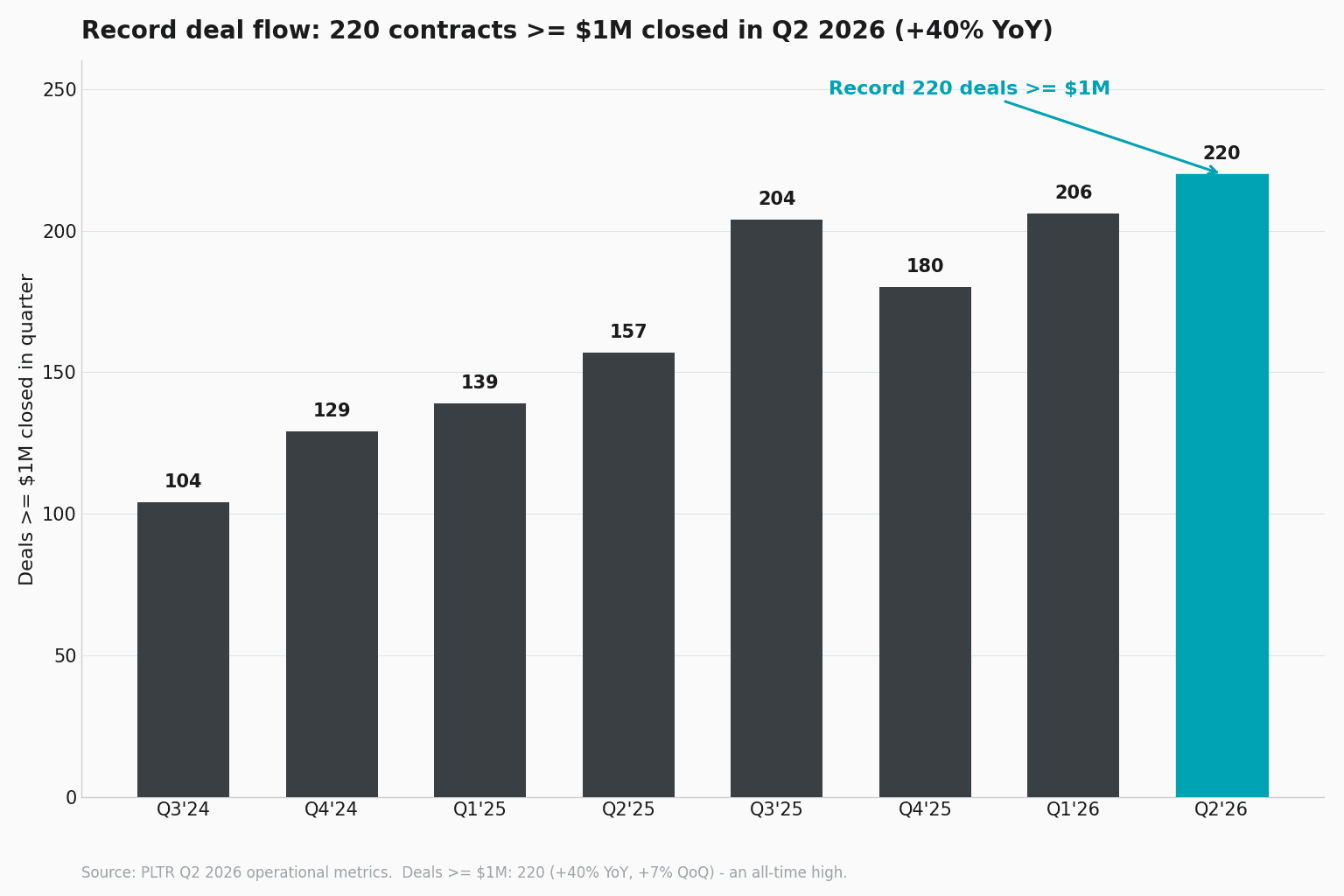
Palantir closed 220 deals worth at least $1 million, a company record, along with 98 deals above $5 million and 73 above $10 million, all-time highs across every size bucket. Management tied the demand to what it calls "AI sovereignty," the idea that large enterprises want to keep control of their own data, workflows and model outputs rather than hand them to a third-party AI provider. "Demand for AI sovereignty has now been unleashed," Karp said, "and Palantir is the only company that has demonstrated it can transform tokens into actual economic value."
Chief technology officer Shyam Sankar offered a concrete example: in a head-to-head test at a major Silicon Valley firm, a frontier AI lab failed to deliver on a customer-service automation task while Palantir's software proactively suggested pricing and marketing changes, converting into a $10 million contract. On the government side, a U.S. program of record chose Palantir's Maven platform as its operating system this quarter, and Sankar noted that Palantir's trailing defense revenue is still less than a quarter of one percent of the Pentagon budget, which he framed as a long runway rather than a ceiling.
Analysts agree on the business, not the price
The market reaction inverted the pattern from three months earlier. After a clean beat in Q1, the stock fell about 7% because the guidance did not clear an impossibly high bar. This time the setup was de-risked: Palantir entered the print down roughly 30% for the year and about 40% off its November 2025 high, so a genuine blowout had room to be rewarded. Shares closed up 2.1% on August 3, then jumped as much as 15% after hours to around $144, still well below the record.
The sell-side is united on the operating story and split on valuation. The average price target sits near $182, with a consensus Buy rating, but the range is extraordinarily wide, from $70 to $255. Bulls such as Wedbush's Dan Ives ($230), who calls Palantir the "Messi of AI," and Rosenblatt ($225) argue that hyper-growth and profitability together justify a premium. The bears do not dispute the execution. Jefferies ($70) and RBC ($90) both praise the business but balk at a multiple near 40 times next year's revenue, the richest in software, and flag harder comparisons in the second half plus competition from Databricks, Snowflake and the model labs. As CNBC's Jim Cramer put it, buyers are "walking up Palantir like the old days," then asked whether the old days are still viable.
The forward look
Management raised guidance across the board, in what it called the largest full-year increase in company history. Full-year 2026 revenue is now guided to $8.150 billion to $8.158 billion, about 82% growth at the midpoint, with the U.S. commercial target lifted to more than $3.424 billion, at least 134% growth. Adjusted operating income was raised to $4.889 billion to $4.897 billion and adjusted free cash flow to $4.5 billion to $4.7 billion. For the third quarter, Palantir guided revenue of $2.160 billion to $2.164 billion. Karp went further on the call, saying he intends to keep the whole company growing at or above the U.S. commercial rate for the next 18 months. Whether the stock keeps up is a separate question, and one on which Wall Street still cannot agree.