Oracle's $638B Backlog Soared 363%. Why Did the Stock Fall?
A record print, sold on the cash flow statement
By every operating measure that mattered, Oracle just turned in the best quarter in its history. Revenue hit $19.2B, up 21% from a year earlier. Non-GAAP earnings per share came in at $2.11, up 24% and a clean beat of the roughly $1.89 the Street expected. Total cloud revenue reached $9.9B, up 47%. And the figure that broke every model: a contracted backlog of $638 billion, up 363% year over year and up $85 billion in a single quarter.
The next day, the stock fell 8.5%, wiping out roughly $70 billion of market value.
That gap between the report and the price tells you what the market is worried about now. For the past two years, the bear question on Oracle was whether a legacy database company could really grow cloud infrastructure into the same league as Amazon, Microsoft, and Google. This quarter answered it, with OCI revenue up 93% and the biggest contracted backlog the company has ever disclosed. So investors moved on to the one line where Oracle now looks exposed: free cash flow, the cash left over after running the business and paying for new equipment.
The backlog is the story
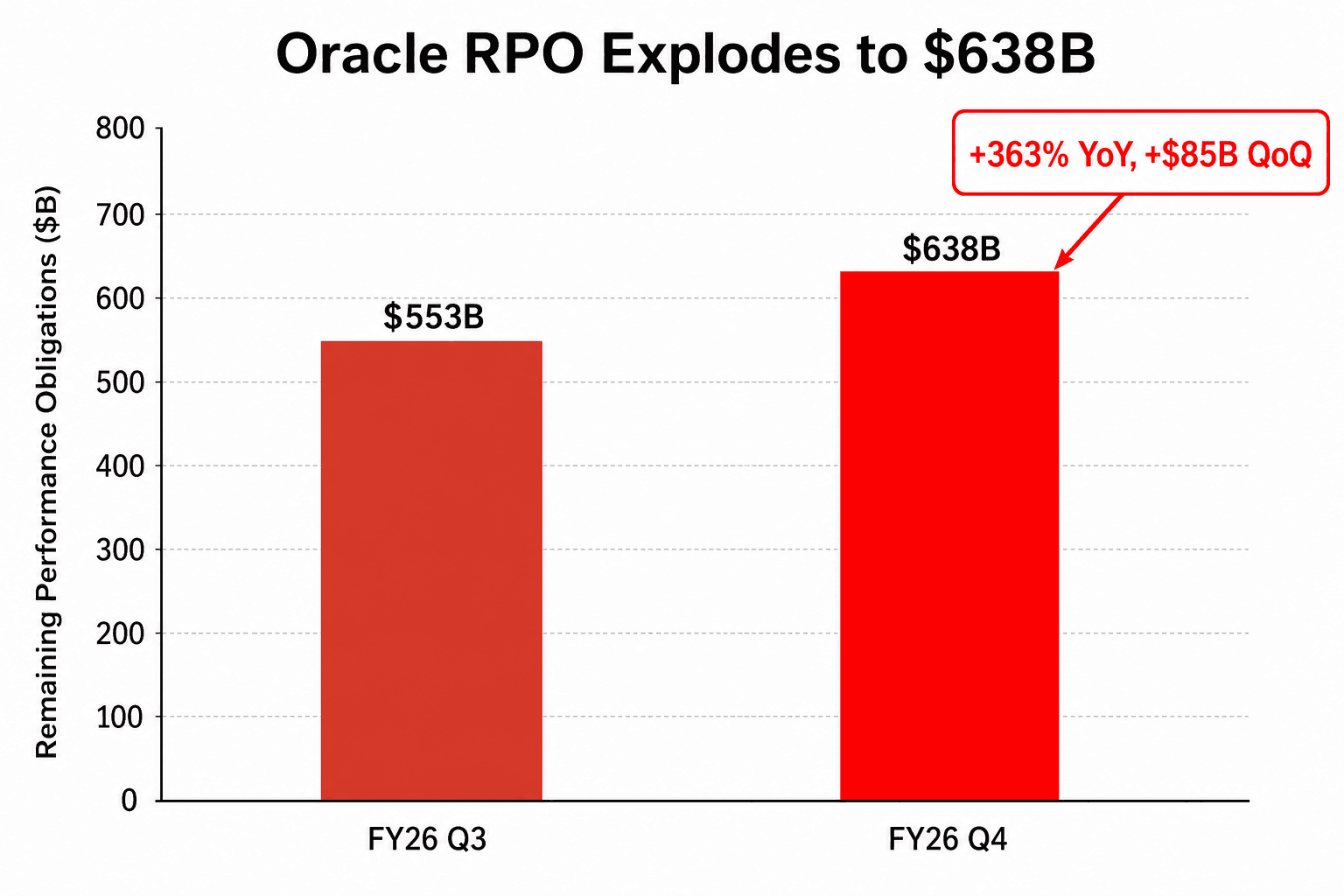
RPO stands for Remaining Performance Obligations. In plain terms it is signed business that has not yet been delivered or booked as revenue, so it is closer to a firm order book than a forecast. Oracle's ended the quarter at $638B. Against trailing annual revenue of $67B, that is close to a decade of contracted work sitting on the books.
The timing of how it converts is what matters. CFO Hilary Maxson said about 12% will be recognized in the next 12 months and another 34% in months 13 to 36, and that both percentages are "expected to accelerate." Most of the increase came from large AI contracts where the customer either paid up front or supplied its own chips. That prepaid-plus-customer-hardware pool now totals $75B. Co-CEO Clay Magouyrk said those deals carry "no degradation in margin compared to our other contracts," and they cut how much cash Oracle has to raise to build the datacenters behind them.
OCI: an acceleration, not a one-quarter spike
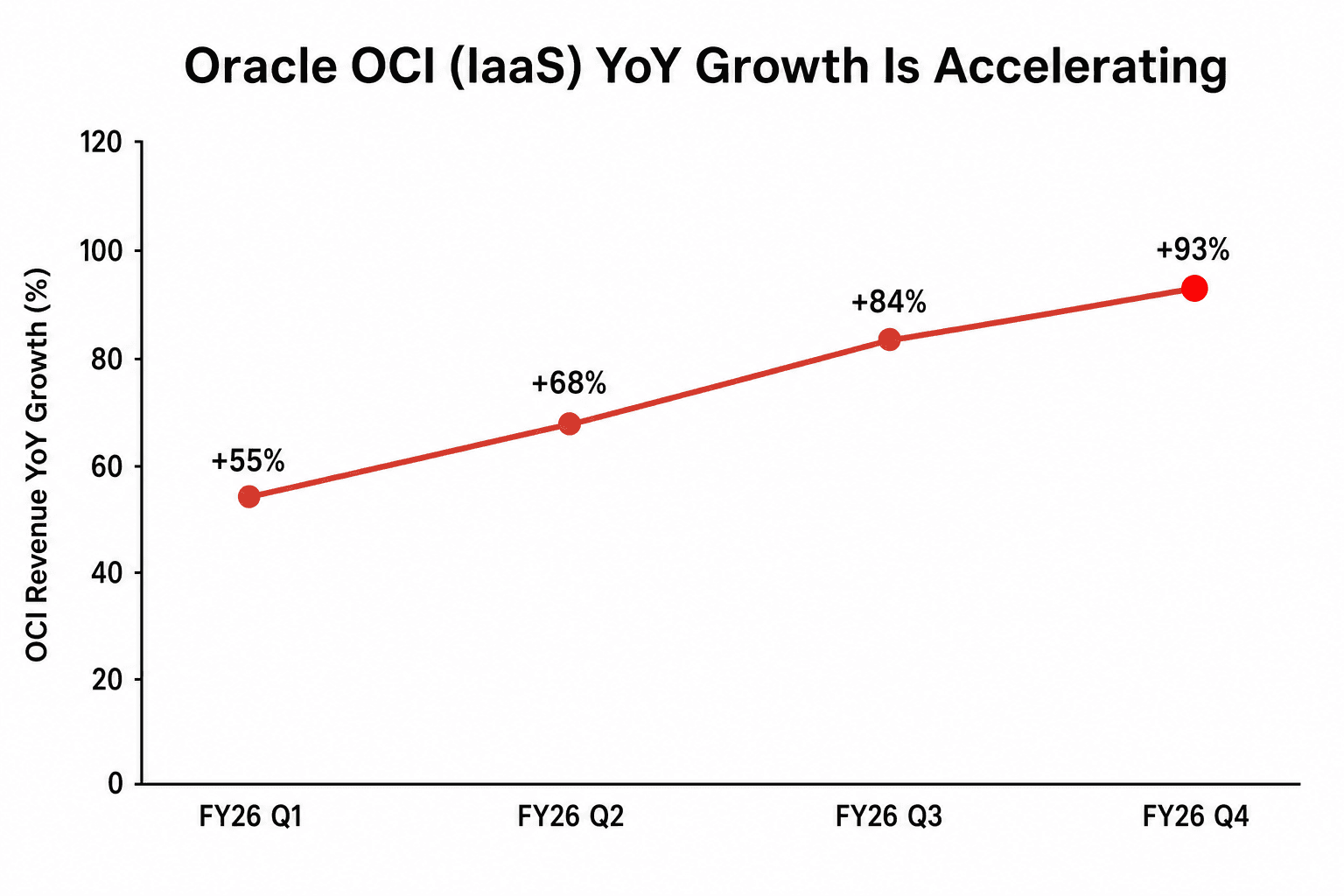
Oracle Cloud Infrastructure, the rentable computing power that runs AI workloads, did not just grow. It sped up for four straight quarters: +55%, +68%, +84%, then +93%. Full-year OCI revenue reached $18.1B, up 77%. And the guide points higher still, with Q1 FY27 total cloud revenue expected to grow 58% to 64%.
Magouyrk framed the demand as limited by supply, not by appetite: "Several years in, there's still a massively higher demand than there is supply." Oracle ran its chips at 97.5% utilization, and when 35,000 of them across 59 customers came up for renewal, most of the small slice that wasn't renewed was resold to other customers in the same quarter. The real constraint is how fast Oracle can build and power datacenters. It delivered more than 1.2 gigawatts of capacity in FY26 and expects to add nearly 1 gigawatt in Q1 FY27 alone, about as much as the prior four quarters combined.
The quieter winner is the database. Oracle's database running inside Amazon, Microsoft, and Google's clouds, which it calls MultiCloud, grew revenue 404% with bookings up 325%. Management called it the fastest-growing business in the company's history. It is how Oracle sells to its huge installed base of database customers even when they run on a rival's cloud.
What actually hit the stock
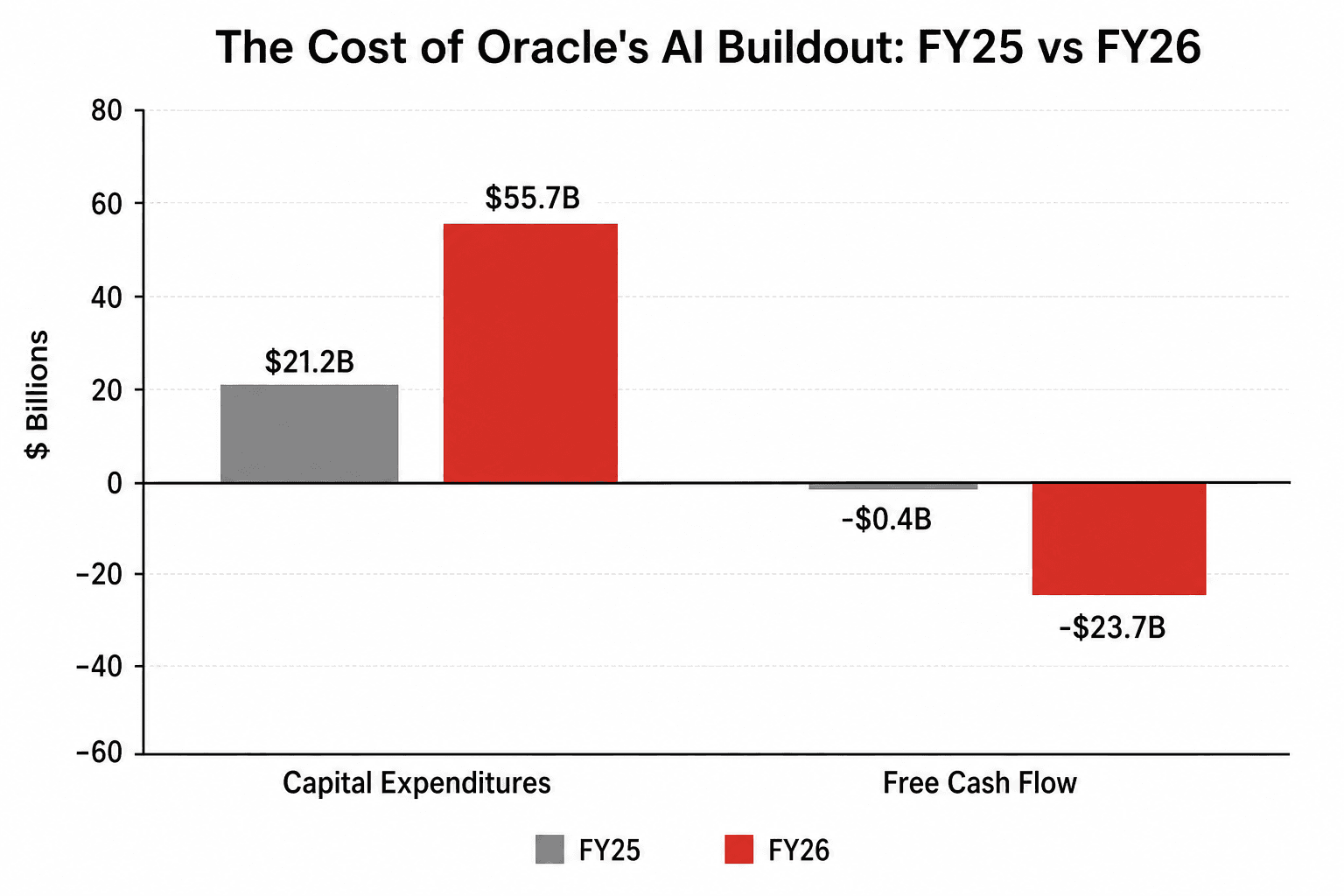
Here is the arithmetic the market ran. Capital spending for the year hit $55.7B, well above the earlier guide of around $50B. Operating cash flow was a healthy $32B, up 54%, but the spending swamped it, leaving free cash flow at negative $23.7B. Then management guided FY27 net cash outlay for capex to about $70B and said Oracle would raise roughly $40B in debt and equity during the year, including a $20B at-the-market stock sale that dilutes existing shareholders.
So a record operating quarter arrived bundled with rising capital spending, deeply negative free cash flow, fresh dilution, and a gross margin that fell about 5 points in FY26 with another step-down on the way. Maxson's explanation is that infrastructure margins "improve rapidly as we reach full contractual revenue levels at our data centers." In other words, new datacenters drag on profit while they fill up, then turn profitable once they do. Bulls take that on faith because the backlog underwrites it. Bears point out that only about 12% of the $638B converts in the next year, so the cash gap is real and it is now.
What management is asking investors to believe
The pitch from the two co-CEOs and the new CFO is consistent: build aggressively now, because the demand is contracted and the returns come later. Magouyrk called AI infrastructure a market worth "trillions per year" and reaffirmed a long-run 30% to 40% margin target for OCI once datacenters are full. Maxson framed the heavy-spending years around return on invested capital, which she put in the high-20s percent at steady state, and noted that the prepaid and bring-your-own-hardware deals earn even more because customers fund the equipment up front.
The new CFO, about two months into the role, reaffirmed the full set of long-term targets: revenue growing at a 31% annual rate and EPS at 28% through FY2030. On a quarter where the cash story spooked investors, that reaffirmation was the steadying message.
Analyst reaction: a buy-the-dip chorus, with one holdout
The sell-side largely shrugged off the drop. Guggenheim kept its Buy and a Street-high $400 target, calling the sell-off one with "no apparently good reason" and telling investors to buy aggressively. Bernstein nudged its target up to $325, noting another quarter with "no major hiccups" despite the capex "sticker shock." Wedbush, BofA, and KeyBanc all kept Outperform or Overweight ratings, framing the decline as a financing-driven overreaction to an otherwise contracted demand story. The average 12-month target sits near $272, well above where the stock landed.
The lone caution came from Zacks, which rates the stock a Hold. Its case is not about demand but about timing and cash: deeply negative free cash flow, fresh dilution, near-term margin pressure, and a premium valuation argue for patience until the backlog actually converts.
Forward look: what the September 10 print turns on
Three numbers will decide whether the buildout thesis holds. First, cloud revenue growth against the 58% to 64% guide. A result at the high end would confirm the backlog is converting on schedule; the low end would reopen the timing debate. Second, the conversion rate of the backlog. Maxson said the 12% and 34% near-term figures should accelerate, and the first sign of that would cool the cash-gap worry. Third, infrastructure gross margin. Any stabilization, against the guided further step-down, would prove out the "margins recover as datacenters fill" claim sooner than expected.
All financial figures are sourced from Oracle's Q4 FY2026 results announced June 10, 2026, the accompanying earnings call, and Oracle Investor Relations. Analyst ratings and price targets are drawn from published coverage by Guggenheim, Bernstein, Wedbush, BofA, KeyBanc, and Zacks. Market-reaction figures are from CNBC and other public market coverage.