Oracle Now Spends More on Capex Than It Earns in Sales
A beat the market sold inside thirty minutes
Oracle reported after the close on Thursday, September 10. The after-hours tape liked it: the stock jumped as high as $167.69 within half an hour of the release and settled the extended session at $159.26, up 4.13% against the $152.94 it had closed at that afternoon.
Then the market opened. Oracle printed $164.38 at the bell, up 7.48%, tagged $166.00, and inside the first five minutes had already traded as low as $154.35. It closed at $150.28, down 1.74% on the day and 8.58% below its own open, effectively at the low. Volume was 55.2 million shares, 3.79 times the prior ten-session average, and more than a quarter of it traded in the opening half hour.
This was not the sector. On the same day Amazon rose 1.94%, Alphabet 1.53%, Microsoft 0.65%, the S&P 500 0.85%, and the software ETF that tracks Oracle's peer group 0.32%. Only Oracle fell. Something in the filing changed minds between the enthusiasm of the evening and the auction the next morning, and it was not the growth figures.
The line that got crossed
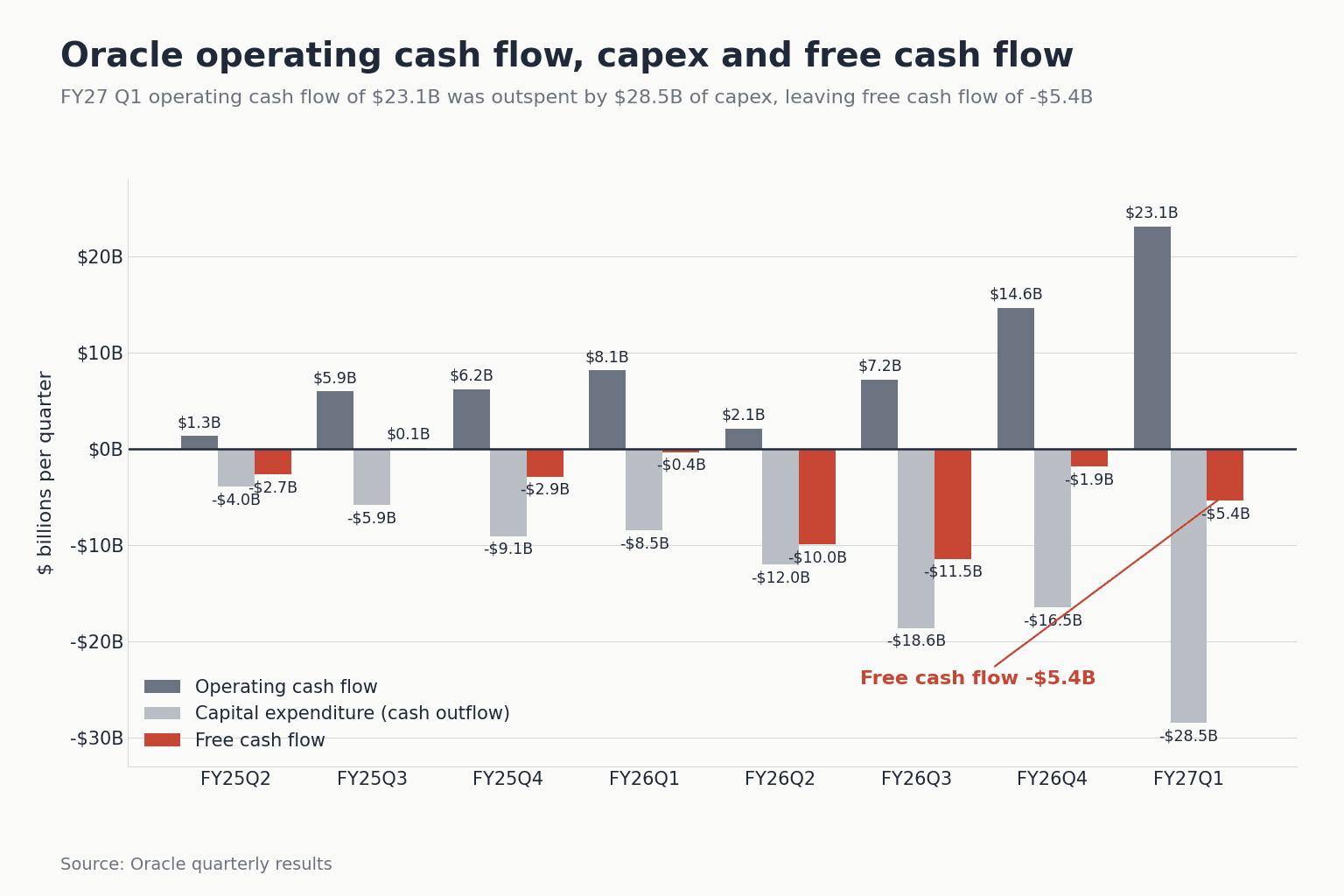
Oracle spent $28,499M on property and equipment in a single quarter, up 73% from the previous three months. That one quarter is larger than the entire capital programme of fiscal 2025, which came to $21,215M.
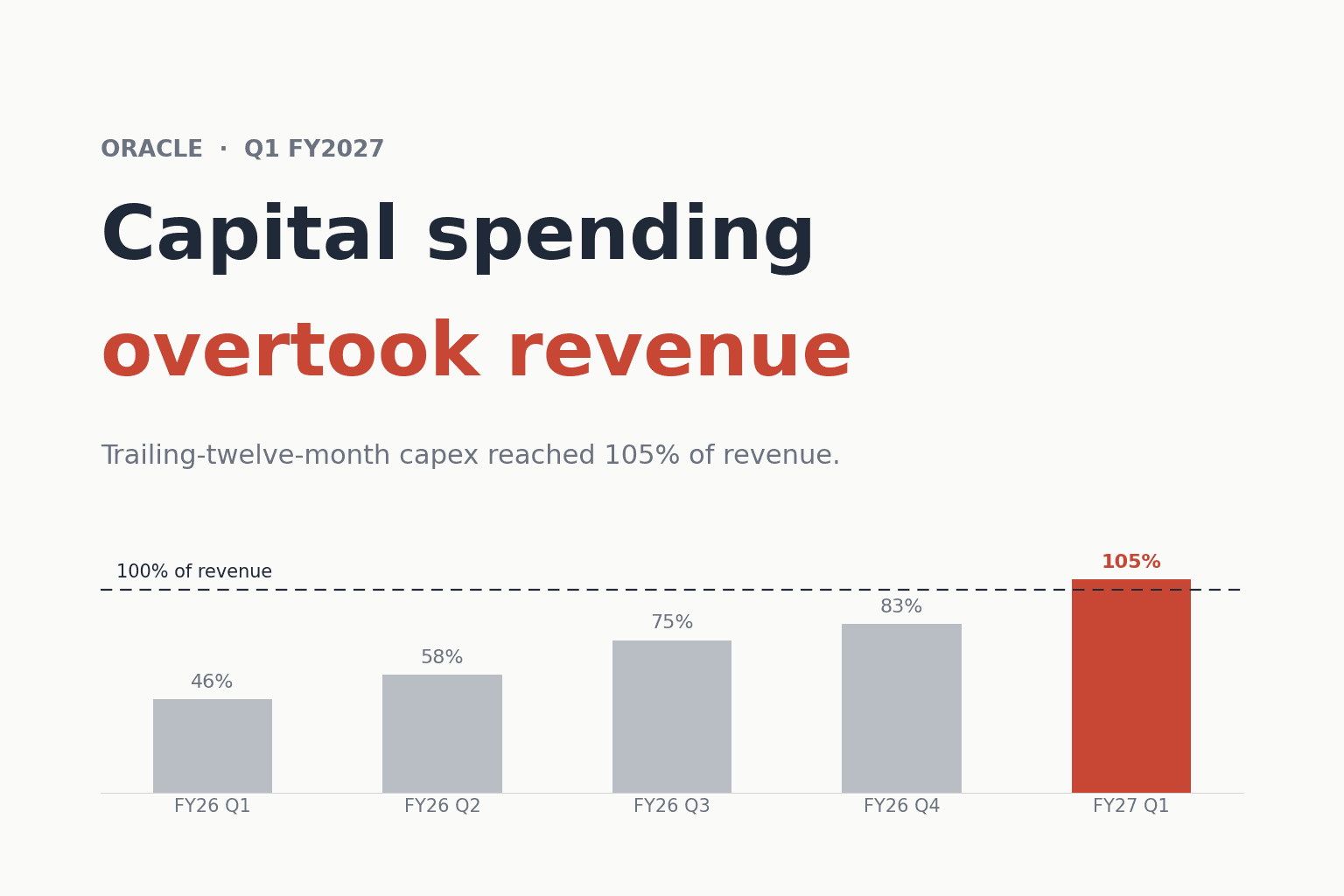
Stack the last four quarters together and the ratio does something no large software company has done. Trailing-twelve-month capital spending is $75,660M against trailing revenue of $71,777M: 105%. Oracle is now laying out more cash on datacentres, chips and land than it collects from customers. A year ago the same ratio was 46%.
There is a reason to build that hard. Oracle delivered 850 megawatts of AI capacity in the quarter, roughly three times what it delivered in the whole of the preceding quarter and 73% of everything it built in all of last fiscal year. More than 300,000 GPUs went in. The fleet ran at 97.9% utilisation, and when older chips came up for renewal, co-CEO Clay Magouyrk said the capacity was renewed or resold at a 20% premium to the expiring contracts, on hardware that is mostly four years old or more. That is the single cleanest evidence in the whole release that this is demand-led rather than hope-led.
The cash flow headline has an asterisk
The release led with record operating cash flow of $23,103M, up 184%. Read plainly, that says Oracle's business suddenly started throwing off almost triple the cash. It did not.
Oracle's own reconciliation shows that $11,363M of that figure is customer prepayments with a significant financing component. Customers paid for capacity in advance. Accounting rules route that money through operating activities even though it functions more like borrowing from a customer than like collecting a bill. Strip it out and cash from operations was around $11.7B, close to the $8.1B of a year ago rather than triple it.
Nothing here is hidden or improper. Oracle publishes the number in the same table where it reconciles capex to what it calls net cash outlay, and the prepayments are the mechanical expression of the contract structures management has been describing for two quarters. Magouyrk was precise about it on the call when an analyst suggested the new contracts need no extra capital spending: "I didn't say, and I don't think myself nor Hilary said, that that doesn't require additional CapEx. We said it doesn't require additional cash from Oracle." The spending still appears on Oracle's balance sheet. Who funds it is the part that has changed.
Either way, free cash flow was negative $5,396M in the quarter and negative $28.7B across the trailing year.
What the money is buying
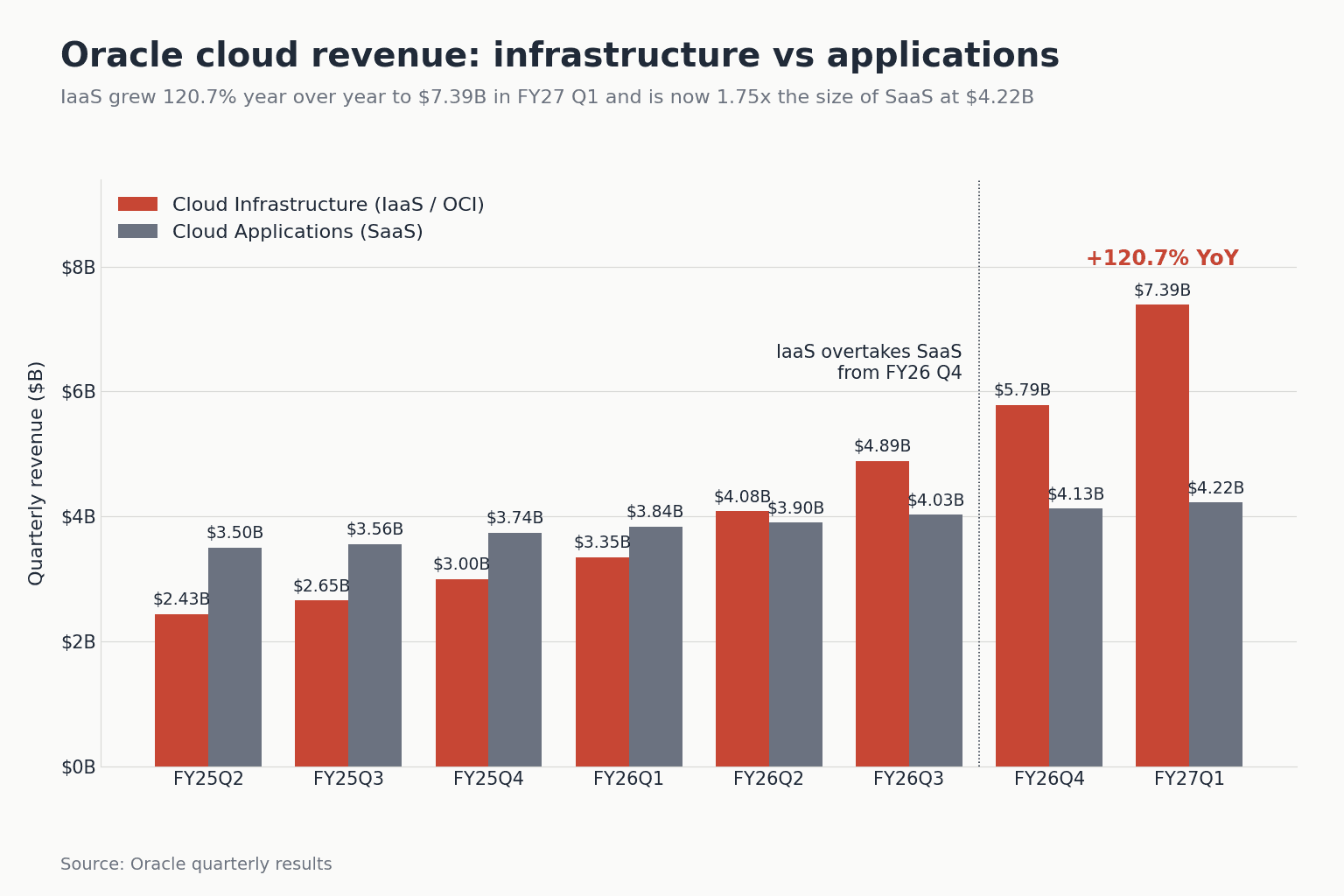
The operating quarter was genuinely excellent. Revenue of $19,345M was up 29.6%, a record, and the first fiscal first quarter in Oracle's history to grow sequentially off a record fourth quarter. Cloud Infrastructure hit $7,388M, up 120.7%, the sixth consecutive quarter of accelerating growth, and added $1,601M of sequential revenue on its own. It now accounts for 38.2% of the whole company, against 22.4% a year ago.
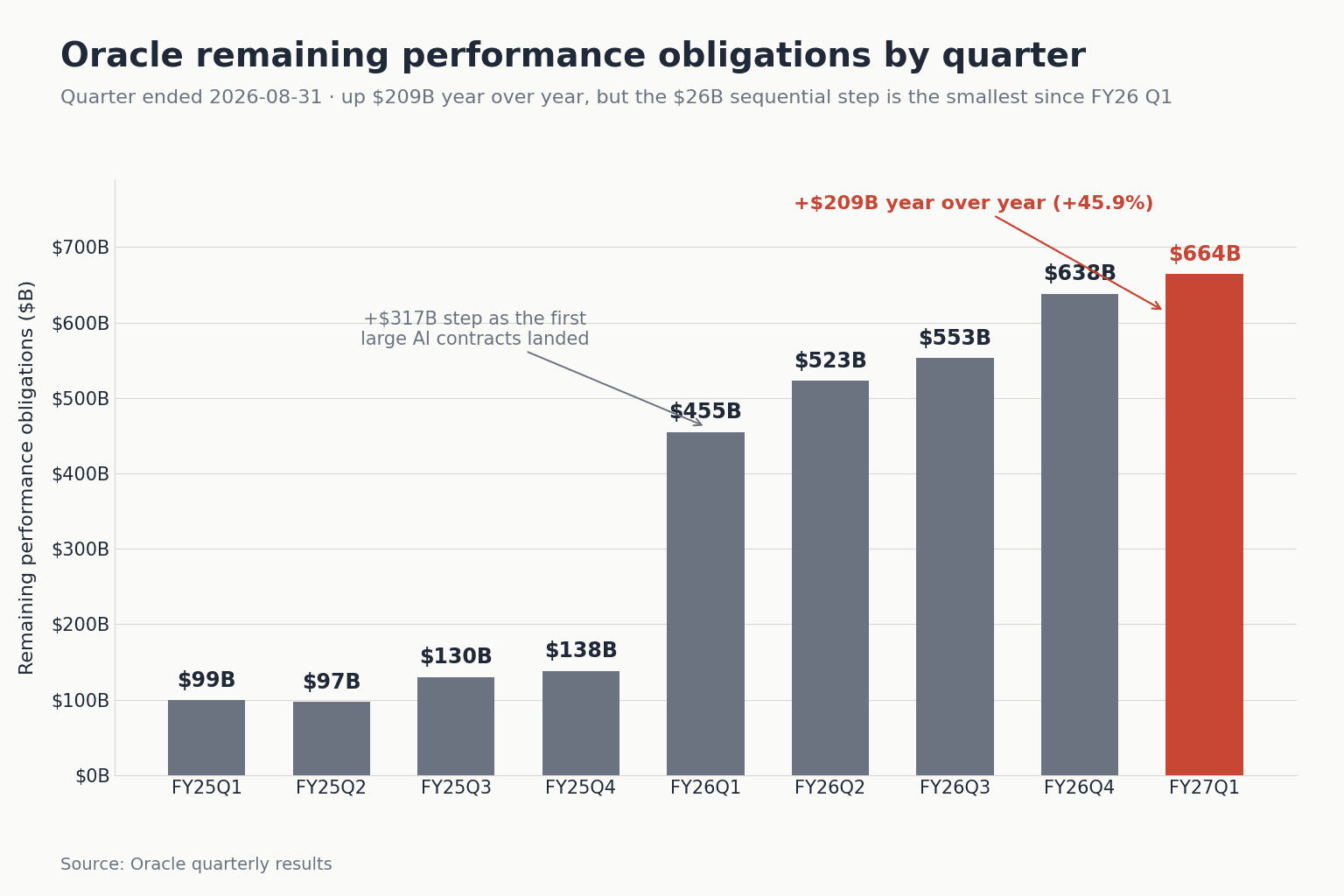
The backlog, which Oracle reports as remaining performance obligations and which is best read as signed work not yet delivered, reached $664B. Oracle booked more than $30B of new AI cloud contracts in the quarter. The sequential step, though, was only $26B, the smallest since these contracts started arriving, because roughly $11.6B of cloud revenue was recognised out of the backlog at the same time. CFO Hilary Maxson now expects around half of that backlog to convert into sales over the next 36 months.
Margins: squeezed at the top, held at the bottom
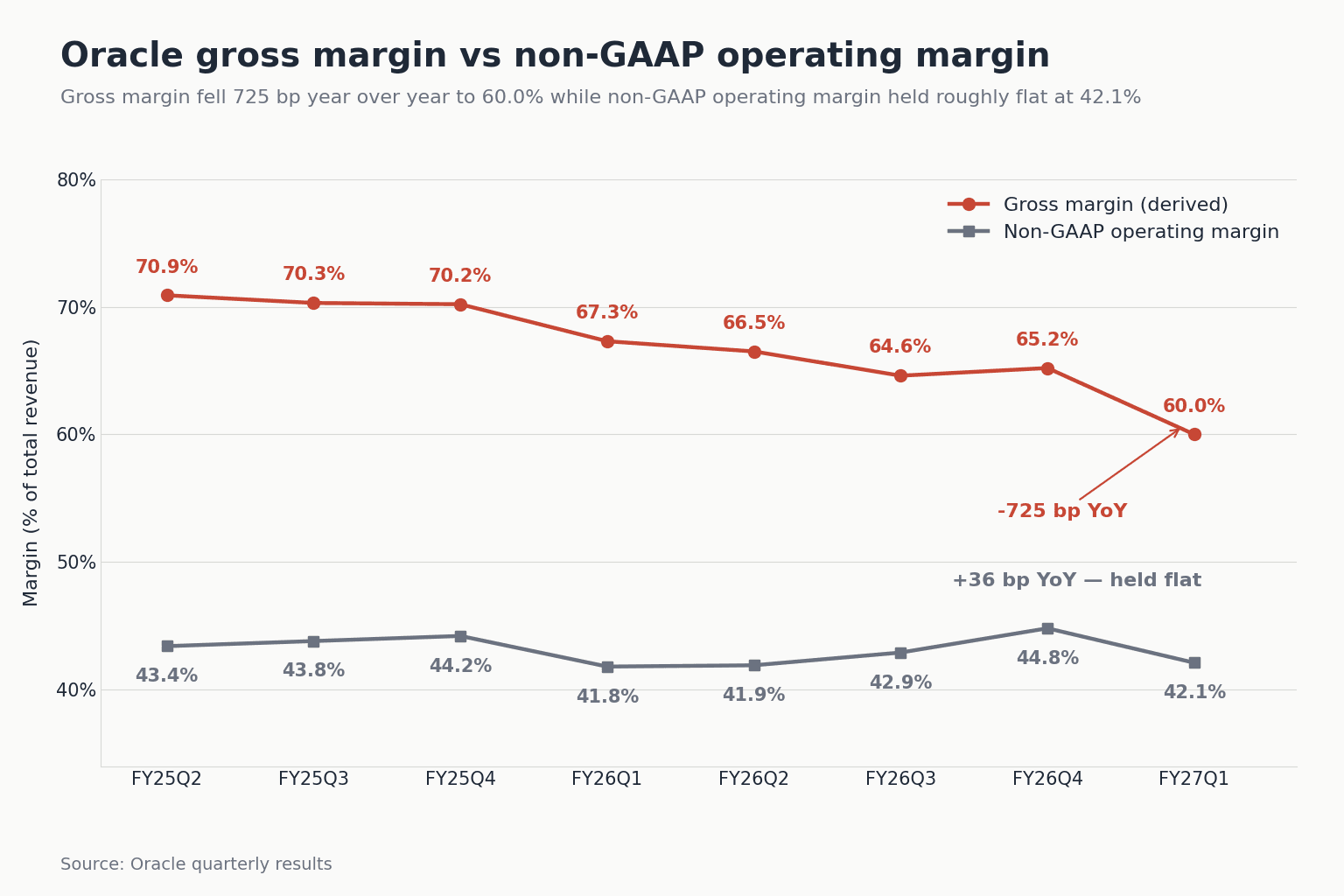
Gross margin fell about seven points year over year to 60.0%, the weakest in this series. The cause is straightforward: depreciation on datacentres that have been energised but not yet filled. The cloud-and-software cost line rose 77.4% and quarterly depreciation more than doubled to $3,156M.
Non-GAAP operating margin, however, held flat at 42.1%. That was achieved below the gross line, by cutting sales and marketing 12.2%, research and development 3.6%, amortisation of intangibles 51.9% and restructuring 77.3%. Maxson told analysts she considers operating margin "the ultimate point that we want to follow," and would say only that gross margin should flatten from here, deferring detail to an October investor day.
Seventeen analysts, zero rating changes
The sell-side reaction was unusual in its unanimity of inaction. Seventeen dated notes appeared, every one on September 11, and there were no upgrades and no downgrades. Four firms cut price targets, RBC hardest, from $190 to $165. Two raised them by token amounts. Eleven simply reiterated. Net drift across the six who moved was minus $73.
The targets now run from RBC's $165 to Guggenheim's $400, a spread of $235 on a $150 stock. That is not a consensus, it is an open argument. And every post-print target on the Street, including the most bearish, sits above where Oracle actually trades. Barclays, which nudged its target up, said openly it was puzzled by the selloff.
Financial figures are from Oracle's Q1 FY2027 results, filed with the SEC on September 10, 2026 as Form 8-K Item 2.02 Exhibit 99.1, and from the accompanying earnings call. Price and volume data are exchange data for the September 10 and September 11, 2026 sessions. Analyst actions are drawn from published research by RBC Capital, BMO Capital, Stifel, UBS, Barclays, Guggenheim, Cantor Fitzgerald, TD Cowen, DA Davidson, Stephens, Citi, Bernstein, Deutsche Bank, Wells Fargo, Bank of America, JPMorgan and Morgan Stanley, as reported by Benzinga and CNBC.