NVIDIA Q2 FY27: a margin reset to buy 70% growth
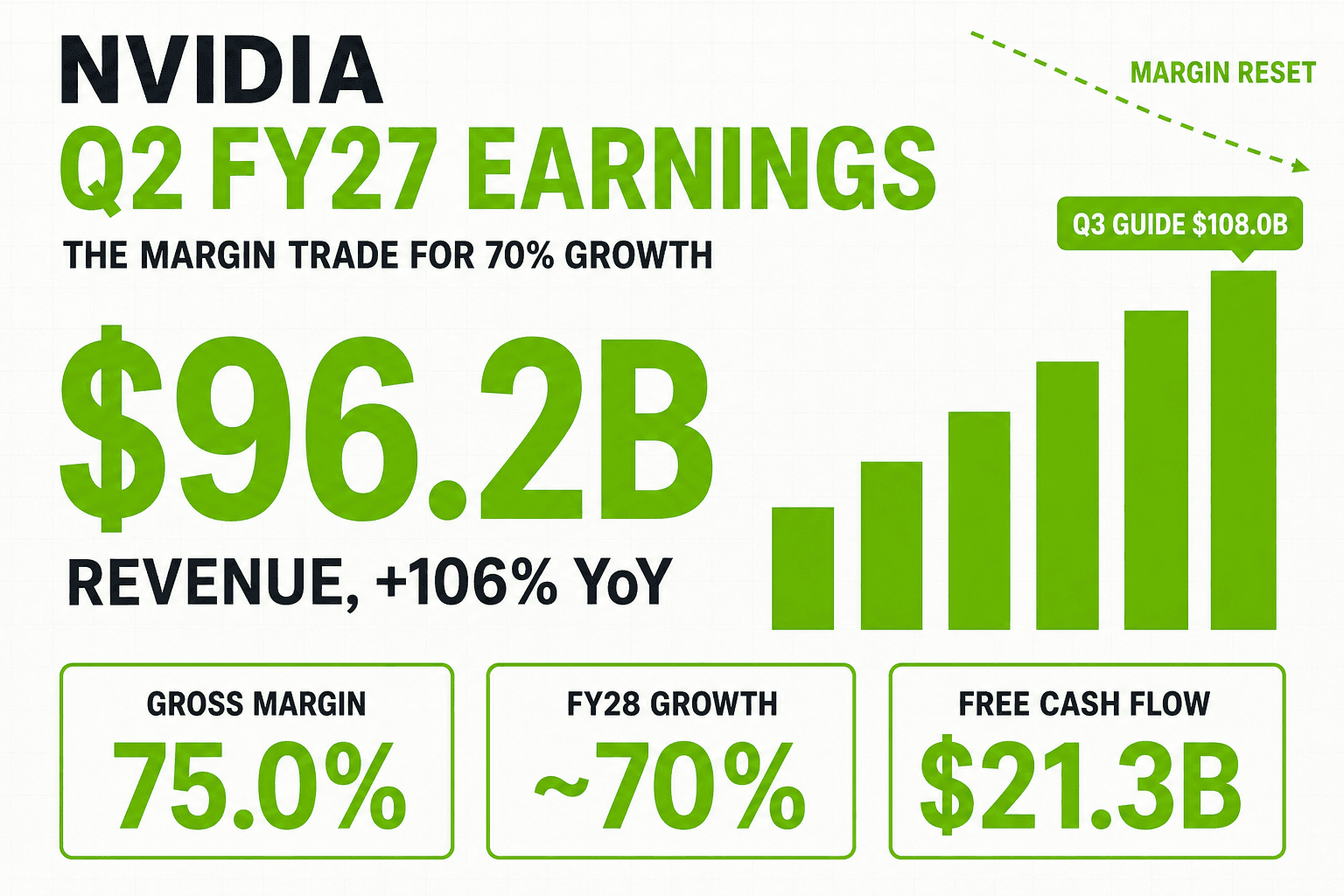
NVIDIA reported the largest quarter in its history on Wednesday evening, and the stock fell as much as 3%.
Hours later it was up almost 5%. Nothing in the numbers changed in between. What changed was that Colette Kress opened her mouth.
The print, first
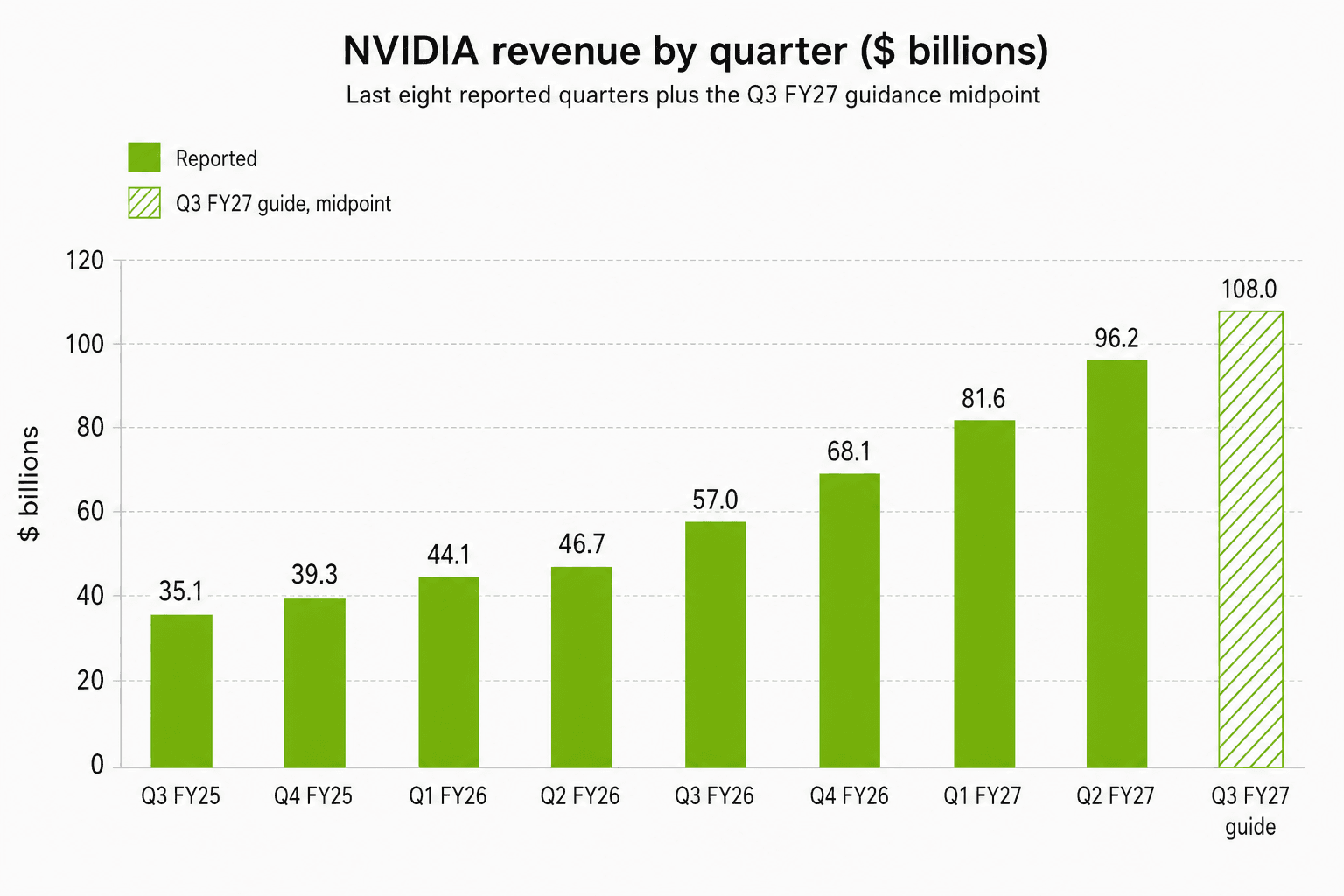
Revenue for the quarter ended July 26 was $96.22 billion, up 105.9% year over year and 17.9% sequentially. Data Center did $89.02 billion, up 116.6%. Edge Computing, which now absorbs the retired Gaming, Professional Visualization, Automotive and OEM lines, did $7.20 billion, up 27.5%. GAAP operating income was $63.73 billion on a 66.2% operating margin. Q3 was guided to $108.0 billion ± 2%, an implied 12.2% sequential step-up, and it assumes zero Data Center compute revenue from China.
Kress opened the earnings call with the framing that growth "accelerated for the 4th consecutive quarter." A company doing $96 billion a quarter is speeding up.
One accounting note before anyone quotes the wrong EPS. GAAP diluted EPS of $2.46 includes $7.77 billion of net gains on equity securities, which is why GAAP net income grew only 2.3% sequentially while operating income grew 19.0%. The number that reflects the operating business is non-GAAP diluted EPS of $2.22, up 119.8% year over year.
The sentence that turned the tape
Then Kress said this: "We expect to grow revenue by approximately 70% in fiscal 2028. This is a supply-constrained outlook."
NVIDIA had never guided a full year in advance before. The Street was modelling roughly 44%. Jensen Huang went further under questioning: "even though our demand is much greater than 70%, our supply allows us to confidently deliver 70%," and later, "The unconstrained would be a lot higher... we grew 100% year over year this year."
That number is not in the 8-K. It is prepared-remarks commentary, and should be read as management's view rather than filed guidance. The market did not care about the distinction. NVDA had closed the regular session at $209.66, down 1.59%. It traded as low as −3% on the release, and by 22:12 ET was marked at $219.53, up 4.71%. That was a recovery, not a record — the stock had closed at $223.47 on May 20. The record part never arrived, but the re-rating did: Thursday it gapped open at $222.86, never traded back to the after-hours print, and closed at $227.98, up 8.74%, its best single session in about fourteen months and clear of that May close, though still short of the $236.54 high.
ACIE is now growing faster than the clouds
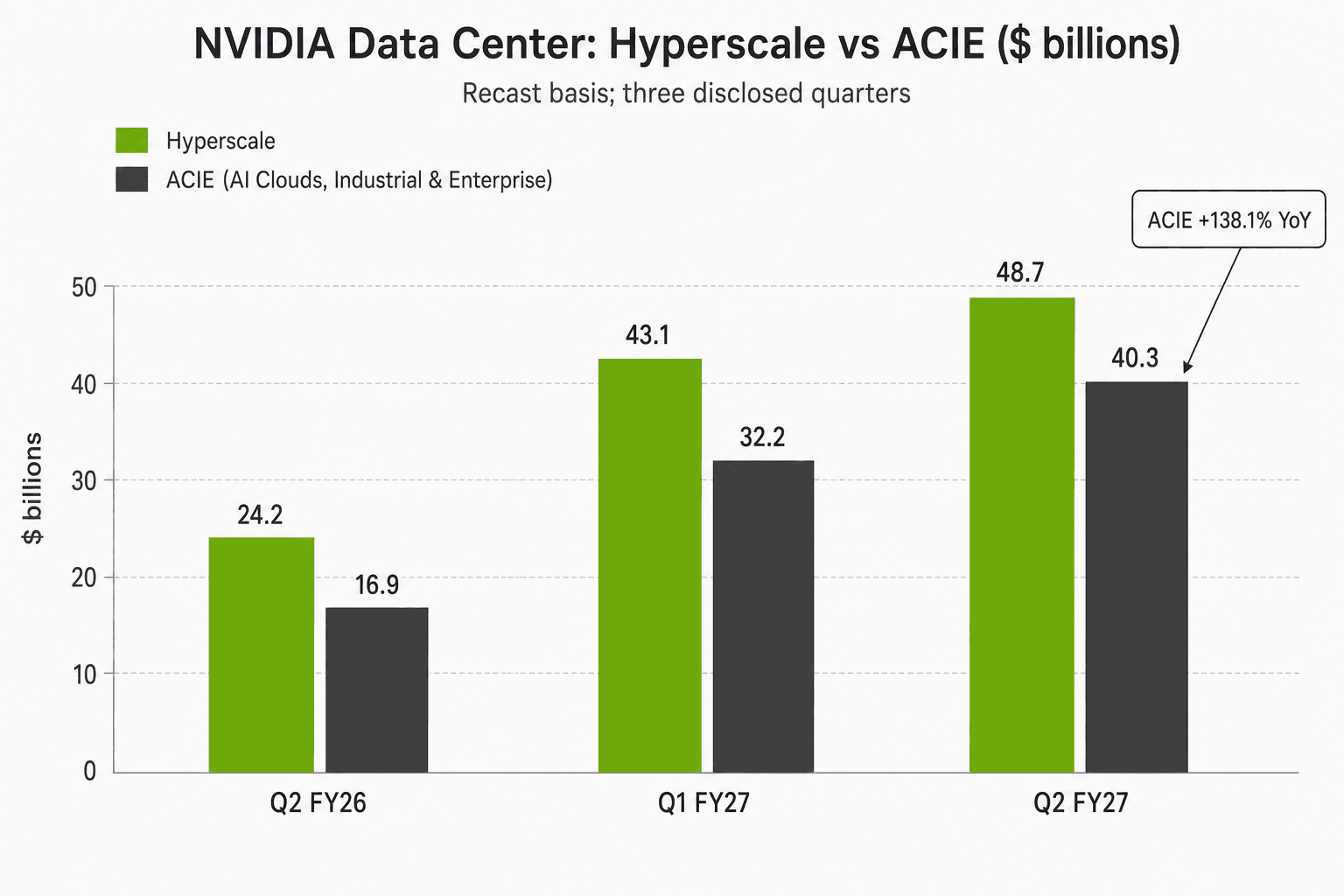
Hyperscale revenue was $48.71 billion, up 101.5% year over year and 13.1% sequentially. ACIE was $40.31 billion, up 138.1% and 25.2%. Hyperscale's share of Data Center has slipped from 58.8% a year ago to 54.7%.
One caveat for anyone comparing to last quarter: NVIDIA moved one company from ACIE to Hyperscale "due to a change in their business model" and recast prior periods. The split published in May is superseded, and only three quarters exist on the current basis.
The concentration data backs it up. The largest direct customer fell to 16% of total revenue from 23% a year ago, and only one direct customer cleared the 10% disclosure threshold this quarter, against two last year. Sovereign AI revenue grew 35% sequentially and more than tripled year over year. Kress expects non-hyperscaler demand to settle at "roughly half of our data center business," with Q3's growth ACIE-led and Hyperscale re-accelerating in Q4 as Vera Rubin supply builds.
The trade: margin for growth
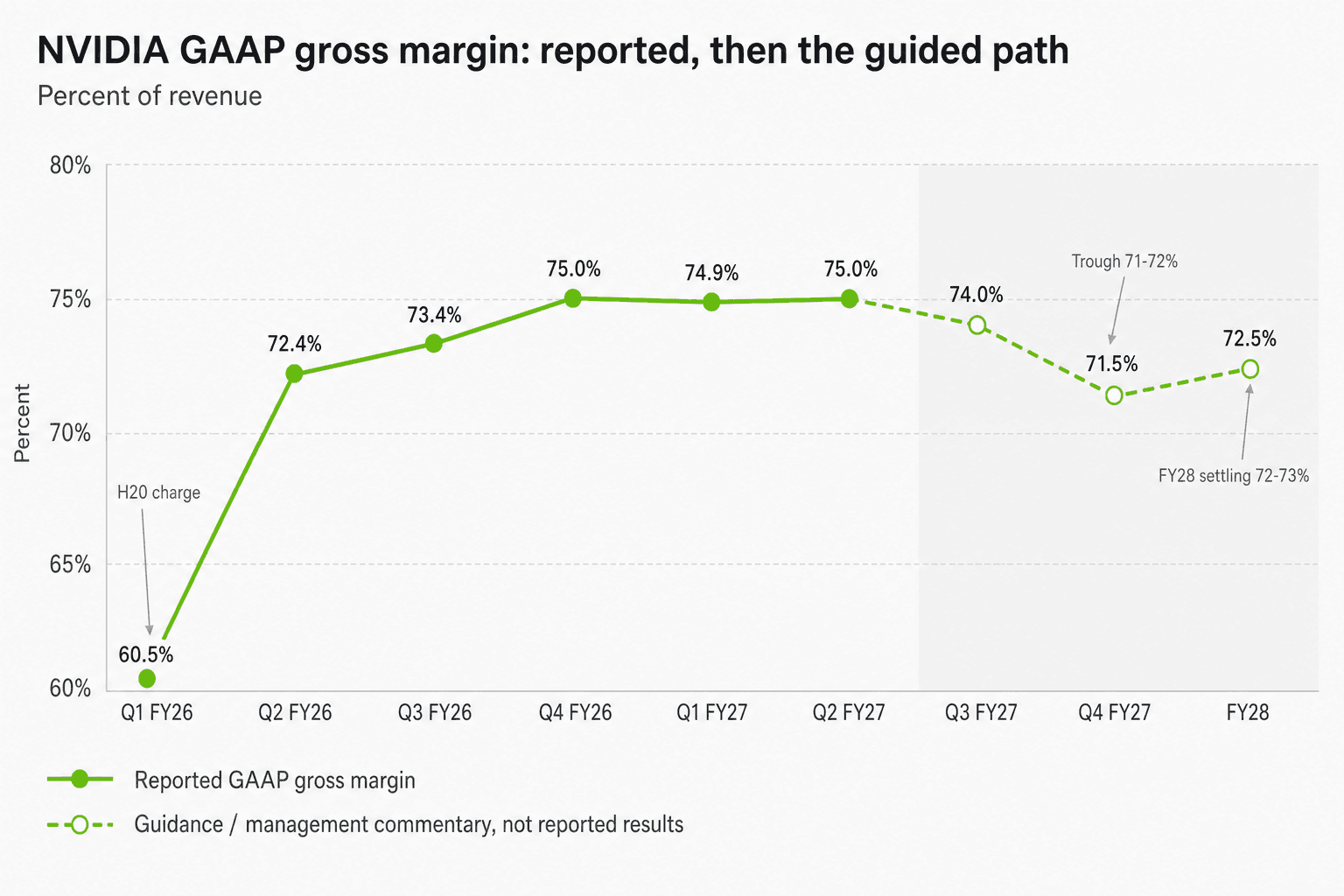
GAAP and non-GAAP gross margin both came in at 75.0%, flat sequentially. Q3 is filed at 74.0% ± 50 bps. Then Kress volunteered the rest of the path on the call, the bearish half of the evening:
"Many of you have expressed concerns regarding our gross margins as component costs have risen significantly. As you are already aware, we are experiencing extreme pricing conditions in memory. The magnitude of the price increase has exceeded our prior expectations and are headed even higher into next year. As a result, we are resetting expectations today."
The reset: 74% in Q3, a trough of 71–72% in Q4 FY27, then 72–73% in FY2028 once executed price increases land in Q1 FY28. Do the arithmetic. On a $108 billion quarter, one point of gross margin is more than a billion dollars of gross profit. Going from 75.0% to a 71.5% trough is roughly $3.8 billion a quarter of gross profit handed to the memory suppliers.
Kress's mitigating argument is that the cost and the growth have the same cause: "tighter memory supply is a symptom of the same demand surge that's driving our own growth." The receipt is in the commitments table. Supply and capacity commitments jumped from $119 billion to $279 billion in one quarter, "primarily related to the procurement of memory."
That is the trade. NVIDIA is paying up for memory to secure the supply that makes 70% growth deliverable, choosing volume over rate.
Cash is where the ramp shows up
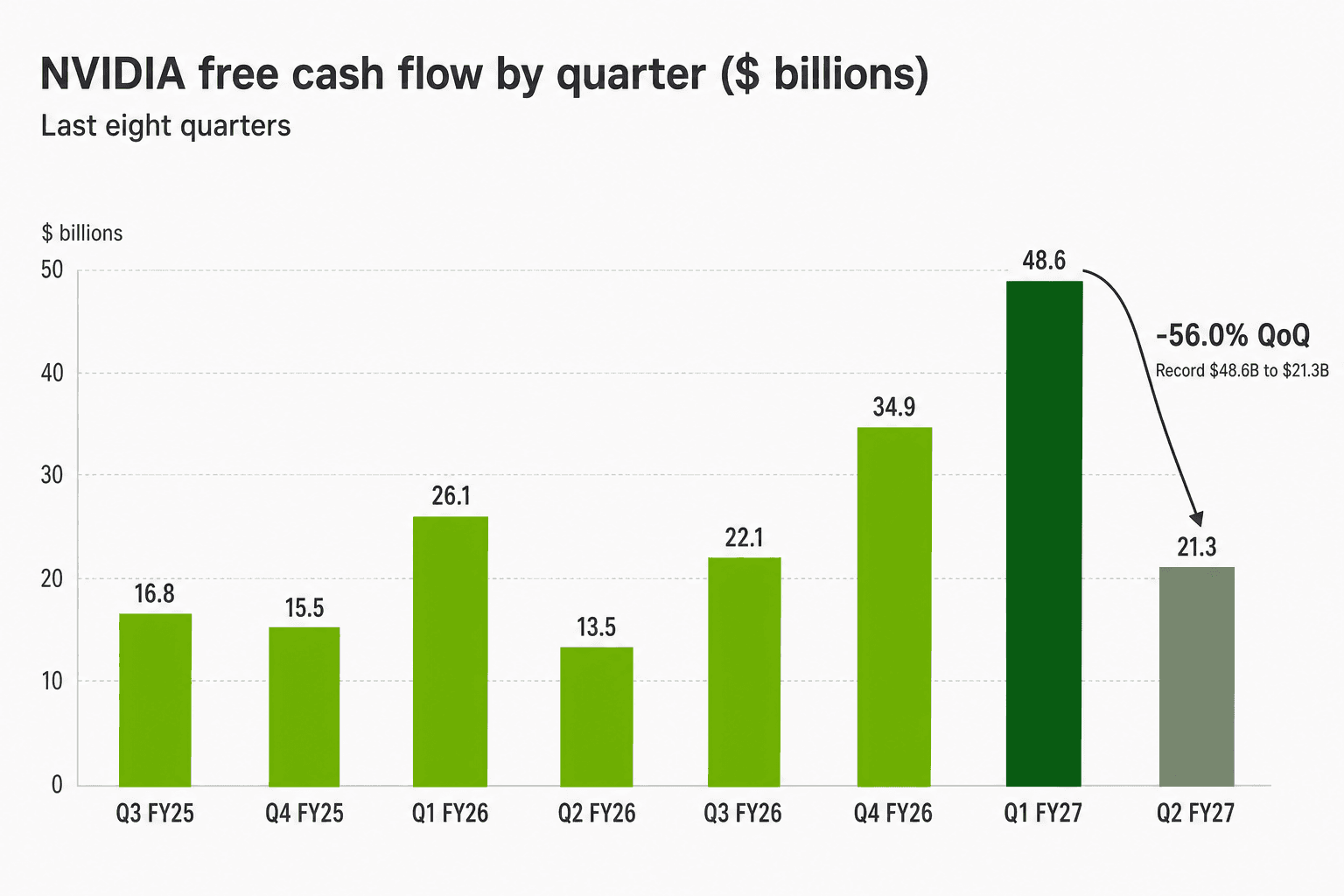
Free cash flow was $21.34 billion, down 56.0% from Q1's record $48.55 billion. Operating cash flow halved to $24.08 billion. The reasons are on the balance sheet: days sales outstanding stretched from 45 days to 60 days on extended payment terms for large multi-quarter agreements, accounts receivable rose $22.3 billion to $63.06 billion, and inventory rose $5.8 billion to $31.58 billion ahead of Vera Rubin.
NVIDIA also issued $25.0 billion of senior unsecured notes, taking long-term debt from $7.47 billion to $32.37 billion. CNBC noted that the 10-Q broke out indebtedness as a standalone risk factor for the first time. Receivables concentration is the line to watch: five direct customers now sit above 10% of accounts receivable, 70% combined, versus three at 56% in January.
None of that stopped the capital return. Roughly $26 billion went back to shareholders, $19.7 billion of buybacks and $6.0 billion of dividends.
What management is actually arguing
Huang's one-line thesis from the release is the cleanest version: "AI has reached its inflection point. It's doing useful work. Its tokens are productive and profitable. Now, compute is revenue."
The hard part of the call was financing. NVIDIA has invested nearly $50 billion in frontier AI labs and set up platforms with Apollo, BlackRock, Blackstone, Brookfield, Goldman Sachs and KKR to mobilise over $500 billion of third-party capital. Kress met the criticism before anyone asked it: "We recognize the scale of this support, and we know some will call this circular financing. We see it differently." Her defence is that NVIDIA is not lending: "Independent Capital still underwrites every deal on its own merits. We're not making loans."
Management expects demand from AI labs where NVIDIA leverages its own balance sheet to be roughly a quarter of next year's business. Bears will hold onto that number.
The bull's number is the revenue-per-gigawatt ladder: about $18 billion with Hopper, $25 billion with Grace Blackwell, $40 billion with Vera Rubin. Asked whether it climbs further, Huang said yes: "The perfect answer is actually infinity per gigawatt."
Where the Street was standing, and what it did next
Positioning into the print was long and slightly bored. S&P Global counted 61 analysts as of August 25: 58 Buy or Strong Buy, 2 Hold, 1 Strong Sell, average target $305.41. Standing targets ran from JPMorgan's $280 to Raymond James's $352, clustering $325–$350. Zero downgrades and zero target cuts were published in the week going in. Siebert CIO Mark Malek had the best line on that setup: "When you are the trade, execution stops being a catalyst and becomes a prerequisite." Which is exactly why a monster beat moved the stock down and a forecast moved it up.
Then the notes landed, and the odd thing about them is that they left the stock looking less attractive than it did the day before. Twenty-four named firms published post-print: 16 price-target raises, zero cuts, zero downgrades, zero upgrades. Everyone was already bullish, so the only move left was a bigger number. The average target went from $305.41 to roughly $321, up about 5%. The stock went up 8.74%. Implied upside compressed from about 44% to about 40%. Sixteen raises, and the tape still outran them.
The spread widened at both ends. Raymond James took $352 to $515, the largest raise on the Street, arguing that supply rather than demand is the binding constraint and that NVIDIA could eventually run at $1 trillion of annual revenue. Argus stayed put at $270, the lowest named target still standing. JPMorgan, the lowest bulge-bracket number going in, went $280 to $320. Morgan Stanley — which had argued before the print that a routine beat-and-raise would not stop the stock falling — made the smallest raise of the group, $288 to $300, and called both the CY27 revenue commentary and the margin reset positives. Eight firms did not move their targets at all.
Targets are cheap. Estimates are the tell, and those moved too: BofA raised FY28 pro-forma EPS 19% to $15.72 and FY29 to $23.17, while UBS reads the CY27 guide as implying EPS above $16.
The one negative-direction move was not an equity call at all, and it is still standing. Morgan Stanley's Lindsay Tyler initiated credit coverage at Neutral, the firm's first rating on NVIDIA's paper, arguing total credit exposure could reach ~$200 billion by end-2028, about $170 billion of it in guarantees and commitments that never appear as debt. The equity desks re-rated the stock. The credit desk did not move.
Three things to watch
Whether the Q4 trough is actually 71–72%. Kress has put a floor on the tape. If memory pricing keeps running and Q3 guides Q4 below 71%, the "we're buying growth" story becomes "we lost pricing power."
That question stopped being an NVIDIA question within a day. Marvell reported after Thursday's close, beat on both lines, raised its FY27 revenue outlook to about $12 billion and its FY28 outlook to about $18 billion — and guided Q3 gross margin down to 57.5–58.5% from 58.9%. The stock fell about 8% after hours. The tempting read is that this is one sector-wide margin event. It is not, at least not on the companies' own accounts: NVIDIA blamed memory prices, an outside cost it does not control, while Marvell's CFO Dan Durn attributed his guide to product mix, saying "we've got a strong ramp in custom" and that the shape was "not a surprise." Two resets, two different causes. Worth remembering before treating either as evidence for the other.
Whether ACIE keeps outgrowing Hyperscale. Management says Q3 growth is ACIE-led and Hyperscale re-accelerates in Q4. If both hold, the concentration bear case keeps shrinking.
Whether the receivables come back as cash. A $22.3 billion receivable build and 60-day DSO is a financing decision, not an accident. It only looks clever if it converts.
NVIDIA just told the market it will grow 70% next year and hand three points of margin to the memory makers to do it. The market said yes. The invoice arrives in Q4.