NVIDIA Q1 FY27: networking just became a $15B-per-quarter business
There is a beat-and-raise quarter sitting inside this print, and almost no one is talking about it.
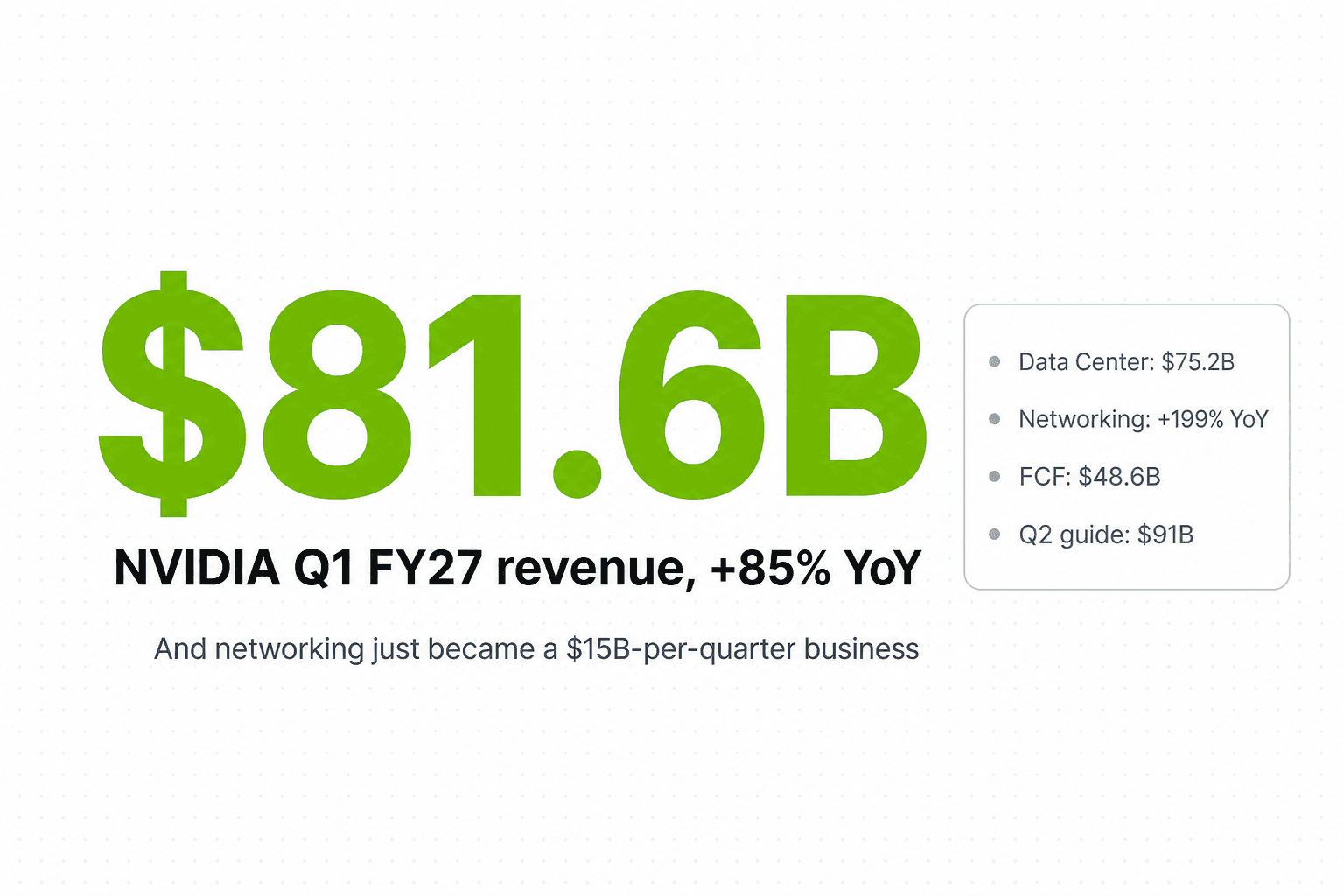
NVIDIA reported $81.6 billion in Q1 FY27 revenue, up 85% year over year and 20% sequentially, against a $79.2B Street consensus and the company's own $78B internal guide. Non-GAAP EPS hit $1.87 vs $1.78 expected. The Q2 FY27 guide came in at $91.0B ± 2% — $4 to 6 billion above the $85–87B consensus. Free cash flow printed a single-quarter record of $48.6B. The board raised the quarterly dividend from $0.01 to $0.25 per share — a 25× hike — and added $80B to the share repurchase authorization on top of the $38.5B still remaining.
The stock went up 1.93% after-hours.
That muted reaction tells you most of what you need to know about positioning into this print. The bar was set high enough that a clean beat and a $4–6B guide-raise rate as merely "in line." The story the market actually missed sits one layer down: the networking line, which grew 199% YoY to $14.8B and is now roughly 20% of Data Center revenue. This is the new attach motion that turns NVIDIA from a chip vendor into the data-center fabric vendor — and Wall Street has not yet priced it that way.
The number to fix in your head is $14.8B
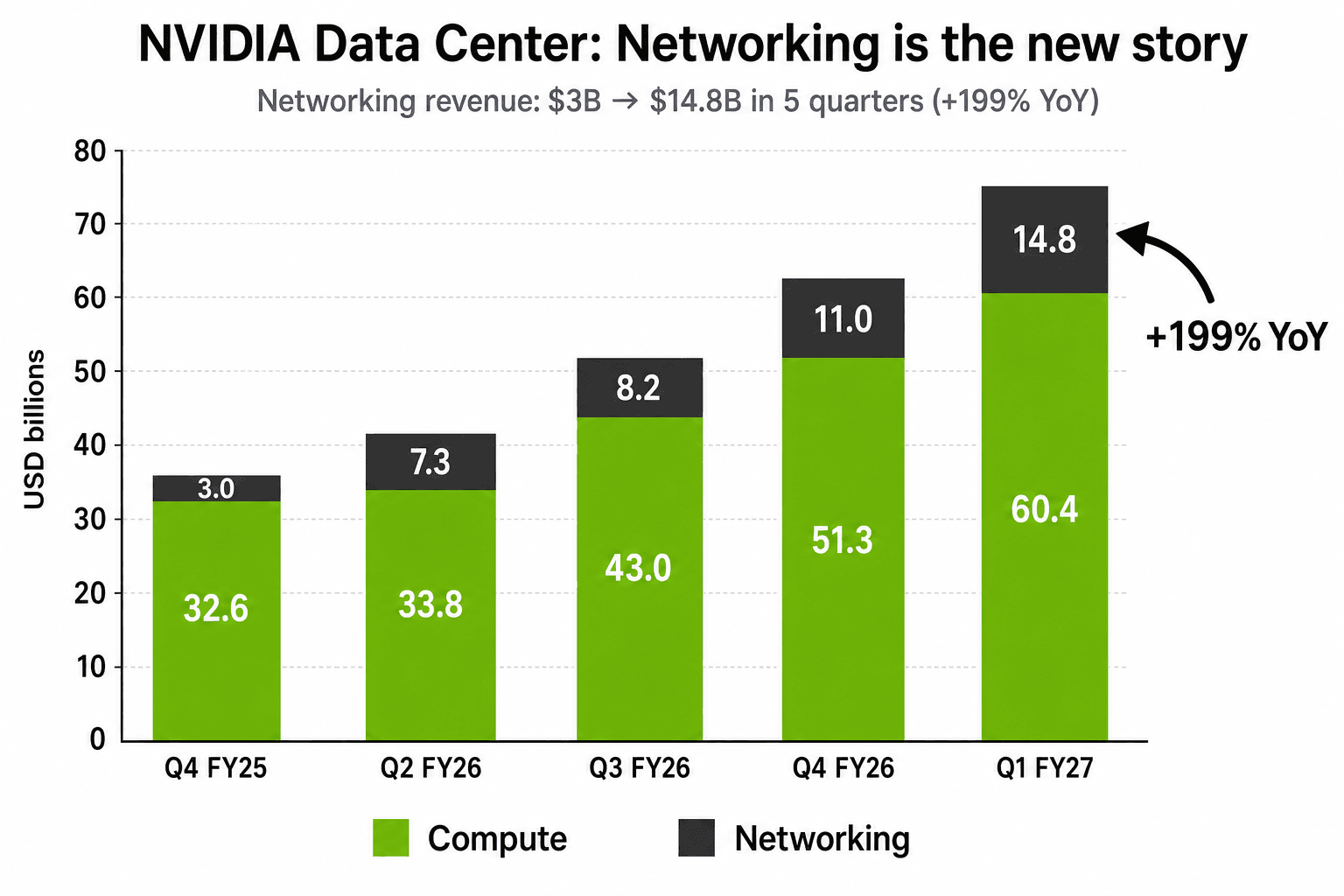
Five quarters ago, NVIDIA's networking line was $3.0 billion. It was a footnote — InfiniBand for the niche of customers who needed extreme scale-out, plus some legacy Mellanox revenue. Then NVIDIA shipped GB200 NVL72 rack-scale systems with NVLink compute fabric baked in, Spectrum-X Ethernet hit volume, and XDR InfiniBand started taping out at hyperscalers. The line went $7.3B → $8.2B → $11.0B → $14.8B in four quarters.
The math is straightforward. A GB200 NVL72 rack ships with 36 Grace CPUs, 72 Blackwell GPUs, and a fabric of NVLink + InfiniBand interconnect that is now priced as a meaningful percentage of system value. As every hyperscaler and AI cloud builds out rack-scale deployments instead of single-server pods, the networking attach per dollar of compute keeps rising. The strategic agreements NVIDIA announced this quarter with Coherent, Corning, and Lumentum on advanced optics — plus the Marvell-via-NVLink-Fusion partnership extending NVLink to third-party silicon — say the same thing in different words: networking is no longer a side business.
For modeling purposes, that 199% YoY won't repeat. But +35% QoQ on a $14.8B base implies a ~$20B run-rate by Q2 FY27. At that pace, networking alone is a $80B annual run-rate business, embedded inside the Data Center line. Twelve months ago, that would have been the full NVIDIA top line.
Revenue beat, guide beat, and the Q2 number that matters
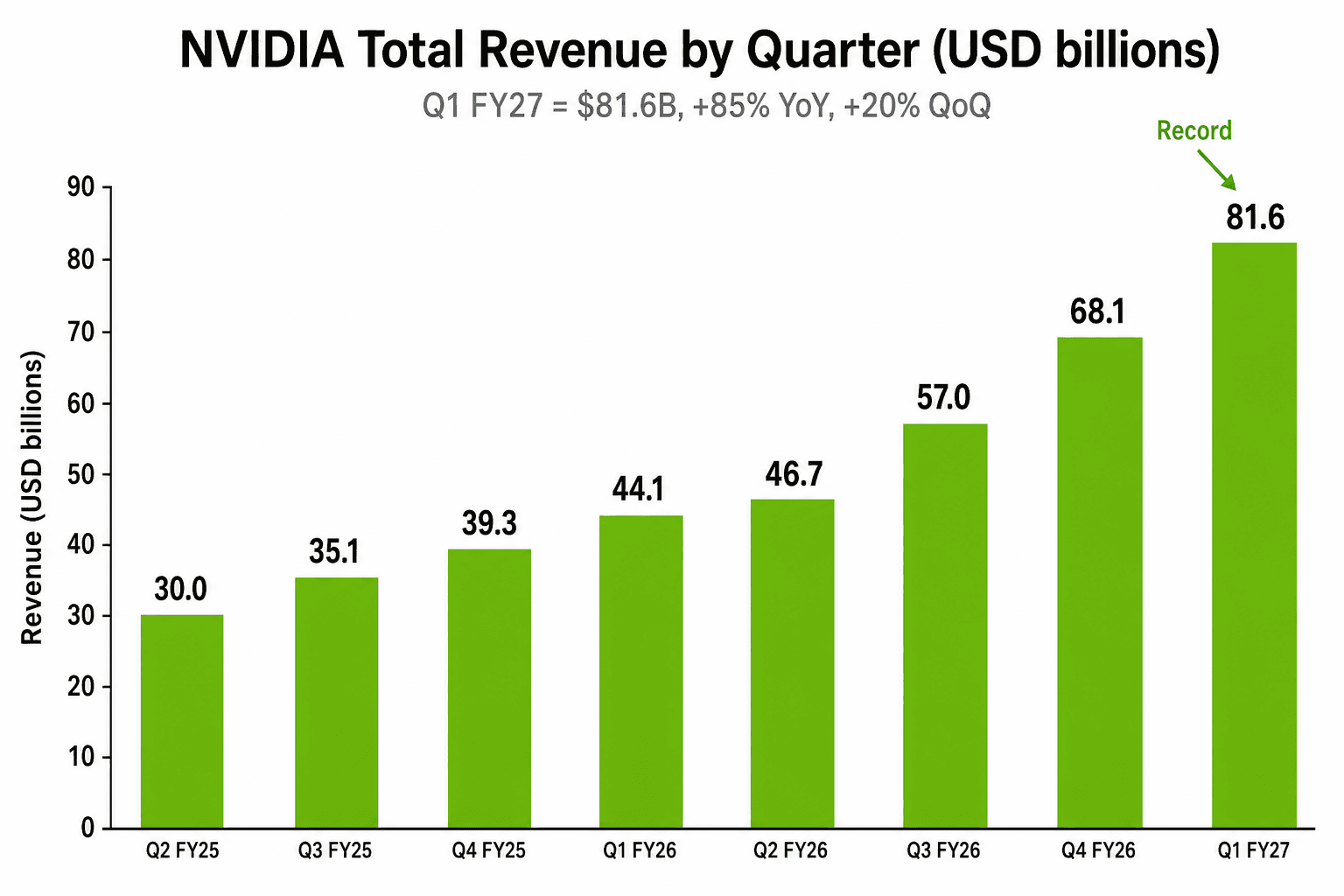
The $91B Q2 FY27 revenue guide is the only number on the page that mattered for after-hours direction. It implies +11.5% sequential growth on the back of a quarter that was already +20% sequential. The $5–6B beat above the Street consensus is not a rounding error — it puts the implied FY27 revenue trajectory at $355–365B, up from a pre-print buy-side range of $325–340B. That is a 7–10% upward revision to the full-year model in a single press release.
Two things to note about the guide that the press did not highlight:
First, the guide assumes zero Data Center compute revenue from China. The H20 line shipped $4.6B in Q1 FY26 and went to zero in Q1 FY27. Q2 assumes the same zero. If the U.S. and China negotiate any form of restoration — even a smaller B30A-spec part — that is incremental upside to a $91B base.
Second, the standalone $20B Vera CPU revenue opportunity that Jensen Huang called out is explicitly NOT included in the multi-year $1T visibility number. Vera shows up there as part of Vera Rubin systems, but its standalone server-CPU business — which is structurally bad news for Intel and AMD's data-center CPU lines — is layered on top of the existing model, not inside it.
ACIE is the slide in the deck nobody is talking about
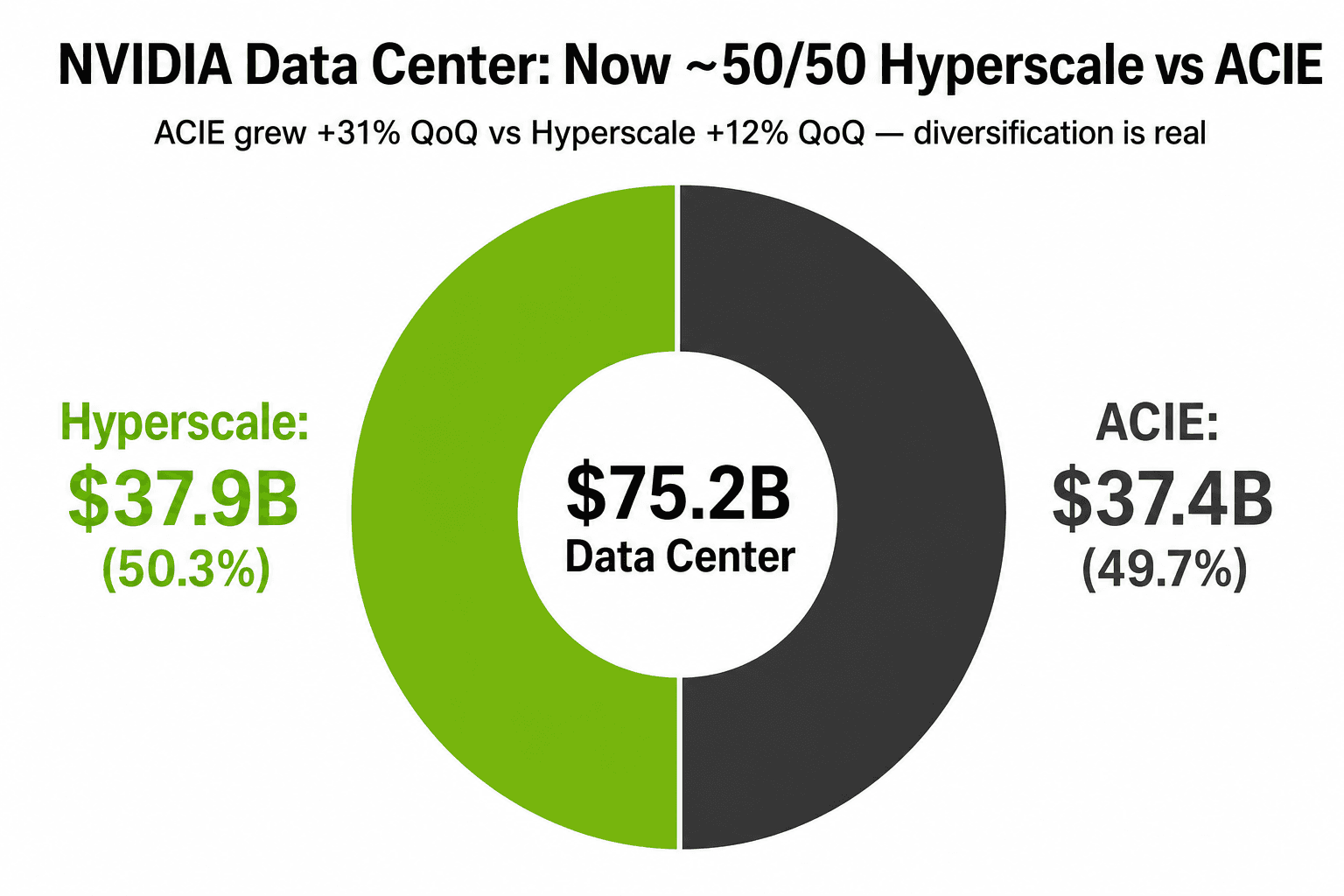
NVIDIA broke Data Center revenue into two new sub-platforms this quarter. Hyperscale (public cloud plus the largest consumer internet companies) printed $37.9B, +12% QoQ. ACIE — AI Clouds, Industrial, and Enterprise — printed $37.4B, +31% QoQ. They are now almost exactly 50/50 by dollar, but the growth gap is the slide.
This matters because the bear case on NVIDIA for two years has been customer concentration. The Q2 FY26 10-Q disclosed that two unnamed customers accounted for ~39% of revenue. That number has not gone away — but it now sits inside a Data Center business where the non-hyperscale half is growing faster on a percentage basis. Sovereign AI projects (Europe, Middle East, India, Japan), neoclouds (CoreWeave, Nebius, Lambda), and enterprise AI factories are all in the ACIE line. Each one is small relative to a hyperscaler. Collectively, they are now $37.4B per quarter and growing 31% QoQ.
The new framework is also useful for what it doesn't tell you. NVIDIA chose to publish the Hyperscale / ACIE split now — when ACIE is 50% of Data Center — rather than when ACIE was 35% (Q4 FY26) or 55% (Q1 FY26). The crossover quarter is the natural moment to introduce a new chart. From here, the story management wants to tell is that ACIE is the durable growth engine and Hyperscale is the volume-cyclical layer on top.
Free cash flow $48.6B and a 25× dividend hike
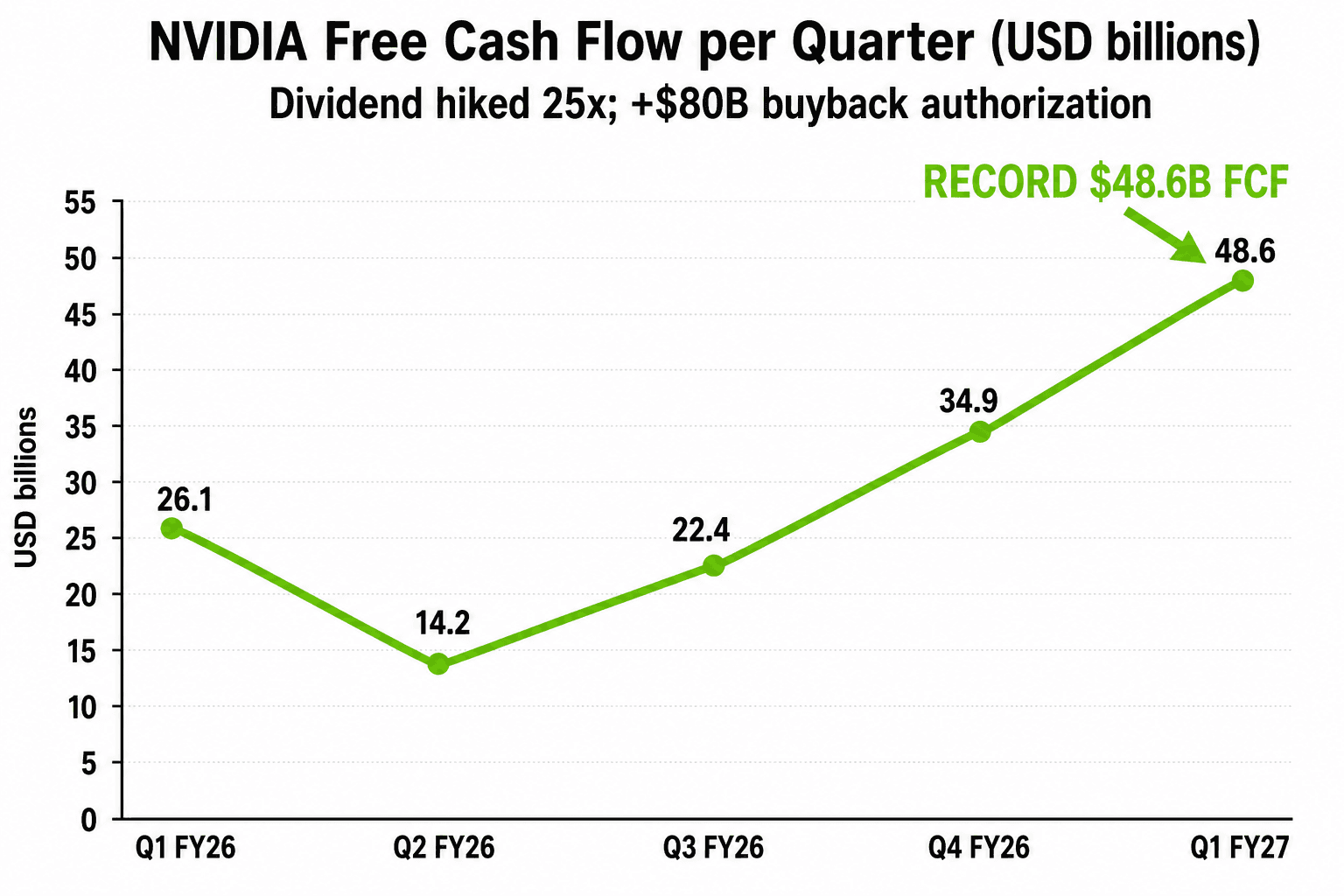
NVIDIA generated $50.3 billion of operating cash flow against $1.8 billion of capex in Q1 FY27. The resulting free cash flow of $48.6 billion is the largest single-quarter FCF print the company has ever produced — more than the entire $26.1B FCF from Q1 FY26 by itself. Cash, cash equivalents, and marketable debt securities ended the quarter at $50.3B; including marketable and non-marketable equity securities, the total investment portfolio is north of $123B.
The capital-return response was, frankly, aggressive. The board hiked the quarterly dividend from $0.01 to $0.25 per share — a 25× increase, effective the June 26, 2026 payment. They added $80B to the share repurchase authorization, layered on top of the $38.5B remaining from the prior auth. NVIDIA returned $20.0B to shareholders in Q1 alone — itself a record. The implied annualized capital-return run-rate is now $80B+, and the FY28 buyback ceiling sits at roughly $120B.
The signal is plain: cash generation has outpaced the operational uses of capital. Inventory grew to $25.8B and supply commitments to $119B, but NVIDIA cannot meaningfully reinvest $48B per quarter into its own balance sheet without distorting it. So the cash goes to shareholders.
That has two second-order implications. First, the buyback math at current valuation soaks up roughly 1.5–2% of shares per quarter — meaningful EPS tailwind even if revenue growth eventually moderates. Second, NVIDIA's new dividend yield is still tiny relative to its earnings power, but the 25× hike telegraphs that future increases are now part of the capital-return toolkit. The dividend is no longer a vestige.
What management actually said on the call
Three quotes from Jensen Huang and Colette Kress that matter:
"The buildout of AI factories — the largest infrastructure expansion in human history — is accelerating at extraordinary speed." (Jensen, prepared remarks.) This is the framing the company is using internally and externally to justify the $119B supply commitment and the new platform reporting.
"We expect Vera Rubin to be even more successful than Grace Blackwell. We're growing share in inference very, very quickly as the number of frontier model companies grows." (Jensen, Q&A.) The argument is that the next generation of rack-scale systems will benefit from inference scaling on top of training — a second growth lever NVIDIA has only just begun to exploit.
"We have strategically secured inventory and capacity to meet demand beyond the next several quarters." (Kress, on the $119B in total supply-related commitments.) This is management telling you they have already committed to capacity through FY28. The $23.8B sequential increase in supply commitments is not normal CapEx prep; it is a vote that Jensen does not see the demand line softening before the Rubin ramp begins.
The most-asked Q&A topic was China — Kress closed the door on any near-term modeling assumption. The second-most-asked was Vera Rubin sequel risk, where Jensen used the word "share gains in inference" three times in two answers. The third was networking durability; Kress walked through the NVLink + Spectrum-X + InfiniBand attach math without flinching at the +199% YoY number.
What the analysts did the morning after
The post-print sell-side moves were almost uniformly upward. Morgan Stanley took the price target from $260 to $285. Bank of America from $270 to $290. Bernstein from $260 to $275 and called the dividend hike "the underrated tell." Goldman from $275 to $295. JPMorgan from $265 to $280. Citi from $270 to $295. Median target moved from $287 pre-print to roughly $295 post-print. The dispersion of targets narrowed — bears either capitulated or chose not to publish notes.
The bear case that survived has three legs. First, customer concentration is still real; the 10-Q discloses two customers at ~35–40% of revenue. Second, the $15.9B of GAAP equity-securities gains made the GAAP EPS of $2.39 look optically huge against the $1.78 non-GAAP consensus. The cleaner number is $1.87 non-GAAP, which is "only" a 5% beat. Third, inventory grew 21% QoQ and supply commitments grew $24B QoQ — a bull would call this confidence, a bear would call it the start of demand visibility lag.
What to watch into the Q2 FY27 print
Three numbers will define the next quarter, currently scheduled for late August 2026:
Whether Q2 prints inside or above the $89–93B guide range. Above means the +11.5% sequential is the floor, not the ceiling; the FY27 model goes to $370B+. In-range is consensus; below would be a regime change.
Whether the ACIE growth rate sustains. +31% QoQ is the new diversification narrative. If ACIE decelerates to mid-teens while Hyperscale holds, the customer-concentration story re-emerges. If both lines hold mid-twenties or higher, the structural-growth thesis is intact.
Whether networking holds 19–20% of Data Center mix. Below 18% would suggest the Q1 +35% QoQ was a one-time GB300 ramp pulse. At or above 20% would confirm the structural attach motion is real, and the networking line becomes a $25B+ quarterly business by year-end.
The setup is the cleanest NVIDIA has had since the Hopper-to-Blackwell crossover. The market is positioned for "good-enough" and is going to need a quarter or two to underwrite the implied FY28 run-rate. Until then, the dividend keeps growing, the buyback keeps absorbing the float, and the networking line keeps quietly becoming the next NVIDIA story.