ServiceNow Q2 2026: AI ACV Crosses $1 Billion
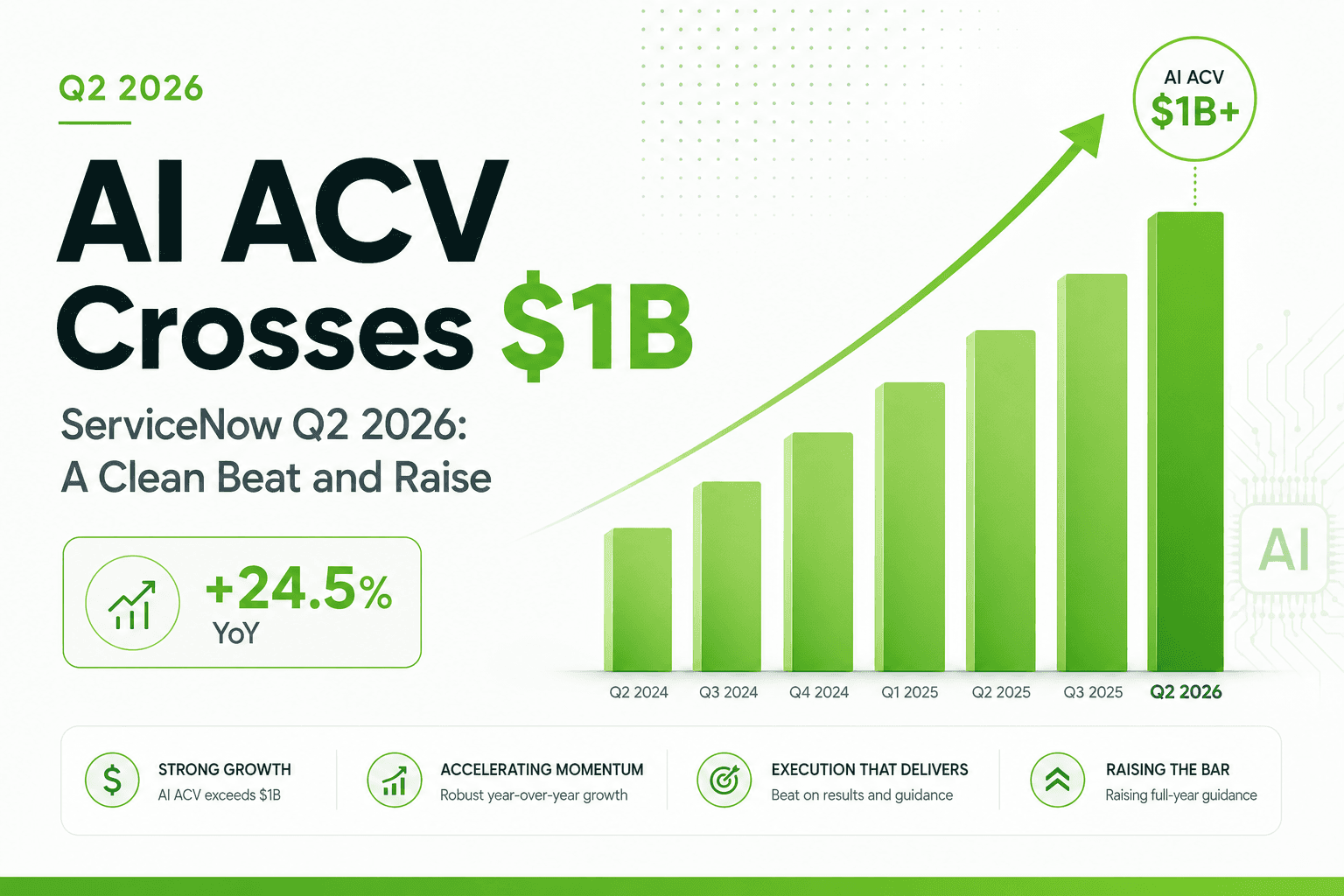
A clean beat into a hated stock
ServiceNow did the one thing a de-rated software leader needed to do this quarter: it beat on everything and raised the outlook. For the three months ended June 30, subscription revenue rose 24.5% from a year earlier to $3,877M, total revenue climbed 24% to $3,987M, and the AI business that bears had spent months worrying about crossed a milestone of its own. On the earnings call, CEO Bill McDermott called it "a stunning Q2 print" and added, "We are who we said we were."
The reaction was measured rather than euphoric, and the setup explains why. NOW entered the print down roughly 38% for the year, part of a broad software selloff that a weak IBM pre-announcement had deepened just days earlier. When a stock is already priced for disappointment, a beat-and-raise is close to what the market expects. The shares rose about 3.4% after hours to near $98.88 from a $95.46 close, a sentiment improvement over the prior quarter's roughly 18% next-day drop, but not a celebration.
Revenue reaccelerates
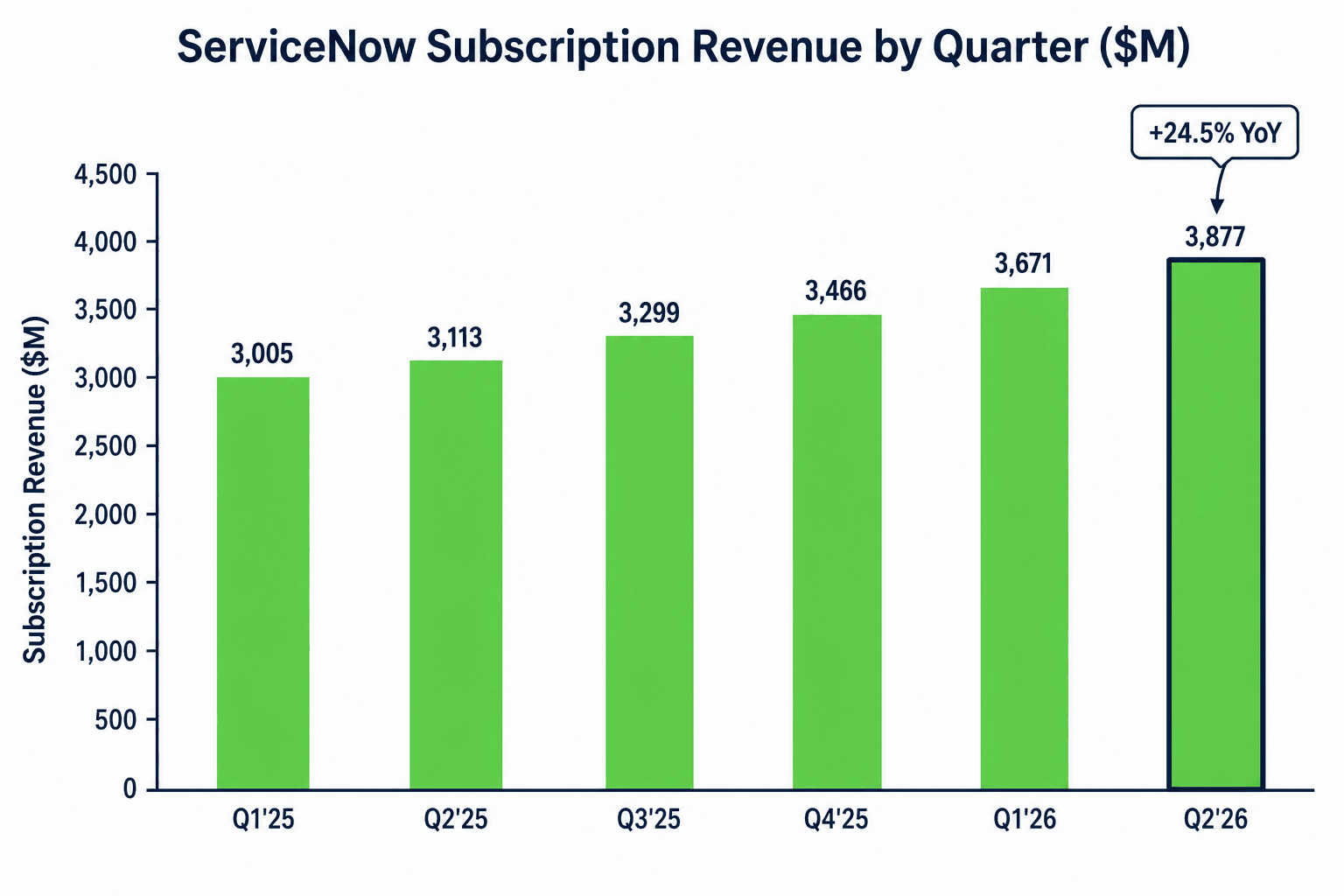
Subscription growth of 24.5% was the fastest in more than a year, and it accelerated rather than faded. On a constant-currency basis, subscription revenue grew 23%, about 1.5 points above the high end of guidance. Management credited outperformance in net-new ACV, a strong quarter in U.S. Federal, and a favorable on-premise revenue mix, with some on-prem revenue pulled from the third quarter into the second. The CFO was careful to note the beat "was not all just on-prem," pointing to genuinely strong net-new bookings that let the company raise its full-year guide.
The large-customer base kept widening. ServiceNow ended the quarter with 658 customers spending more than $5M in annual contract value, up about 23% year over year, and closed 123 net-new-ACV deals worth more than $1M each, up nearly 40%. The renewal rate held at its long-standing, best-in-class level of about 98%, a reminder that the installed base is not going anywhere even as the debate rages over AI disruption.
The AI story gets a number
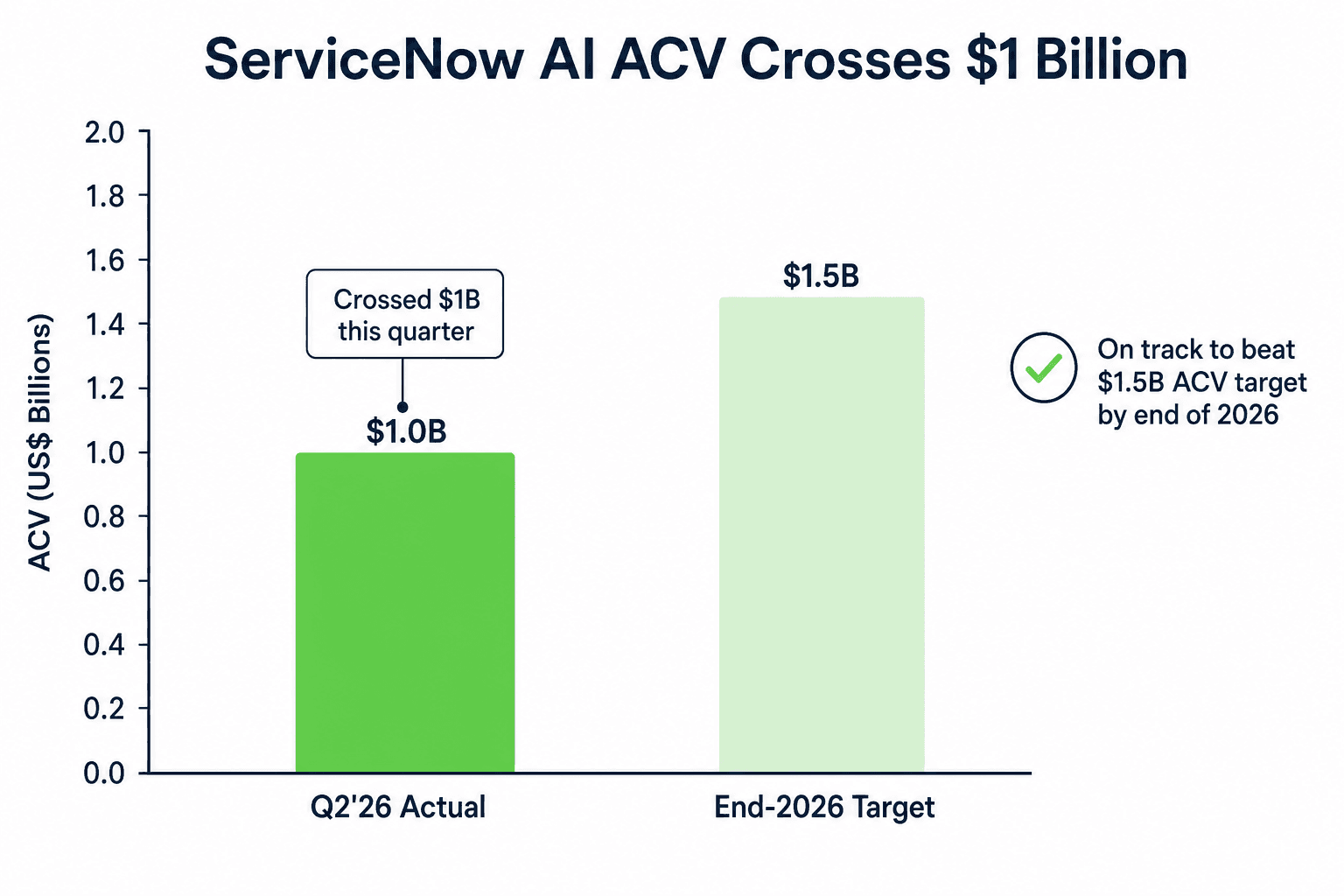
For a company whose valuation hinges on whether it can sell AI, the cleanest news was a number. ServiceNow AI, the suite spanning Now Assist and the company's newer AI products, crossed $1 billion in annual contract value during the quarter. ACV is the annualized run-rate of what customers are committed to pay, and this figure grew from effectively a standing start about two years ago. That trajectory keeps ServiceNow on track to beat its target of $1.5 billion in AI ACV by the end of 2026, a goal it had already raised from $1.0 billion earlier in the year.
The adoption signals underneath the headline were just as important. Customers running agentic AI in production grew ninefold over the last nine months, and renewal customers buying agentic AI for the first time doubled both sequentially and year over year. Pricing is holding: the CFO said Pro Plus SKUs continue to carry pricing uplift above 30%, with newer AI-native products in the 20% to 30% range. Asked directly when AI would inflect ServiceNow's growth, McDermott's answer was blunt: "It already has."
Demand you can see a year out
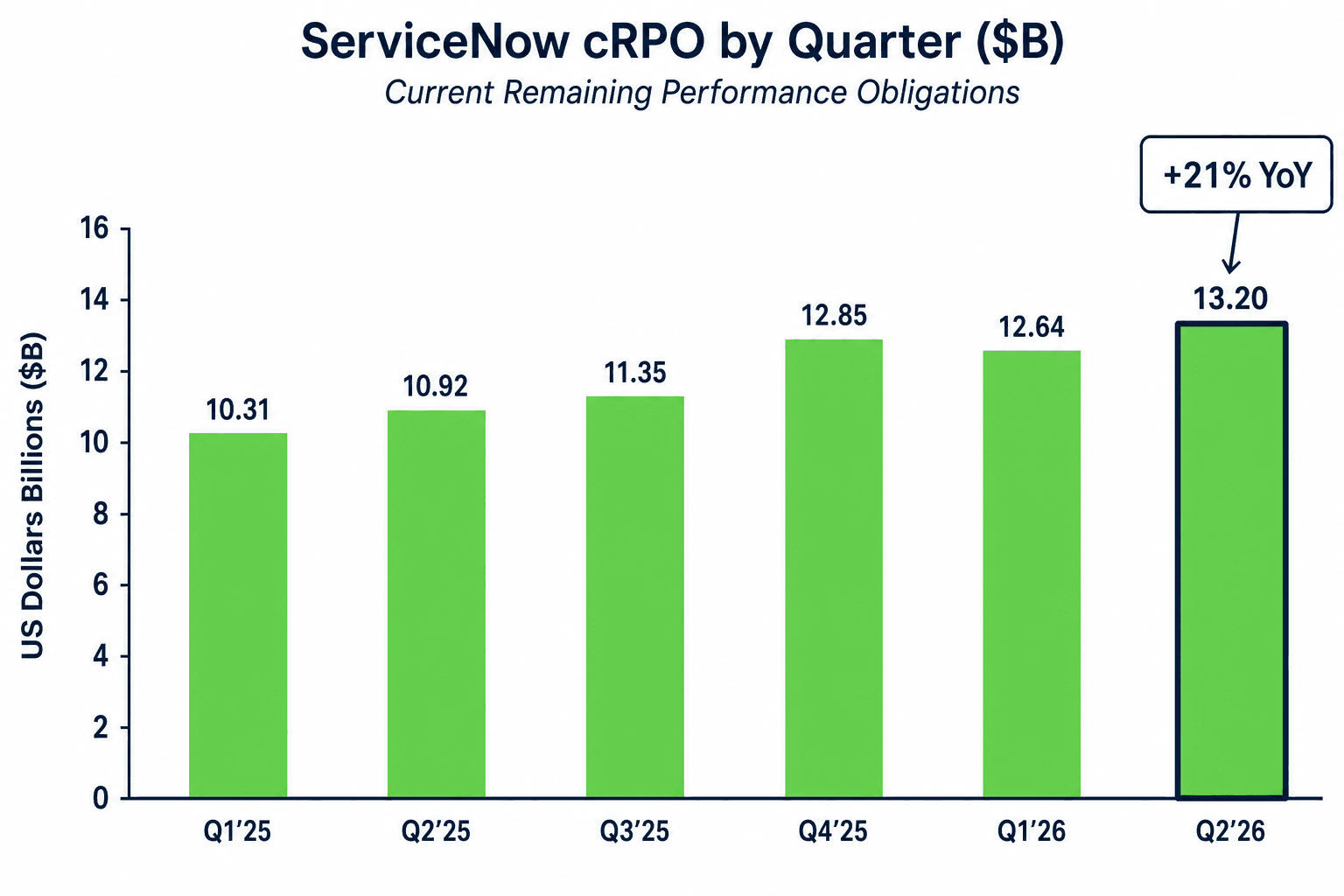
The best gauge of near-term demand is current remaining performance obligations, or cRPO, roughly the contracted revenue a company expects to recognize over the next 12 months. ServiceNow's cRPO reached $13.20B, up 21% year over year and, on a constant-currency basis, up 21.5%, beating the roughly 19.5% guide by more than two points. Total remaining obligations, including longer-dated commitments, climbed to $29.0B. Management attributed the strength to longer customer commitments and growing demand across its partner ecosystem, and flagged a modest currency headwind of about $35M to third-quarter cRPO from a stronger dollar.
Profitability holds through the integration
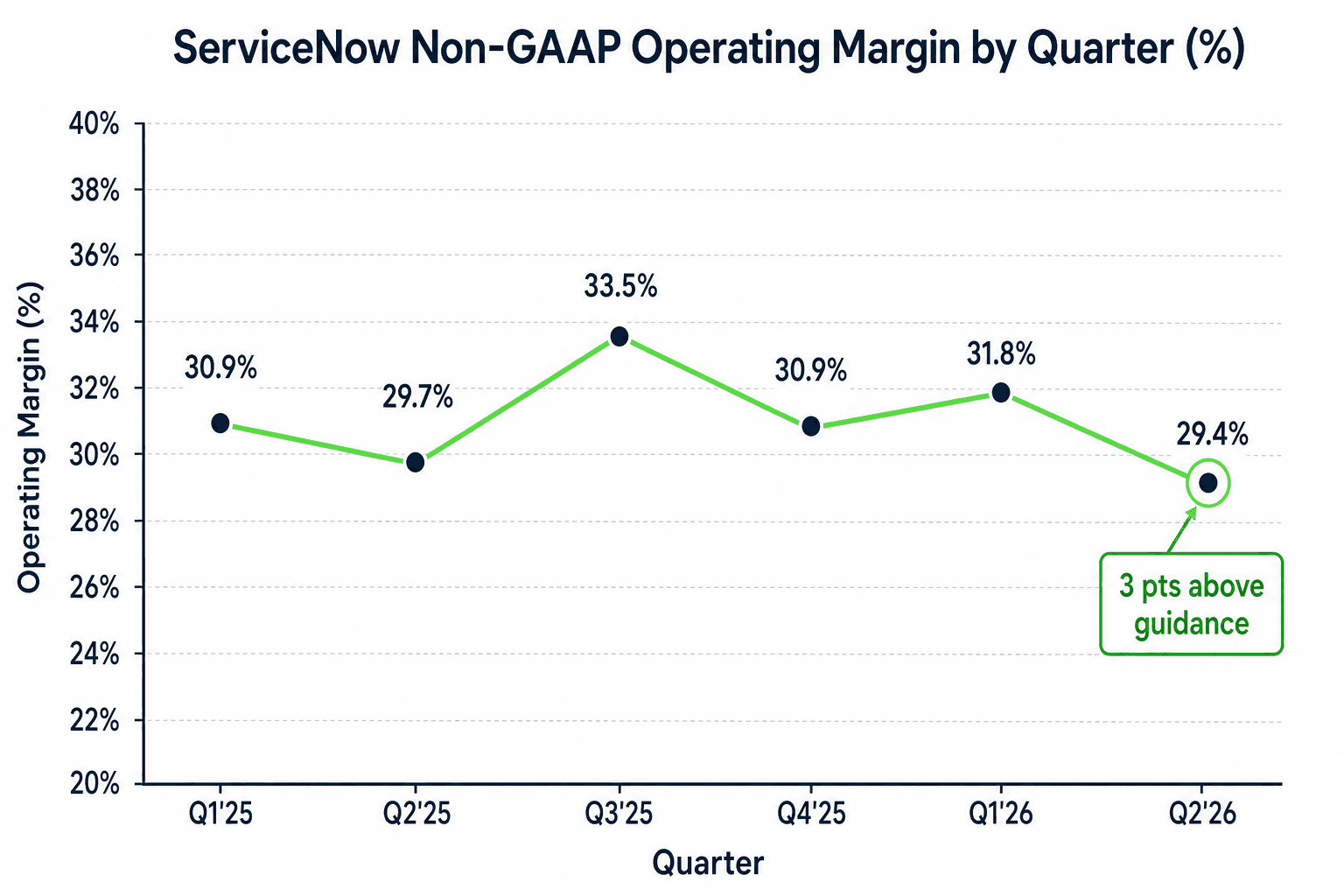
Profitability was the quiet win. Non-GAAP operating margin of 29.4% ran about three points above the company's own guide, even as GAAP operating income fell sharply on stock-based compensation, intangible amortization, and integration costs tied to the Moveworks, Veza, and Armis acquisitions. Non-GAAP diluted earnings were $0.90 per share, ahead of the roughly $0.86 consensus, while GAAP earnings were $0.29. Free cash flow, which is seasonally light in the second quarter, came in at $634M, up about 18% from a year earlier.
The margin story is really a story about scale. Gross margin compressed as more customers ran on hyperscaler infrastructure and AI-consumption costs rose, but Mastantuono argued that unit costs fall as that volume grows, so operating margins accrete over time. McDermott added a pointed commitment: ServiceNow will start 2027 "with the exact same headcount" it had before the acquisitions, a promise of margin and cash-flow leverage that lands harder than any single quarter's number. The company reiterated its aim of reaching the Rule of 60 by 2030.
A measured raise
ServiceNow lifted its full-year subscription revenue outlook to a midpoint of roughly $15.77 billion, up about 22.5% as reported and 21% in constant currency. The raise was deliberately modest, reflecting only partial flow-through of the beat, since some second-quarter strength was on-prem timing pulled forward, plus prudent currency and geopolitical assumptions. For the third quarter, the company guided subscription revenue to $3,975M to $3,980M and non-GAAP operating margin to 31%.
Management used the call to widen the lens beyond core workflow. McDermott described a new $1 billion-plus cybersecurity business, built on the AI Control Tower plus the Armis and Veza acquisitions, that he called the fastest-growing among the top 10 enterprise cyber vendors. He framed ServiceNow as "optionality on all AI outcomes, not a bet on any one," arguing that whichever chip, model, or pricing regime wins, enterprises still need a single governed layer of record for work. An autonomous Level 1 service-desk specialist, already handling 80% to 85% of requests at more than 40 customers, showed the roadmap turning into deployed product.
The Street stays split
Sell-side sentiment came into the print overwhelmingly bullish, with a consensus target near $139 to $141 on a post-split basis, well above the pre-print price. It is worth remembering ServiceNow completed a 5-for-1 stock split in December 2025, so the roughly $1,000 targets that still circulate in some feeds are stale pre-split figures. Bulls at Oppenheimer, RBC, BNP Paribas, Truist, and Evercore argued the drawdown had priced in a disruption fear the fundamentals did not support.
The skeptics were not silenced. CLSA cut the stock to a sell-equivalent rating on valuation and disruption risk, and UBS stayed on the sidelines. Even Guggenheim's upgrade to Buy was explicitly a valuation call, not an AI-bull call, with the analyst expecting AI monetization to disappoint. That tension captures the moment: almost no one disputes the quarter, and almost everyone disputes the multiple.
The forward look
This was the print ServiceNow needed. Growth reaccelerated, the AI business finally has a billion-dollar number attached to it, demand visibility improved, and margins held through a heavy integration year. For a stock sold all year on the theory that AI would hollow out workflow software, evidence that AI is instead adding a billion dollars of contracted value is the most direct rebuttal available.
What it did not do is settle the argument. The new all-in AI licensing model went live on July 1, and the next few quarters will show whether customers absorb the higher pricing that bulls are counting on or push back the way bears fear. Until that verdict arrives, ServiceNow will keep trading less on what it reported and more on what investors believe comes next.