Netflix Q2 2026: Strong Margins, Soft Guide Sinks Stock
A good quarter that the market treated as a bad one
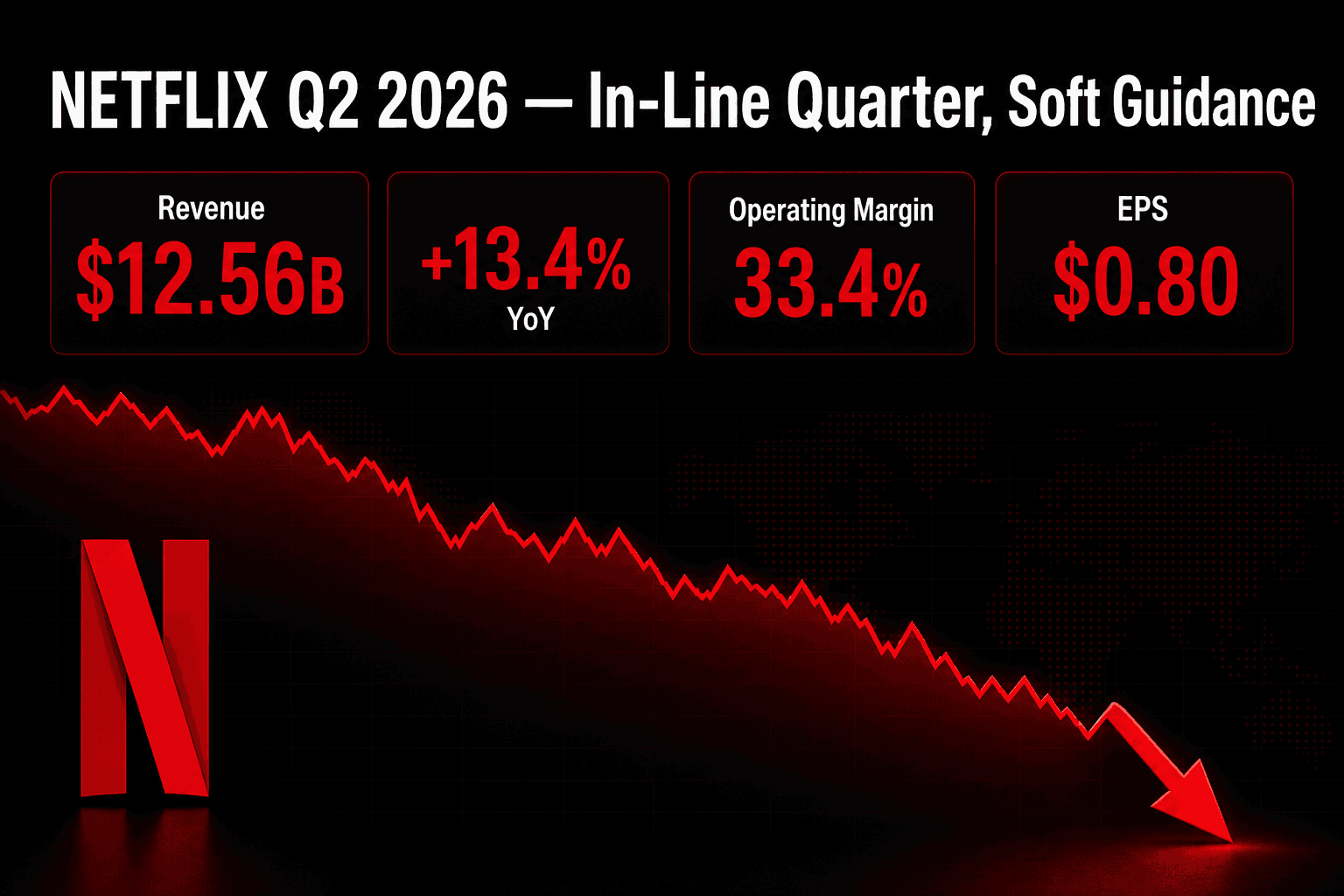
Netflix delivered almost exactly the second quarter Wall Street had penciled in, and the stock fell nearly 9% anyway. Revenue for the three months ended June 30 rose 13.4% from a year earlier to $12.56B, operating margin held at a healthy 33.4%, and diluted earnings came in at $0.80 per share, a shade above the company's own forecast. None of that was the problem. The problem was the road map for next quarter.
The gap between a solid print and a punished stock is the whole story of this report. When a company trades at a premium valuation, investors are paying for growth to hold up or speed up. Netflix instead pointed to a third quarter that would grow more slowly than any in about two years. That single fact reset the shares, even as the underlying business kept doing what it has done for several years now: grow revenue at a double-digit clip and expand margins.
The setup: revenue keeps climbing
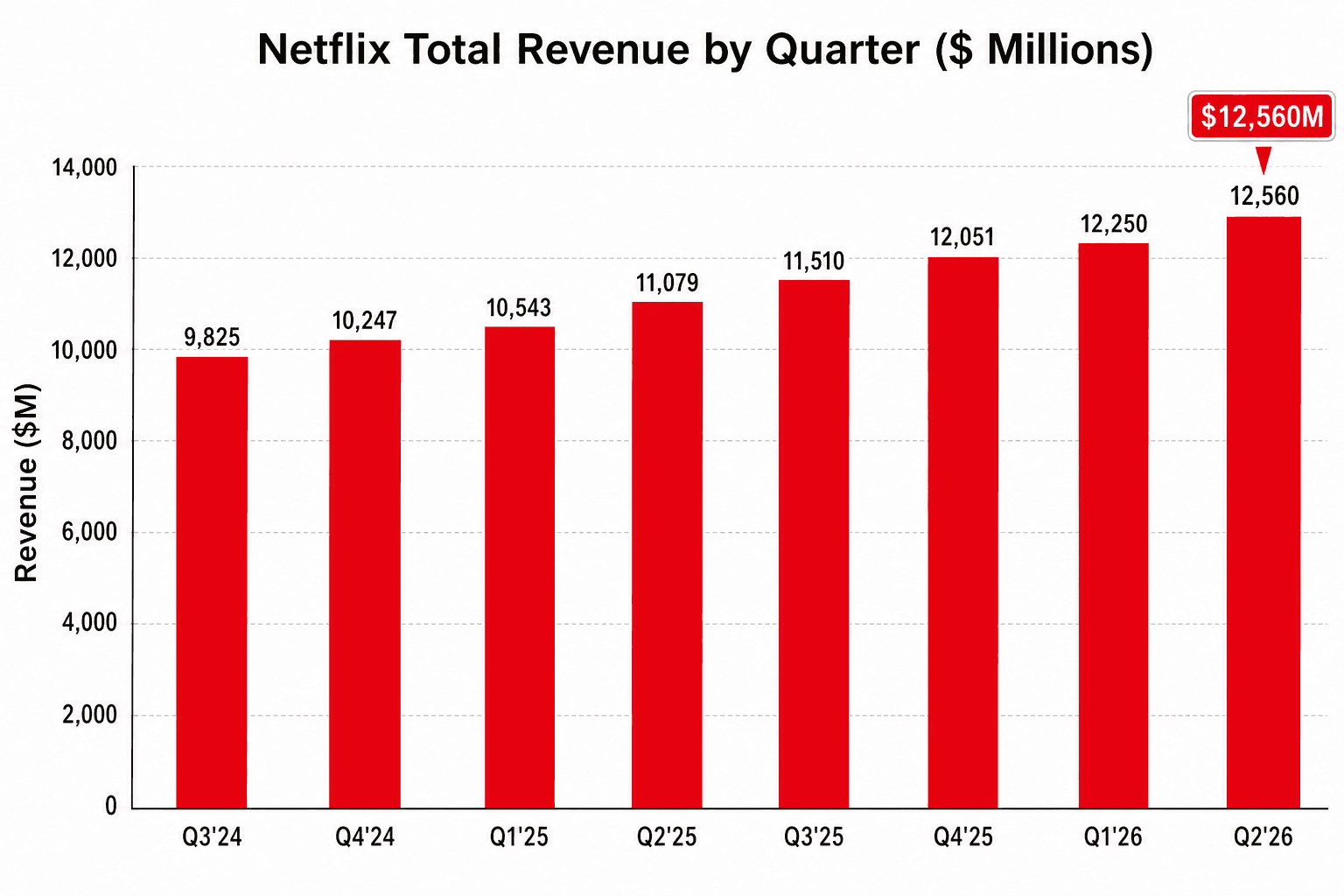
The revenue line has been a steady ramp. Eight quarters ago Netflix did $9.83B; this quarter it did $12.56B. Management credited three drivers: membership growth, higher prices, and a growing advertising business. On a currency-neutral basis, which strips out the effect of a weaker or stronger dollar, growth was 12%, close to the 13% reported.
That growth is broad. Every one of Netflix's four reporting regions grew double digits from a year earlier, which is unusual and speaks to how global the service has become. It is also the reason the soft guidance stung: the business is not obviously breaking anywhere, so the deceleration reads as the maturing of a very large company rather than a stumble in any one market.
Where the money comes from
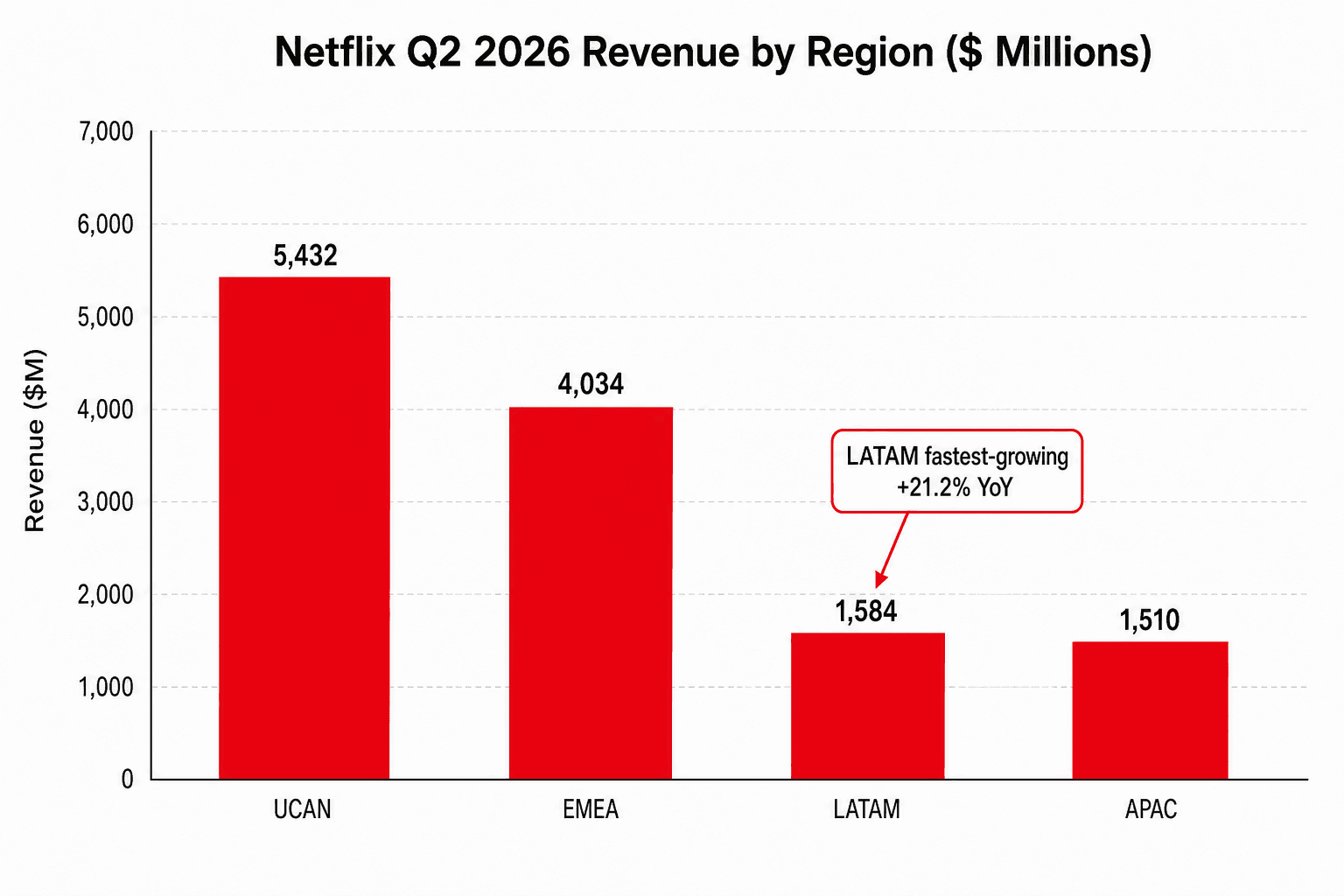
The United States and Canada, which Netflix calls UCAN, is still the biggest engine at $5.43B, up about 10% from a year ago. That figure matters more than it looks. The 10% reflects only a partial-quarter benefit from a recent US price increase, so the fuller effect lands in the back half of the year. In other words, UCAN's headline growth understates the pricing power now flowing through.
Europe, the Middle East and Africa passed the $4.0B mark for the first time, up 14%. But the fastest grower was Latin America, up 21.2% to $1.58B, followed by the Asia-Pacific region up 15.7% to $1.51B. Both of those regions each crossed $1.5B in quarterly revenue for the first time. The takeaway: the mature US market provides the ballast and the pricing lever, while the emerging regions provide the growth rate.
Margins hold up, content spending accelerates
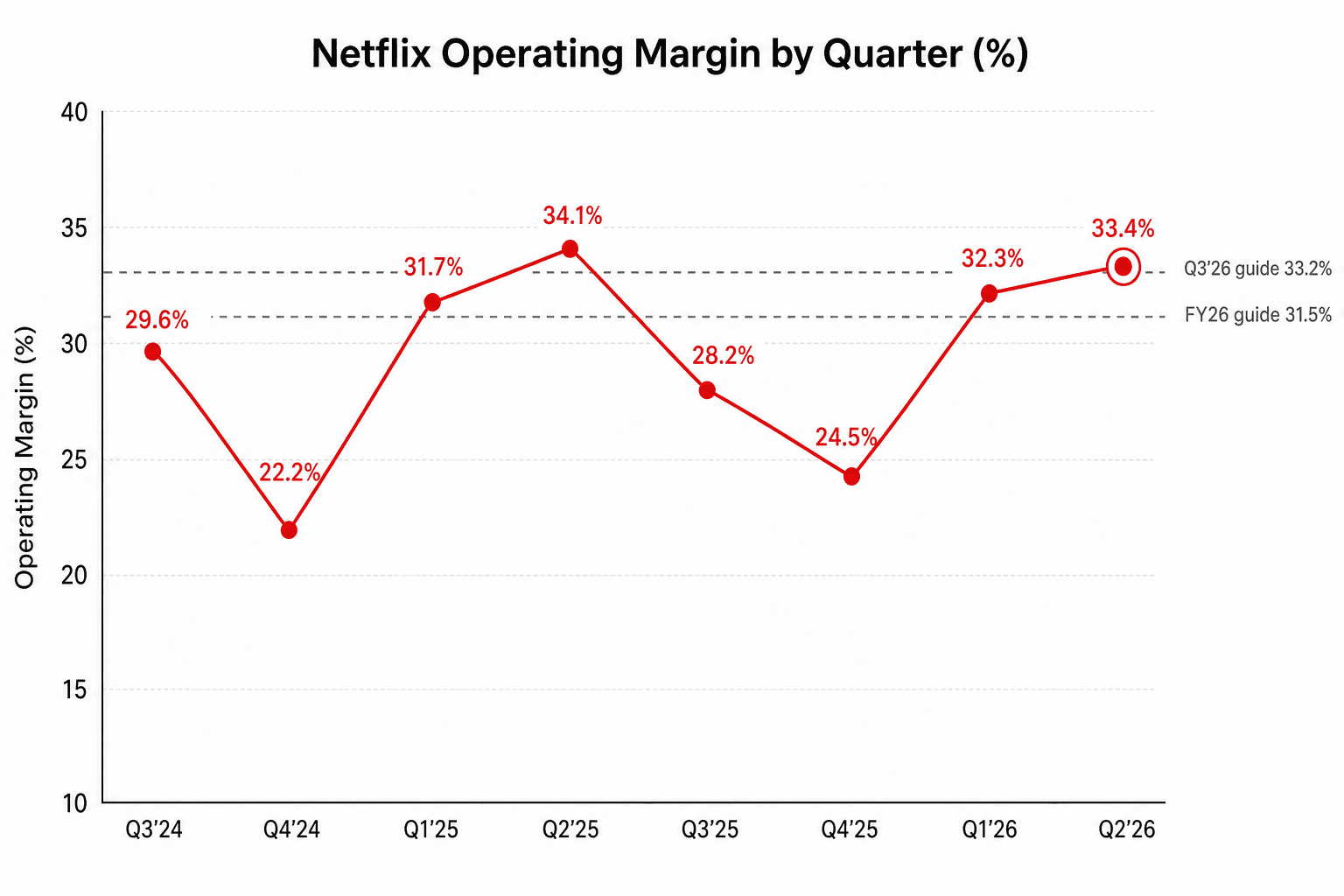
Operating margin, the share of revenue left after all the costs of running the service, was 33.4%. That is a hair below the 34.1% of a year earlier, and there is a clean reason for it. Netflix front-loads its content amortization, the accounting cost of spreading a show's or film's price over the years it will be watched, into the first half of the year. That makes first-half margins look a touch softer even as the business gets stronger. Management reaffirmed a full-year operating-margin target of 31.5%, up from 29.5% in 2025, which implies operating-income growth north of 20% for the year.
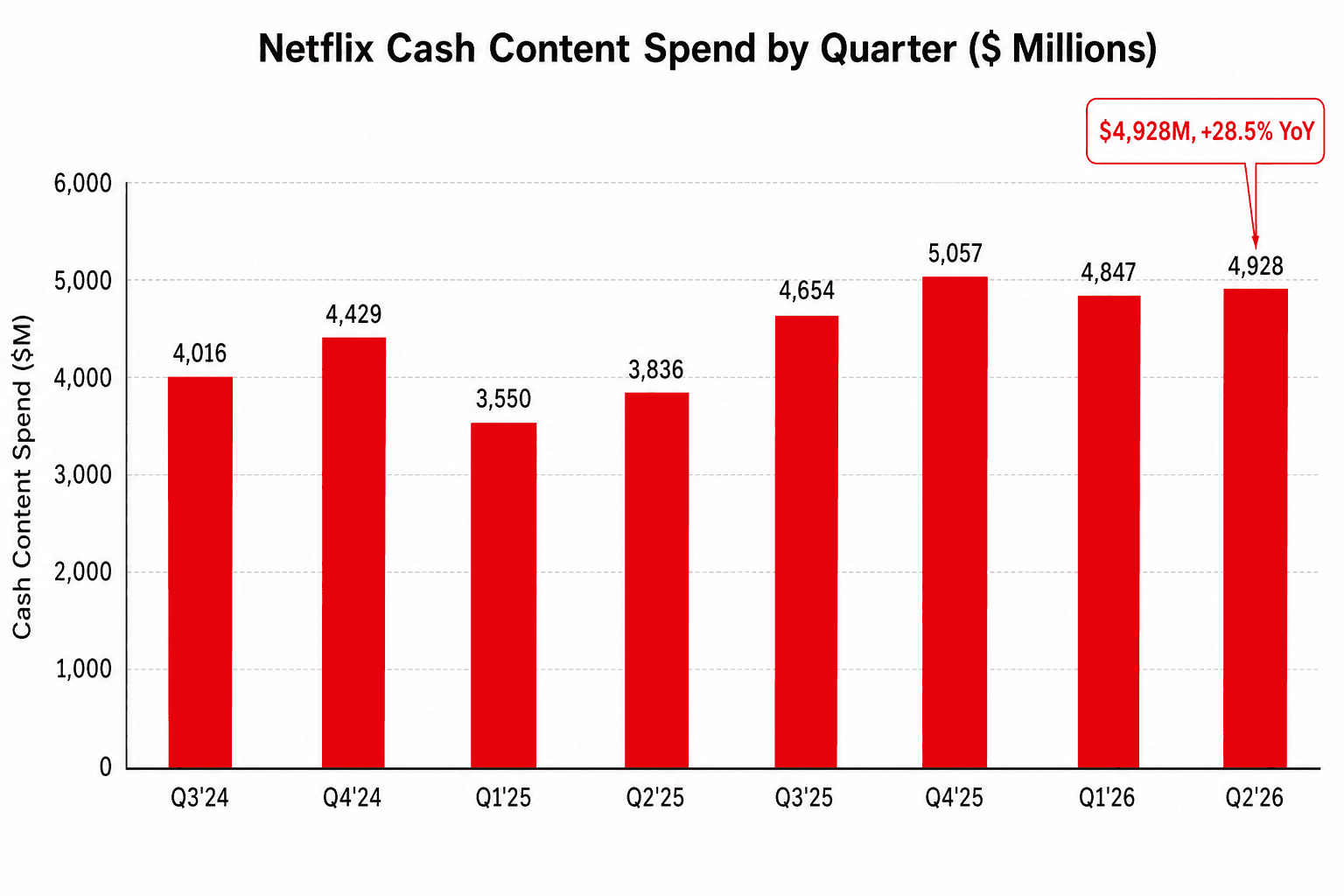
Behind those margins, Netflix is spending more than ever to fill the pipeline. Cash content spend, the actual money that went out the door for shows and films, was $4.93B, up 28.5% from a year earlier. That is the fuel line for the whole business. Netflix expects the accounting cost of content, the amortization, to rise about 10% for the full year, slower than the cash outlay, which is part of how it keeps margins expanding while investing heavily.
There is a nuance worth flagging on cash. Free cash flow, the money left after operating costs and capital spending, was $1.53B, down from $2.27B a year ago. That drop was driven mostly by higher cash tax payments, partly tied to a termination fee related to Warner Bros., rather than any weakening of the underlying cash engine. Netflix still guides to roughly $12.5B of free cash flow for the full year.
What management said, and what it stopped saying
The three-part framing from the shareholder letter was familiar: deliver more entertainment value, use technology to improve the service, and improve monetization. On engagement, Netflix said view hours grew about 2% in the first half of 2026, with members watching more than 97 billion hours, and that non-English titles again drove more than a third of all viewing. It also leaned on a "not all hours are equal" argument, noting that live programming is just over 5% of content spend and only about 1% of view hours, yet drove six of the top 10 new-member sign-up days of the past five years.
The more consequential communication was about what Netflix will no longer share. Having already dropped quarterly subscriber disclosures in 2025, the company said it will move its detailed twice-yearly viewing report to an annual release from 2027, to keep the focus on revenue and operating profit. In a quarter when engagement grew only modestly, that decision landed as defensive with some investors and became part of the negative narrative around the print.
On advertising, management reiterated the target of roughly $3B in ad revenue for 2026, close to double the prior year, and said US upfront commitments were in advanced stages and due to close within weeks. Netflix is also extending programmatic access to its Pause Ads and live inventory to court smaller advertisers.
The reaction: a de-risked Street, a punished stock
Netflix closed the regular Thursday session at $74.35, up 0.91% on the day, then fell as much as 9% once the guidance hit, trading near $67.82 after hours, an 18-month low. The move came off an already weak base, with the stock down roughly 21% for the year heading into the print.
Analysts had largely seen it coming. Ahead of the report, several firms trimmed their targets, with Oppenheimer cutting from $120 to $100 and Citigroup from $115 to $100, both keeping positive ratings on valuation grounds. The bulls held their line: Bank of America stayed at $125 and Guggenheim at $120, arguing that advertising scaling, US pricing power, and a record buyback pace support the multi-year story. The common thread is that few analysts think the business is broken; the debate is about how much to pay for slowing growth.
On capital returns, Netflix put its money where its guidance was not welcomed. It repurchased $4.7B of stock in the quarter, its largest buyback ever, drawing on a $25B authorization approved in April that leaves about $27.1B of capacity. It ended the quarter with $9.1B of cash and short-term investments against $14.4B of gross debt.
The forward look
For the third quarter, Netflix guided to $12.86B of revenue, up 11.7% and its slowest growth in about two years, a 33.2% operating margin, and $0.82 of diluted earnings per share. For the full year, it narrowed its revenue range to $51.0B to $51.4B, a 13% to 14% increase, held the 31.5% operating-margin target, and reaffirmed roughly $12.5B of free cash flow.
The tension in those numbers is the tension in the stock. The margin and cash-flow guidance describe a company that is more profitable and more disciplined than it has ever been. The revenue guidance describes one that is growing more slowly than the market had priced in. For the rest of 2026, the two questions that settle the argument are how much the delayed US pricing benefit adds in the back half, and whether the advertising business can scale fast enough to matter. Until those land, a solid quarter will keep reading, to a nervous market, like a warning.