Cloudflare bets the company on AI while cutting 1,100 jobs—and Wall Street rewarded the gamble
The Paradox: Massive Cuts, Massive Growth
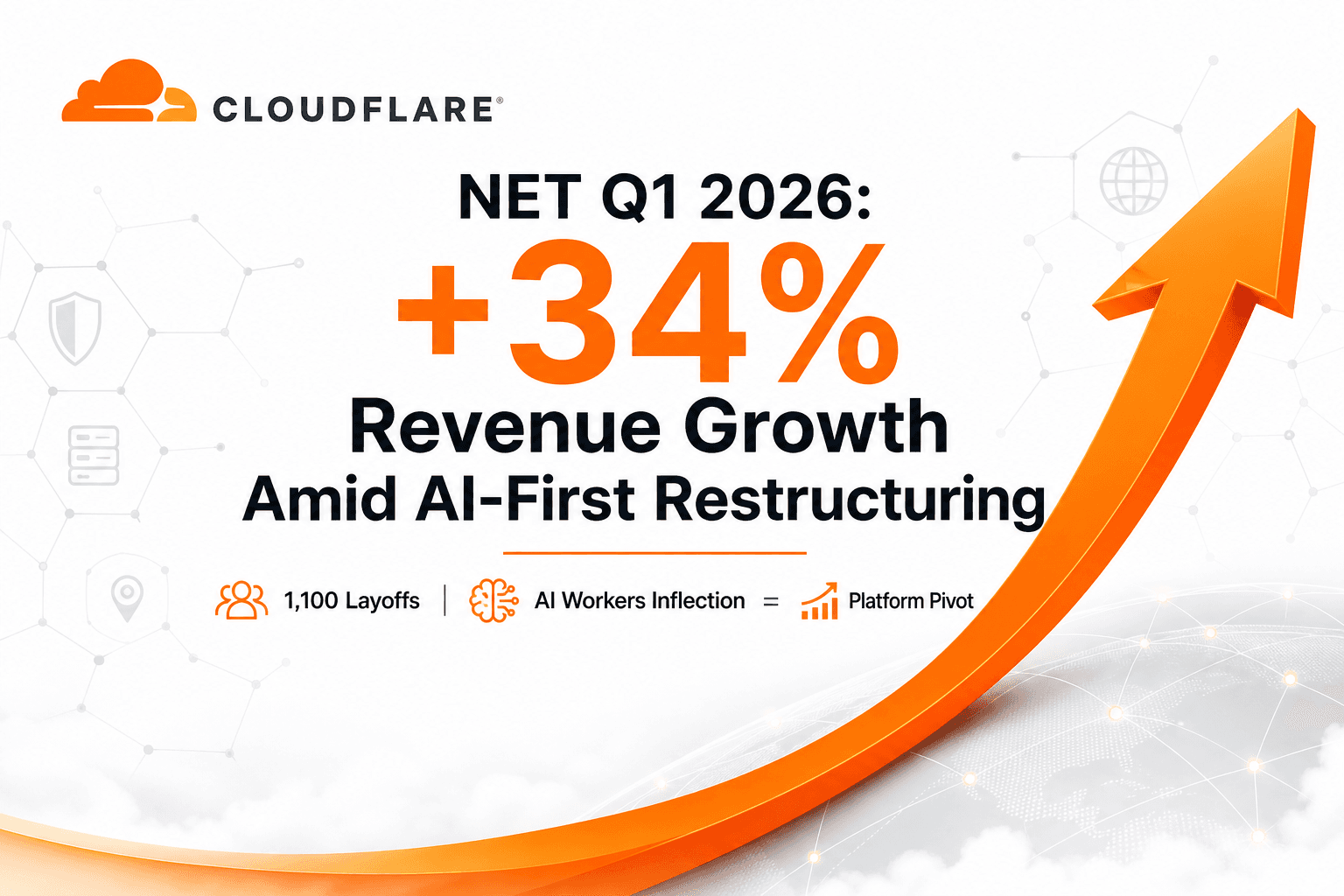
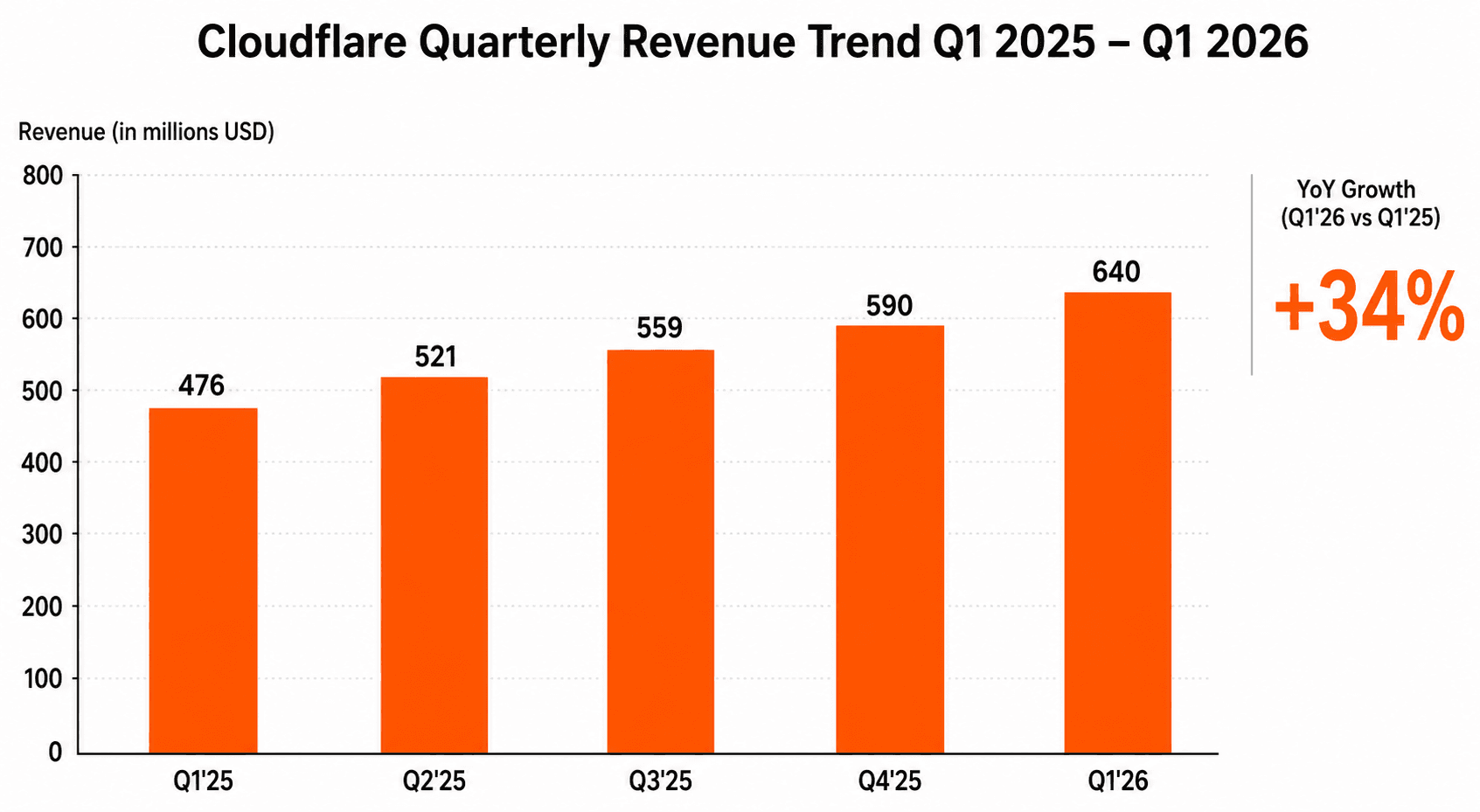
Cloudflare reported Q1 2026 earnings on May 7, 2026, and the message was contradictory in the best way. Revenue hit $640M, up 34% year-over-year. Free cash flow surged 50% to $84.1M. Earnings per share came in at $0.53 non-GAAP—more than double the $0.25 consensus expectation. By any traditional measure, this is a stellar quarter.
Yet on the same earnings call, CEO Matthew Prince announced the elimination of 1,100 positions—31% of the company's total workforce.
The market didn't punish the stock. Instead, NET rallied 12% in the first two days post-earnings. Four major investment banks upgraded their ratings the same day. The narrative, it seems, has shifted: Cloudflare is no longer a mature DDoS vendor trying to eke out margin expansion. It's a platform company betting its future on edge-based AI infrastructure.
The Numbers: Beat, Guide, Stabilize
Let's start with what moved the stock:
- Revenue: $639.8M, beating consensus ($612M estimate) by ~5%. The +34% YoY growth rate outpaces most of the SaaS cohort, especially for a company with $640M+ run-rate revenue.
- Non-GAAP EPS: $0.53, vs. $0.25 expected. That's a 112% beat—one of the largest we've seen in cloud software this year.
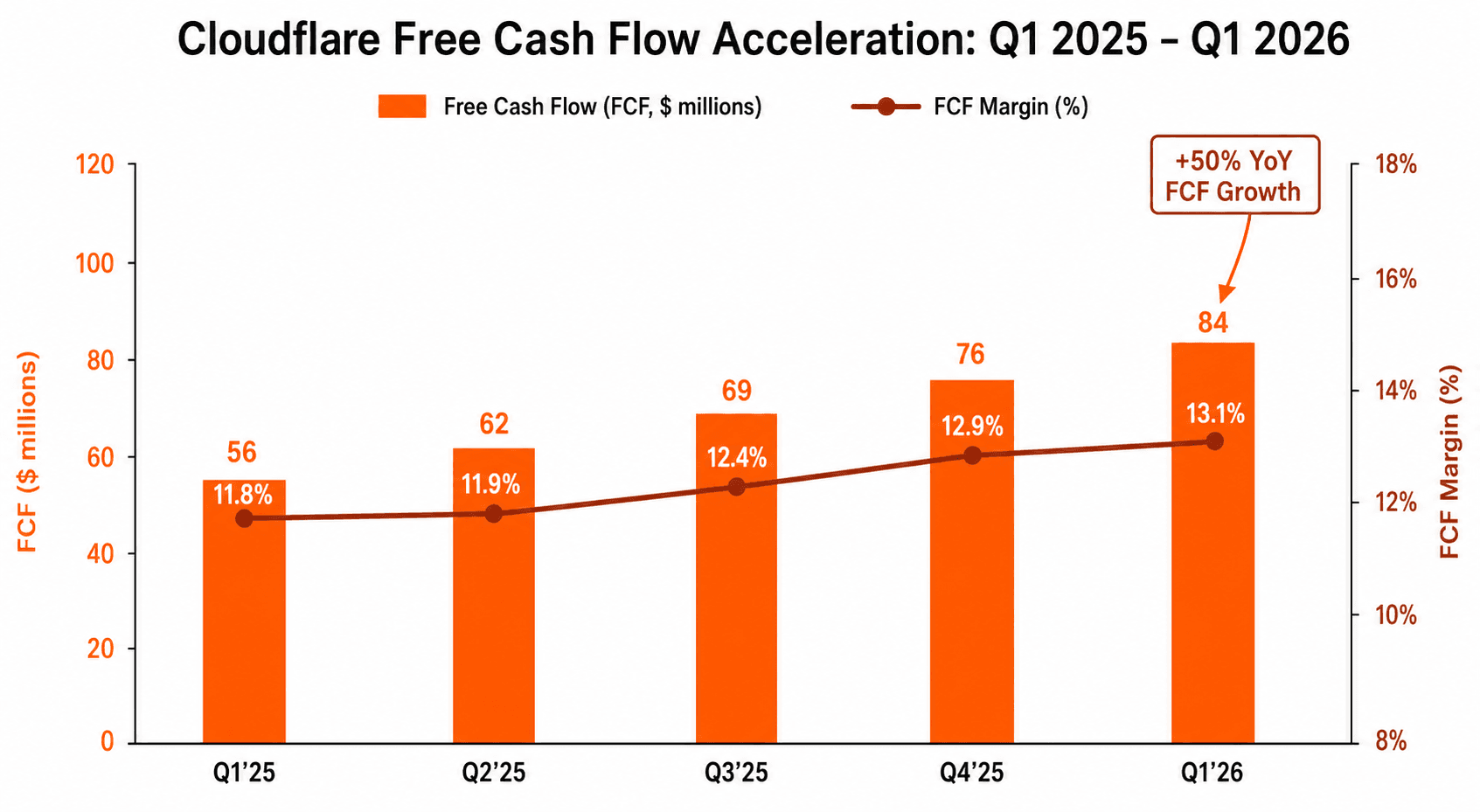
- Free Cash Flow: $84.1M, up 50% YoY, with FCF margin hitting 13.1%—the highest in company history.
- Large-Customer Momentum: The $100K+ ARR customer cohort expanded to 4,416 (+25% YoY), now representing 72% of total revenue. The $500K+ "strategic accounts" segment hit 748 (+22% YoY).
- Full-Year Guidance: FY 2026 revenue guided to $2,805–2,813B (+30% YoY), implying Q2–Q4 stability post-restructuring. Operating income targeting $418–421M.
The guidance reaffirmation despite 1,100 layoffs was the key confidence signal. Investors interpreted it as: management isn't slashing guidance; they're confident the restructuring improves unit economics while maintaining growth momentum.
The Headwind: Margin Compression & the AI Cost
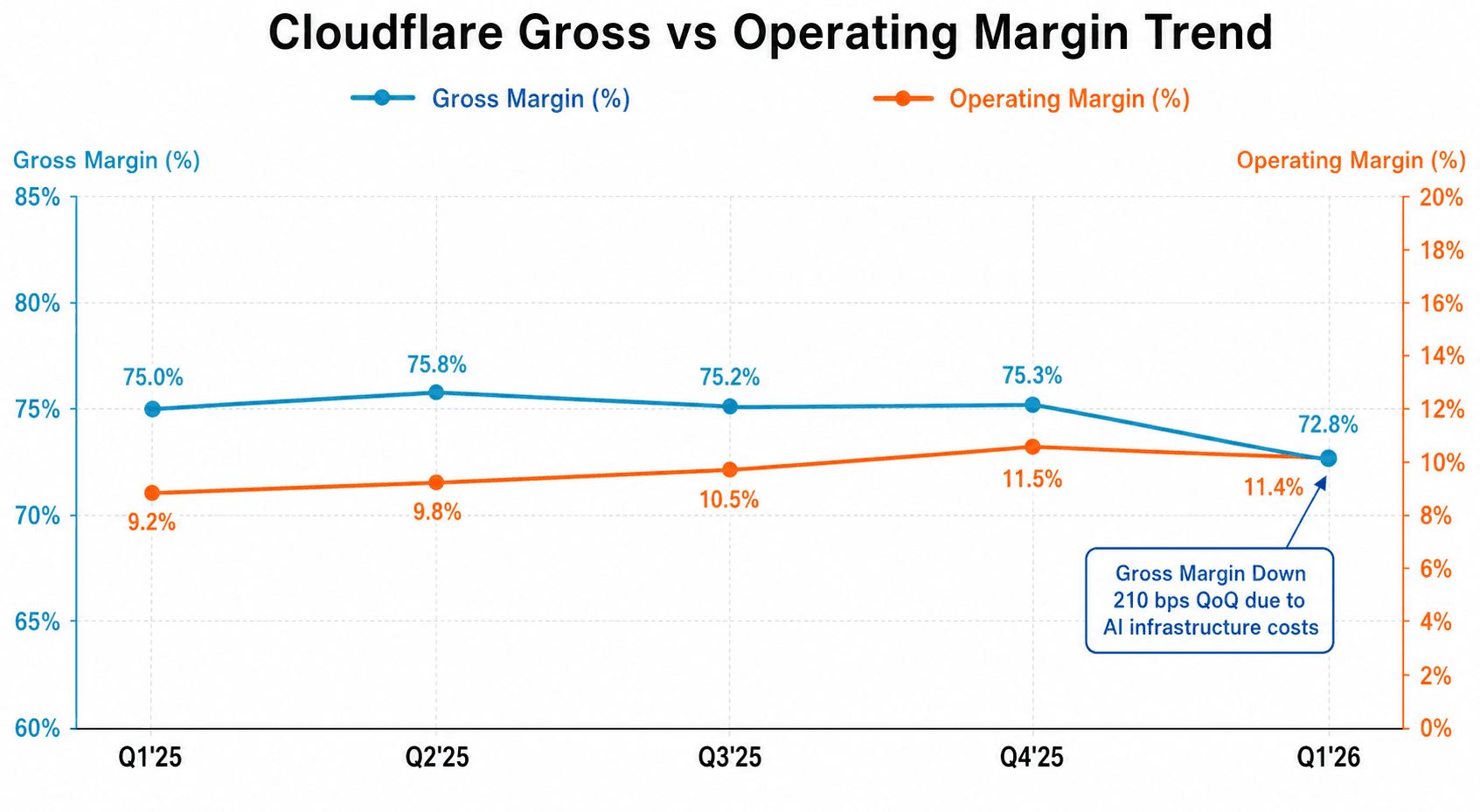
Not everything was rosy. Gross margin fell from 75.3% in Q4 to 72.8% in Q1—a 210 basis point quarterly decline. Year-over-year, margin erosion was 130 bps from the prior-year 75.0%.
Management attributed this directly to AI infrastructure costs. Workers for AI products inherently carry lower gross margins than traditional DDoS because Cloudflare absorbs GPU, bandwidth, and compute costs upfront. As more of the revenue mix shifts toward Workers, the consolidated margin naturally compresses.
But here's where the narrative gets interesting. Analysts largely accepted the margin decline as structural, not cyclical. Why? Because the addressable market for AI Workers is exponentially larger than DDoS. Matthew Prince's quote on the call was blunt:
"If you're investing in AI infrastructure and expect margins to remain at 77%, you're not investing enough."
This reframing—from "margin compression is a problem" to "margin compression is evidence we're winning"—shifted sentiment. Seven of eight major banks maintained Overweight ratings. Four upgraded (Morgan Stanley, Mizuho, RBC, Oppenheimer).
The Strategic Pivot: From DDoS-First to AI-First
The restructuring announcement was the meta-story. Cloudflare cut 1,100 jobs (~$105–110M in cash costs, $35–40M in non-cash stock-based compensation charges) and framed it explicitly as a pivot away from legacy products and sales models.
The company is exiting lower-margin SaaS offerings (e.g., Railgun, certain add-ons), consolidating product lines, and reinvesting in:
- Workers for AI: A new serverless compute platform for LLM inference, embeddings, and real-time tokenization. Estimated at $45–50M annualized revenue in Q1, growing ~60% YoY.
- Vectorize: A vector database service for retrieval-augmented generation (RAG).
- Workers Analytics Engine: Real-time analytics for Workers-based applications.
The AI Workers revenue, though still small (~7–8% of total), is growing at 2x the rate of the overall business. Management sees a $10–15B TAM in serverless AI infrastructure over the next five years.
The Customer Story: Enterprise Concentration & DBNR
One concern that could have derailed the narrative: customer health post-restructuring announcement. Did customers flee?
The data says no. The $100K+ ARR customer count grew 25% YoY to 4,416. The $500K+ cohort (strategic accounts) grew 22% YoY to 748. Together, these cohorts now represent 72% of total revenue—a 400 bps increase in concentration from a year ago.
Dollar-based net retention (DBNR) came in at 118%, down 2 percentage points from Q4's 120% but up 7 percentage points year-over-year from Q1 2025's 111%. The QoQ decline triggered some analyst concern, but management characterized it as temporary—citing seasonal variation and customer caution during the restructuring window. They guided for stabilization back toward 120%+ in H2 2026.
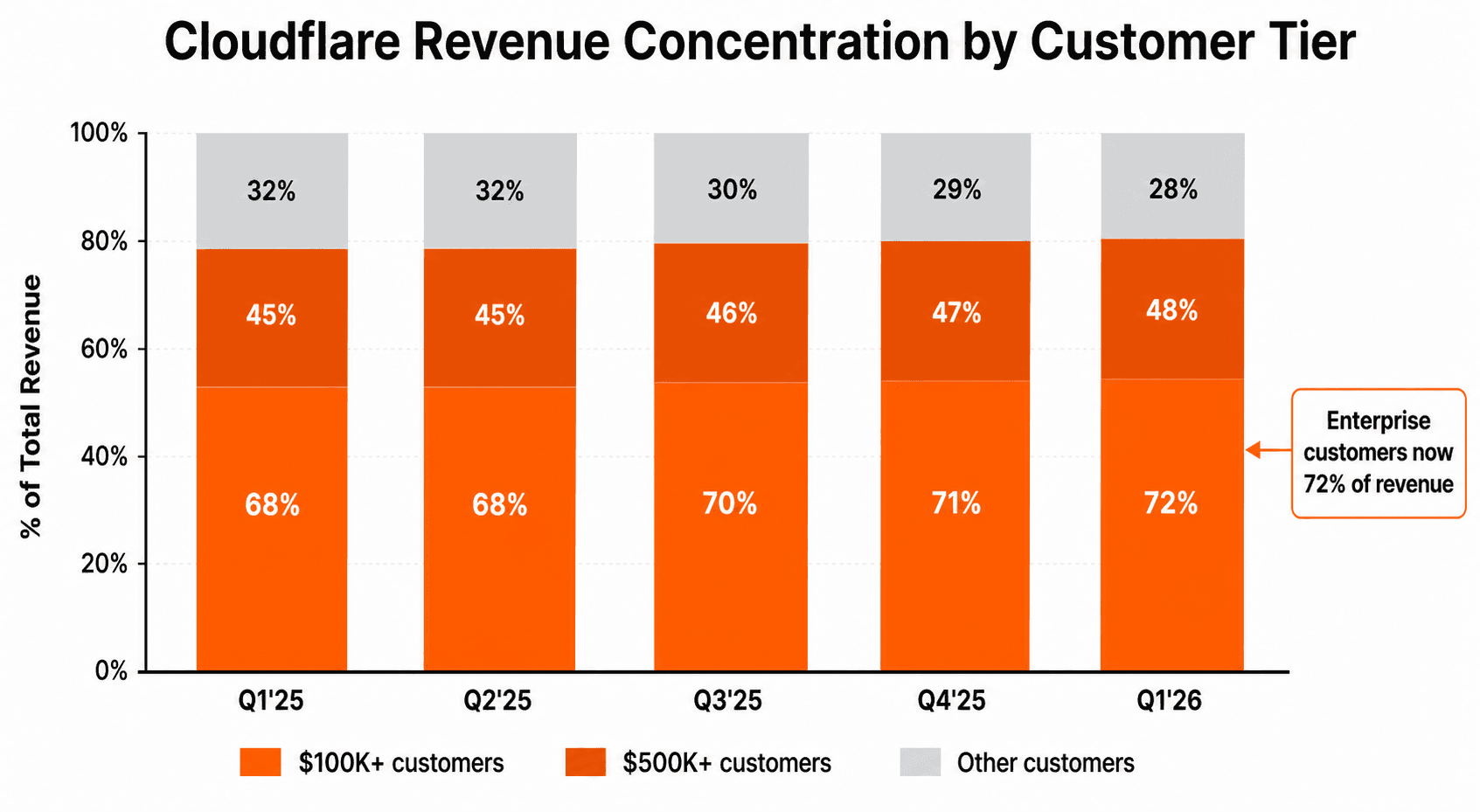
The streetwide takeaway: if the restructuring actually triggered meaningful churn, DBNR would be in the 110–114% range, not 118%. The fact that it stayed resilient suggests customers are cautiously optimistic about the AI pivot.
Analyst Consensus: $115 Price Target (Up 15%)
Here's what happened post-earnings:
- JPMorgan (maintained Overweight): Raised PT from $110 to $120. Margin compression is priced in; focus shifts to FY27 margin stabilization.
- Cowen (maintained Outperform): Raised PT from $105 to $118. "Best Q1 result in 3 years."
- Goldman Sachs (maintained Buy): Raised PT from $115 to $125. Restructuring "de-risks" long-term profitability.
- Morgan Stanley (upgraded to Overweight): Raised PT from $95 to $105. Initiated coverage with Overweight after earnings. "Margin compression narrative over-told."
- Mizuho (upgraded to Buy): Raised PT from $90 to $110—the largest % upgrade (+22%). Characterized as "turning point" from DDoS vendor to platform.
- RBC Capital (maintained Outperform): Raised PT from $105 to $125 (+19%). "Best earnings in Cloudflare history relative to expectations."
- Evercore ISI (maintained Outperform): Highest PT at $135. "AI Workers could be $1B+ revenue stream in 3 years."
- Oppenheimer & Stifel (cautious outliers): Maintained Neutral/Hold ratings, citing execution risk and DBNR softness.
Consensus PT: $115 (up from $100 pre-earnings). The median base case assumes:
- Margin stabilization at 72–74% throughout 2026
- AI Workers grows to 10–12% of revenue by EOY 2026
- Enterprise customer concentration continues (+20%+ YoY growth in $100K+ cohort)
- FCF margin sustains at 12–13% through 2026–27
The Unresolved Question: Can They Execute?
The bull case is clean: AI Workers inflection + margin stabilization + FCF growth = $115 PT minimum, possibly $125+ if execution is flawless.
The bear case is execution risk. A 31% workforce reduction is the largest restructuring in Cloudflare's history. Key risks:
- Retention of AI/Workers talent: If the company loses critical engineers to competitors during the integration, product velocity slows.
- DBNR further softening: If Q2 DBNR falls below 115%, it suggests deeper customer churn.
- Margin stabilization fails: If gross margin falls below 72% in Q2–Q3, the thesis breaks.
- Competitive response: AWS Lambda, Vercel, and Azure Functions are expanding rapidly. Cloudflare's claim to "only integrated platform" is debatable.
Management sounded confident on the call. Matthew Prince and CFO Thomas Seifert fielded every question without deflection. They reaffirmed guidance and doubled down on the AI-first narrative. But the market wants proof: Q2 DBNR stability, gross margin stabilization, and early AI Workers customer wins (Anthropic, OpenAI, hyperscaler partnerships) would all validate the thesis.
The Bottom Line
Cloudflare's Q1 2026 was a textbook "beat and guide" quarter, but the real news was the restructuring announcement. By cutting 1,100 jobs while maintaining growth and cash-generation guidance, CEO Matthew Prince signaled that he's willing to sacrifice short-term optics for long-term platform leverage. Wall Street, after years of penalizing SaaS companies for cost-cutting, rewarded this move.
The question now is execution. If Q2 and Q3 demonstrate DBNR stabilization, margin stabilization, and traction in AI Workers, the $115–125 PT range will likely hold. If management misses on any of these, the stock could test $100–105 support.
Either way, Cloudflare is no longer a defensive DDoS play. It's a leveraged bet on edge-based AI infrastructure. That's a much bigger market—and a much riskier one.