Micron FY26 Q3: HBM Supercycle, Record 85% Margin
A memory maker just posted software-like margins
For most of its history, Micron has been a textbook commodity business. It makes the memory chips that go inside servers, phones, cars, and laptops, and it has lived through brutal boom-bust cycles where prices crater the moment supply catches up with demand. A 40% gross margin used to count as a good year.
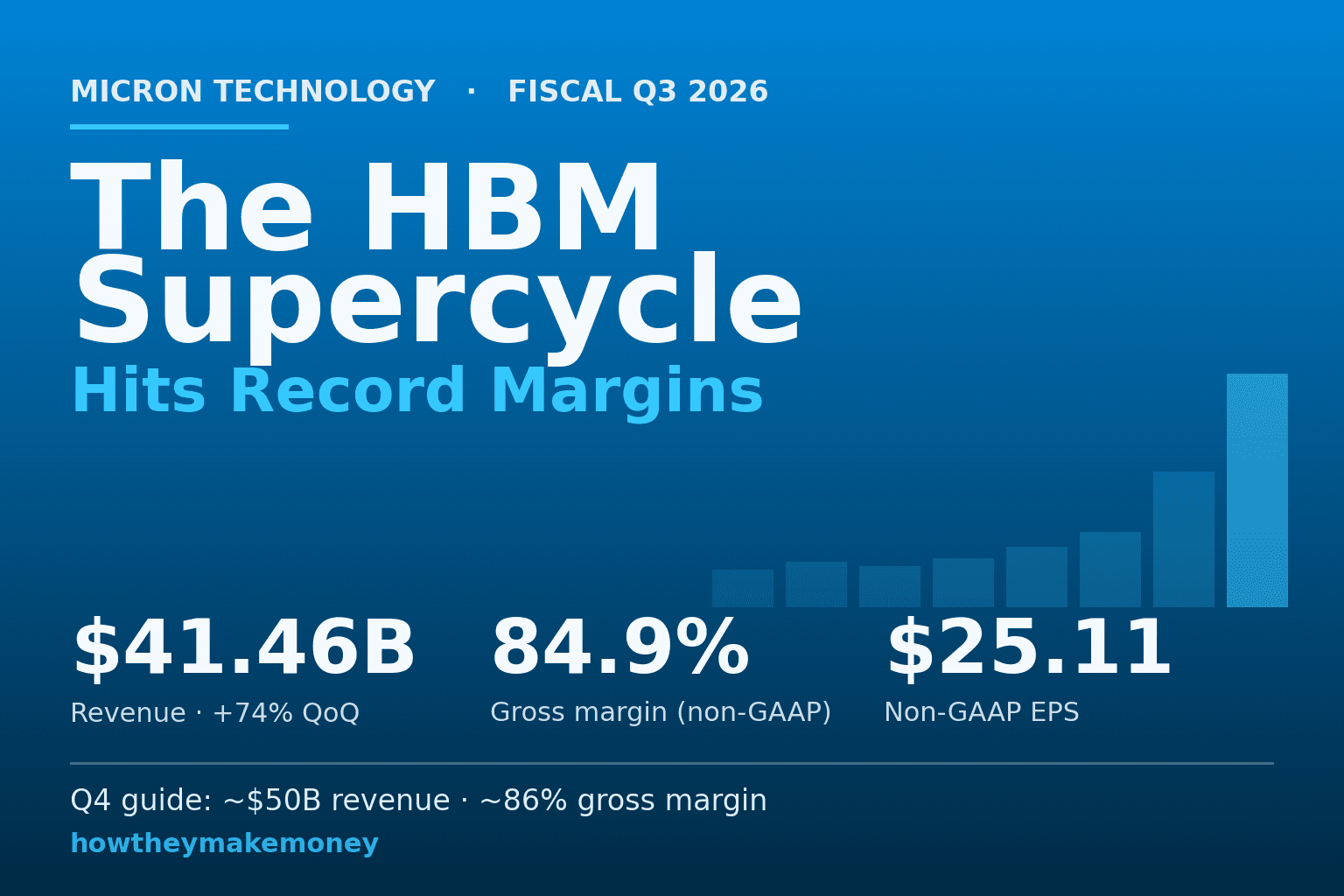
Fiscal Q3 2026, the quarter that ended May 28 and was reported on June 24, broke that frame. Revenue came in at a record $41.46 billion, up 73.7% from the prior quarter and up 345.7% from a year earlier. Non-GAAP gross margin, the share of revenue left after the direct cost of making the chips, hit 84.9%. Non-GAAP earnings per share were $25.11, more than ten times the figure from the same quarter last year. Then management guided the current quarter to roughly $50 billion in revenue, well above what Wall Street expected.
Numbers like these are the financial signature of a genuine shortage. The story underneath is the AI buildout colliding with an industry that cannot make memory fast enough.
The setup: why this quarter happened
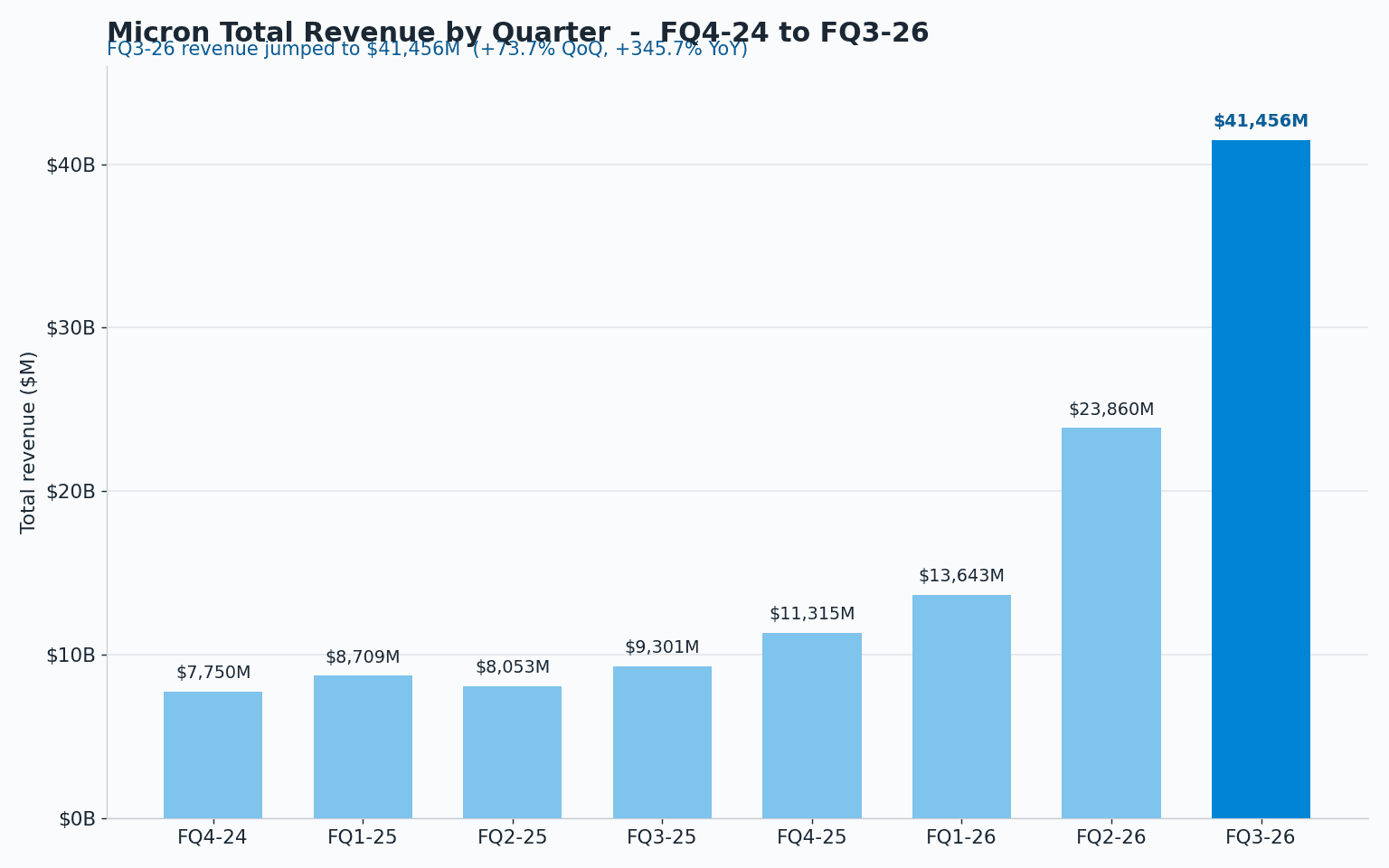
The revenue line tells the cleanest version of the story. Eight quarters ago Micron did $7.75 billion. This quarter it did $41.46 billion. The $17.6 billion sequential jump was, in CFO Mark Murphy's words, the largest in the company's history.
Two things drove it. Prices rose sharply, and the product mix moved upmarket. DRAM, the fast working memory that feeds processors, saw average selling prices climb roughly 60% versus the prior quarter, even as the actual volume of bits shipped rose only in the low single digits. NAND, the flash memory used for longer-term storage, saw prices jump in the mid-80s percent. When you can charge far more per chip without shipping many more chips, revenue and margin both spike. That is exactly what a supply shortage looks like on an income statement.
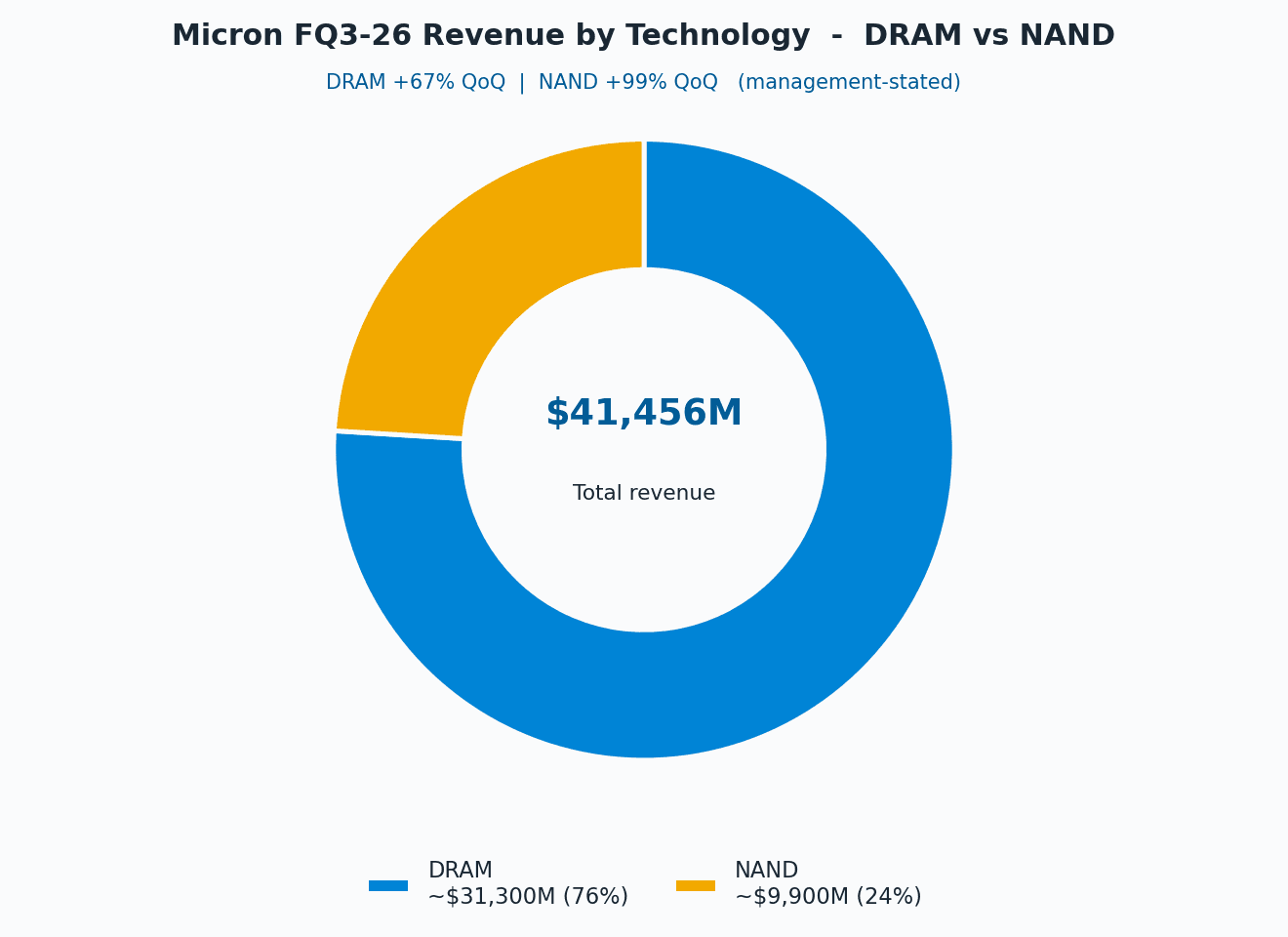
Micron does not break out DRAM and NAND dollars in its filings, so those splits come from management's prepared remarks: DRAM was roughly $31.3 billion, or 76% of revenue, and NAND about $9.9 billion, or 24%. Both set records.
Margins go vertical
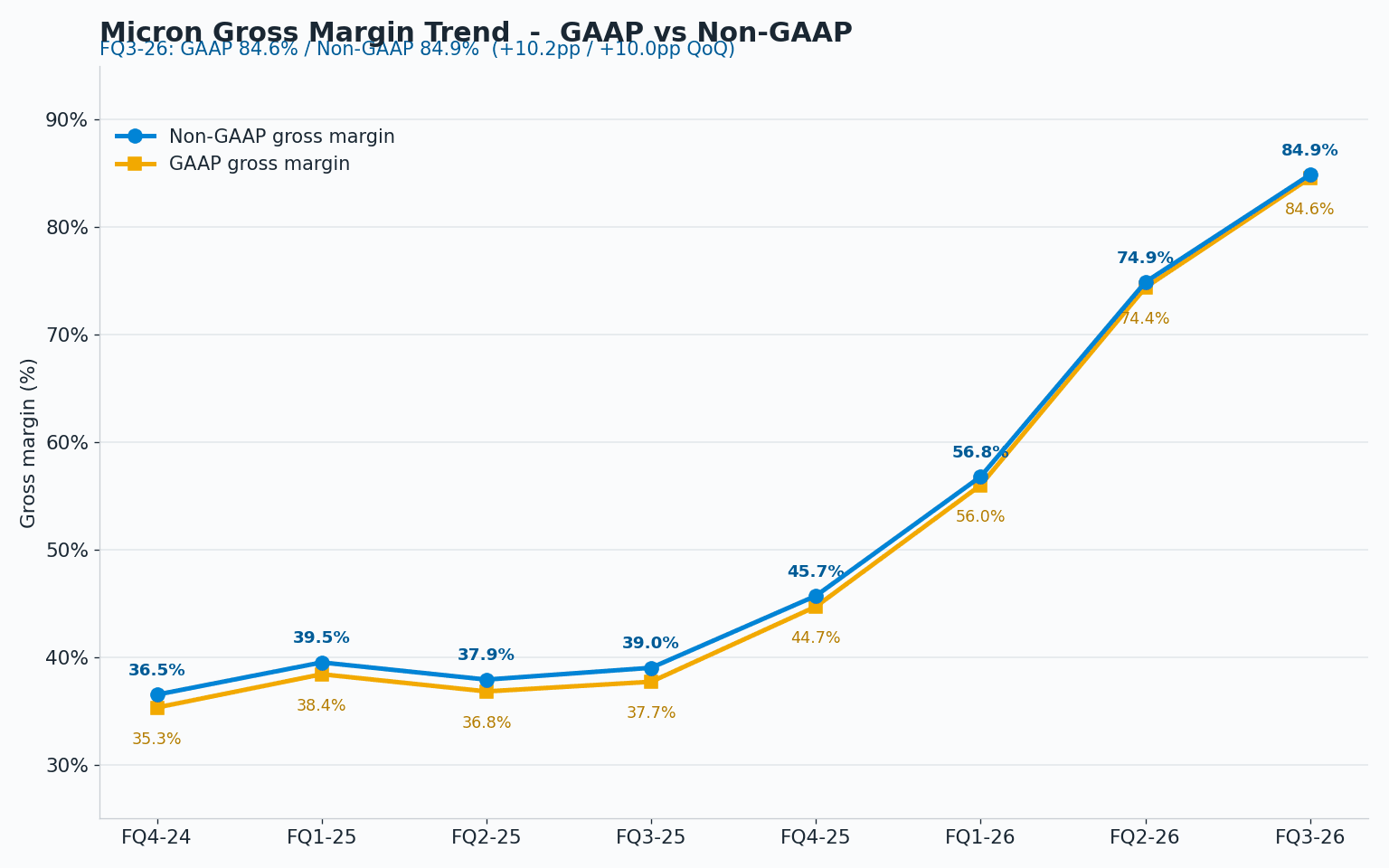
The margin chart is the one that stops people. Gross margin measures how much of each sales dollar survives the direct cost of production. A year ago Micron's non-GAAP gross margin was 39%. This quarter it was 84.9%, up roughly 10 percentage points from the prior quarter alone. Operating margin, which also subtracts research and overhead, reached 81%.
That kind of margin is normally the territory of software companies, not factories that etch silicon. It exists because pricing ran far ahead of cost in a shortage, and because the highest-value products carried more of the weight. Management was candid that this is not a normal level. The Q4 guide of about 86% assumes the rate of price increases starts to cool.
Data center is now the whole story
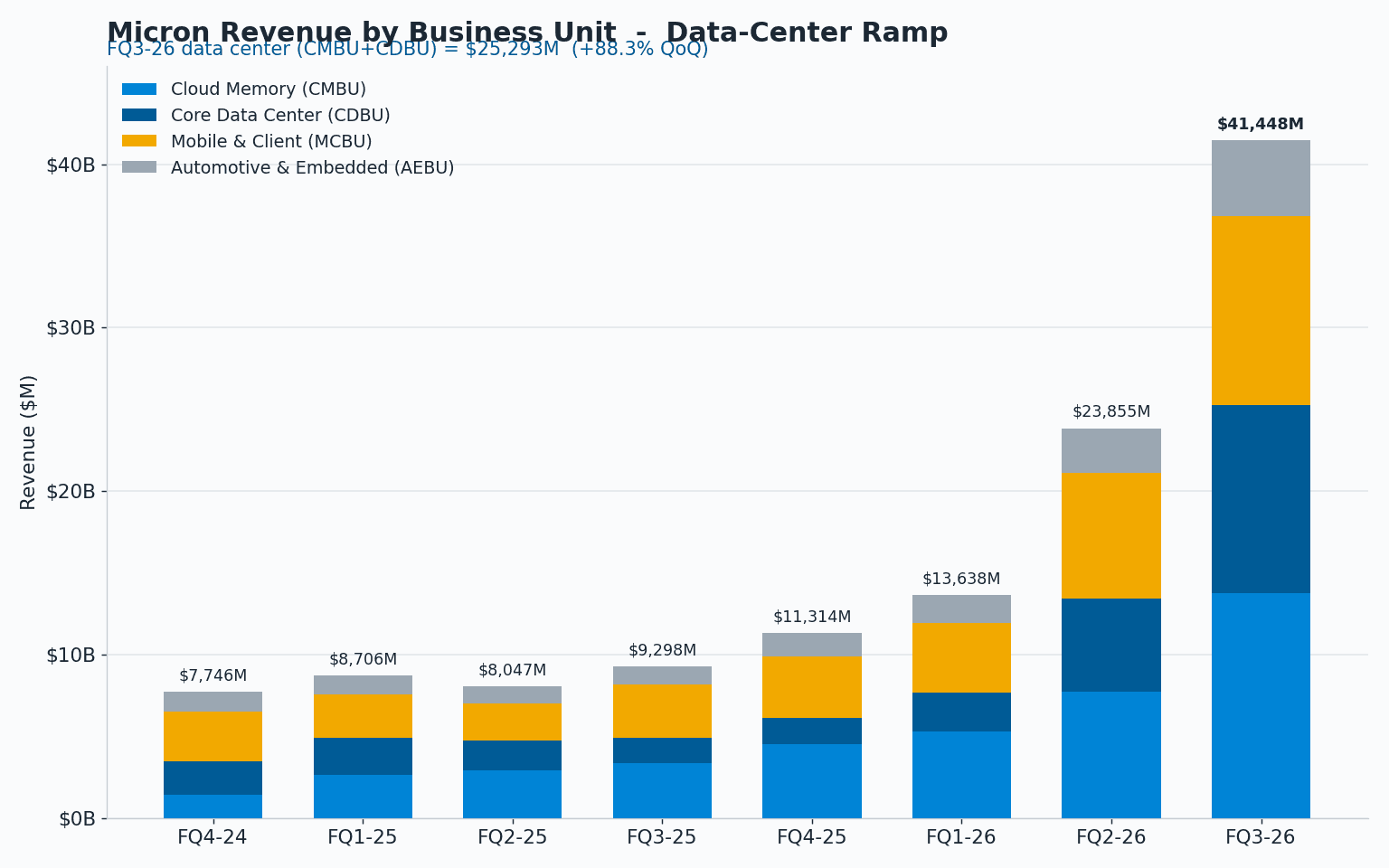
Micron sorts its revenue into four units. The two that serve AI data centers, Cloud Memory and Core Data Center, together brought in $25.3 billion this quarter, up 88% from the prior three months. That is more than the entire company earned in any quarter before this fiscal year. Management put the data-center business at an annualized run rate above $100 billion.
At the center of it sits high-bandwidth memory, or HBM. This is DRAM stacked into vertical towers and placed right beside AI accelerator chips so data can move with very little delay, which is precisely what training and running large AI models demands. Micron said its newest generation, HBM4, has already crossed $1 billion in shipped revenue and is ramping about twice as fast as the prior generation. The company now expects the total market for HBM to clear $100 billion in 2027, a year earlier than it had previously forecast.
The mobile, client, automotive, and embedded units all grew too, but the message of the quarter is that Micron has become, first and foremost, a supplier to the AI data center.
What management is betting on
The most consequential disclosure was not a number on the income statement. It was the contract book. Micron has signed 16 Strategic Customer Agreements, multi-year deals that lock in both volume and pricing with its biggest buyers, mostly spanning 2026 through 2030. Cumulative committed value across those contracts is roughly $100 billion.
These are structured as "take-or-pay," meaning customers commit to buy the agreed volumes and, as Chief Business Officer Sumit Sadana put it bluntly, "cannot be canceled. There is no provision in this agreement to enable a customer to walk away." Each deal carries a price floor through its term and a ceiling near current market prices. The intent is to break the historical pattern where memory prices collapse without warning. Sadana's framing of the broader shortage was just as direct: "the shipment growth for bits is not really determined by demand anymore. It's actually more determined by the supply."
CEO Sanjay Mehrotra tied it together, saying the record results and stronger outlook "reflect the strategic value of memory in the AI era," and that the multi-year agreements should "enhance the durability and predictability" of the company's performance.
The balance sheet reflects the windfall. Adjusted free cash flow, the cash left after running and investing in the business, was a record $18.3 billion.
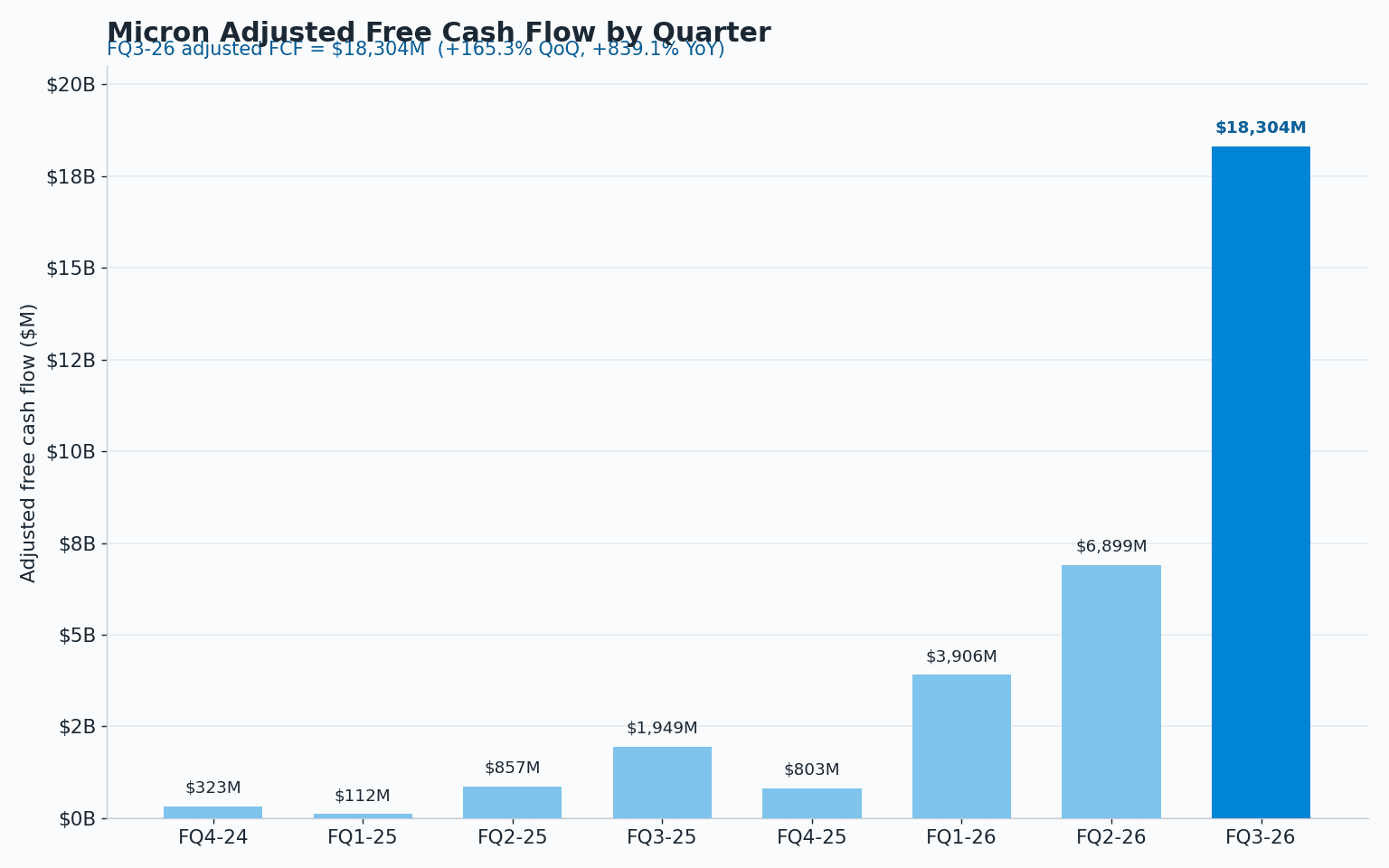
Micron ended the quarter with $30.2 billion in cash and investments, cut its debt by $4.4 billion to $5.7 billion, and declared a $0.15 quarterly dividend. Capital spending is climbing too, with full-year capital expenditure raised to about $27 billion to build new fabrication plants in Idaho, New York, Taiwan, and Singapore.
Wall Street, and the one bear
The analyst reaction was already extraordinary heading into the print. In the weeks before June 24, most sell-side targets were doubled or tripled. UBS lifted its target from $535 to $1,625, Susquehanna went to a Street-high $1,750, and Bank of America, Stifel, Wedbush, and Morgan Stanley all landed between $1,050 and $1,500. The common thread: a view that the memory shortage is structural rather than the usual short cycle, which would justify valuing Micron more like an AI infrastructure company than a commodity chipmaker.
The notable holdout is Goldman Sachs, which kept a Neutral rating even while raising its target to $900. Its analysts called roughly 85% gross margins "unprecedented" and questioned whether they can last once Micron, Samsung, and SK Hynix all add capacity at once. That is the real debate. The bulls are buying the contract book and the structural-shortage thesis; the bear is reminding everyone that memory has always been cyclical.
The stock sided with the bulls, at least overnight, rising roughly 13% to 16% in after-hours trading. It did so off a weak base, since shares had dropped more than 12% the prior day in a broad selloff tied to a roughly 10% crash in South Korea's KOSPI index, a macro shock rather than anything about Micron.
The forward look
For fiscal Q4, Micron guided to revenue of about $50 billion, give or take $1 billion, a gross margin near 86%, and non-GAAP EPS around $31. If it lands, that would be another record by a wide margin, and it would put the company on an annualized revenue pace that was unthinkable two years ago.
The question that decides the next year is the one Goldman is asking. Roughly 85% gross margins have never held in this industry. Micron's answer is its contract book, the floor pricing locked in through 2030 on a large share of volume. If those floors hold as new capacity arrives, this stops being a cycle and starts being a plateau. If they don't, this quarter will read as the peak. The next few prints will tell which.