Microsoft Just Disclosed the Largest Software Backlog Ever — and the Stock Closed Down
A clean print, sold on the gross margin guide
By the income-statement metrics that matter, Microsoft's Q3 FY26 was the strongest enterprise-AI quarter any vendor has produced in this cycle. Revenue $82.9B (+18% YoY). Operating income $38.4B (+20% YoY). EPS $4.27 (+23% YoY).
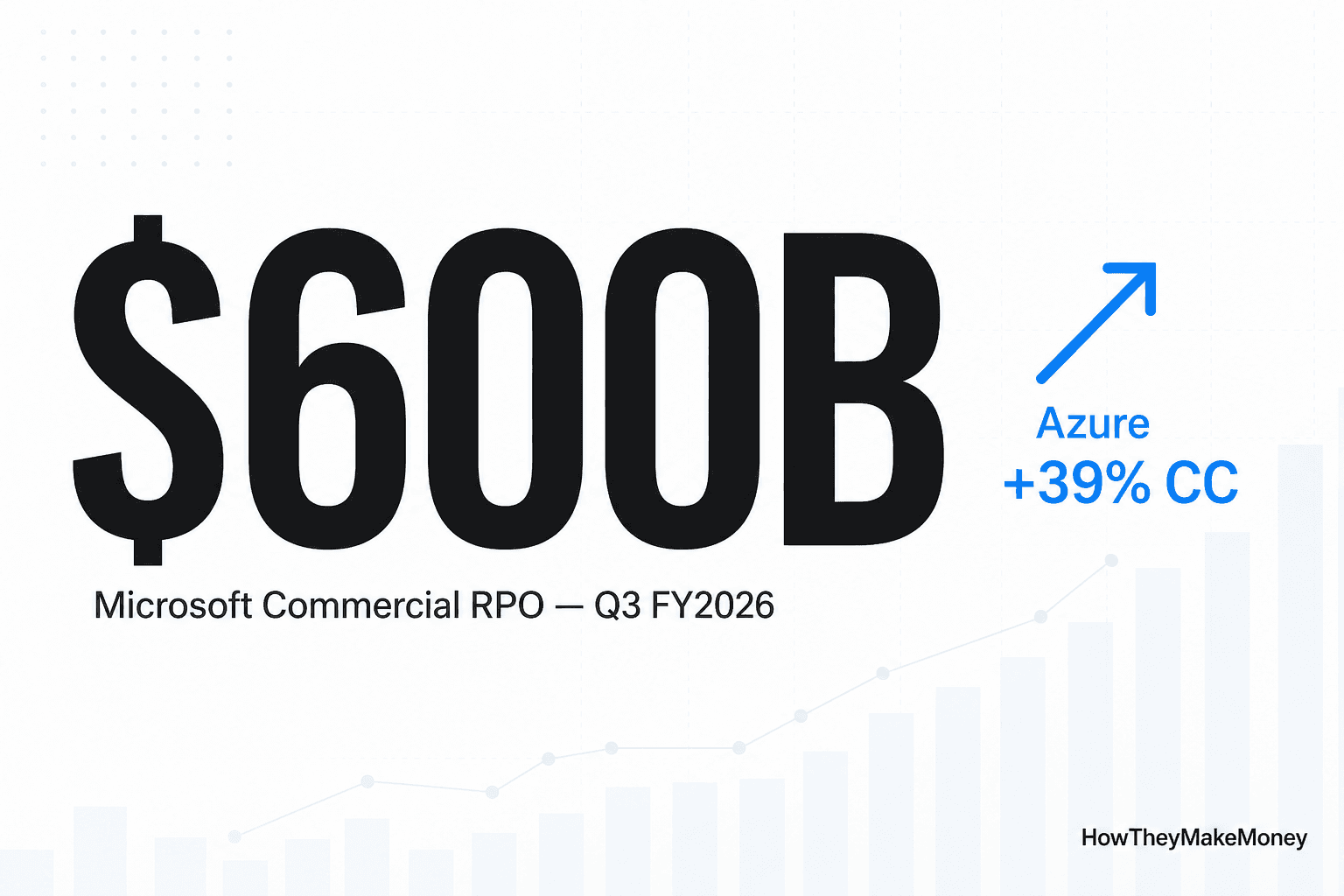
The operational specifics under the headline are even stronger. Microsoft Cloud crossed $54.5B, +29% YoY — a meaningful re-acceleration from the +20-24% growth band of the prior four quarters. Azure constant-currency growth re-accelerated to +39%, the highest reading since FY24 Q1. AI ARR hit $37B, growing +123% YoY. M365 Copilot paid seats crossed 20 million, up +43% sequentially after a +40% sequential quarter the prior period. And — the one that broke the spreadsheets — commercial RPO over $600 billion.
The stock closed -1.2%.
The gap between operational quality and price reaction tells you what the market is actually pricing now. Through 2024, the question was can MSFT keep growing Azure into the 30%s. Through the first three quarters of 2025, the question was can MSFT find AI monetization at scale. Microsoft answered both questions definitively in Q3 FY26 — and the market moved the goalposts to the gross margin trajectory and the 2027 capex line.
Azure: re-acceleration is now confirmed
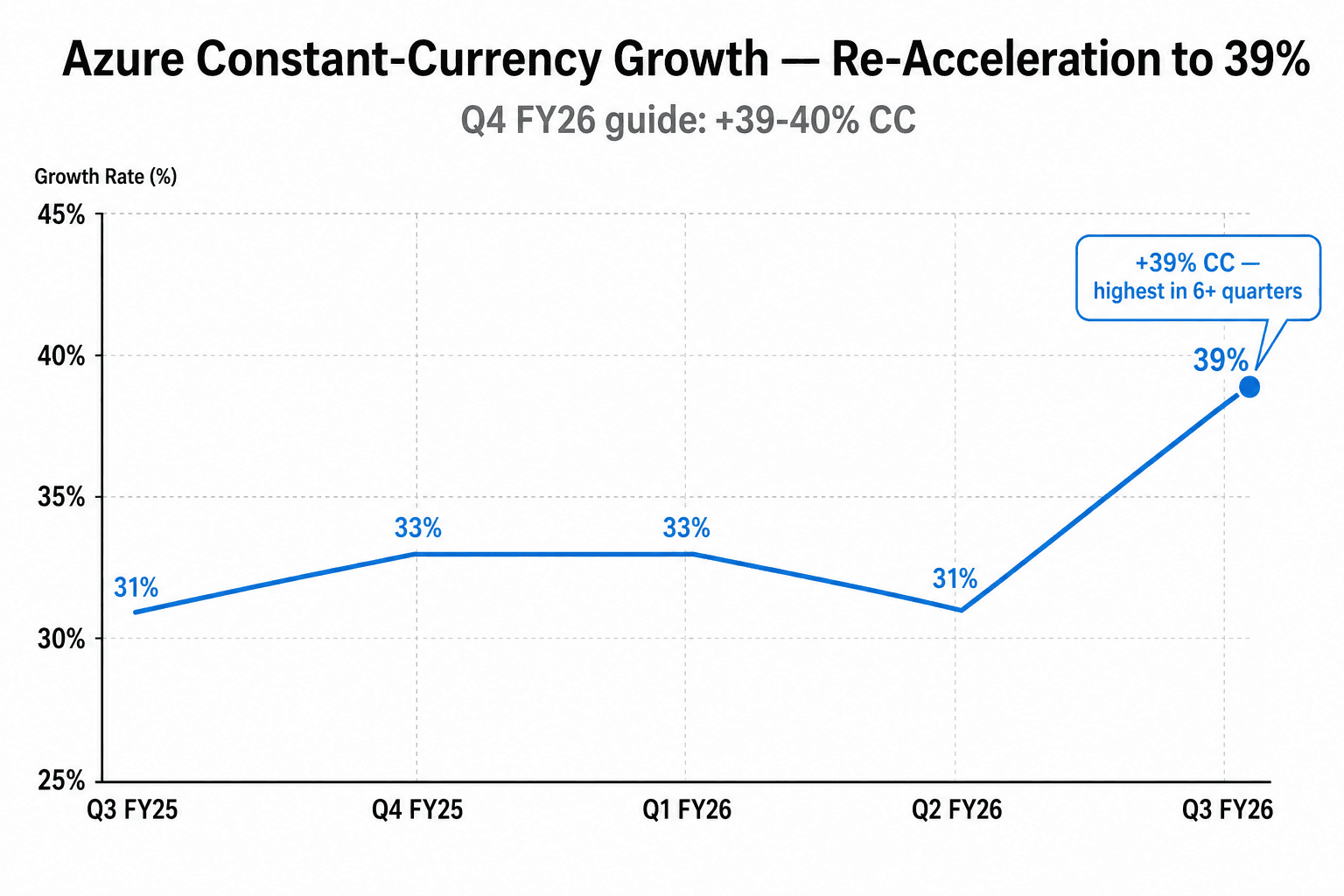
For four straight quarters, Azure had printed CC growth in the 31-33% band. Q3 FY26 broke the band — to +39% CC, +40% reported. Two things matter about this:
First, Q4 FY26 guidance is +39-40% CC, meaning the Q3 print is not a one-quarter spike. It is the new operating range.
Second, Satya Nadella explicitly framed the re-acceleration as structural: "AI is now embedded in essentially every Azure deployment we do. The +39% Azure constant-currency growth is what the platform looks like when AI moves from a feature to the operating system of enterprise compute."
The crucial detail is what Amy Hood added: Microsoft is capacity-constrained, not demand-constrained. The +39% is what they can ship, not what customers want. As more capacity comes online through the rest of FY26 and FY27, the upper bound on Azure growth could move further — meaning the bull case isn't just "39% holds" but "39% might be the new floor."
The $600B number changes the conversation
CFO Amy Hood's most consequential sentence on the call:
"We have over $600 billion of revenue that still needs to be delivered."
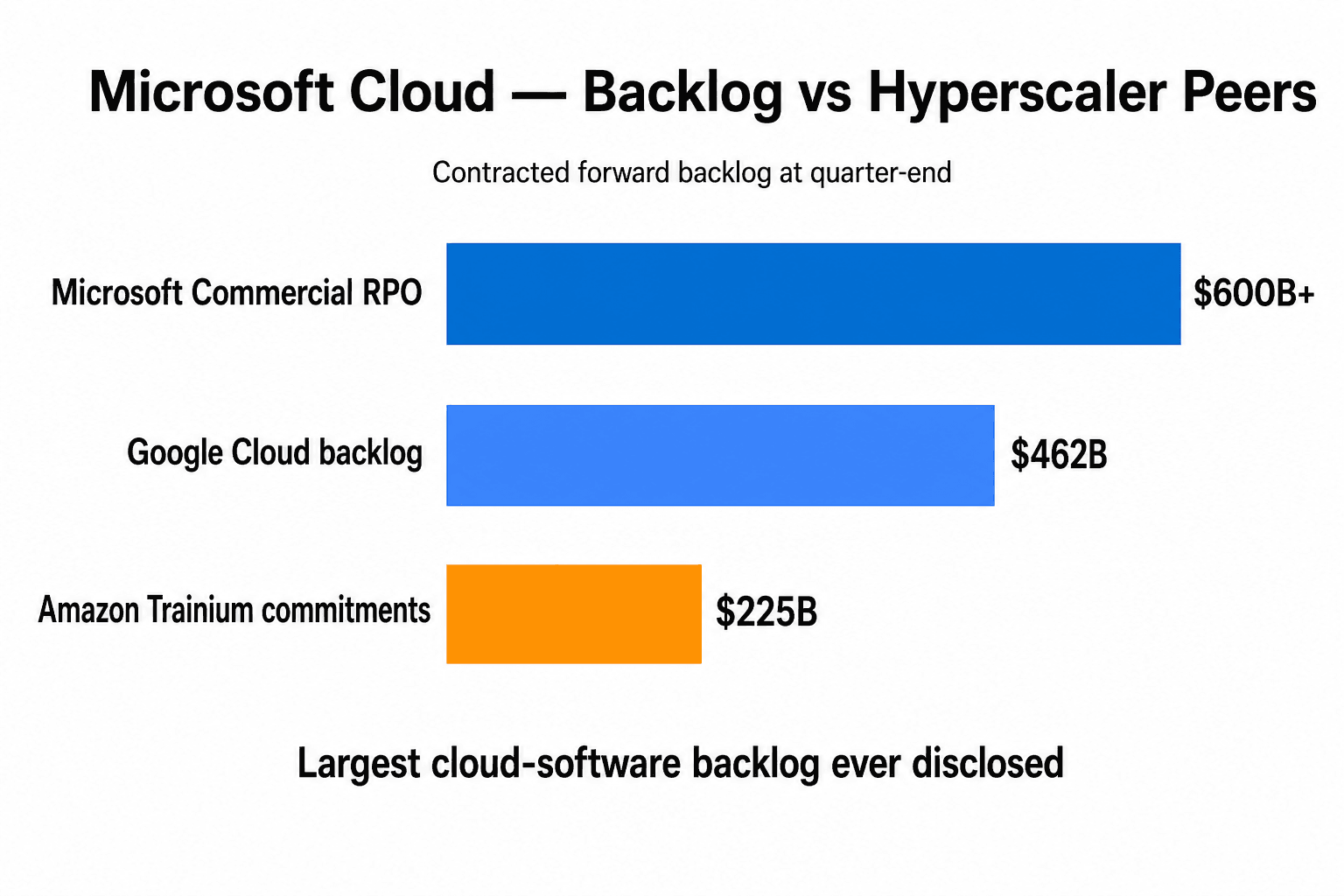
That is contracted, not forecast. RPO covers all Microsoft commercial agreements — Azure, M365, Copilot, Dynamics, GitHub, Power Platform — that have been signed but not yet revenue-recognized. By way of reference, Microsoft's current trailing-twelve-month commercial revenue is roughly $200-220B. A $600B+ RPO means Microsoft has approximately 3 years of contracted forward revenue on the books.
For comparison, on the same day (4/29), Google Cloud disclosed $462B in Cloud-only backlog (from $240B at end of Q4 2025 — nearly doubling QoQ), and Amazon disclosed $225B in Trainium-only commitments. Microsoft's $600B is broader scope but it is the largest software backlog ever publicly reported.
What that does to the bear case: the 2027 capex commitment of "significantly higher than $190B" is no longer a leap of faith — it is the cost of fulfilling already-contracted demand. That changes the conversation from "is there a return?" to "how fast does the return compound?"
Copilot: the AI monetization datapoint Wall Street wanted
Through 2024 and most of 2025, the most-asked question on every Microsoft earnings call was how many Copilot seats are paid? For most of that period, the answer was either "we don't disclose" or implied figures in the 5-12M range.
Q3 FY26 changed that:
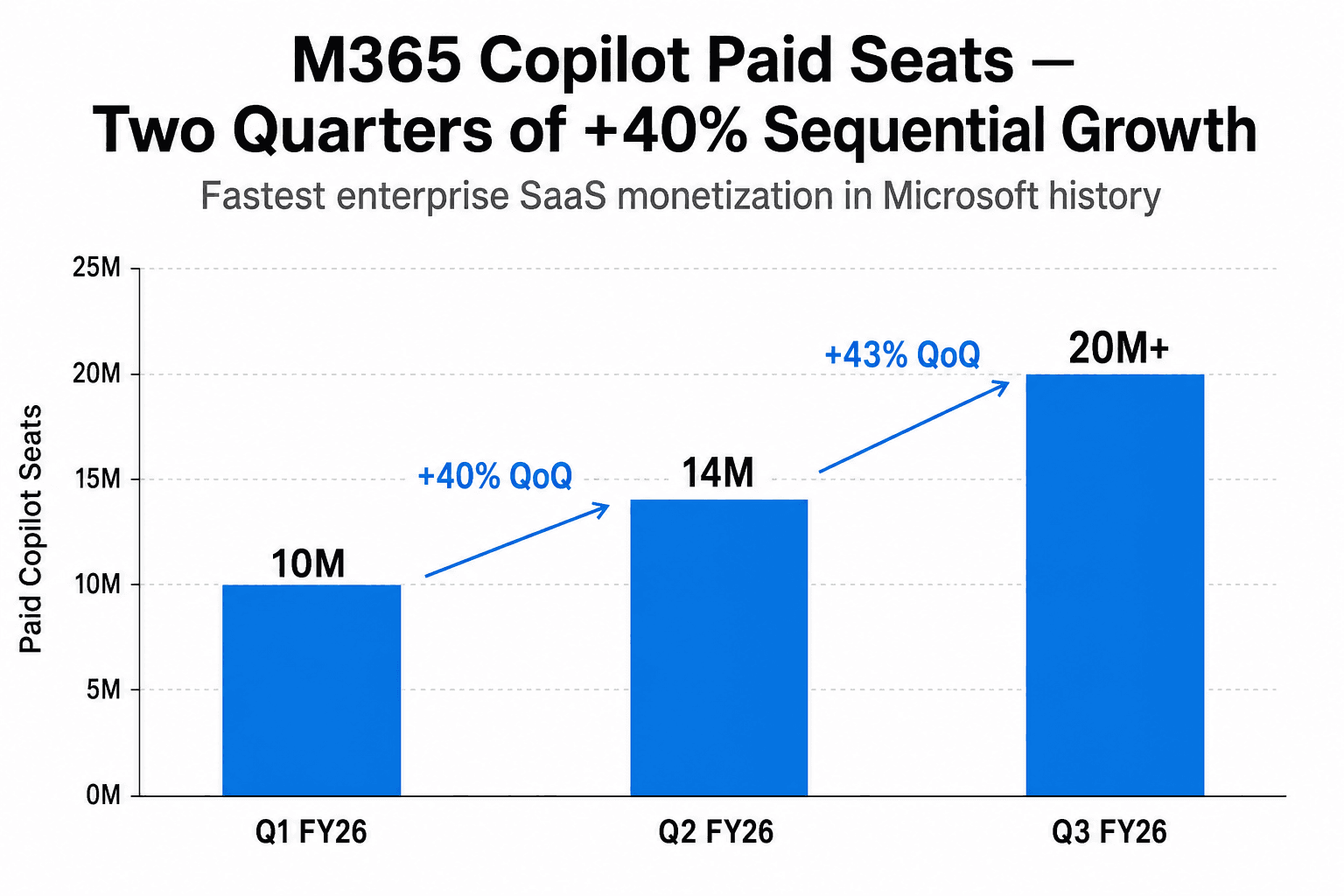
- Q1 FY26: ~10M paid Copilot seats
- Q2 FY26: ~14M (+40% sequential)
- Q3 FY26: >20M (+43% sequential)
Two consecutive quarters of >40% sequential growth on a base now exceeding 20M. That is the fastest enterprise SaaS monetization in Microsoft's history — faster than Office 365's original Office-to-cloud transition, faster than Teams' COVID-era ramp.
The pricing structure matters too: Copilot is sold at $30/user/month on top of M365. At >20M paid seats, that is a roughly $7-8B annualized Copilot revenue stream sitting inside the broader $35B Productivity & Business Processes segment. And it is the cleanest "AI is paying" datapoint any vendor has produced.
What hit the stock
The print was structurally bullish across every Azure, AI, and Copilot metric. The two things that compressed the next-day reaction:
First, the Q4 FY26 Microsoft Cloud gross margin guide of ~64% — down from 69% in Q3. Each percentage-point of compression on $54B+ revenue is real dollar earnings drag. Amy Hood explained the cause directly: AI capacity is depreciating through the P&L before the corresponding AI revenue scales. As utilization rates rise on already-deployed infrastructure, gross margin normalizes — but the company is "not yet at the steady-state."
UBS now models steady-state Microsoft Cloud gross margin in the low-60s through 2026-2027, versus the 70%+ profile MSFT carried in FY24. That is a structural reset of the operating-margin expectation, even if the underlying business growth is faster than ever.
Second, the 2027 capex commentary. Hood declined to give a specific 2027 capex number, saying only it will be "significantly higher" than 2026. That is the same phrase Anat Ashkenazi used at Google and Susan Li used at Meta the same day — and the language drove META -7% on the day. MSFT investors gave it a different read because the $600B RPO underwrites the spend, but sell-side (UBS, JPMorgan, Wedbush) still cut PTs to reflect FY27 capex scenarios beginning with a 2 ($200B+).
What the bulls and bears actually fight about
Bull case: Microsoft is the only enterprise-AI platform with all four ingredients now visible at industrial scale — Azure as the inference fabric (+39% CC growth, capacity-constrained), Copilot as the application layer (>20M paid seats, +43% sequential), M365 as the distribution layer (300M+ commercial seats), and a $600B RPO that pre-funds 3 years of forward revenue. The capex line is the cost of building permanent infrastructure for an industry-scale AI platform that customers are already paying for.
Bear case: 2027 capex is unbounded, and Microsoft Cloud gross margin compression to 64% (and possibly lower) on $200B+ annual cloud revenue is a multi-billion-dollar structural earnings reset. Per-seat to per-usage transition makes traditional SaaS booking comparability harder. And the Apple-Anthropic-OpenAI battle for who controls the AI distribution layer is not yet resolved — Microsoft's MSFT-OpenAI exclusive arrangement is being renegotiated and OpenAI has moved meaningful workloads to AWS Trainium and Google TPU.
The print did not resolve the debate. It simply confirmed the bull case has the strongest contracted-backlog evidence of any vendor, and the bear case has the cleanest gross margin compression evidence yet seen.
Forward look — what the FY26 Q4 print (late July 2026) will turn on
Three datapoints to track:
- Azure CC growth Q4. Guide is +39-40%. A print at +40%+ would suggest the structural re-acceleration has further upside. A print below +38% would suggest Q3's +39% was a capacity-rebound rather than a structural step.
- Microsoft Cloud gross margin Q4. Guide is ~64%. A print at 65%+ would meaningfully cool the margin-compression bear case. Sub-63% would deepen it.
- Copilot paid seats Q4. Q3 was >20M. Anything above 28M (= +40% sequential again) confirms the SaaS-flywheel narrative. Anything below 25M would suggest the rapid sequential compounding is moderating into a more typical software adoption curve.
All financial figures sourced from Microsoft's Q3 FY2026 Press Release (filed 2026-04-29), the Q3 FY2026 earnings call transcript, and the Microsoft IR Performance page. Analyst quotes and price-target moves sourced from Marketbeat, TipRanks, and Public.com coverage.