Microsoft FY26 Q4: Azure Reaccelerates to 43%
A record year, and a quarter the market rewarded
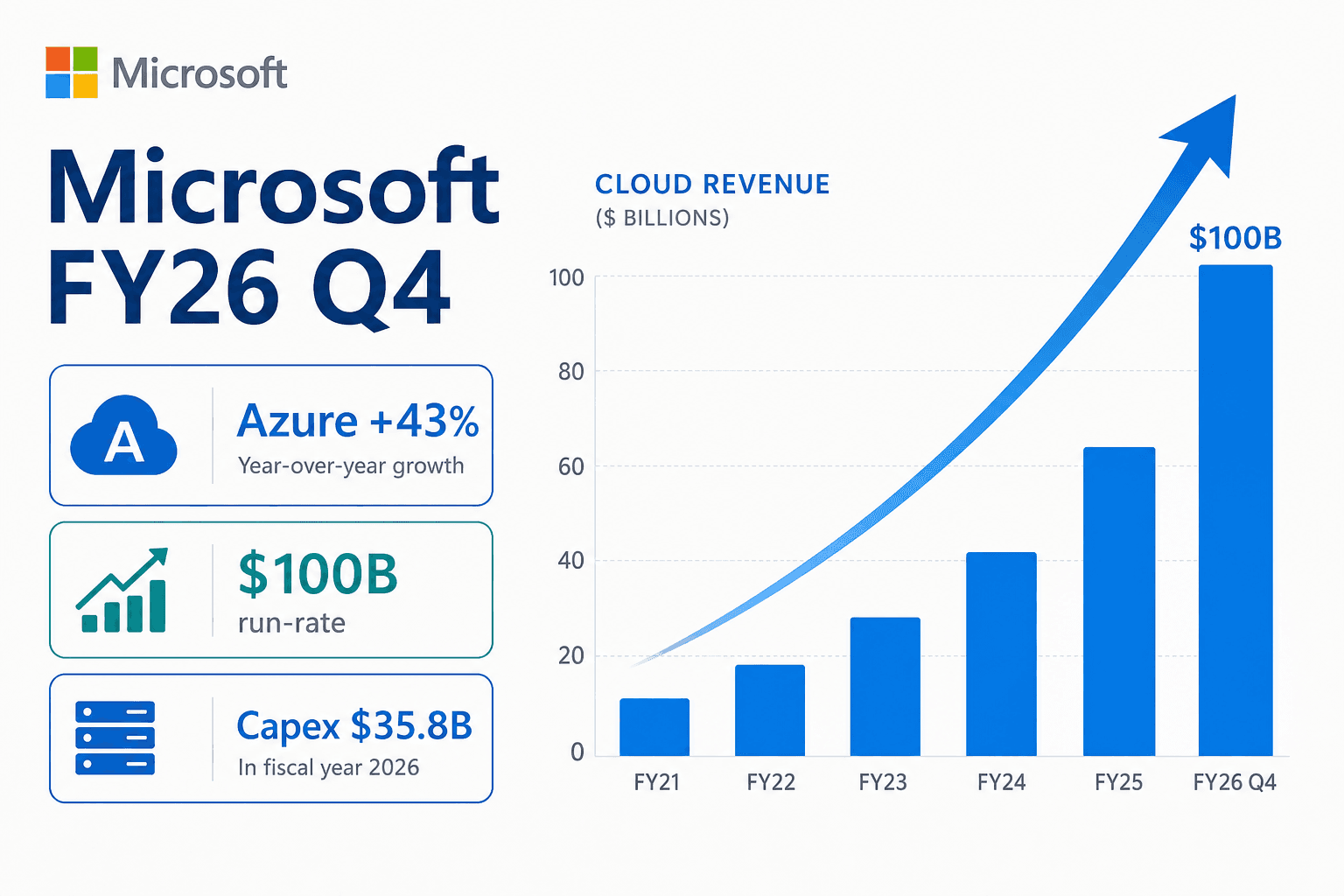
Microsoft closed its 2026 fiscal year with the kind of quarter that settles an argument. For the three months ended June 30, 2026, revenue rose 17.7% from a year earlier to $90.0B, and the number investors cared about most, Azure growth, reaccelerated to 43%. That was the fastest pace in years and a decisive break from the 39% to 40% plateau Azure had sat on for four straight quarters, a flatness some read as the early sign of a slowdown.
The reaction was immediate. Microsoft shares had closed the regular session at $390.54, slightly lower on the day, then rose 7% to 8% after hours toward $418 to $420 as the results landed. The timing made the move stand out: Meta reported the same evening and fell sharply on an earnings miss and collapsing free cash flow. Two of the biggest spenders on artificial intelligence delivered opposite verdicts within an hour of each other, and the difference came down to whether the spending was visibly paying off.
Azure breaks the plateau
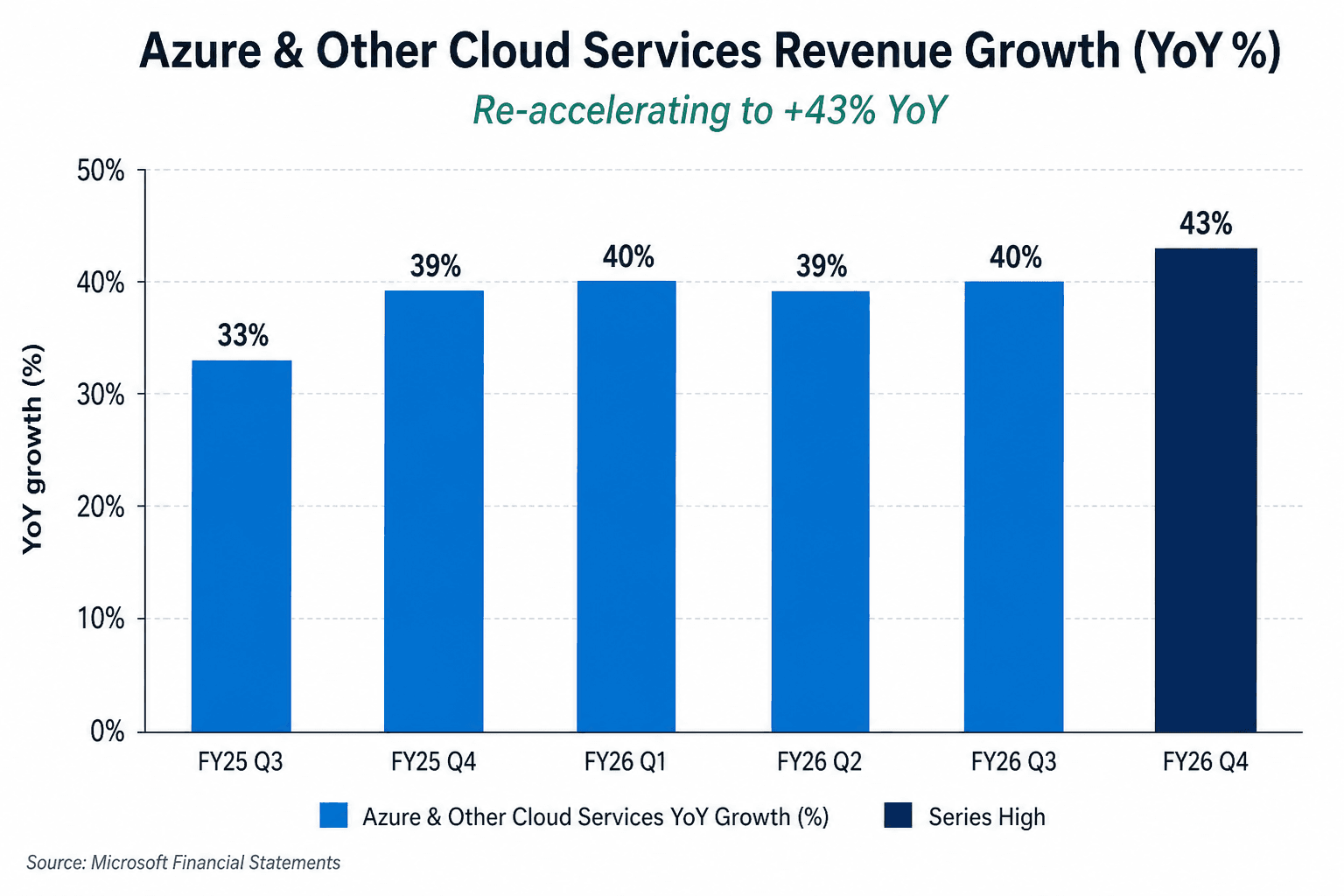
The acceleration matters because of what it broke. Azure had grown 39%, 40%, 39% and 40% over the prior four quarters, a remarkably steady band that fed a narrative about the law of large numbers finally catching up with Microsoft's cloud. The jump to 43% punctured it. On the call, Amy Hood tied the reacceleration directly to supply: customer demand continues to exceed available capacity, and when Microsoft squeezes out efficiency gains, they are "quickly monetized in the quarter." The constraint is real enough to show up in spot-market pricing for cloud assets.
The milestone underneath the growth rate is the bigger story. Azure crossed $100B in annual revenue for the first time this fiscal year, up 41%. A business that size still compounding above 40% is unusual, and it reframes Azure from a promising segment into one of the largest cloud franchises in the world. For the first quarter of fiscal 2027, management guided Azure growth to about 45% in constant currency, above the roughly 41% analysts expected, a rare case of a company guiding acceleration rather than the usual deceleration.
Microsoft Cloud crosses $59B
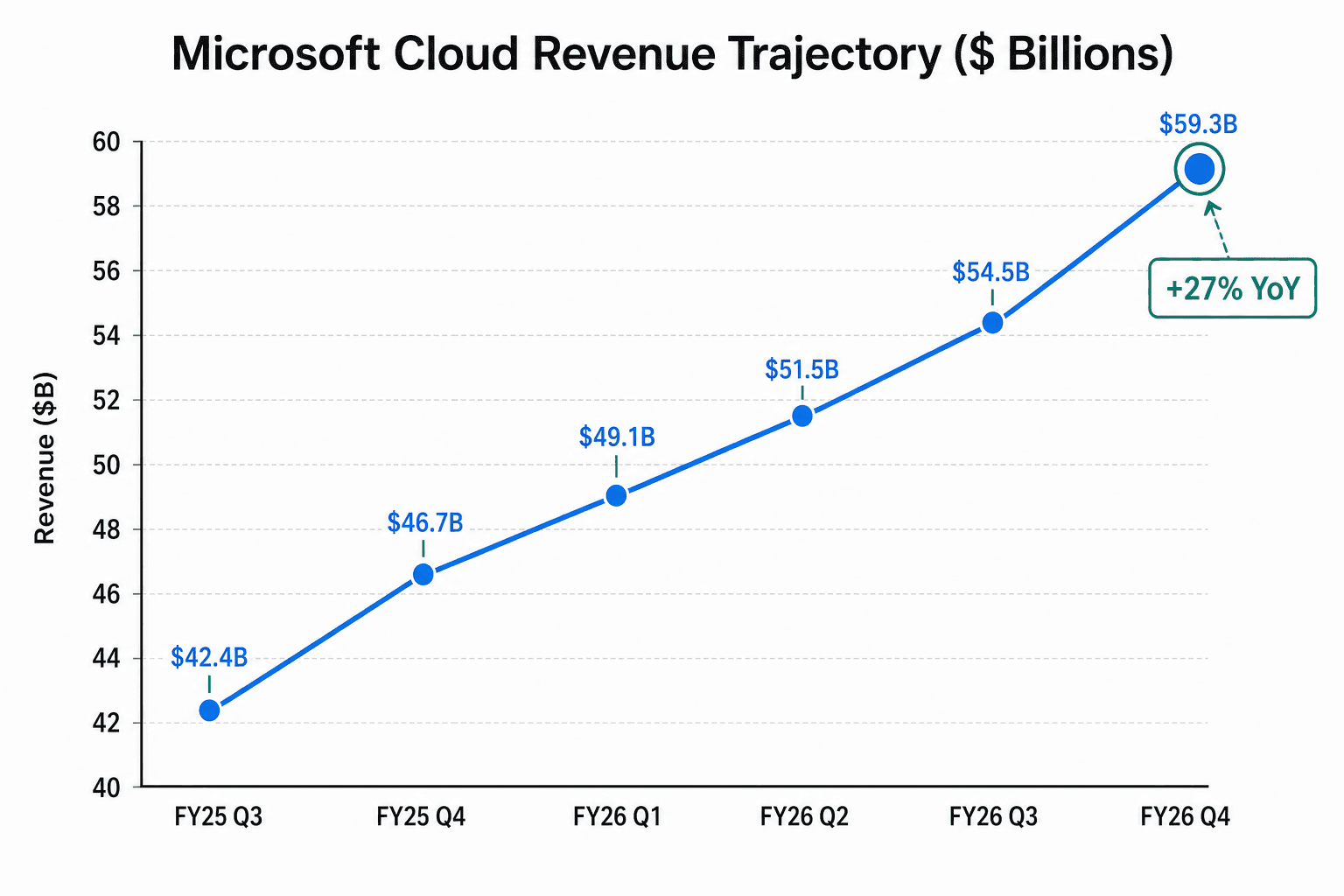
Azure sits inside a broader cloud aggregate. Microsoft Cloud, which bundles Azure with the commercial versions of Microsoft 365, Dynamics 365 and LinkedIn, reached $59.3B, up 27% year over year. That pulled the Intelligent Cloud segment up 32% to $39.3B and helped lift companywide operating income 18% to $40.6B, with the operating margin holding at 45% even as depreciation from the AI build-out climbed. For the full fiscal year, Microsoft Cloud surpassed $214B in revenue, also up 27%.
The margin discipline is the part that reassures. Companywide gross margin, the share of revenue left after the direct cost of delivering products, slipped to 67% as the mix shifted toward the more capital-heavy Azure. Hood noted Microsoft Cloud's own gross margin came in "better than expected at 65%," down year over year but cushioned by efficiency gains in Azure and the Microsoft 365 commercial business. Microsoft is growing its cloud fast without letting profitability fall apart, the balance investors most want to see at this stage of the AI cycle.
The capex surge and how it gets funded
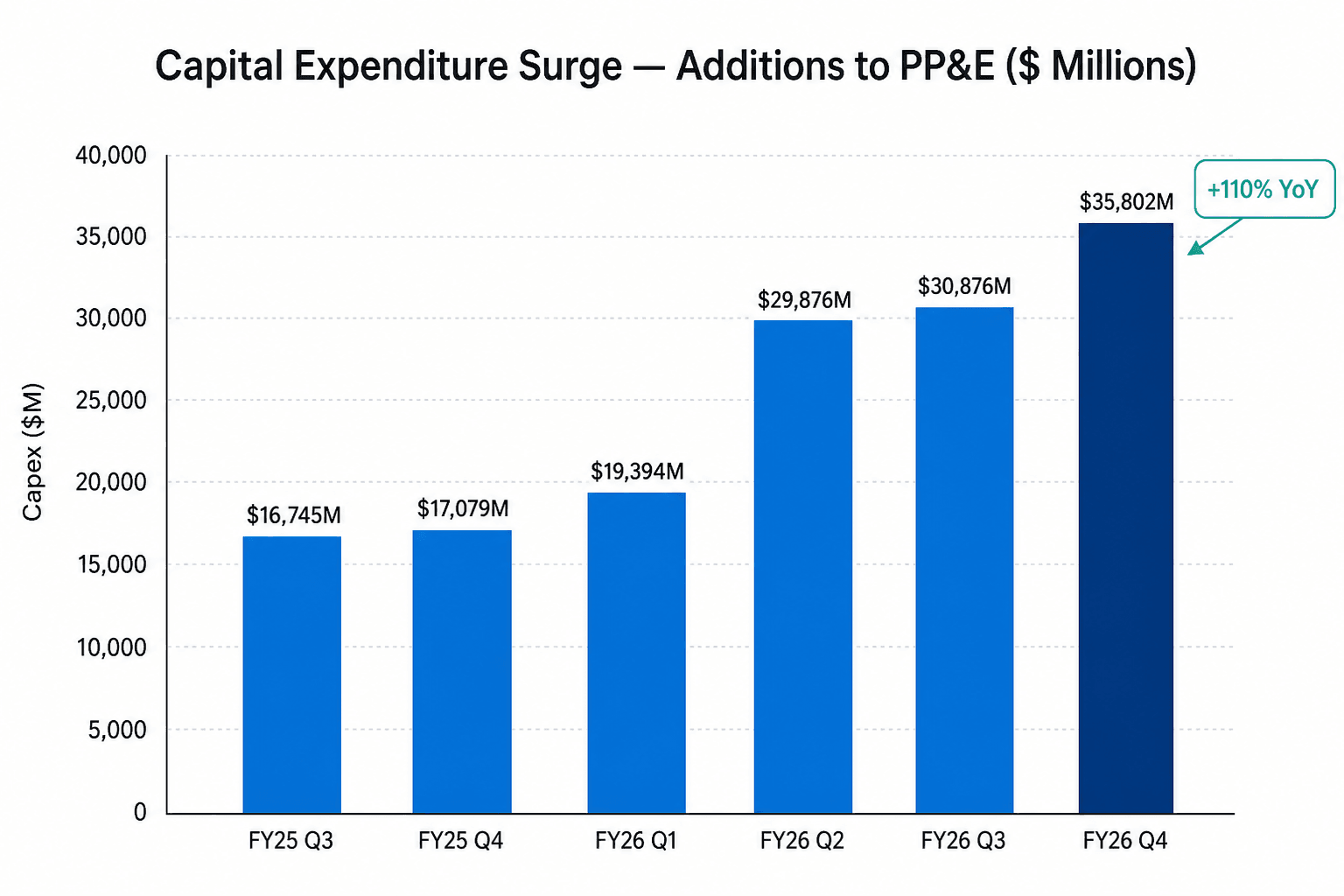
Here is the number that would have sunk a weaker report. Cash capital expenditure, the money Microsoft sinks into long-lived assets like data centers and chips, hit $35.8B, up 110% from a year earlier and a single-quarter record. Counting finance leases, total capital spending was about $41B, and Hood said roughly two-thirds went to short-lived assets, mainly the CPUs and GPUs that run AI workloads rather than the buildings that house them. For the full fiscal year, capex nearly doubled to $115.9B.
What kept the market calm is that Microsoft is still paying for this out of its own pocket. Operating cash flow rose 30% to $55.4B, comfortably covering the capex and leaving $19.6B of free cash flow, the cash left after running the business and investing in it. Microsoft still returned $10.2B to shareholders in the quarter and more than $43B across the fiscal year. That self-funding is the cleanest contrast with peers: Meta's free cash flow cratered to $784M under a similar spending ramp, and its stock paid the price the same night.
The forward guide is where the spending gets uncomfortable. Management guided first-quarter FY27 capex above $50B and said full-year spending would grow again, a trajectory analysts peg near $255B to $260B, up roughly 35%. One accounting change complicates the picture: starting in FY27 Microsoft is stretching the assumed useful life of its data centers and buildings from 15 to 25 years, shifting more leases from finance to operating leases and mechanically lowering the reported capex line. That reclassification is why the company trimmed its stated calendar-2026 capex expectation to about $175B while insisting the actual build-out is unchanged.
A record backlog underwrites the spend
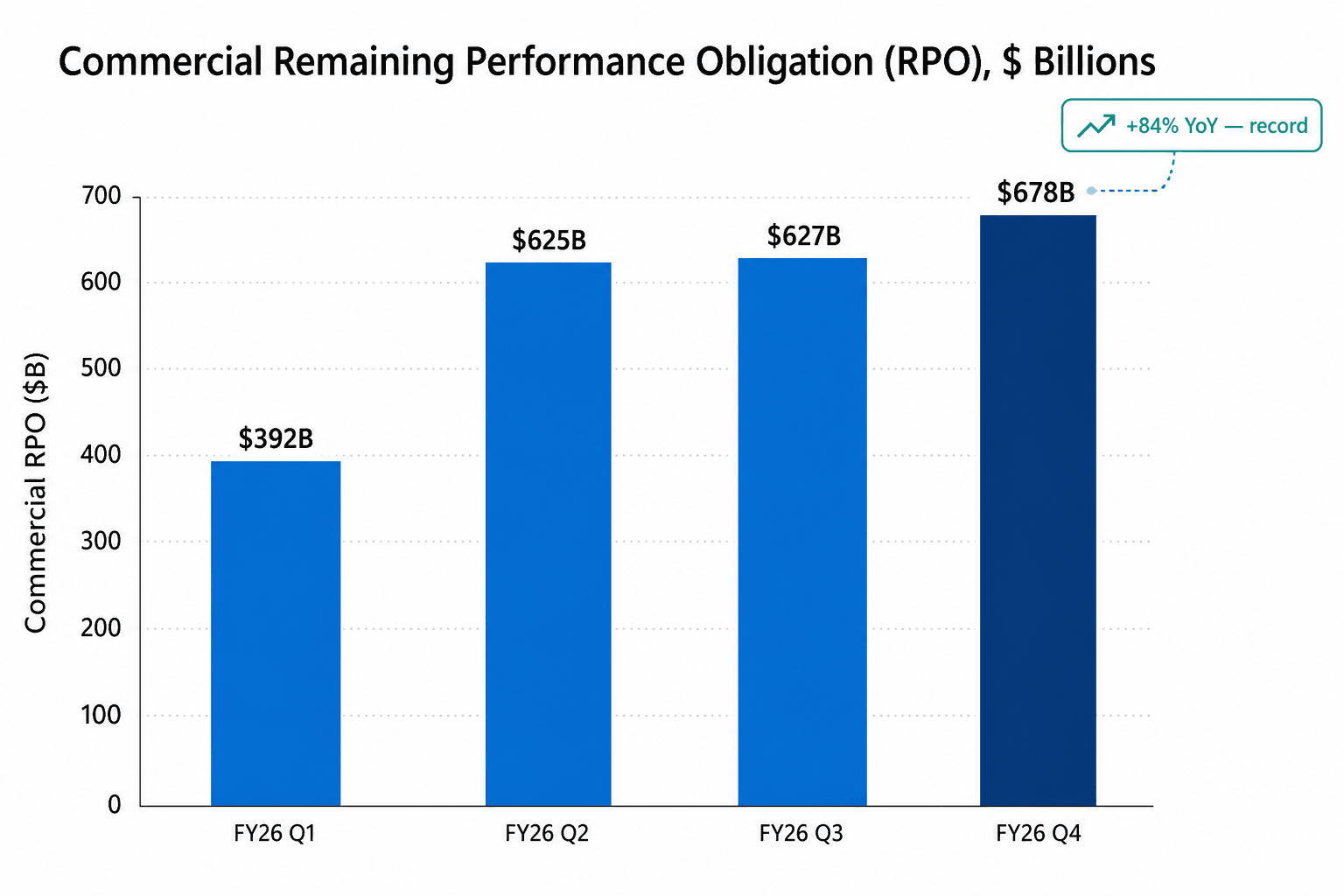
The single figure that let investors look through the capex was the backlog. Commercial remaining performance obligation, or RPO, the contracted future revenue Microsoft has signed but not yet recognized, jumped 84% to a record $678B. Even excluding the large Azure commitments from OpenAI, it grew 25%. The backlog carries a weighted-average duration of 2.3 years, and Hood said roughly 30% of it should convert to revenue within the next twelve months. When a company is spending a record amount on capacity, a backlog growing even faster is the strongest evidence the demand is real, and it is the datapoint that most separated Microsoft's night from Meta's.
The earnings-quality footnote
The headline profit needs a small asterisk. GAAP diluted EPS of $4.81 was up about 32% year over year, but "other income" this quarter included a roughly $3.2B gain on Microsoft's stake in the AI lab Anthropic, worth about $0.33 of that EPS. Adjusted for investment items, EPS was closer to $4.74, up 23%. The Anthropic gain is a paper revaluation of a holding Microsoft has not sold, so it can reverse in a later quarter and tells you nothing about how the core business performed. Microsoft's other big AI relationship cut the other way in a smaller amount: its OpenAI investment added about $0.07 to EPS this quarter, after dragging on earnings a year ago. The honest gauge of the quarter's profit is the $40.6B operating line.
What the Street made of it
Coming in, sentiment was already positive, with a consensus Buy to Strong Buy across roughly 90 to 100 covering analysts and an average price target near $590. The reaction split along a familiar line. Houses that had trimmed targets into the print on capex-digestion worries, including Citi, which cut to $570, Wells Fargo to $625, and Mizuho to $490, were answered by post-print raises from the bulls: Morgan Stanley's Keith Weiss lifted his target to roughly $650 and called Microsoft a top pick, Wedbush's Dan Ives went to about $600 arguing "Wall Street is underestimating Azure," and Bernstein's Mark Moerdler moved to roughly $641, writing that "the engine of growth is strong and getting stronger."
The debate that remains is not about demand. Azure's reacceleration, the $678B backlog and the above-consensus FY27 Azure guide gave the bulls their forward visibility. The open question is the FY27 capex-and-margin trade: whether spending toward $255B a year compresses returns faster than the cloud revenue can absorb it. Management's answer, repeated in different words all call, was that the spend is demand-driven and adjustable, weighted toward short-lived assets and flexible leases it can slow if demand softens.
The forward look
This report was the cleanest possible answer to the question hanging over every hyperscaler: can record AI spending coexist with a healthy business? For one quarter, Microsoft's answer was yes. Azure reaccelerated instead of fading, the backlog grew faster than the capex, cash flow still covered the bill, and the operating margin held at 45%. That combination is why the stock rose while Meta's fell on the same theme the same evening.
The risks did not disappear, they moved out a year. FY27 capex is guided sharply higher, gross margin is drifting down as the mix tilts to Azure, and a useful-life change now sits between the reported numbers and the physical build-out, making the spend harder to read. For the coming quarters, three things will decide how the stock holds its gains: whether Azure can sustain growth near the 45% it just guided, whether the record backlog converts into revenue on schedule, and whether free cash flow stays positive as capex climbs past $50B a quarter. Microsoft has bought itself the benefit of the doubt. Now it has to keep spending into it.