Marvell Q2 FY27: margin plateau traded for scale
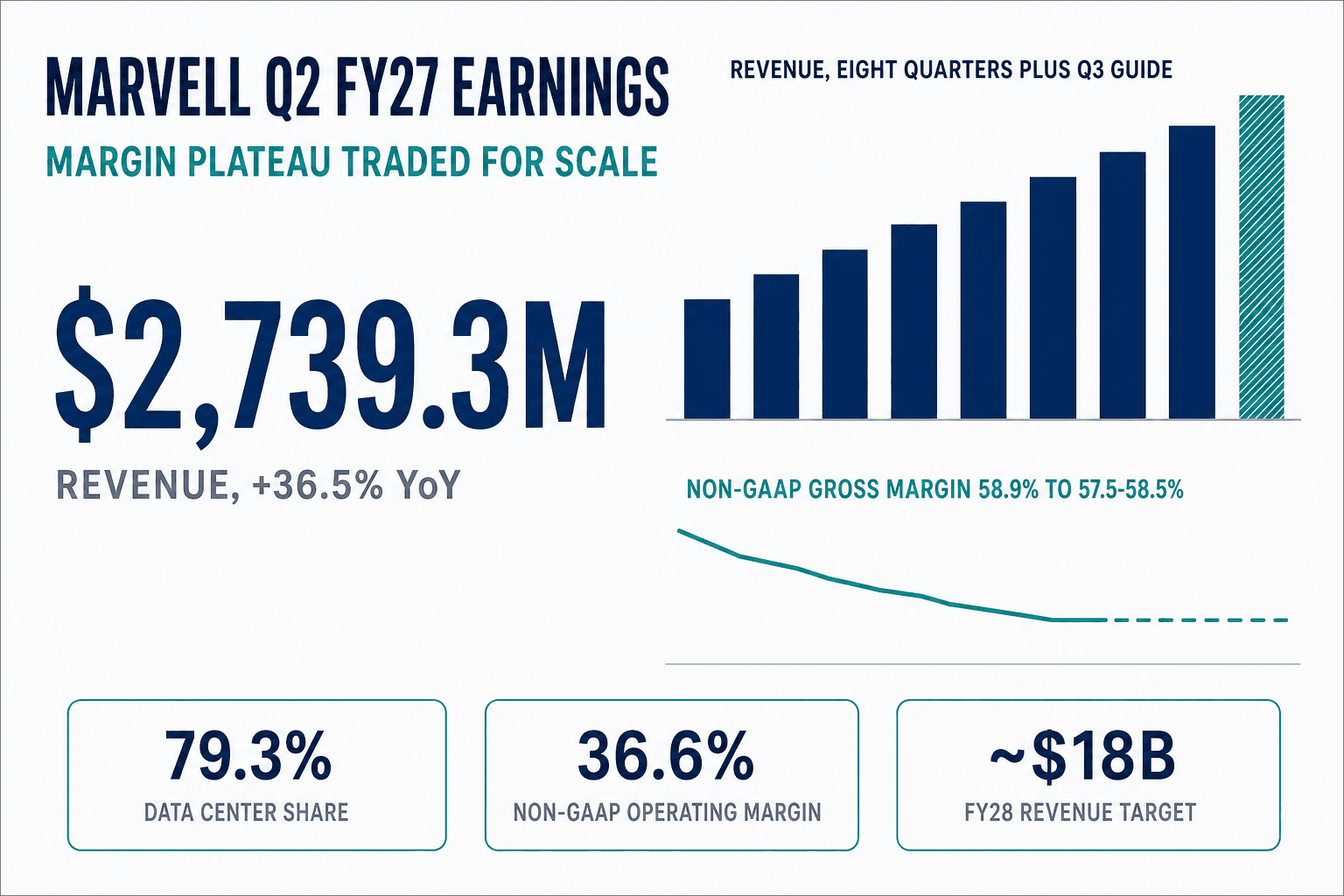
Marvell reported the best quarter in its history on Thursday evening. The stock fell about 8%.
Nothing in the release did that. The damage came from a handful of sentences spoken by a CFO on his first earnings call.
The print, and the raise
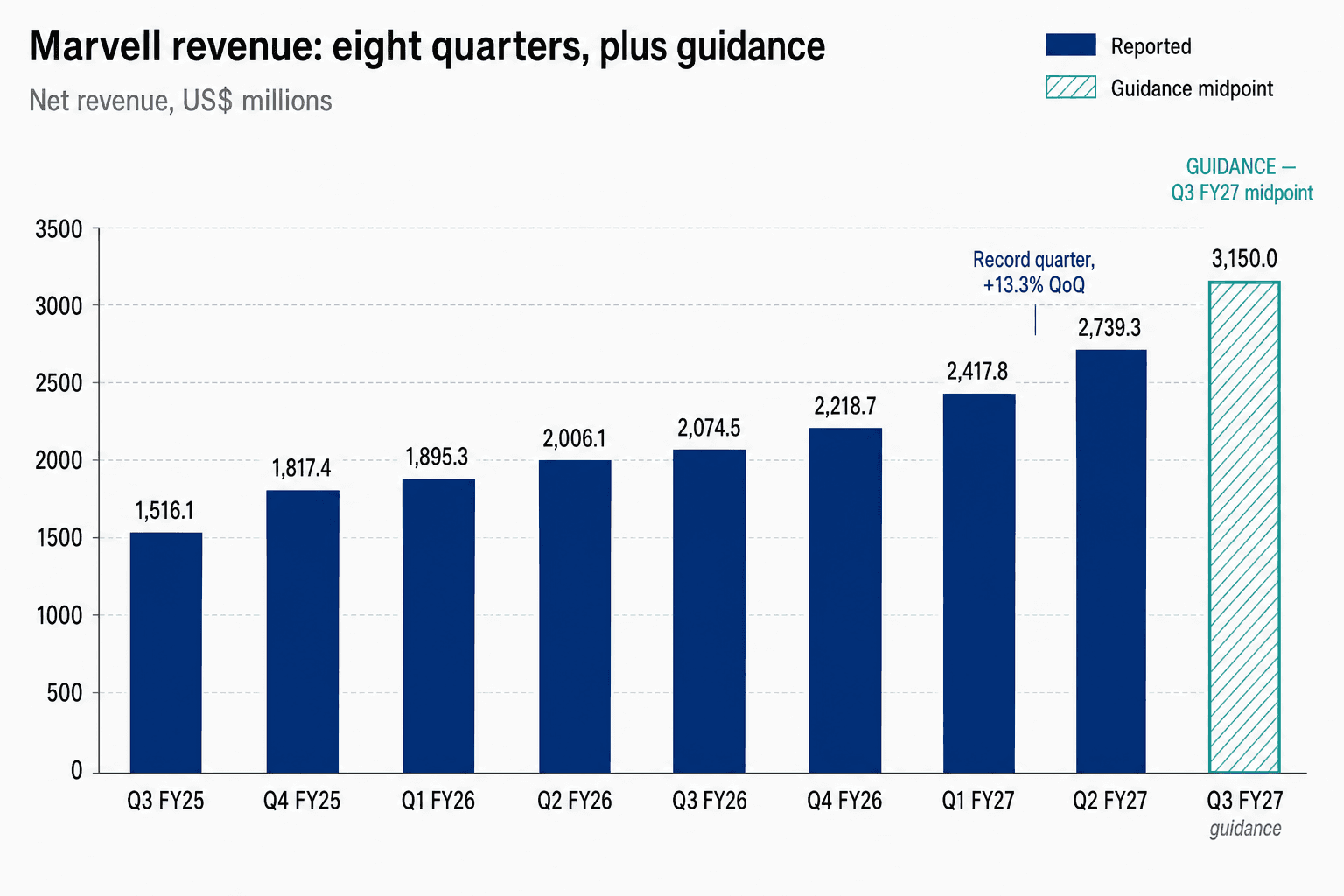
Revenue for the quarter ended August 1 was $2,739.3 million, up 36.5% year over year and 13.3% sequentially. That is a record, the fastest sequential growth since January 2025, and $39.0 million above the midpoint Marvell guided in May. Non-GAAP diluted EPS was $0.94, a cent above the guided midpoint and up 40.3% year over year. (Non-GAAP strips out stock compensation and acquisition accounting; it is the number both management and the Street model.)
Then the guidance, which was better than the quarter. Q3 revenue is guided to $3.150 billion ± 5%, roughly 3.6% above the ~$3.04 billion consensus. The fiscal 2027 target went to about $12 billion from about $11.5 billion. Fiscal 2028 went to about $18 billion from $16.5 billion, a $1.5 billion raise on a year that has not started. Matt Murphy's framing: "even as our revenue base becomes significantly larger, our growth rate is accelerating."
One accounting note before anyone quotes the wrong figure. GAAP diluted EPS of $0.33 against $0.04 last quarter is not a 725% improvement in the business. Marvell marks contingent consideration from the Celestial AI and XConn acquisitions to market every quarter, and it has computed EPS under the two-class method since NVIDIA's $2.0 billion convertible preferred investment in March. The GAAP series is not comparable quarter to quarter. Use non-GAAP.
Data center is now four fifths of the company
Data center revenue was $2,171.5 million, up 18.5% sequentially and 45.7% year over year, and 79.3% of total revenue. That is the highest data-center concentration Marvell has ever reported, up 350 basis points in a single quarter. Both growth rates accelerated from Q1's 11% sequential and 27% annual.
Communications and other did $567.8 million, down 3.0% sequentially, its first sequential decline in eight quarters. Management guided it down again in Q3, then promised "a solid sequential recovery in the fourth quarter."
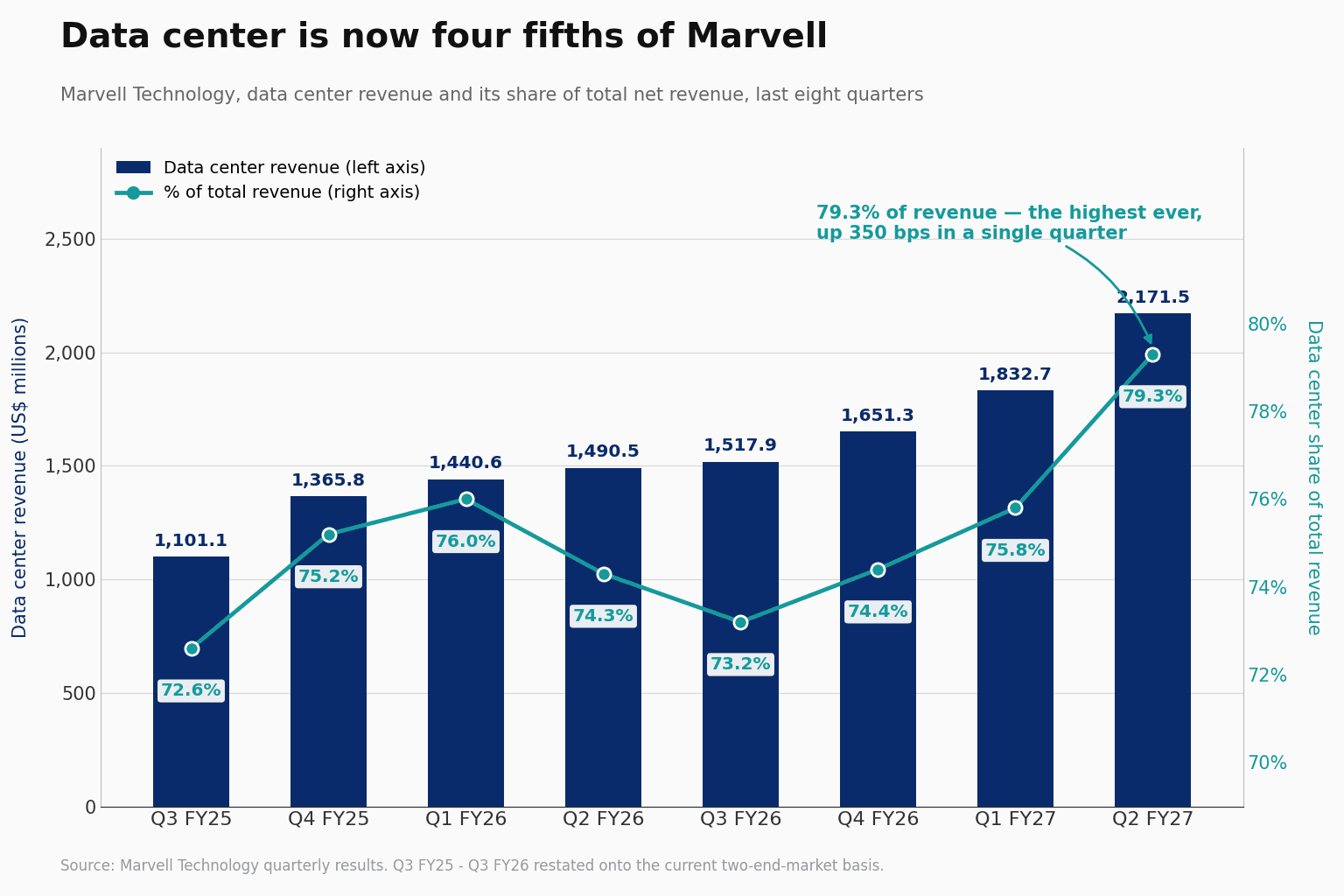
If you are comparing against older coverage, Marvell now discloses only two end markets. Enterprise networking, carrier infrastructure, consumer and automotive stopped being separate lines after Q3 FY26 and now sit inside "communications and other" with no split.
The sentence that cost 8%
Q3 non-GAAP gross margin is guided to 57.5% to 58.5%, against the 58.9% just delivered. Ninety basis points at the midpoint. On its own, forgettable.
Then CFO Dan Durn kept talking. Asked on the earnings call whether custom silicon was the cause, he said:
"Part of the acceleration story in Q3, as you point out, mix is the primary driver. We've got a strong ramp in custom, and so you can see that play out in the profiling of the margin. Not a surprise. We've been signaling that custom ramp for quite some time."
Custom silicon means chips Marvell designs to one customer's specification rather than catalogue parts sold to everyone, and it carries a structurally lower gross margin than the optics and switching products it is displacing in the mix. On Q4: "we see Q4 gross margins in the same target range as Q3." On next year: "My preliminary view is gross margins next year are going to be in a similar range, same range as we're exiting this year."
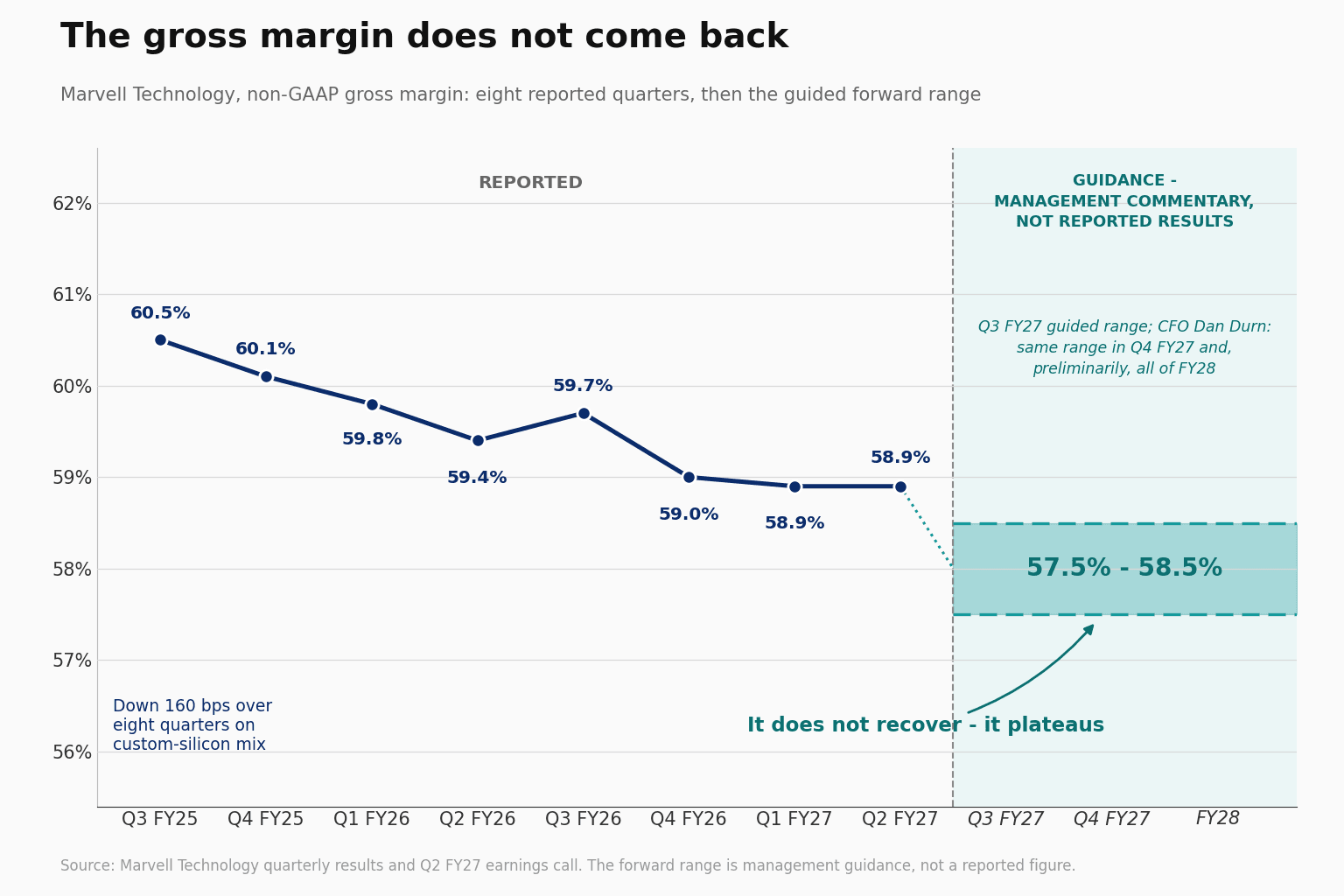
That is not a dip. It is a plateau, held for roughly two years, disclosed to a shareholder base sitting on a 184% year-to-date gain.
It is tempting to file this next to NVIDIA, which reset its own margin outlook the night before. Do not. NVIDIA blamed memory prices, an input cost it does not control. Marvell blamed mix, an internal choice about what it sells. Same direction, different disease.
The other half of the trade
The part most coverage will underplay: non-GAAP operating margin went the other way. It was 36.6%, up 160 basis points sequentially and 180 year over year. Management expects it to enter the long-standing 38% to 40% target range in Q4 FY27, and to reach the high end of that range through fiscal 2028, because operating expenses are planned to grow at roughly half the rate of revenue.
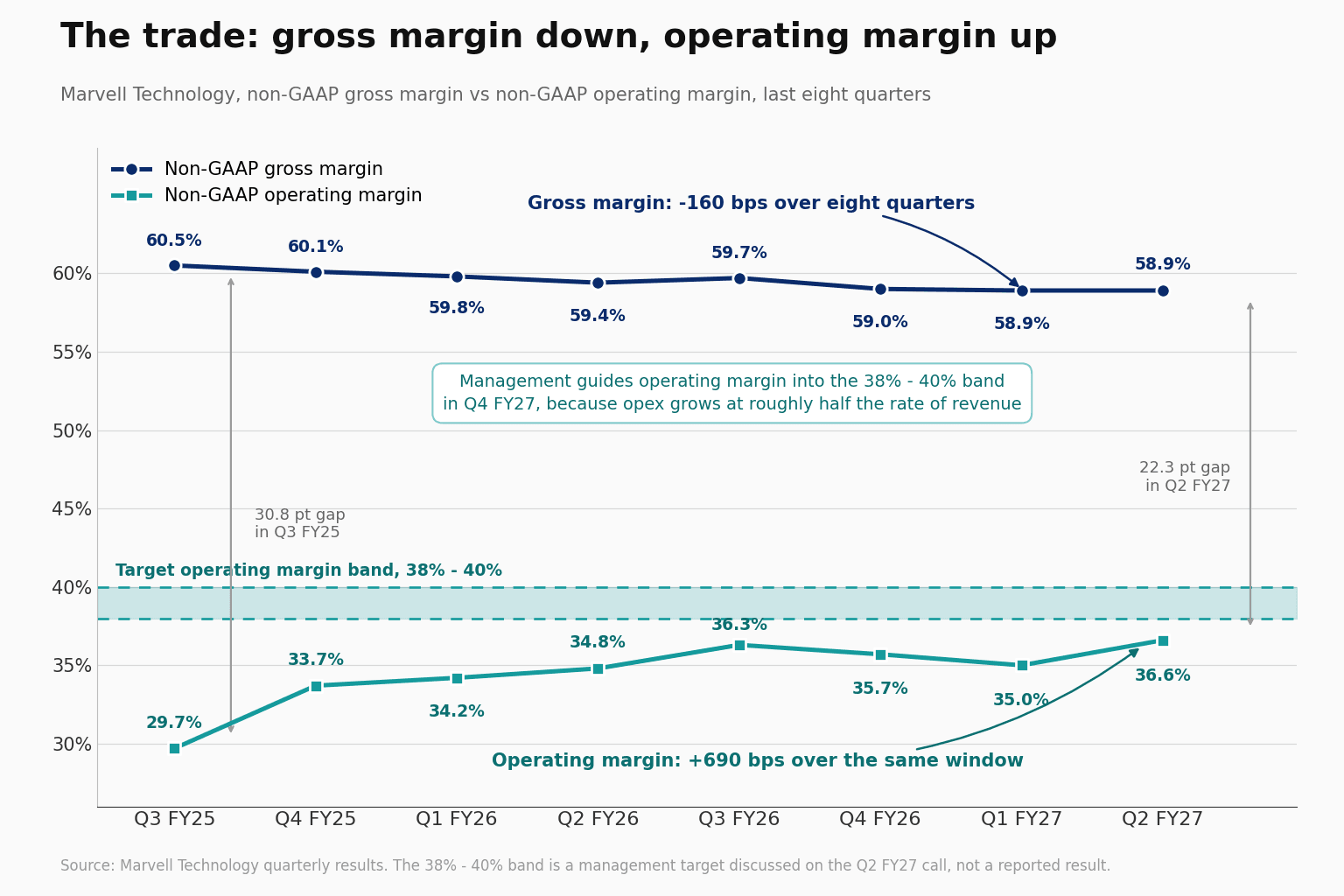
That divergence is the whole argument. Marvell is buying a much larger revenue base at a permanently lower gross margin, and betting operating leverage more than pays for it. On an $18 billion year, each point of gross margin is $180 million. Each point of operating margin is the same $180 million, and management thinks it can add three or four of them. The arithmetic favours the trade. Whether the mix stops sliding at 57.5% is the part nobody can prove yet.
Two smaller items belong in the same column. The non-GAAP tax rate goes from 11% this year to about 13% next, roughly two points of drag on EPS growth. And operating cash flow of $605.5 million fell 5.2% sequentially despite higher earnings, because Marvell is prepaying suppliers for capacity, about $1.0 billion of it this year. Supply, not demand, is the stated constraint.
Connectivity, and Google's actual clock
Two details from the call deserve more attention than they will get.
First, the $1.5 billion FY28 raise is not mainly a custom-silicon story. Asked directly, Murphy said connectivity "is probably the largest driver, net-net, of the $1.5 billion raise," pointing at scale-up optics, scale-out transceivers and switching. Custom is additive. The margin complaint and the growth driver are not the same product line.
Second, the Google warrant. The 8-K filed on August 19 covers up to 58,970,907 shares at $206.58, most of it vesting in 240 tranches of $500 million of custom-products revenue through fiscal 2033. Analysts did the multiplication out loud on the call: an envelope of roughly $120 billion over about six and a half years at full vesting. Murphy accepted the arithmetic, then said the thing the tape did not want to hear: revenue from those programs "through fiscal 2028 is already reflected" in existing targets. It is a contractual ceiling, not a forecast, it is not in the earnings release, and its incremental effect starts in fiscal 2029. Anyone who bought the 9.8% pop on August 19 as a near-term revenue event was corrected.
Where the Street was standing
Into the print, the sell side was as long as it gets: 42 buy-or-better ratings, 7 holds, no sells, consensus around $269. Every published target change in the week before the quarter was upward. There was no bear left to convert.
Then Marvell closed the August 27 regular session at $241.45, down 1.49%, before it reported. On a day when NVIDIA rose 8.74% and the connectivity complex ran hard behind it, Marvell was the worst performer in its cohort. It gapped up 3.4%, tagged $254.60, and bled all afternoon. Holders were taking risk off ahead of an event they did not want to be long into. After the release it traded around $221.50, roughly 8.3% below the close.
The verdict is still landing. As of early Friday only two sell-side firms had published dated post-print actions, and they disagreed politely: Oppenheimer went $300 to $325 and stayed Buy, TD Cowen went $225 to $245 and stayed Hold. Zero upgrades, zero downgrades. Two data points are not a revision wave.
Three things to watch
Whether 57.5% is a floor or a waystation. Durn's "same range" covers Q4 and, preliminarily, all of fiscal 2028. If the custom ramp is steeper than modelled, that range gets tested from below.
Whether concentration gets discussed. The hard numbers are stale, from the Q1 FY27 10-Q, and they are not comfortable: one distributor at 45% of revenue, one direct customer at 16%, the ten largest at 82% of last fiscal year. Data center just went to 79.3% of the company, and both NVIDIA and Google now hold equity or equity-linked instruments in it.
The Investor Day on October 6. Murphy acknowledged "a lot of upside bias" to the $10 billion-plus fiscal 2029 custom target and refused to resize it. Durn said the long-term model itself gets reset in New York. Refusing to quantify your upside on the day you disappoint on margin hands the bears six clear weeks.
Marvell just raised two years of guidance and told the market the gross margin is not coming back. Both statements are true. The market gets to decide which one it is buying.