Marvell Q1 FY27: NVIDIA just bought a piece of the merchant silicon bridge
There is a quarter sitting inside this print that nobody priced in, and Matt Murphy spent half the conference call describing it.
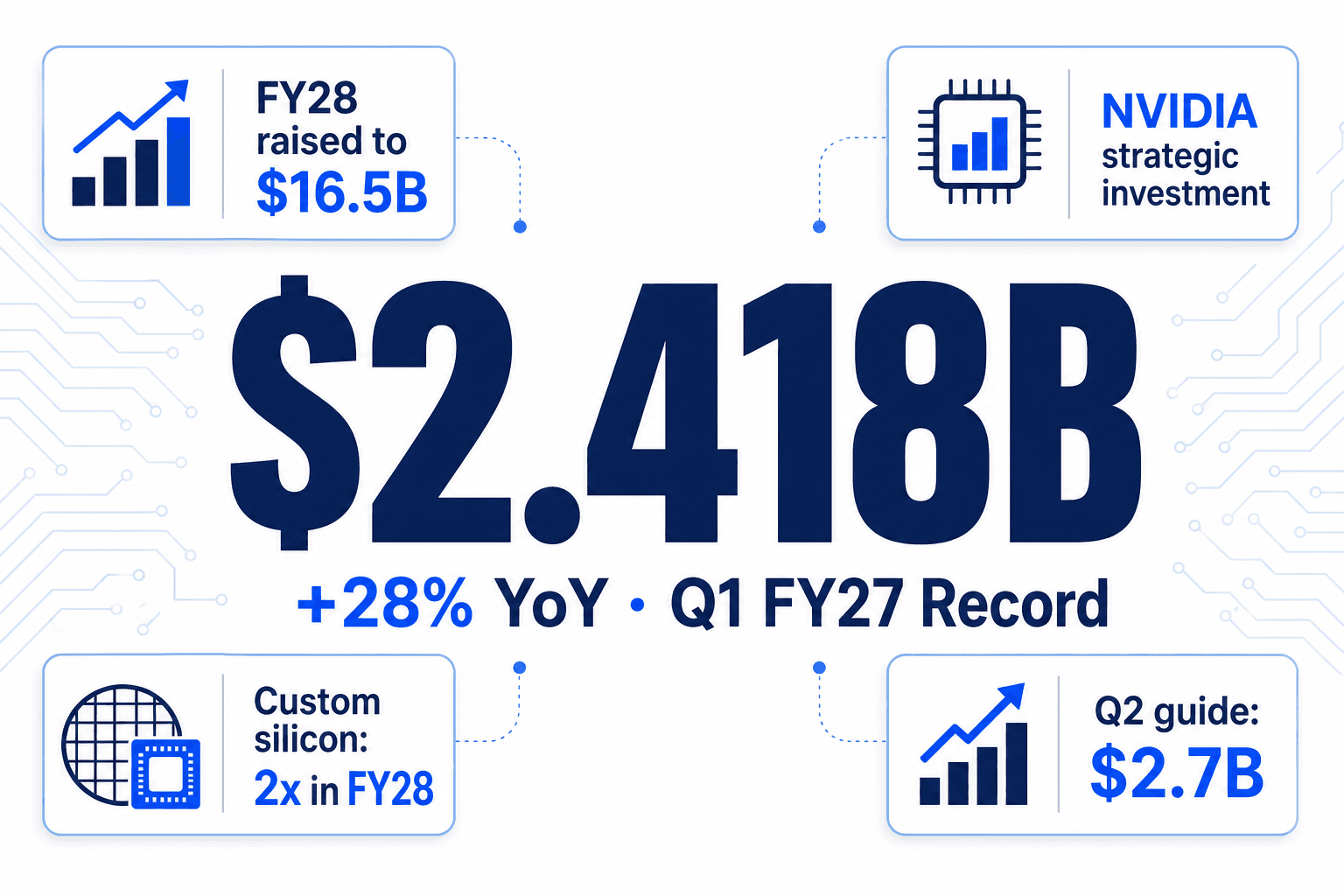
Marvell delivered Q1 FY27 revenue of $2.418B (+28% YoY, +9% QoQ), non-GAAP EPS of $0.80 (beating the $0.75 consensus), and Q2 FY27 revenue guide of $2.7B (+35% YoY at midpoint, $4–6B above where buy-side models sat post the March guide-up). Those are good numbers in a setup where the stock had already doubled YTD. The market gave it +3.5% after-hours on the release.
Then the conference call started, and the story changed.
The headline buried in the prepared remarks: NVIDIA has taken a strategic equity investment in Marvell, alongside a three-pillar partnership spanning optics, custom silicon, and AI RAN. The single largest customer concentration risk overhanging every merchant silicon company — NVIDIA's vertical integration eventually swallows the AI rack — just got partially neutralised by NVIDIA itself. The stock traded another +3.5% by close of call and held it overnight.
The four numbers to fix in your head
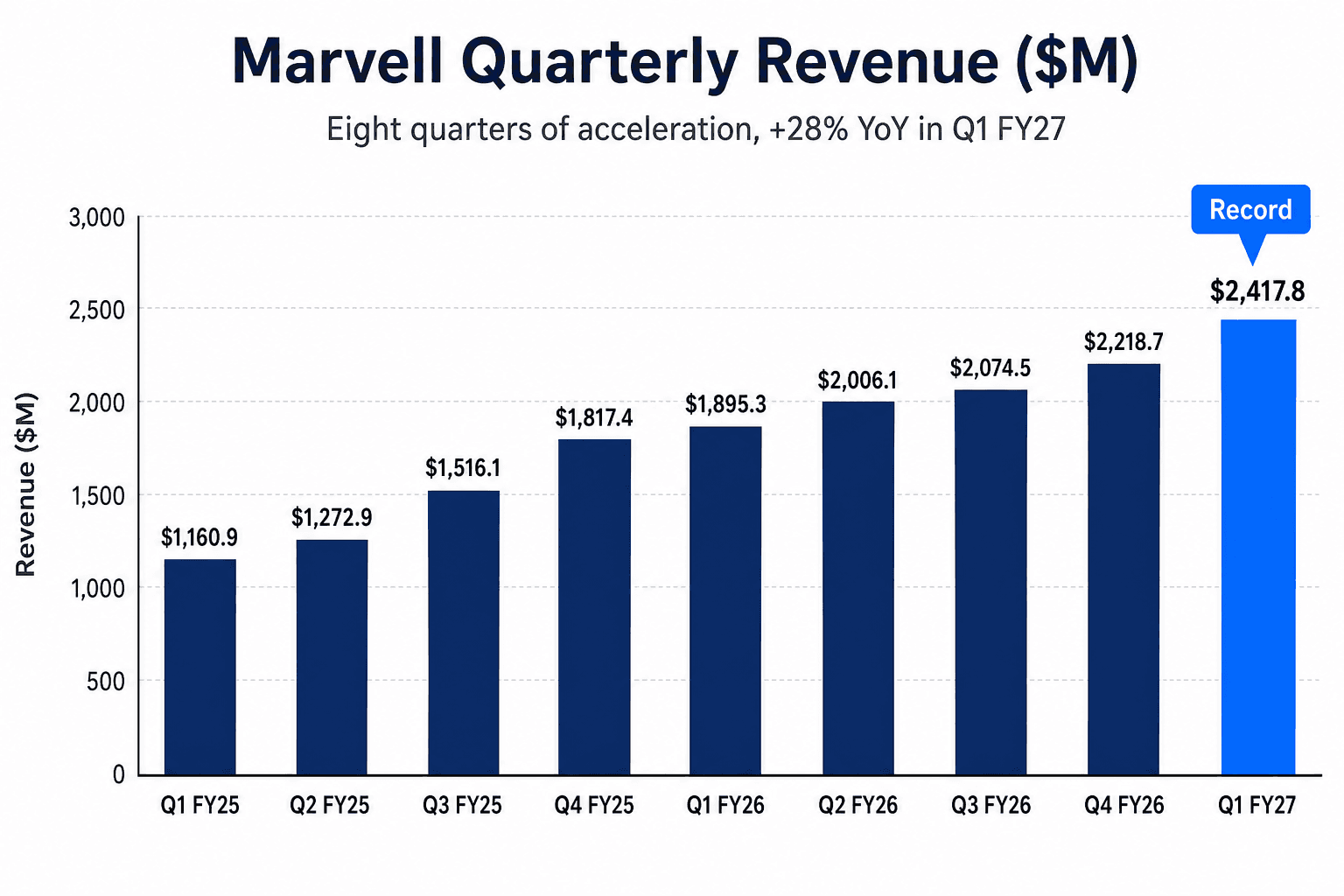
Q1 revenue $2.418B, +28% YoY. Q2 guide $2.700B, +35% YoY at midpoint. FY28 revenue ~$16.5B, up from the prior $15.0B outlook given just 12 weeks ago at the Q4 FY26 print. Non-GAAP EPS $0.80 in Q1, $0.93 at the midpoint of the Q2 guide — implying +16% sequential EPS growth on +12% sequential revenue, the kind of operating-leverage shape that has been missing from Marvell's P&L for two years of M&A drag.
The single most underrated line of the press release: "We expect revenue growth to continue accelerating each quarter throughout fiscal 2027." That is not the language of a company guiding to a typical AI-semis ramp. That is a company telling you the trough quarter of the year is already in the rearview.
The math on the FY28 guide is brutal: $11.5B implied FY27 → $16.5B FY28 is +43% YoY growth at the company level. With Communications & Other growing low single-digits, the entire delta is data center, which means data center is being guided to ~+55% YoY growth in FY28. That is faster than FY27's projected ~+50%. Which is faster than FY26's actual +46%. Three consecutive years of accelerating data center growth in a company where data center is now 76% of revenue.
Data center is the company now
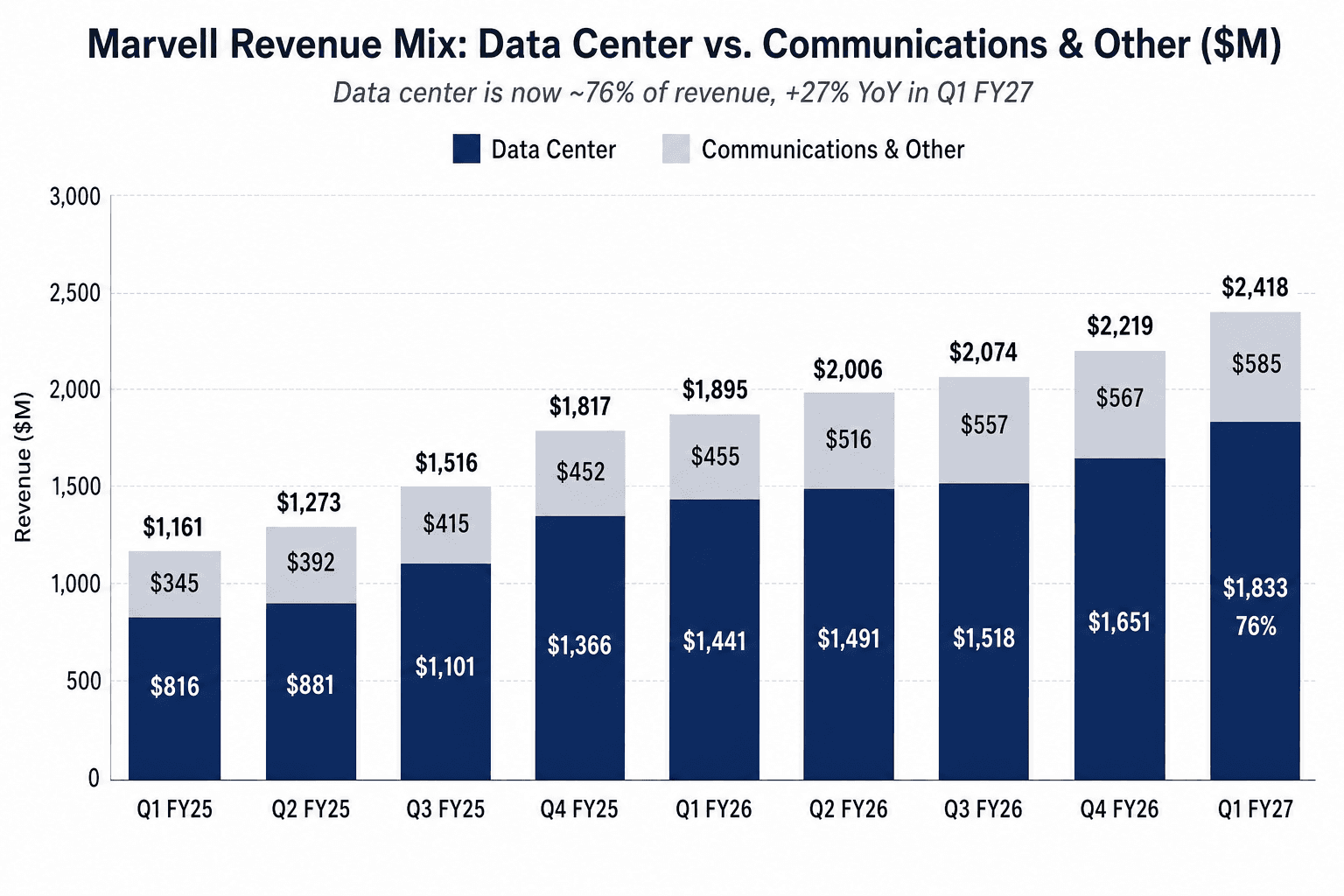
Marvell quietly collapsed five end-market reporting buckets — Data center, Enterprise networking, Carrier infrastructure, Consumer, Automotive — into two: Data center and "Communications and other." The change happened at the Q4 FY26 print but the implication is clearer this quarter: the legacy non-data-center half is being framed as cyclical recovery, not growth. Comms & Other is now $585M, growing low single-digits. Data center is $1.83B, growing +27% YoY and +11% sequentially, a re-acceleration from the +9% sequential print in Q4 FY26 and the +2–4% sequential prints earlier in FY26.
Inside data center, the company won't disclose explicit "AI revenue" — but they will disclose custom silicon revenue, which went from zero to $1.5B in FY26 and is guided to more than double in FY28. Marvell now has flagship XPU design wins at three Tier-1 US hyperscalers (Amazon Trainium is the named relationship; Microsoft Azure custom XPU and a third hyperscaler are the open secrets), plus 10+ XPU-attach programs in production. The June 2025 custom-silicon analyst day talked about a 50+ opportunity pipeline; Murphy's update this quarter: "Every program we looked at a year ago is larger when we look a year later."
The long-term FY29 custom-silicon target was lifted from ~$8B (April 2024 analyst day) to ~$10B+ (June 2025 update) and reiterated this quarter, implicitly at 18–20% share of a $55B+ TAM. For a company that printed zero custom silicon revenue in FY25, that is the steepest five-year ramp in the AI silicon comp set.
The NVIDIA partnership is not a press release
The NVIDIA deal has three pillars and matters in different ways:
Pillar one — optics. Marvell DSPs and optical components going into NVIDIA reference designs across InfiniBand and Ethernet. Reading-through to the AI-server bill of materials: every NVIDIA rack that integrates Marvell 1.6T DSPs is a unit of Marvell content that previously had to be competed for by module-by-module sale. This is the most operationally meaningful pillar.
Pillar two — NVLink Fusion + custom silicon. This is the strategic one. NVLink Fusion is NVIDIA's open NVLink-fabric initiative announced at GTC March 2026, allowing third-party silicon to participate in NVLink rack topologies. Marvell custom XPUs (the Amazon / Microsoft / third-hyperscaler designs) will interoperate with NVIDIA NVLink fabric — meaning a hyperscaler can mix a NVIDIA GPU rack with a Marvell-designed custom XPU rack and still have unified NVLink memory semantics across both. Murphy described Marvell as "the bridge between custom and merchant architectures." Translated: NVIDIA has acknowledged that custom XPU silicon is not going away and would rather own the fabric layer than fight Marvell module-by-module.
Pillar three — AI RAN. Marvell Octeon base-station processors working with NVIDIA GPUs for converged 5G/6G + AI workloads at the telco edge. This is the smallest of the three pillars by near-term dollars but the largest by optionality — if AI RAN is the form factor for 6G, Marvell + NVIDIA is now the reference architecture.
The equity investment is the tell. NVIDIA doesn't take strategic positions in companies it intends to compete with. The bear case ("NVIDIA will eventually own the optical and the fabric") just bumped into the bear case's biggest counterargument: NVIDIA bought a piece of the merchant silicon bridge instead of building it.
Gross margin is the only thing the bears still own
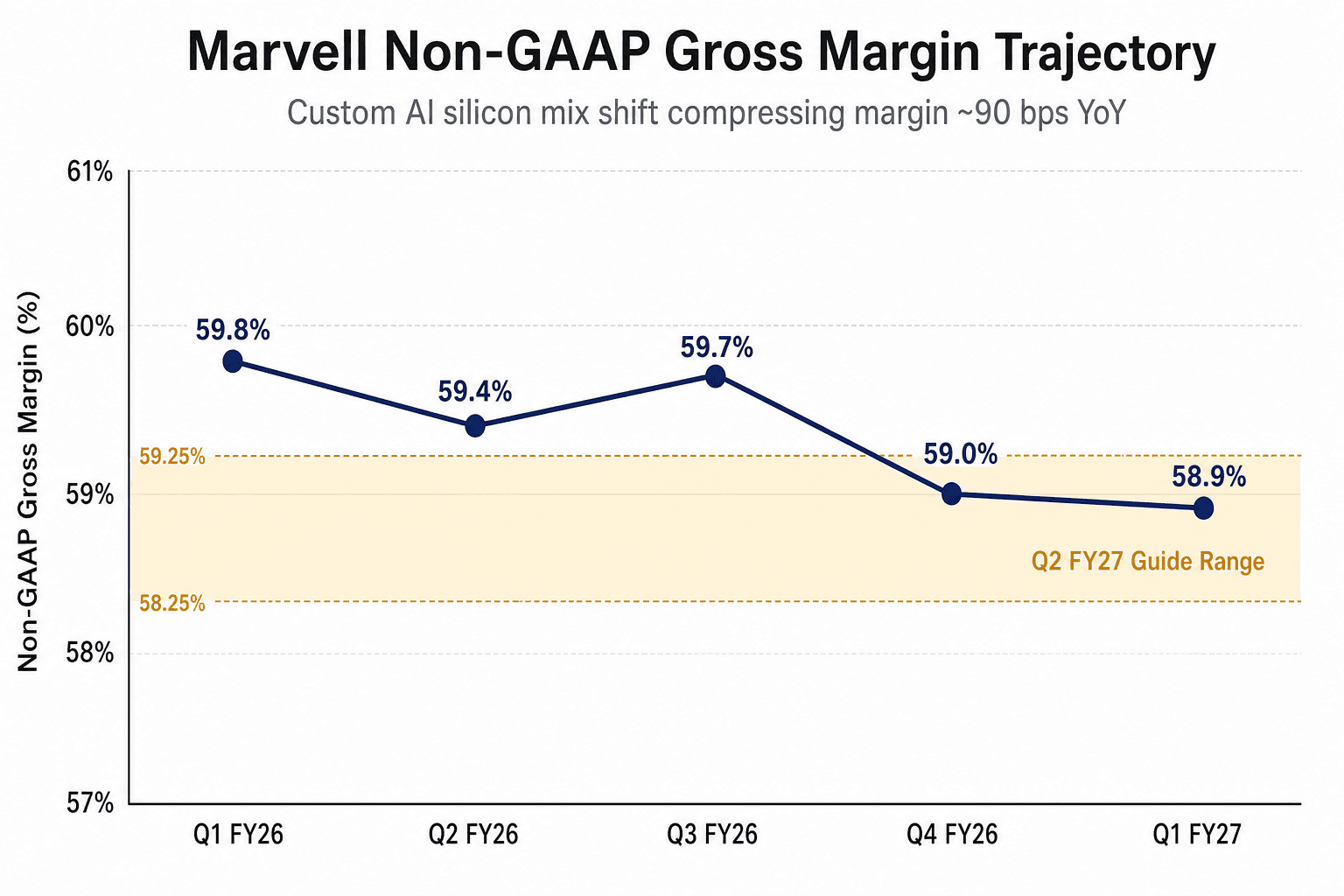
Non-GAAP gross margin printed 58.9% in Q1 FY27, down 10 bps QoQ and down 90 bps YoY. The Q2 FY27 guide range of 58.25%–59.25% implies management is signalling continued mix-driven compression. Custom ASIC carries lower gross margin than legacy networking or optics; as Trainium 3 and the second hyperscaler XPU ramp, the mix shift continues to bite.
The bull counter: GAAP gross margin is actually expanding (+180 bps YoY to 52.1%) as the Inphi/Innovium intangible amortization rolls off. The two lines are converging — which is exactly what you would expect when a company finishes integrating a series of acquisitions and the structural earnings power becomes visible underneath. Marvell's operating leverage in Q2 FY27 (NG EPS $0.93 vs revenue $2.7B = ~+16% sequential EPS on +12% revenue) is the first quarter in two years where the leverage shape looks right.
If you are a bear, the trade is short-volatility around the 58–59% gross margin band. If you are a bull, the trade is the operating leverage that emerges as the custom silicon revenue scales past the absorption costs of the early Trainium and Microsoft ramps.
What the analysts did
The pre-print PT moves were already aggressive: HSBC $300, Citi $215, BofA $200, Morgan Stanley $172 (all raised in the week before earnings). Post-print, the action was concentrated in the second tier of firms catching up: Bernstein lifted to ~$230, JPMorgan to ~$225, Susquehanna to ~$245. The mean PT moved from ~$162 pre-print to ~$195 post-print on a ~+20% upward revision to the FY28 model. Goldman remained the only major holdout at Neutral, $125 PT — explicit valuation call, not a thesis disagreement.
The clean read: the sell-side has not finished revising. FY27 consensus revenue is still parked at ~$11.5B vs the implied path from the Q2 guide, the FY28 raise to $16.5B has only been in models for 36 hours, and the NVIDIA-equity-investment optionality is not in any DCF yet because nobody knows the size of the stake or the warrant economics.
What to watch into Q2 FY27
Three numbers will define the August print:
Whether data center revenue crosses $2.0B in a single quarter. The Q2 guide implies it (data center growing mid-to-high teens sequentially on a $1.83B base puts it at $2.1B+).
Whether non-GAAP gross margin holds the 58.25% floor. Below that and the bear case re-emerges; in-range and the operating leverage shape remains intact.
Whether Marvell starts disclosing explicit custom silicon revenue as a line item. AVGO does this; Marvell has resisted. As custom approaches ~30% of data center, the resistance becomes harder to defend, and the disclosure itself will be a re-rate event.
The setup heading into the next 90 days is the cleanest Marvell has had since the Inphi deal closed. The stock has doubled YTD. The FY28 revenue target just moved $1.5B. NVIDIA bought a piece. The bears are running out of inventory.