Merck's Q2 Loss Is an Accounting Artifact, Not a Miss
A "loss" that is not what it looks like
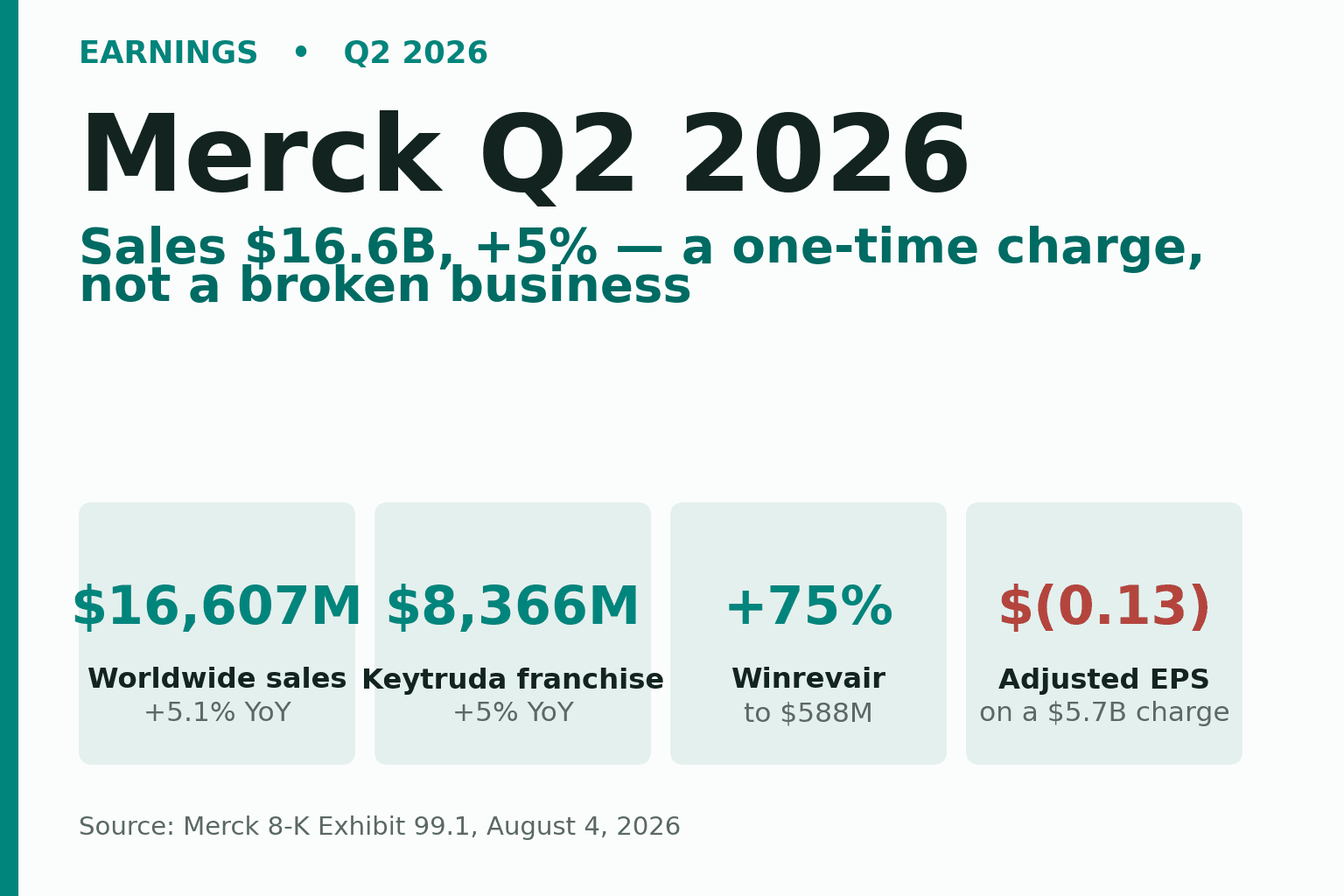
Read the top line of Merck's second-quarter report and you would think something broke. The company posted a GAAP net loss of $(1,335)M, or $(0.54) per share, and even its adjusted figure, the number management prefers because it strips out one-off items, came in at a loss of $(0.13) per share.
Now read the second line. Worldwide sales rose 5.1% to $16,607M, ahead of what Wall Street expected. Keytruda, the immunotherapy that anchors the whole company, held at $8.4B. Newer launches grew fast. And Merck actually raised its full-year revenue forecast.
Those two pictures cannot both be the story. The reconciling fact is a single one-time charge, and once you see it, the quarter reads as a healthy business wearing an ugly headline.
The charge that flipped the sign
During the quarter Merck closed its $6.8B acquisition of Terns Pharmaceuticals, which brings an experimental oral cancer drug for chronic myeloid leukemia. Under the accounting rules, Merck had to record a $5.7B, or $2.31 per share, "acquired in-process research and development" charge. That term describes the value assigned to a drug program that has been bought but is not yet approved to sell. Because the deal was treated as an asset purchase, that value gets expensed all at once rather than carried on the balance sheet.
The charge landed inside research and development expense, which is why R&D ballooned to $9,741M from $4,048M a year earlier. That one line was enough to swing the entire quarter to a loss. Merck also chose to leave the charge in its adjusted results, so unlike a typical restructuring or acquisition cost, it was not backed out. Both GAAP and non-GAAP numbers show red.
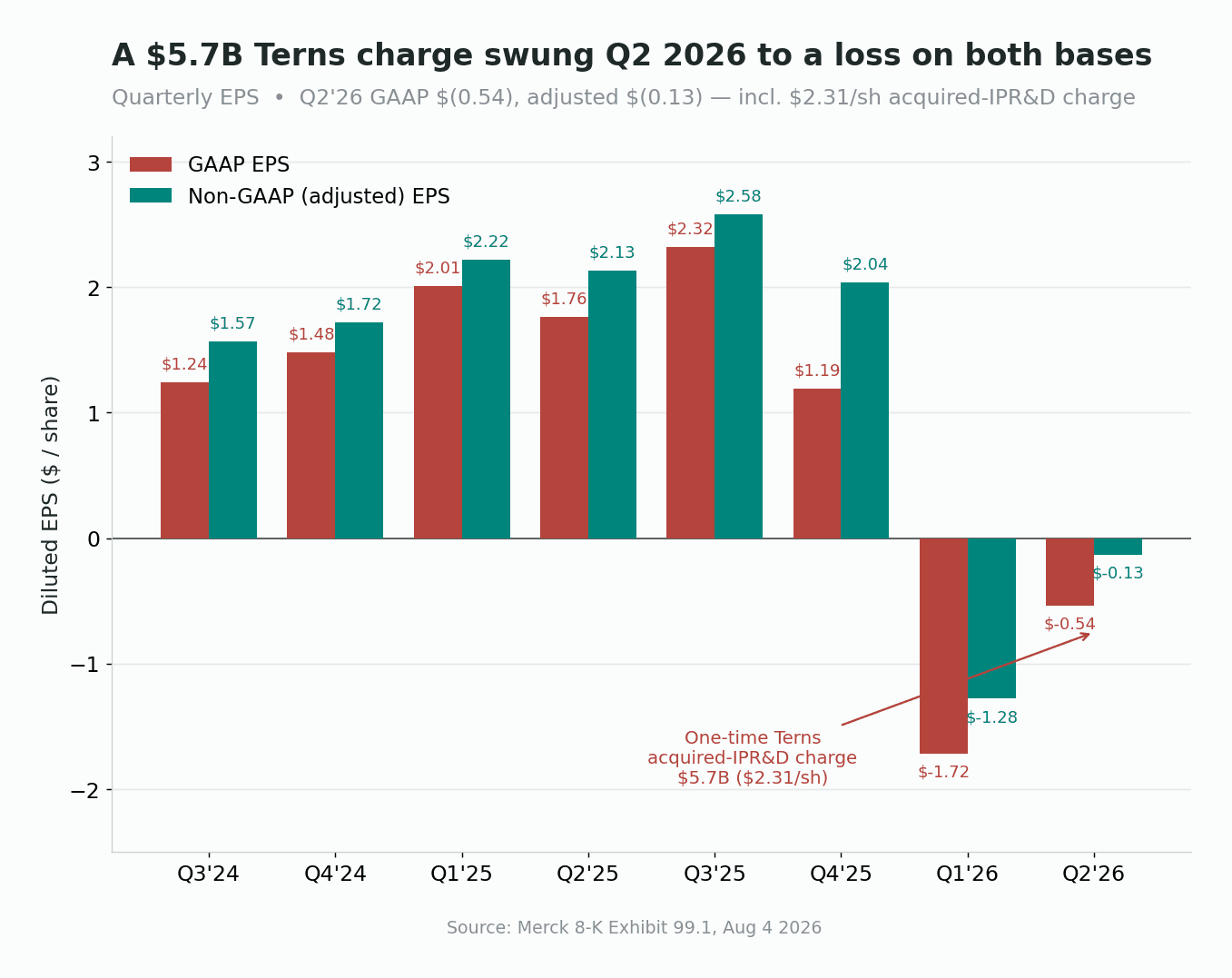
One point of confusion is worth clearing up. Some coverage lumps in a much larger, roughly $9B charge from Merck's Cidara acquisition. That charge was booked in the first quarter of 2026, not this one. The only thing that pushed Q2 into a loss was Terns. It is also worth noting that the adjusted loss of $(0.13) was actually narrower than the roughly $0.27-per-share loss analysts had penciled in, since the Street already knew the charge was coming. In other words, even the "loss" beat.
The base business was in good shape
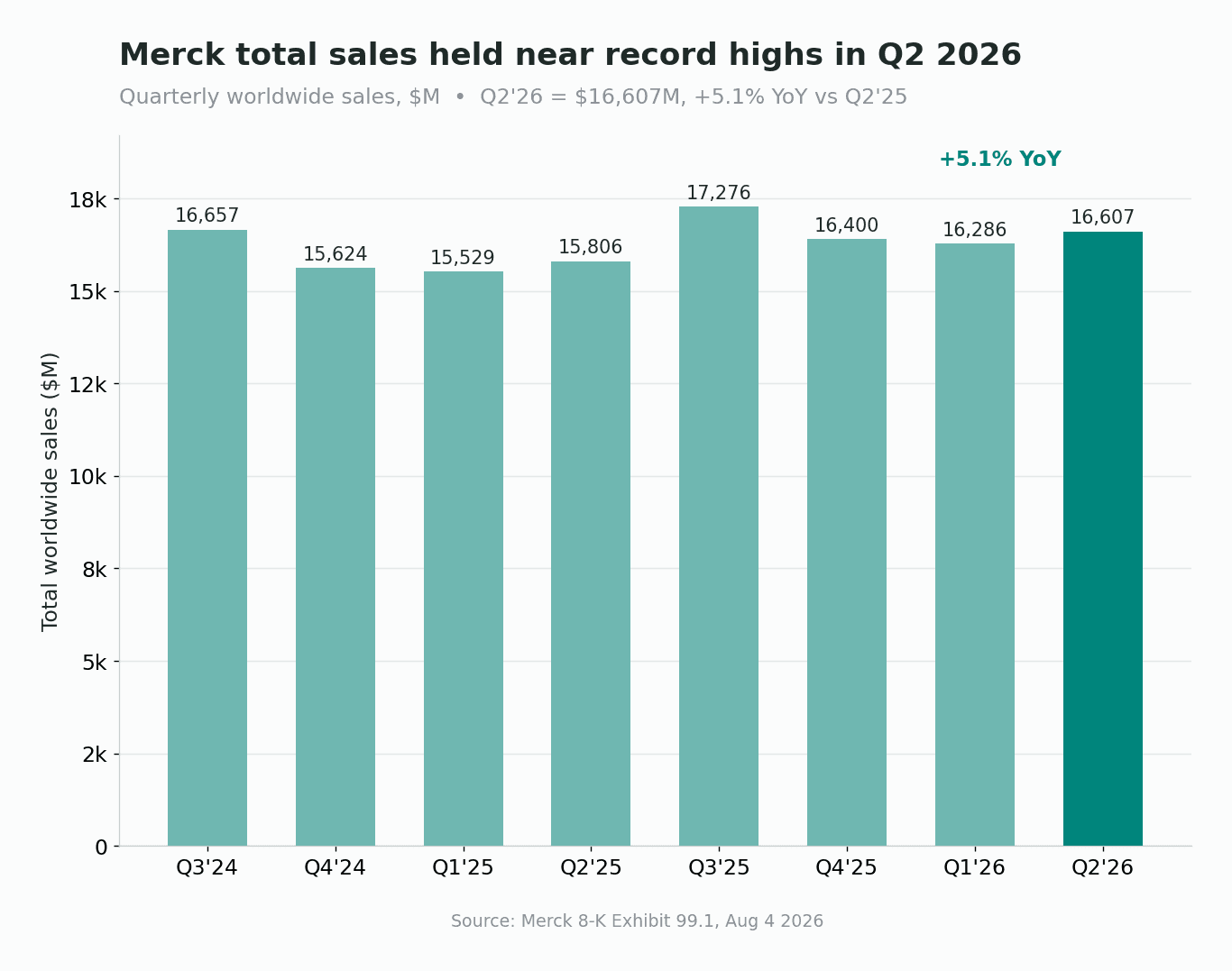
Set the charge aside and the operating quarter was solid. Total sales of $16,607M sat near the company's record highs and grew 5.1% year over year, or about 4% excluding a small currency tailwind.
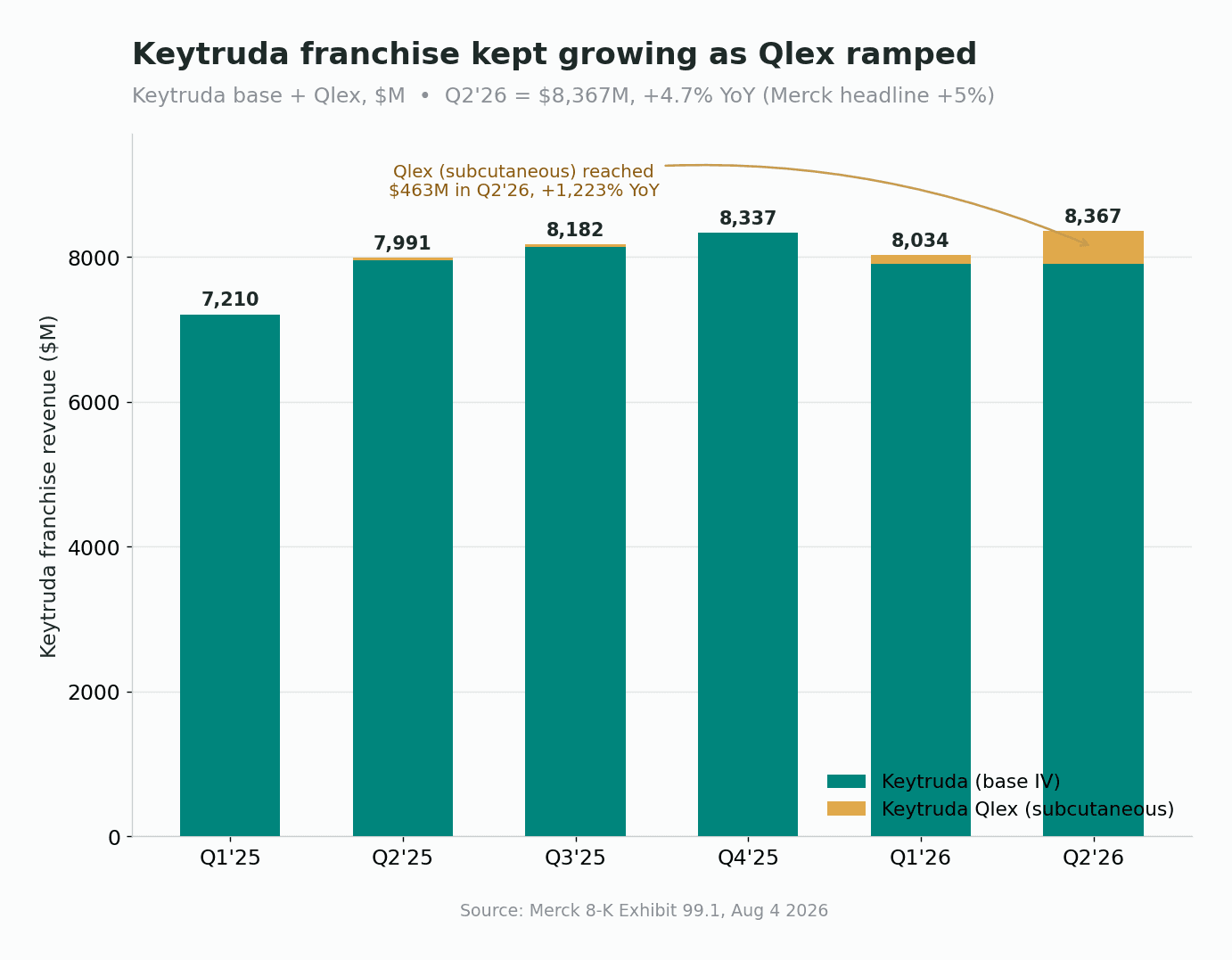
The engine, as always, was Keytruda. The franchise, which now includes both the original infused version and a newer under-the-skin injection called Qlex, reached $8,366M, up about 5%. The interesting shift is inside that number. Base Keytruda was roughly flat as demand moved toward the subcutaneous version, and Qlex jumped to $463M after a permanent billing code took effect in April. Merck is, in effect, migrating its biggest product to a more convenient format without losing the revenue.
The launch cohort is doing its job
The reason investors care about Merck's newer drugs is simple: Keytruda loses key patent protection in 2028, and management needs a wave of younger products to fill the gap. This quarter that wave grew. Winrevair, for pulmonary arterial hypertension, rose 75% to $588M. Welireg climbed 67% to $271M. Capvaxive, a pneumococcal vaccine, was up about 40% to $184M. Merck also won U.S. approval for LIPFENDRA, positioned as the first once-daily oral drug in a cholesterol-lowering class that has so far required injections.
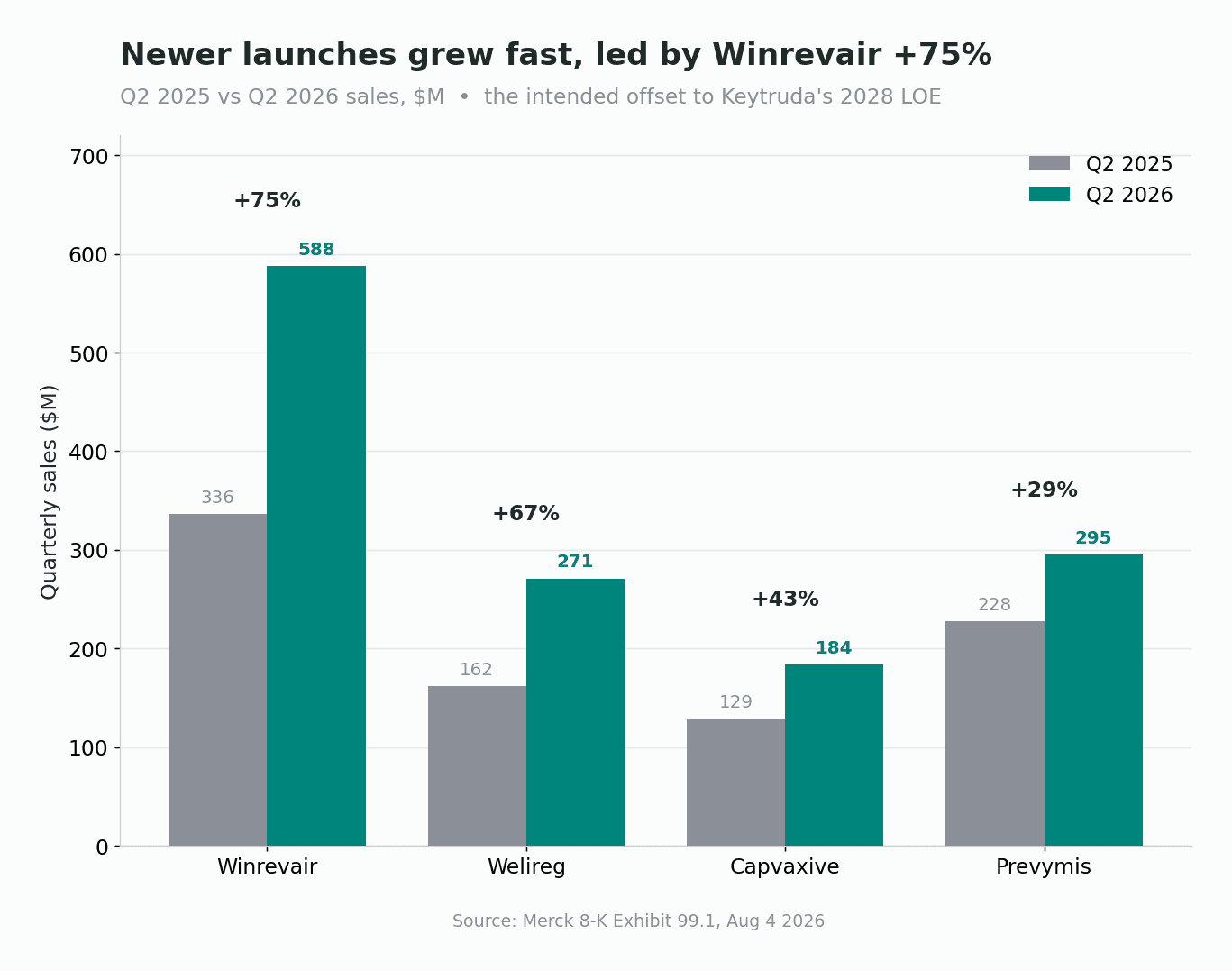
On the call, CEO Robert Davis described the coming Keytruda patent cliff as "more of a hill than a cliff," a shallow dip followed by a return to growth, and pointed to more than $70B of commercial opportunity across 20-plus new products. That is the long-term bet the launch numbers are meant to support.
Guidance: revenue up, profit down, one reason for both
The clearest tell that this was not an operational problem is the guidance. Merck raised and narrowed its full-year sales outlook to $66.3B to $67.3B, up from $65.8B to $67.0B. At the same time it cut full-year adjusted EPS to $2.66 to $2.76, down from a prior $5.04 to $5.16.
That looks alarming until you count what changed. The cut is almost entirely the two one-time charges flowing through the full year, the Terns charge at $2.31 and the earlier Cidara charge at $3.62, plus a higher tax rate driven by the fact that neither charge is deductible. Management said plainly that the reduction is the charges, not the base business. A company cutting profit guidance because operations were weakening does not raise its revenue guidance in the same breath.
Why the market shrugged
Investors did the arithmetic quickly. MRK closed at $128.00, up 0.18%, essentially flat, after swinging between $126.22 and $129.99 during the day. The beat on sales and the raised revenue outlook roughly cancelled the optics of the loss, and the stock ended almost exactly where it started. Peers across large-cap pharma were steady to firm the same session, so there was no spillover fear about the sector.
Analysts were positioned constructively into the print, with a median price target around $140 and a range that ran from Morgan Stanley's cautious $113 to Scotiabank's $155. The bear case did not go away. It rests on the 2028 Keytruda patent cliff, the risk from U.S. drug-price negotiation, and the question of whether the 20-launch pipeline can fill the hole fast enough. But none of that is what the second-quarter loss was about.
The takeaway
Merck's Q2 2026 is a lesson in reading past the headline. The company grew sales 5%, kept Keytruda near record levels, watched its newer launches accelerate, and lifted its revenue outlook for the year. The loss is real on paper, but it is the accounting echo of a $5.7B acquisition charge, a cost Merck took on purpose to add a drug to its pipeline. The market's flat reaction was the right one. The number to watch from here is not this quarter's EPS, but whether that pipeline can carry the company through the Keytruda cliff it keeps promising to clear.