Merck just printed a $4.2B GAAP loss. The story is the $8B Keytruda line right above it.
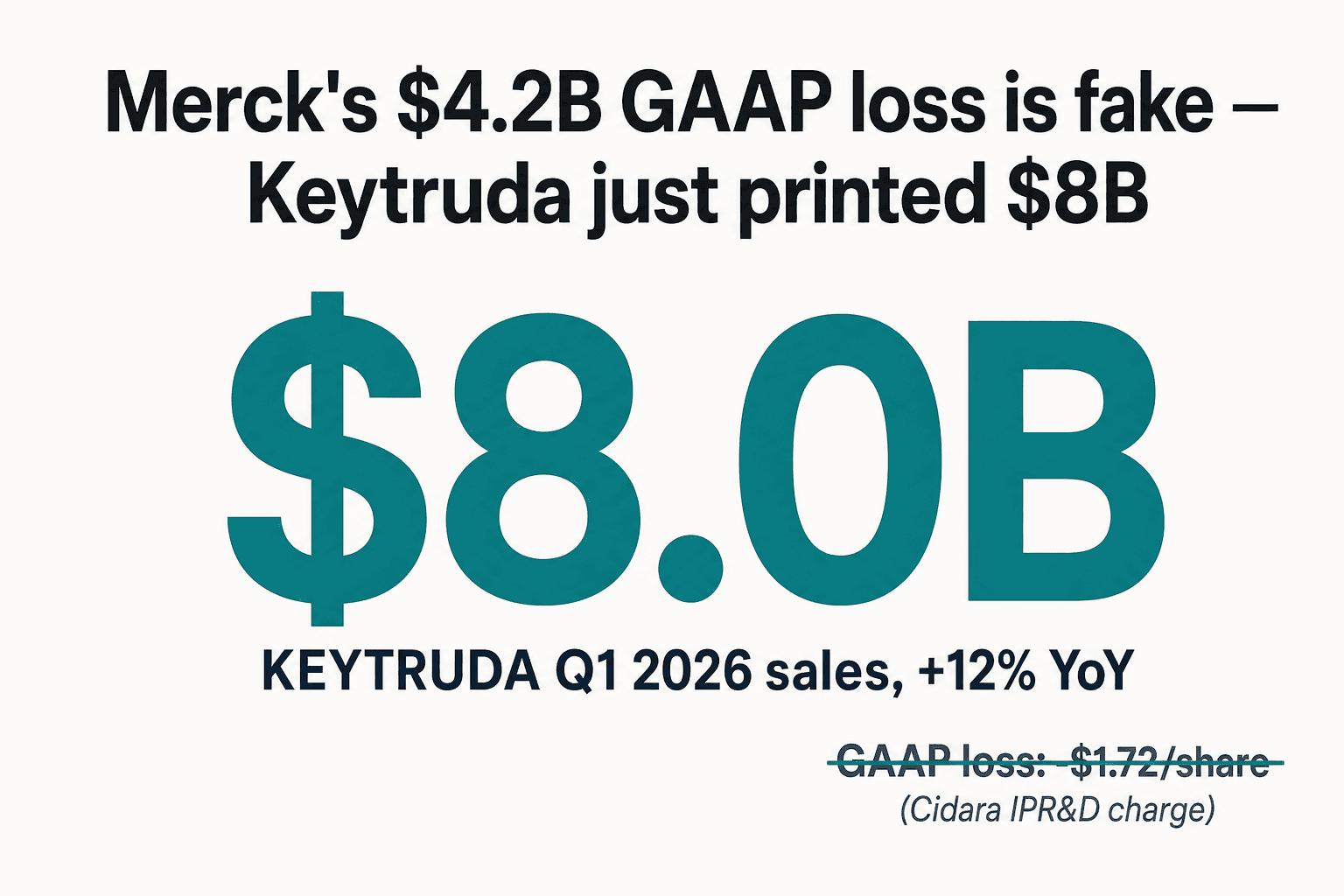
The Q1 2026 print from Merck is two stories in one. The headline number — a GAAP loss of $4.24B, or -$1.72 per share — looks like a disaster. The line right above it, Keytruda at $8.0B in a single quarter, looks like one of the highest-quality print runs in U.S. large-cap pharma.
Both are true. The headline loss is entirely a one-time accounting charge for the Cidara Therapeutics acquisition that closed in January. The $3.62-per-share IPR&D writedown is real cash gone, but it's a single-period, non-recurring entry — and analysts who model around it landed on ex-Cidara Non-GAAP EPS of approximately $2.34, ahead of the $2.22 prior-year base.
Strip away the charge and what's left is a clean beat-and-raise. Sales $16.29B vs $15.82B Street consensus. Non-GAAP EPS -$1.28 vs -$1.51 expected (the consensus already accounted for the charge). Full-year 2026 sales guide raised at the low end. Non-GAAP EPS guide raised at both ends.
The market took ~30 minutes to do the arithmetic and then moved the stock +2.1% on the day.
Keytruda is doing what Keytruda does
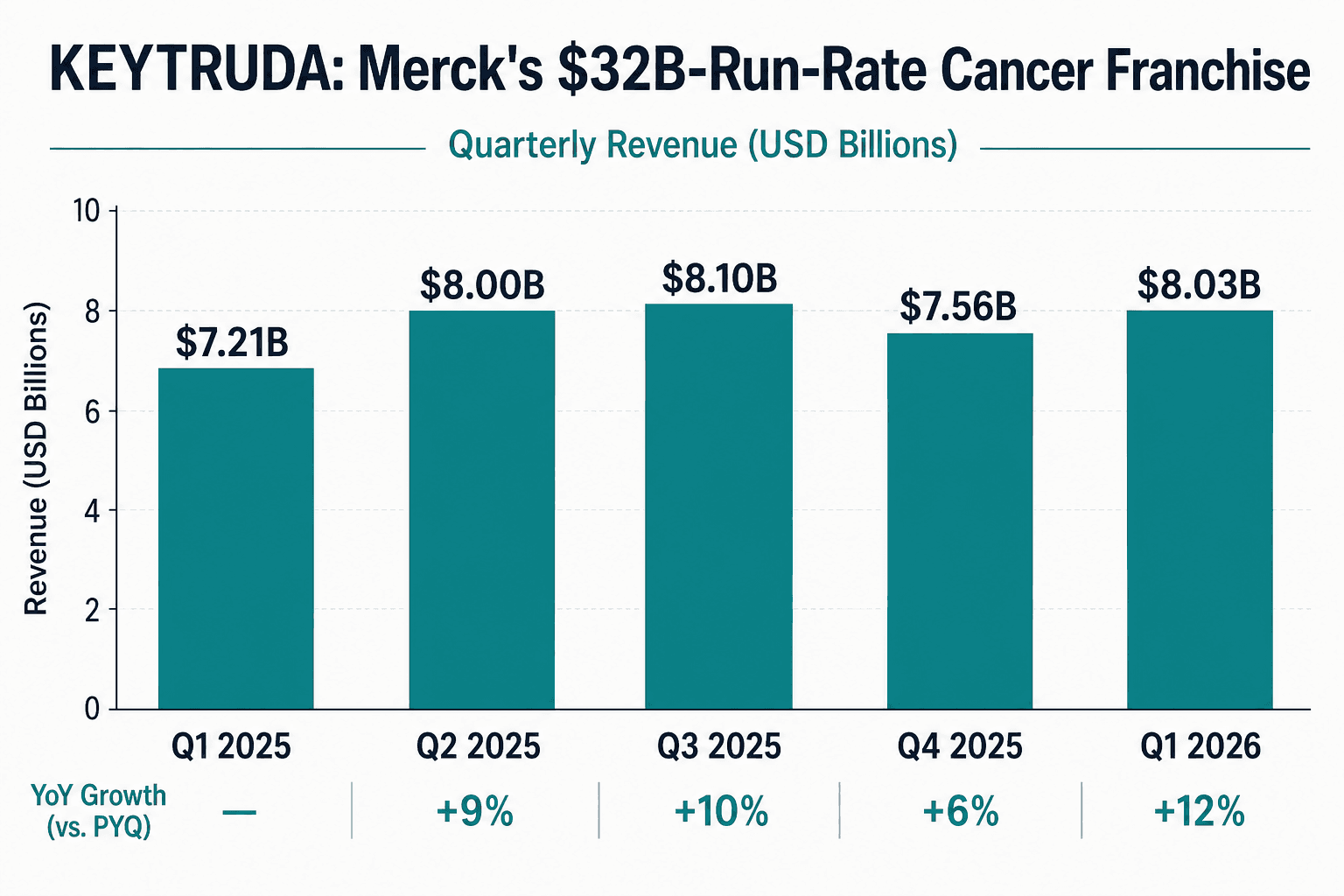
The math on Keytruda is unchanged from where it has been for three years: it is a $32 billion drug. Q1 2026 added $8.03B at +12% YoY (+8% ex-FX). Drivers split between earlier-stage indications (triple-negative breast cancer, cervical, RCC) and continued metastatic share-of-voice (urothelial in particular).
The new wrinkle is Keytruda QLEX, the subcutaneous formulation. QLEX revenue was $128M in Q1, up from $40M in Q4 2025 (the first full quarter post-FDA approval for all solid-tumor indications). The trajectory matters because the Keytruda IV patent expires in 2028, and Merck's bridge across the LOE depends on how much of the existing IV business can be retained on the SC formulation, which has its own patent runway.
QLEX revenue at $128M is roughly 1.6% of total Keytruda. By the time the IV LOE arrives in 2028, that share needs to be measured in tens of percent for the franchise to maintain its 2025/2026 run-rate. The Q1 ramp tells you the curve is steepening.
Winrevair is the breakout
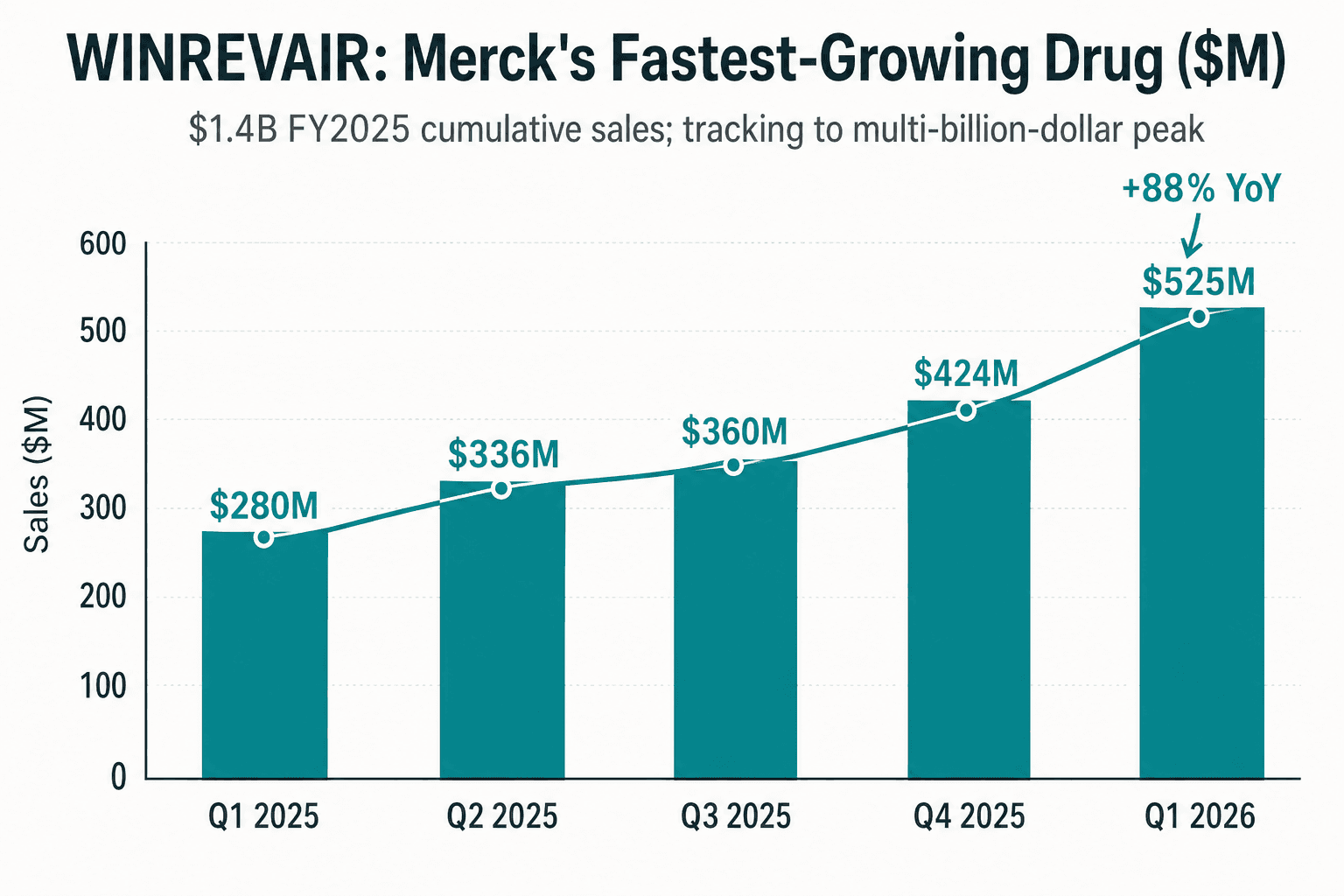
Winrevair (sotatercept; pulmonary arterial hypertension) is the one product on Merck's income statement that is genuinely re-rating in real time. Q1 2026 sales of $525M are +88% YoY, and the sequential ramp is steepening: Q4 2025 was $424M, Q3 2025 was $360M, Q2 2025 was $336M.
If Q1 2026's quarterly run-rate ($525M) holds for the rest of 2026, full-year Winrevair revenue would print around $2.5B. Sell-side peak-sales models for the drug have steadily moved up — most are now at $5–7B by the late 2020s on full international launch. The drug also benefits from minimal generic competition in PAH and a pricing model anchored to specialty/orphan economics.
For investors, Winrevair plays a specific role: it's the post-Keytruda growth thesis, in compressed form. If you believe Winrevair gets to a multi-billion-dollar peak, the 2028 LOE narrative loses some of its weight.
The Gardasil china problem isn't fixed, but isn't getting worse either
Gardasil revenue of $1.069B was -19% YoY (-22% ex-FX). That sounds bad, but it's the smallest YoY decline in five quarters for the franchise, which has been compressed by lower Chinese demand and the wind-down of Japan's national catch-up immunization program.
For context: Q2 2025 Gardasil printed -55% YoY. Q4 2025 (full year basis) was -39% for the year. Q1 2026 at -19% suggests the worst of the China step-down may be in the rear-view. It does not mean the franchise grows from here — that requires either re-acceleration in the U.S. or a re-opening of Chinese channel orders. Neither is reflected in Merck's 2026 guide.
Cidara, Terns, and what the IPR&D charges mean
The $3.62/share Cidara IPR&D charge is the kind of accounting line that shows up exactly once and never again for that deal. Cidara brings CD388, a long-acting flu antiviral candidate Merck believes can become a multi-billion-dollar product. Whether you believe that or not, the charge isn't recurring revenue compression — it's a one-period non-cash adjustment.
Then comes Terns Pharmaceuticals, a deal Merck announced for ~$5.8B at close (expected May), which will book another ~$2.35/share IPR&D charge in Q2. Terns adds TERN-701, a BCR-ABL allosteric inhibitor for chronic myeloid leukemia — directly addressing the resistance setting where existing CML therapies (including Bristol-Myers' Sprycel and Pfizer's Bosulif) lose efficacy.
Two consecutive quarters of large IPR&D charges is unusual. It is also the visible evidence of CEO Robert Davis's stated strategy: aggressively use the cash flow now to assemble a post-Keytruda portfolio, ahead of the 2028 IV cliff. Bears worry about execution risk in compressing two large M&A integrations into 90 days. Bulls treat the charges as the cost of a portfolio rebuild they would have wanted Merck to do anyway.
The guide is the quiet signal
Merck raised full-year 2026 sales guidance to $65.8B–$67.0B, up from the prior $65.5B–$67.0B (the high end held; the low end moved up $300M). Non-GAAP EPS guide moved to $5.04–$5.16, up from $5.00–$5.15.
The magnitudes are small but the direction is what matters. Three months into the year, with a known $5.8B Terns deal still to close (which would normally trigger a guide cut to absorb the additional dilution from charges), Merck's underlying business is running ahead of plan by enough to lift the floor. That is a confidence statement, not a beat statement.
What to watch into Q2 (late July 2026)
Three things define the next print.
The first is whether QLEX revenue compounds again sequentially. If Q2 prints in the $200–250M range, the LOE bridge thesis gets a meaningful tailwind. If it stalls in the $130-150M range, bears will argue SC-switching has a cap.
The second is how Q2 absorbs the Terns charge. Expect another GAAP/Non-GAAP loss (~$2.35/share charge) to dominate the headline. The underlying ex-charges number is what matters.
The third is Gardasil at -19% or smaller. If the YoY decline compresses below -10% in Q2 or Q3, China stabilization is real. If it widens back to -25% or worse, the franchise is structurally lower.
For now, the line that fits the data is the simple one: the GAAP number is noise. The Keytruda + Winrevair lines are the signal. Merck is buying its post-2028 portfolio in real time, and the underlying business is running ahead of plan.