Meta Q2 2026: Revenue +28%, Margins Crushed
A growth quarter the market read as a spending quarter
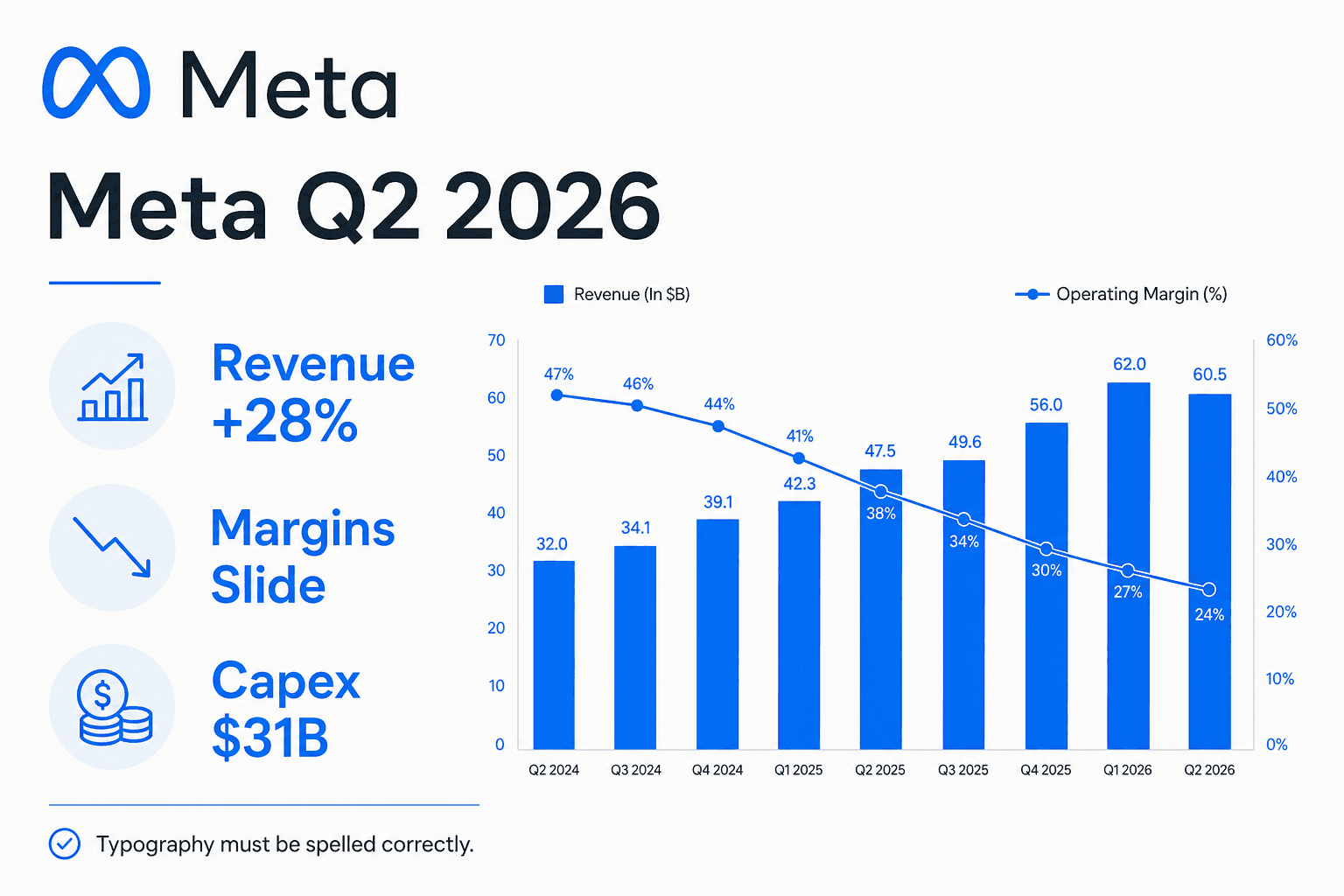
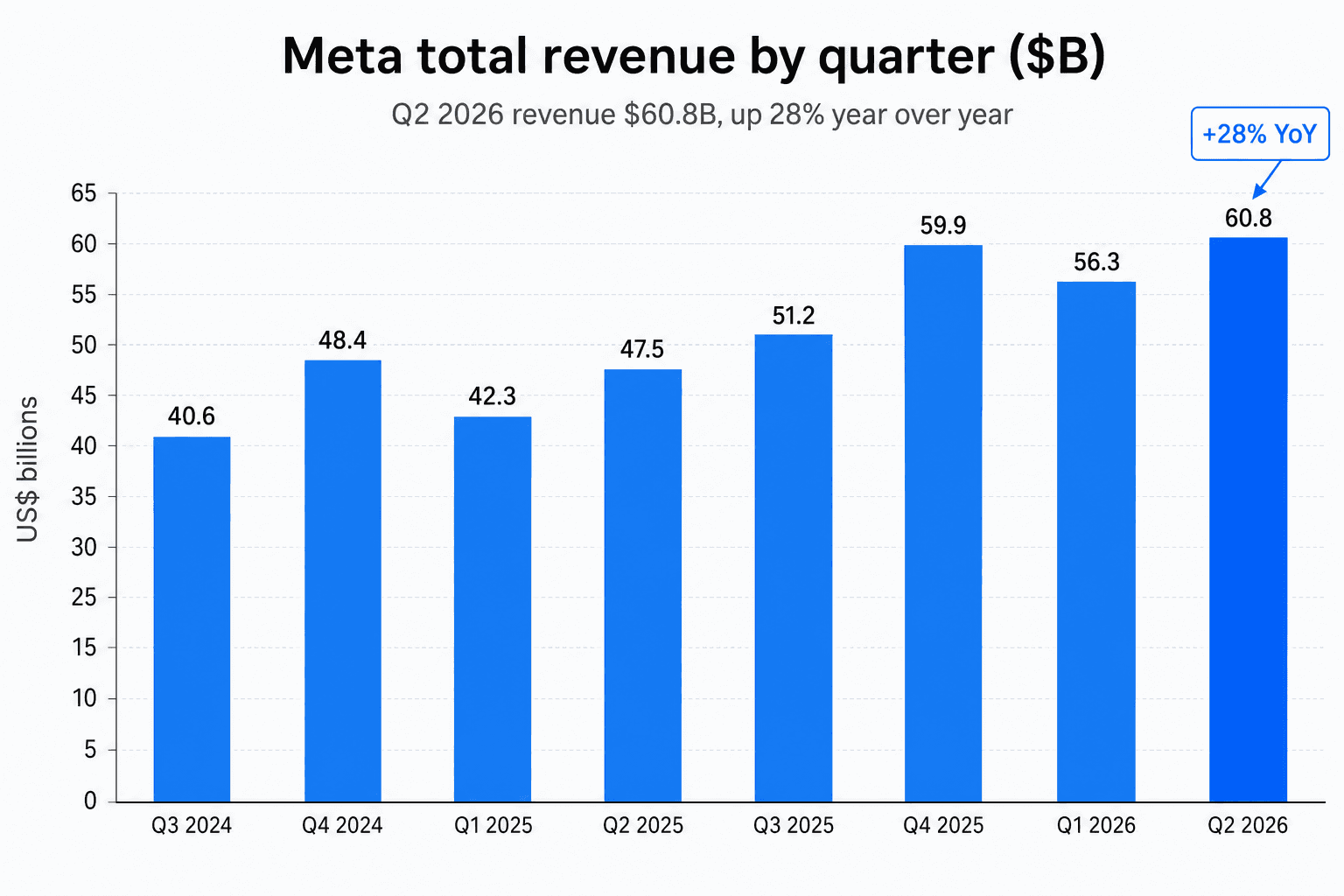
Meta grew fast and got punished for how much it spent to do it. For the three months ended June 30, 2026, revenue rose 28% from a year earlier to $60.8B, comfortably ahead of Wall Street forecasts near $59.5 to $60.2B. Advertising, still almost the entire business, climbed 27.5% to $59.4B. By the standard that usually matters most for Meta, the top line, this was a clear beat.
Then came the bottom line. GAAP diluted earnings per share of $6.18 fell 13% from a year earlier and missed the roughly $7.13 to $7.22 that analysts expected. Meta beating on revenue while missing on profit is an unusual reversal for a company that has spent the past two years training investors to expect the opposite. The stock fell as much as 10% in after-hours trading, roughly to $529, before recovering to about 7% lower near $543. The quarter was strong on demand and weak on everything downstream of it.
Revenue: the ad engine is still humming
Under the profit noise, the advertising machine looks as healthy as ever. Ad impressions across Meta's apps rose 14% year over year and the average price per ad rose 12%, and those two combine to roughly the 27% advertising-revenue growth. Meta credited its AI work directly: better content recommendations and ad targeting lifted ad clicks about 8% and conversions about 16% on Facebook. Engagement kept setting records, with 3.6 billion daily active people across the Family of Apps, Instagram passing 2 billion daily actives, and Threads clearing 500 million monthly users.
There were even green shoots in newer lines. Family of Apps "other" revenue, which captures things like business messaging, reached $1.0B and grew 73%, the fastest-growing part of the business, and Meta says more than a million businesses now use its AI agents each week. The demand side of Meta simply was not the problem this quarter.
The cost side is where it broke
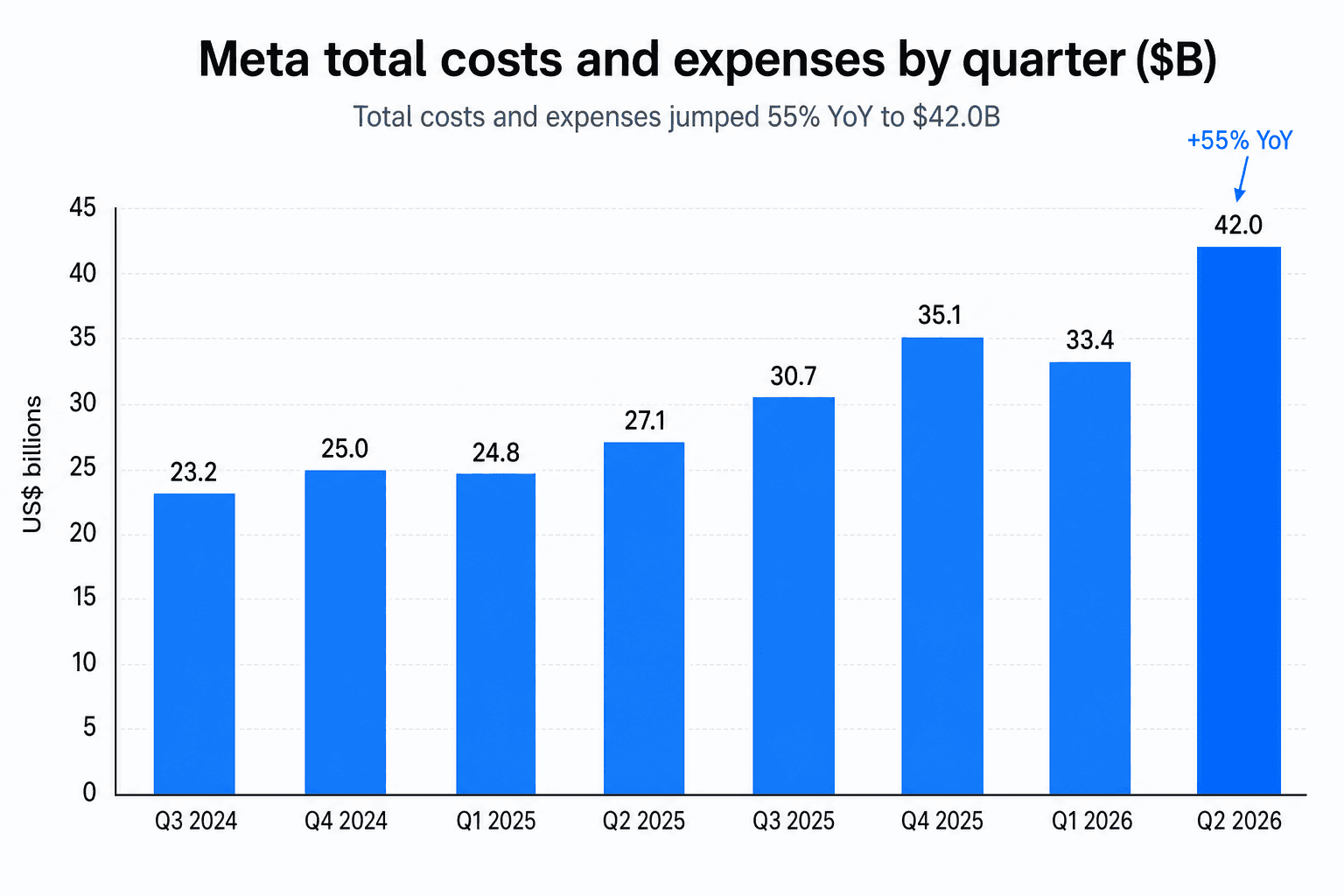
Total costs and expenses jumped 55% to $42.0B, far outpacing the 28% revenue growth, and that gap is the whole story of the profit miss. Two unusual charges did much of the damage. A $2.4B charge tied to legal proceedings, linked to the youth-safety trials hanging over the company, landed in general and administrative expense and sent that line up 111%. Separately, $1.18B of severance from the roughly 8,000-role headcount reduction announced in May 2026 spread across the expense lines. Together those two items came to about $3.58B, or roughly 8.5% of the quarter's costs.
Beyond the one-time charges sits a more permanent pressure. Research and development rose 67% as Meta added AI headcount and, more importantly, absorbed rising depreciation from its data centers and chips. That depreciation does not go away next quarter. It is the recurring cost of the AI build-out, and it will keep weighing on the reported numbers as the spending compounds.
Margins take the hit
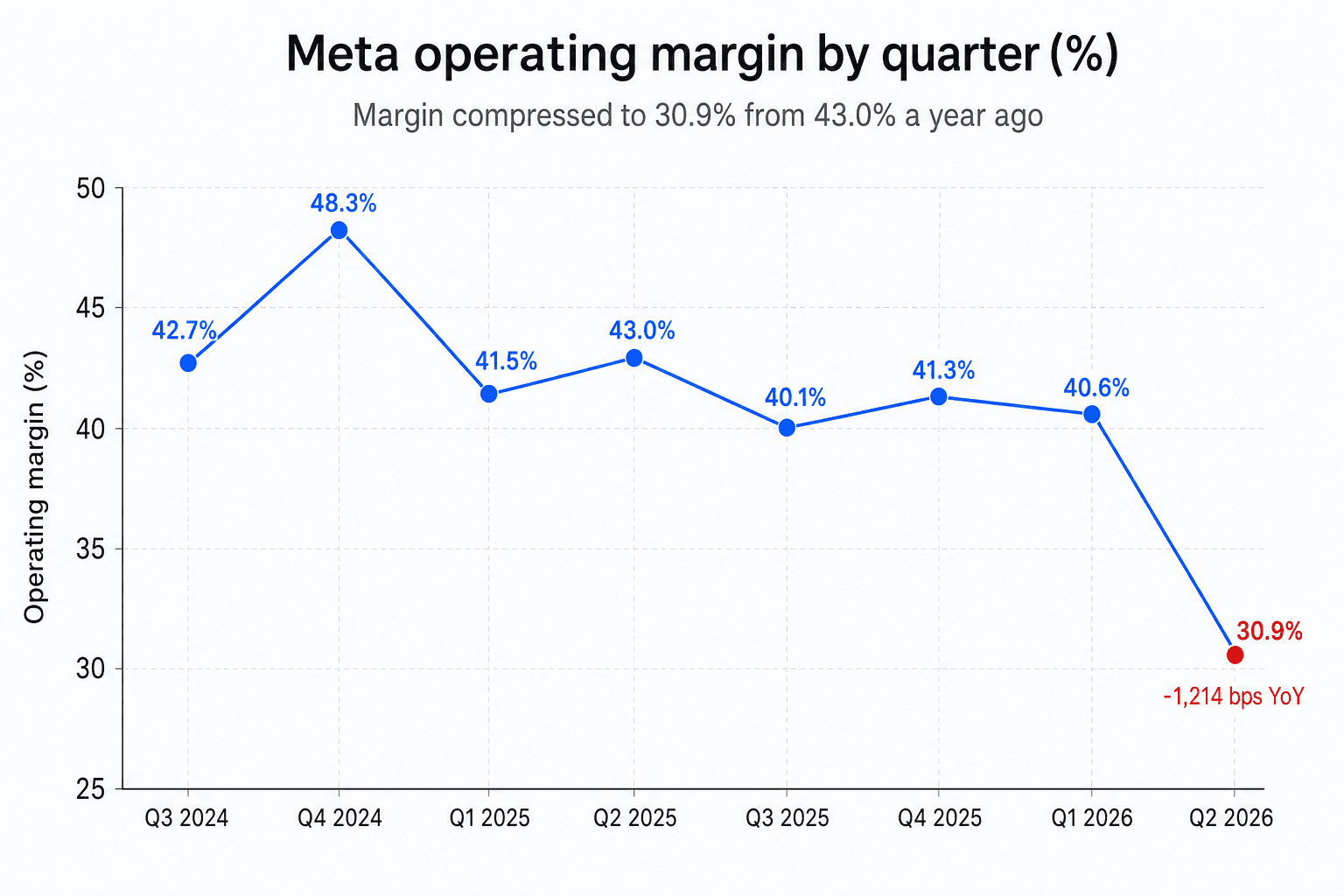
When costs rise almost twice as fast as revenue, margins pay for it. Operating income fell 8% to $18.8B, and operating margin, the share of revenue left as profit, compressed to 30.9% from 43.0% a year earlier. That is a drop of about 1,214 basis points, one of the sharpest single-quarter margin declines Meta has posted in years, and it turns what would have been a record-revenue quarter into a profit decline. Net income fell 14% to $15.8B.
It is worth separating the two forces at work. The legal and severance charges are temporary and account for a meaningful chunk of the compression. The AI depreciation is structural. Investors can look past the first but have to price in the second, which is why a margin chart that had drifted gently downward for a year suddenly fell off a cliff.
The free-cash-flow squeeze
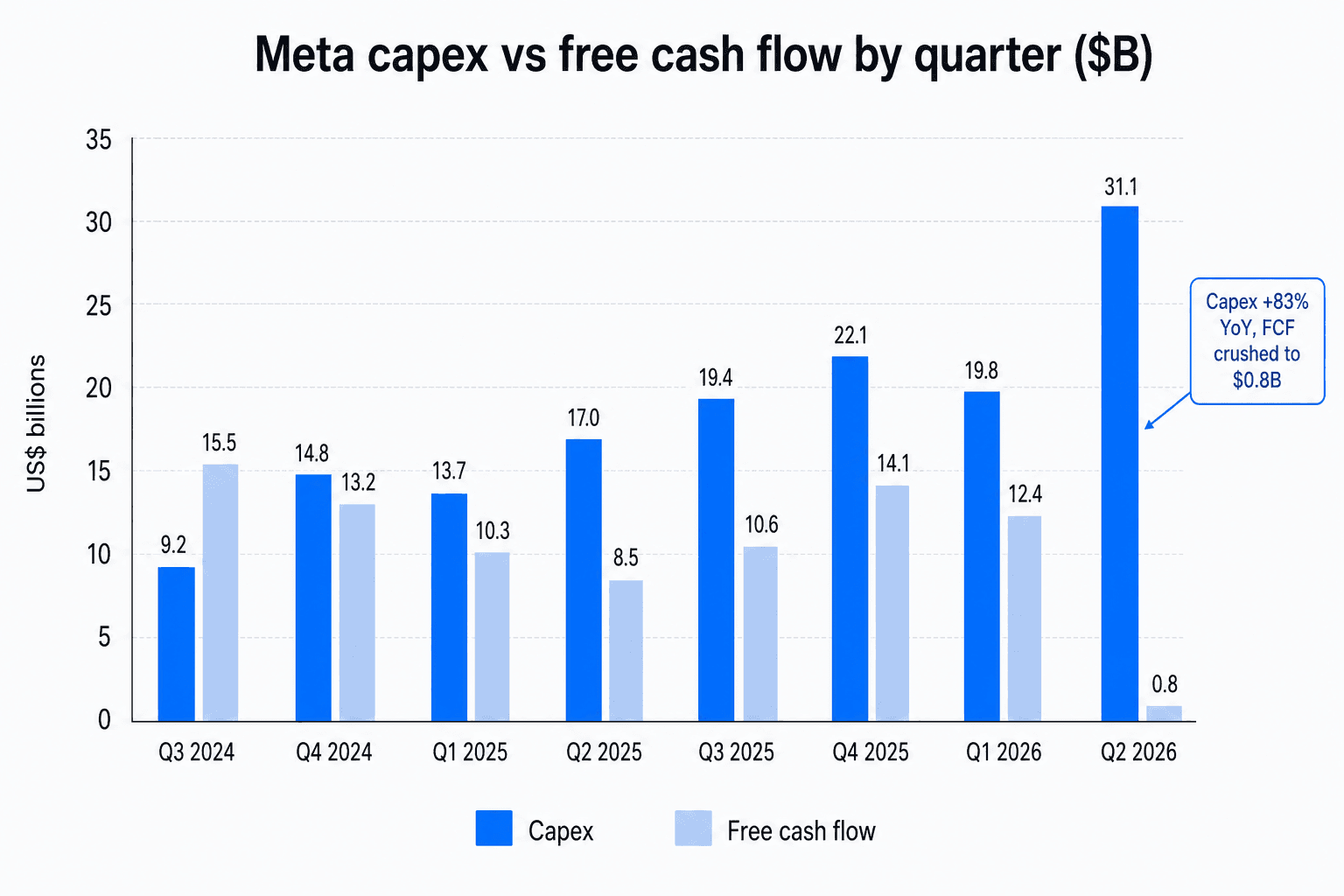
Here is the chart that unsettled investors most. Meta's operating cash flow was strong, up 25% to $31.9B. But capital spending reached $31.1B, up 83% from a year earlier, and it consumed almost every dollar of that operating cash. What was left, free cash flow, came to just $784M, down 91% from the $8.5B Meta generated a year earlier. The company funded the gap partly with debt, issuing about $24.9B of new long-term borrowing during the quarter, and paid $1.35B in dividends with no buybacks.
Fortune's take was blunt, describing free cash flow as "crushed" and warning that Meta risks "turning into a utility," a capital-heavy business that pours cash into infrastructure. The comparison that stung most came the same evening: Microsoft reported that its Azure cloud crossed $100B in annual revenue, a reminder that rival hyperscalers can at least rent their AI infrastructure back out for immediate revenue. Meta spends without that cloud escape hatch, a gap Zuckerberg acknowledged on the call when he floated, and quickly downplayed, the idea of selling compute directly.
What management is telling investors
Zuckerberg framed the spending as a deliberate bet on a huge prize. Meta, he said, is building toward "personal superintelligence for everyone," AI agents that work out of the box for billions of people, and he argued the company's scale and data give it a durable edge. On the temptation to rent out its scarce computing power, he said it "would be foolish to sell all compute for a short-term profit when we can build intelligence on top of it, which compounds the value." Susan Li reinforced that Meta is "demand-constrained today and expects to be for the foreseeable future."
The guidance sketches the shape of the bet. Meta narrowed full-year capex to $130 to $145B and raised the low end of full-year expense guidance to $165 to $169B to absorb the legal charge. It guided Q3 revenue to $61 to $64B, a range whose midpoint struck some analysts as light, and lifted its expected tax rate for the rest of the year to 15 to 17%. Management still expects full-year operating income above 2025's $83.3B, a signal that it views the current squeeze as a spending choice rather than a demand problem.
The Street stays bullish, but the debate is real
Coming into the print, sell-side sentiment was firmly positive, clustered around Buy and Overweight ratings with an average price target in the $825 to $840 range. The bulls run from Rothschild's Street-high $1,000 target, arguing the capex compounds into a bigger and better-converting ad engine, down to more cautious voices. UBS had already trimmed its target to $766 before the print, flagging that higher depreciation from the capex surge would pressure near-term earnings, exactly what played out.
The skeptic's case has a clear standard-bearer. Wedbush's Ygal Arounian, at a Neutral rating and a $671 target, has framed Meta's spending as a widening "monetization gap," wanting proof that the AI capex converts into revenue before paying up for it. That is the fault line the quarter exposed. Almost no one doubts Meta's advertising business or its engagement. The argument is over timing: how long investors will fund an AI build-out that is now consuming nearly all of the company's free cash flow before it visibly pays for itself. This quarter Meta asked the market for more patience, and the market, at least for a night, said no.