Meta Beat the Quarter and Lost the Story to a Single Sentence
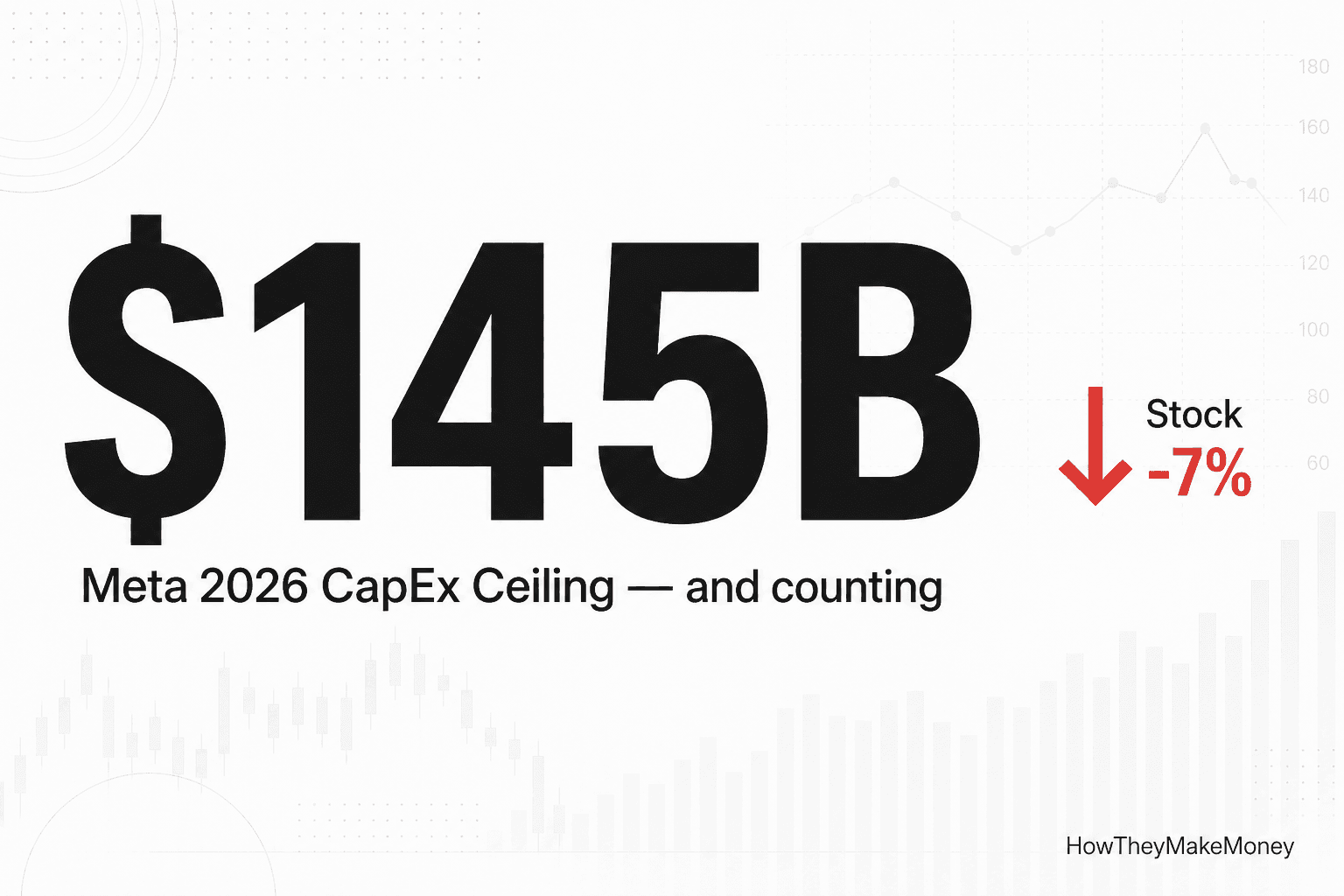
A clean print, sold on a single sentence
By every line on the income statement, Meta's Q1 2026 was the best Q1 the ads business has printed in three years. Revenue $56.31B, up 33% year-over-year. Ad impressions +19%. Price per ad +12%. Operating margin 40.7%. Family Average Revenue per Person $15.66, up 27% YoY even as DAP growth decelerated to single digits.
Then Susan Li answered an analyst's question about 2027 capex: "We have continued to underestimate our compute needs even as we have been ramping capacity significantly."
The stock was up 1.8% after-hours when the headline numbers crossed. By the end of the call it was down 6%. By the close on Thursday, it was down 7% — Meta's worst single-day drop since the 2022 Reality Labs disclosure shock.
This is the cleanest example of a "good print, bad guide" reaction the cycle has produced. The print is real; the guide changed the multiple.
What actually changed in the model
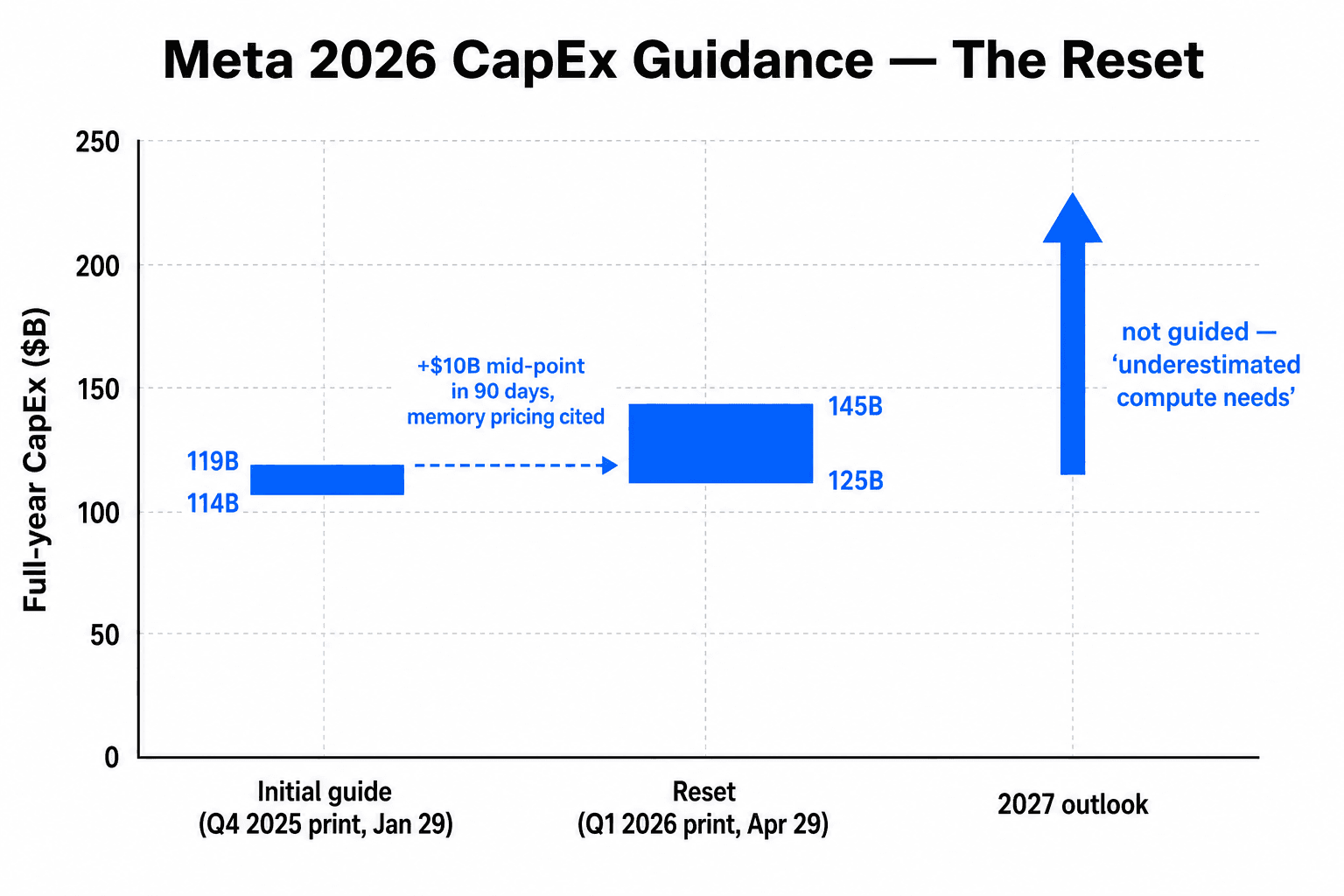
Three things moved at once:
First, the 2026 capex range went up by $10B at the mid-point (from $115-135B to $125-145B). Susan Li attributed the raise primarily to memory pricing — the same DRAM/NAND tightness that GOOG and MSFT also called out on the same day. That is a re-rate of the depreciation slope, not a one-time capex pull-forward.
Second, 2027 capex was not guided — and the language used to deflect the question was unusually candid. "Continued to underestimate our compute needs" is not a sentence a CFO says lightly. Sell-side models that were pencilling 2027 capex at $140-150B are now updating to scenarios that begin with a 2.
Third, Q1 2026 free cash flow collapsed to $3.55B, down 68% YoY — even though revenue grew 33%. The capex pull-through is already happening. With the 2026 capex range now reaching $145B, Meta's TTM FCF could compress further before any 2027 number lands.
The arithmetic is what hit the stock. In a P/FCF framework, Meta has been valued at roughly 35x trailing FCF. If 2027 capex is $200B and FCF compresses by another $20-30B vs prior models, the multiple stays the same but the denominator gets smaller — and the stock has to find a new price.
The print itself was excellent
Lost in the post-call drubbing is that the underlying ads business is firing on every cylinder it has.
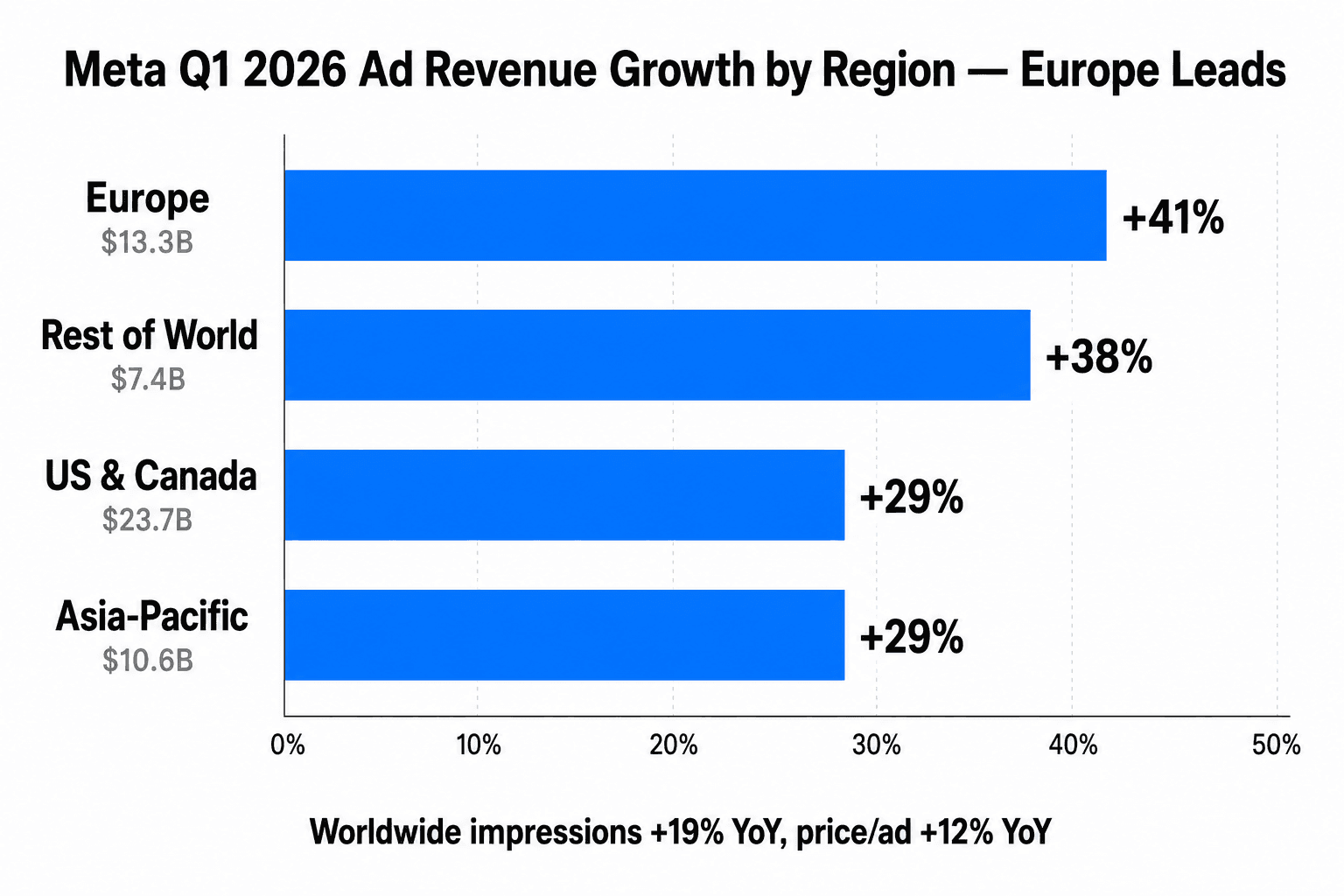
Ad revenue grew across all four regions, with Europe leading at +41% YoY and the price-per-ad spread between Europe (+19%) and Asia-Pacific (+5%) the widest since 2024. That spread tells you AI-driven ad targeting is compounding faster in higher-CPM markets, which is the structural narrative bulls have been waiting two years to see in the data.
Advantage+ — Meta's AI-driven campaign automation product — now powers >70% of total ad revenue, up from roughly 40% a year ago. Mark Zuckerberg framed this as the under-appreciated lever: "AI is rewriting our ads stack from the bottom up." Every percentage point of Advantage+ adoption translates to higher attach rates on the conversion APIs that feed the model, which in turn lifts price-per-ad.
ARPP at $15.66 (+27% YoY) against DAP growth of just +4% YoY says it more cleanly: virtually all of the FoA revenue growth this quarter came from monetization, not user count. That is the high-quality version of growth.
Reality Labs: the tax that won't go away
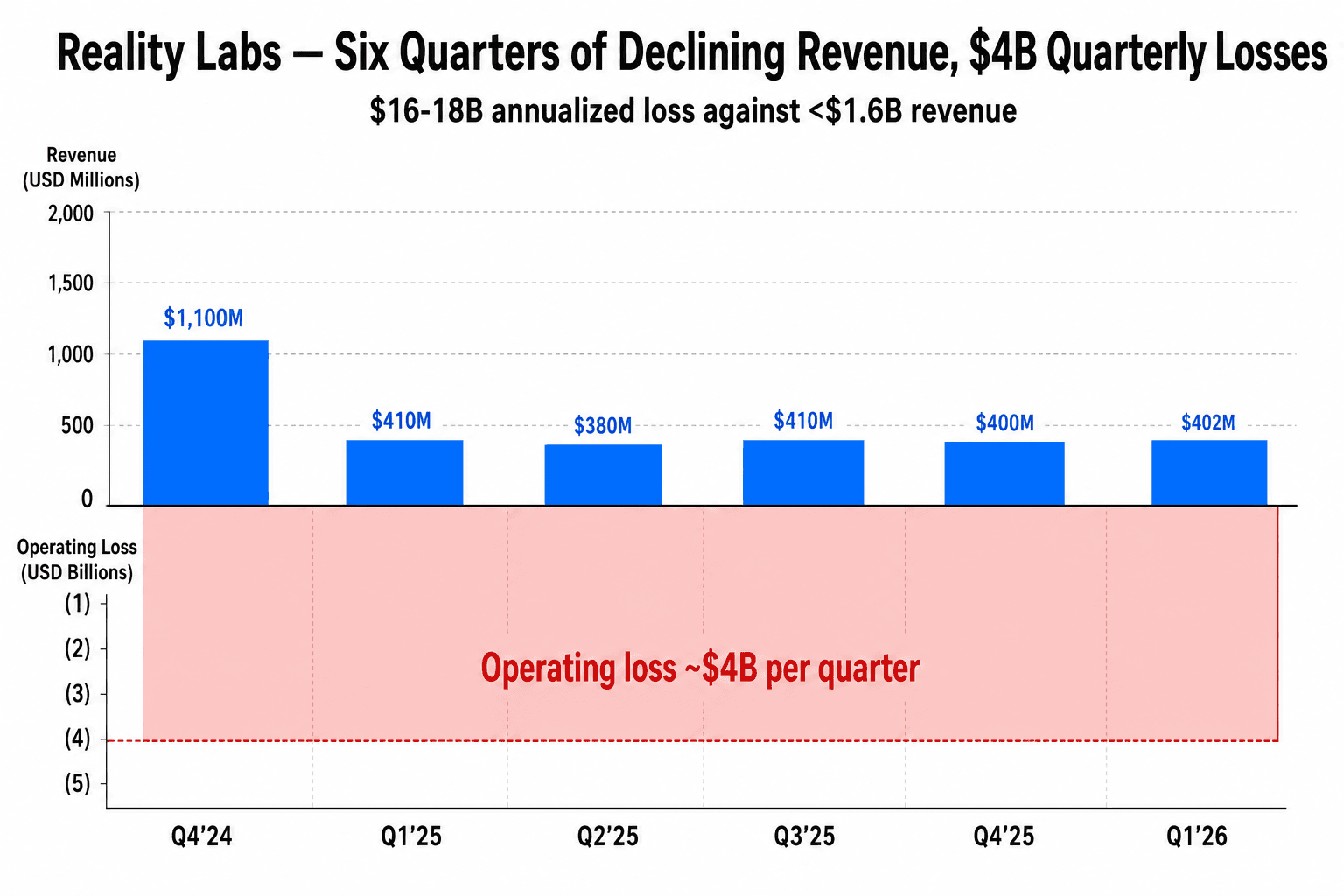
Reality Labs revenue was $402M, down 2% YoY — the sixth straight YoY decline. Operating loss was $4.03B, in line with the prior four quarters. That puts the full-year 2026 RL loss on track for $16-18B, against revenue that may not clear $1.6B.
Asked whether the segment is being re-evaluated, Zuckerberg pushed back hard: "I have never been more confident in the Reality Labs roadmap. The AI glasses surface is the long-term winner. We are not slowing down."
For investors, this is a pricing question, not a strategy question. RL is, in P&L terms, a ~$16-18B annual tax on the FoA print. As long as FoA can grow operating income faster than RL grows operating loss, Meta is still expanding consolidated operating income — which is what the 2026 expense guide ($162-169B, unchanged) implies. But the line keeps moving up. RL operating loss in 2026 will be "meaningfully higher than last year," per Susan Li.
What the bulls and bears actually fight about
Bull case: AI is rewriting Meta's ads stack from the bottom up, and the +12% price-per-ad with +19% impressions at a 40.7% operating margin is the proof. Advantage+ at 70% of ad revenue means the AI moat is already monetized, not theoretical. The capex line is the price of building permanent infrastructure for an inference economy where Meta will be a net seller of AI compute, not just a buyer.
Bear case: 2027 capex is now functionally unbounded. Susan Li's refusal to guide is a forward-warning, not a humility statement. If 2027 capex prints at $200B+, depreciation flowing through 2028-2029 P&L compresses operating margin from 41% toward the low-30s. Reality Labs is structurally bleeding $16-18B/year with no top-line trajectory. And the AI ads moat is real — but Google's Gemini-powered Performance Max and TikTok's Symphony are closing the gap, not widening it.
The print itself does not resolve the debate. It just confirmed the bear case has a credible numerator now.
Forward look — what the Q2 2026 print will turn on
Three datapoints to track between now and the late-July Q2 print:
- Q2 capex run-rate. Q1 came in at $24B. To hit the new $125-145B 2026 guide, Q2-Q4 needs to average $33-40B/quarter. A Q2 print at $30B or below would suggest the high-end is theoretical. A print at $38B+ would validate the new range as real.
- DAP recovery. Q1's QoQ DAP slip (3.58B → 3.56B) was attributed to Iran/Russia disruption. If Q2 doesn't recover sequentially, the explanation gets harder to defend.
- Advantage+ disclosure. At 70% of ad revenue, the next break-out the Street will demand is what is happening at 80%, 90%. If Meta starts disclosing AI-attributable lift on price-per-ad, the structural narrative quantifies. If it doesn't, the bear case ("AI ads moat is asymptotic") gets oxygen.
All financial figures sourced from Meta's Q1 2026 Earnings Release and Q1 2026 Earnings Presentation (filed 2026-04-29) and the Q1 2026 earnings call transcript. Analyst quotes and price-target moves sourced from Marketbeat, Public.com, and TipRanks coverage.