Eli Lilly Q2 2026: Mounjaro, Zepbound Drive Record Sales
A record quarter, powered by two drugs
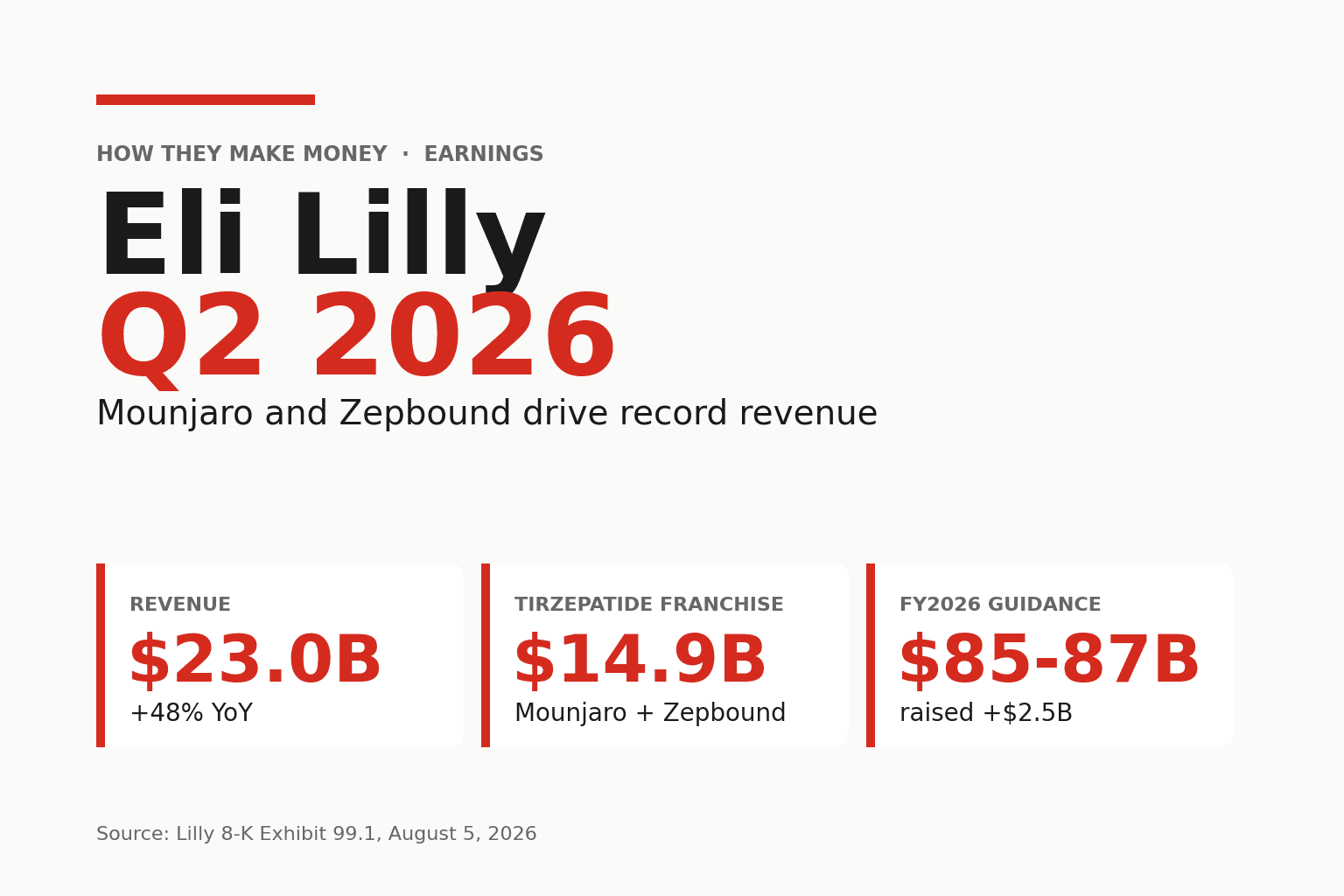
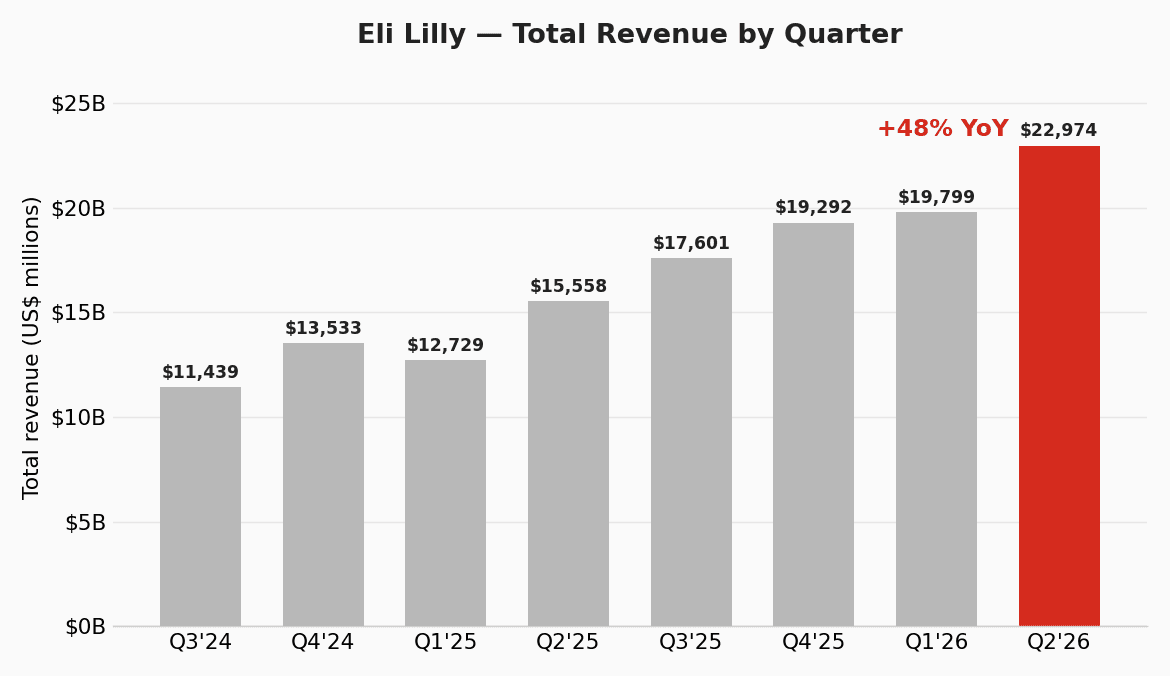
Eli Lilly turned in one of the largest quarters in its 150-year history. Revenue for the second quarter of 2026 reached $22,974M, up 48% from a year earlier, as demand for its weight-loss and diabetes medicines outran even the most bullish forecasts. The number the company wanted investors to see was volume: prescriptions and doses shipped grew 60% year over year, while the average realized price fell 13% as Lilly cut prices and expanded into lower-cost markets. Growth by the truckload, at a lower price per unit, is the trade the company is happy to make.
Profit followed. Non-GAAP earnings per share, a measure that excludes items like intangible amortization and one-time charges to show underlying operations, came in at $8.38, up 33% and far above the roughly $6.55 that Wall Street had penciled in. GAAP earnings per share, the standard accounting figure, were $7.94. Both numbers carried a heavy weight: a $3.03-per-share charge for acquired IPR&D, or in-process research and development, the cost of buying drug programs from smaller companies before they are approved. Strip nothing else out and Lilly still beat by a wide margin.
The top line and the margins
The revenue chart tells the story in one glance. Lilly has more than doubled its quarterly sales in under two years, and the latest bar towers over the rest.
Gross margin, the share of revenue left after the direct cost of making the medicines, expanded to about 86%, up from 84% a year earlier, helped by a richer mix of high-margin incretin drugs. Reported operating income rose a more modest 31% because the quarter absorbed $2,776M of that acquired-research spending, tied to deals for Orna, Ajax, Centessa and Kelonia, plus $703M of restructuring and impairment charges. Cash generation was the quieter highlight: operating cash flow more than tripled year over year to $10,690M, leaving $7,757M of free cash flow after the company's heavy factory build-out.
Inside the tirzepatide franchise
The engine is a single molecule, tirzepatide, sold under two brands. Mounjaro is the version approved for type 2 diabetes; Zepbound is the same drug approved for obesity. Together they generated about $14.9B in the quarter, an annualized run-rate near $59B, and contributed roughly $6.3B of the company's entire year-over-year growth.
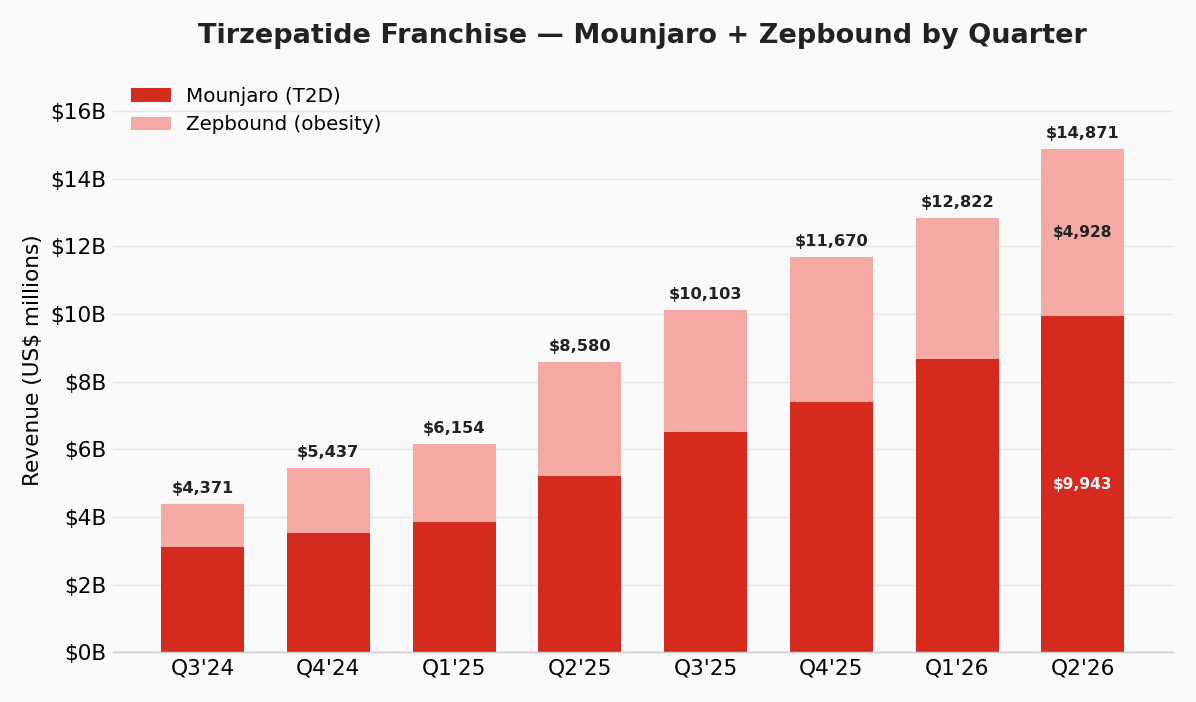
Mounjaro alone brought in $9,943M, up 91% year over year and now the largest single product line Lilly has ever sold. Zepbound added $4,928M in the U.S., up 44%, returning to sequential growth after a soft first quarter. The scale is hard to overstate: two drugs that did not exist five years ago now account for nearly two-thirds of the company's revenue.
When international overtakes home
The most telling shift this quarter was geographic. For the first time, Mounjaro's international revenue passed its U.S. revenue.
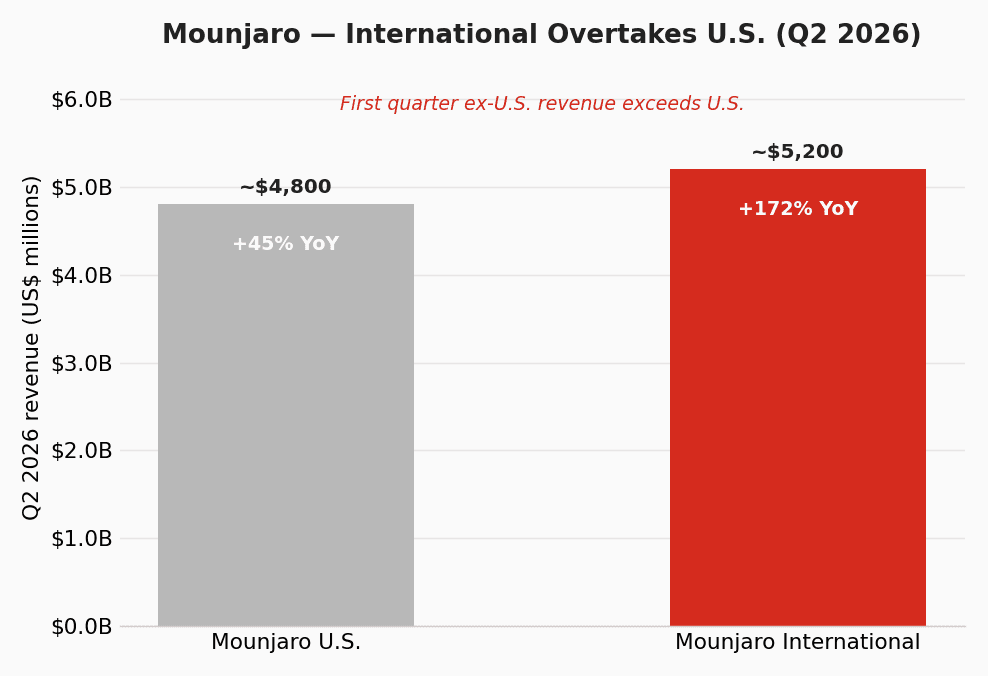
International Mounjaro sales of about $5.2B grew 172% year over year, nearly four times the 45% U.S. pace, and edged past U.S. sales of about $4.8B. A big part of that came from China, where Lilly added Mounjaro to the national reimbursement list and reached category leadership after 16 months. That access came at a price, literally: ex-U.S. realized price fell 36% even as ex-U.S. volume rose 113%. Management framed it as a deliberate volume-for-price trade, betting that far more patients at a lower price beats fewer at a high one.
A guidance raise, masked by a charge
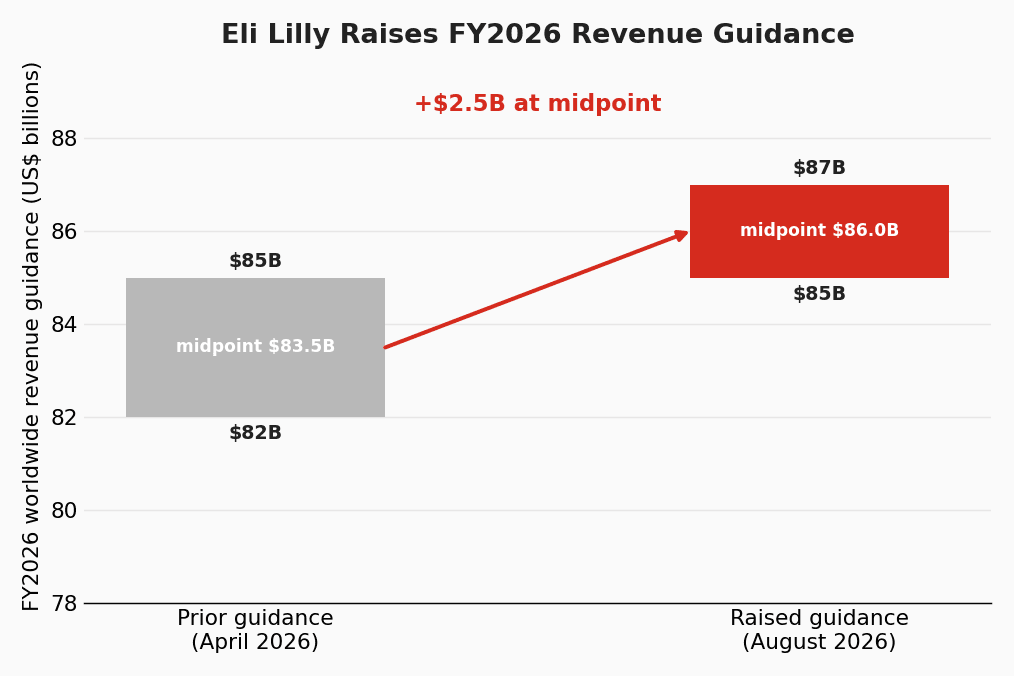
Lilly lifted its outlook across the board. Full-year revenue guidance rose to $85-87B, up $2.5B at the midpoint from the prior $82-85B.
The earnings guidance needs a translation. Lilly set non-GAAP EPS at $35.50-36.50. On the surface that midpoint slipped slightly. Underneath, the business was strong enough to raise EPS by $2.78 at the midpoint. The catch is the $3.03 of acquired-research charges booked in the quarter, which more than swallowed the operating raise. CFO Lucas Montarce spelled it out, telling analysts the company now expects EPS of $35.50 to $36.50, "an increase of $2.78 per share at the midpoint of our range before updating our guide for the $3.03 impact of Q2 acquired IPR&D charges." Lilly also raised its performance-margin target to 49-50.5%.
What management emphasized
Beyond the headline drugs, Lilly used the call to point at what comes next. Orforglipron, sold as Foundayo, is the company's first oral GLP-1 pill and posted $98M of revenue in its launch quarter. Chief executive David Ricks and U.S. president Ilya Yuffa acknowledged the rollout started "somewhat slower than anticipated" but flagged a late-July inflection, with the prescriber base jumping from about 8,000 to 36,000 and roughly one in four new obesity patients starting on the pill. A pill is easier to make and ship than an injection, which is why the market cares.
Lilly also leaned on access. A new Medicare GLP-1 Bridge Program launched July 1, giving about 20 million eligible Americans obesity coverage at roughly $50 a month out of pocket. And the next-generation candidate, retatrutide, completed its Phase 3 obesity package, with a U.S. filing targeted for the first quarter of 2027.
The Street and the tape
The reaction split between the numbers and the follow-through. Lilly stock opened up about 4.8% to roughly $1,169, snapping a five-day losing streak, then faded to about 3% near $1,148 by midday as investors weighed the U.S. price erosion and the slow start for Foundayo. Notably, the beat squeezed a heavily bearish options crowd; put-buying into the print had ranked higher than 98% of the past year. Sell-side sentiment stayed firmly positive, with targets clustered well above the pre-print price near $1,116, from Leerink's $1,232 up to Citi's Street-high $1,600.
The competitive read-through was just as loud. Rival Novo Nordisk had reported the day before and fell about 6% in U.S. trading, hit by an experimental drug that underperformed tirzepatide in a head-to-head diabetes study and an oral product that came up short. The split screen, Lilly up and Novo down, underscored how far ahead Lilly now sits in the obesity race.
The forward look
The bull case is straightforward: two drugs compounding at extraordinary rates, an international ramp that is only beginning, a pill and a next-generation injectable in the wings, and a guidance raise to match. The watch items are just as clear. U.S. realized price is falling as Lilly discounts to widen access, the Foundayo launch needs to prove its late-July inflection is durable, and guidance implies some deceleration in the second half against a tough prior-year base. Lilly delivered a genuine beat-and-raise. The question for coming quarters is whether volume can keep outrunning price long enough for the newer bets to carry the load.