Eli Lilly grew 56% in a quarter. Then it raised its 2026 guide by another $2B.
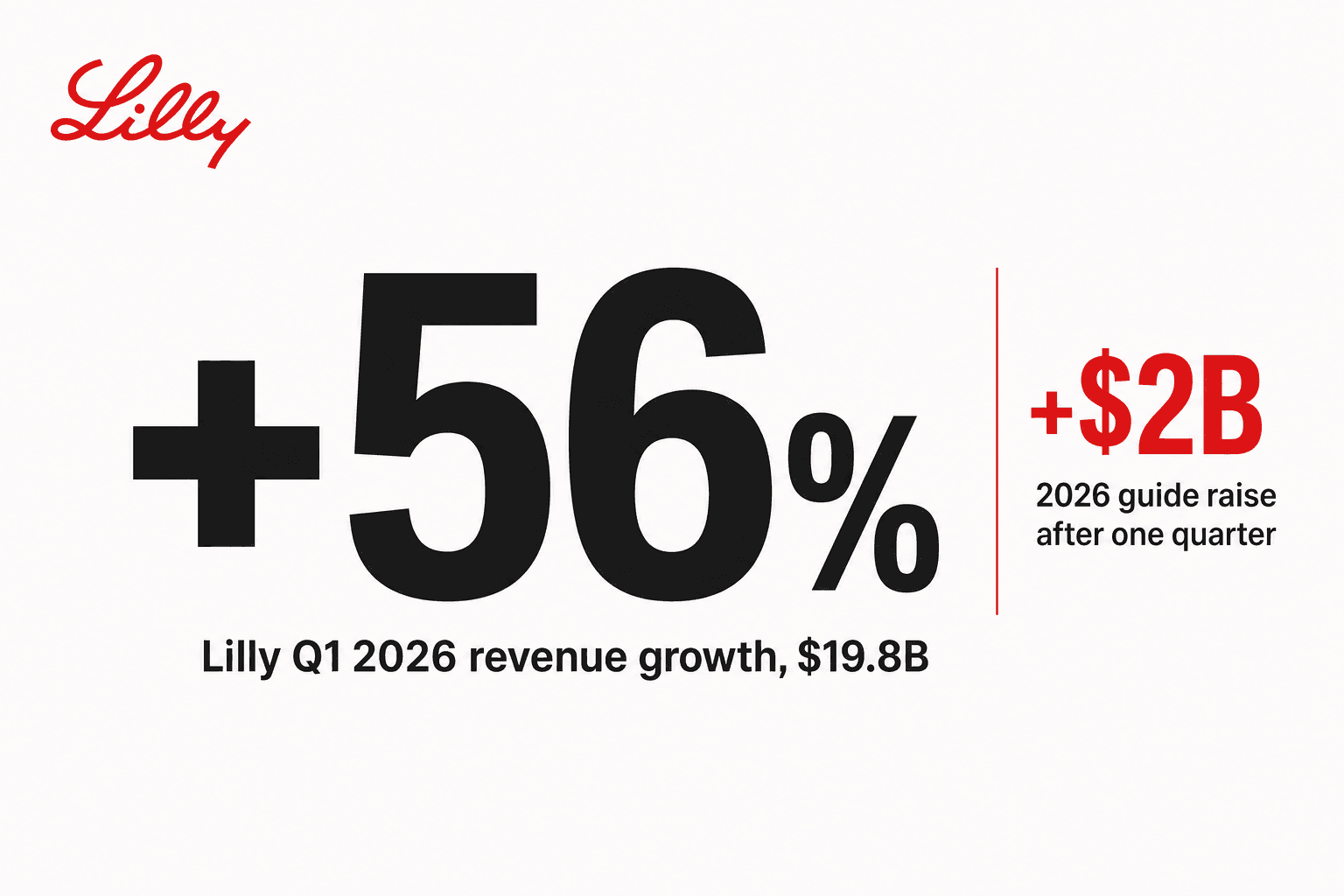
The Eli Lilly Q1 2026 print is a number that doesn't fit normal large-cap pharma frames. Revenue of $19.8 billion, up 56% year over year. Non-GAAP EPS of $8.55, up 156%. The single product line for Mounjaro printed $8.66 billion in one quarter — bigger than every Tesla quarterly automotive segment except Q4 2024.
The quarter ahead of that one — Q4 2025 — was already a $19.3B print. So Lilly's revenue is basically running flat sequentially at ~$19.5B/quarter, against a Q1 2025 base of $12.7B. The +56% YoY growth rate doesn't come from one-time catalysts. It's the GLP-1 franchise compounding into a much larger base than it had a year ago.
Then, three months into the year, Lilly raised the 2026 guide by $2B at the midpoint. Revenue from $80–83B to $82–85B. Non-GAAP EPS from $33.50–35.00 to $35.50–37.00. After one quarter. The stock closed +10.3% on the day.
Mounjaro is now a $34B-run-rate drug
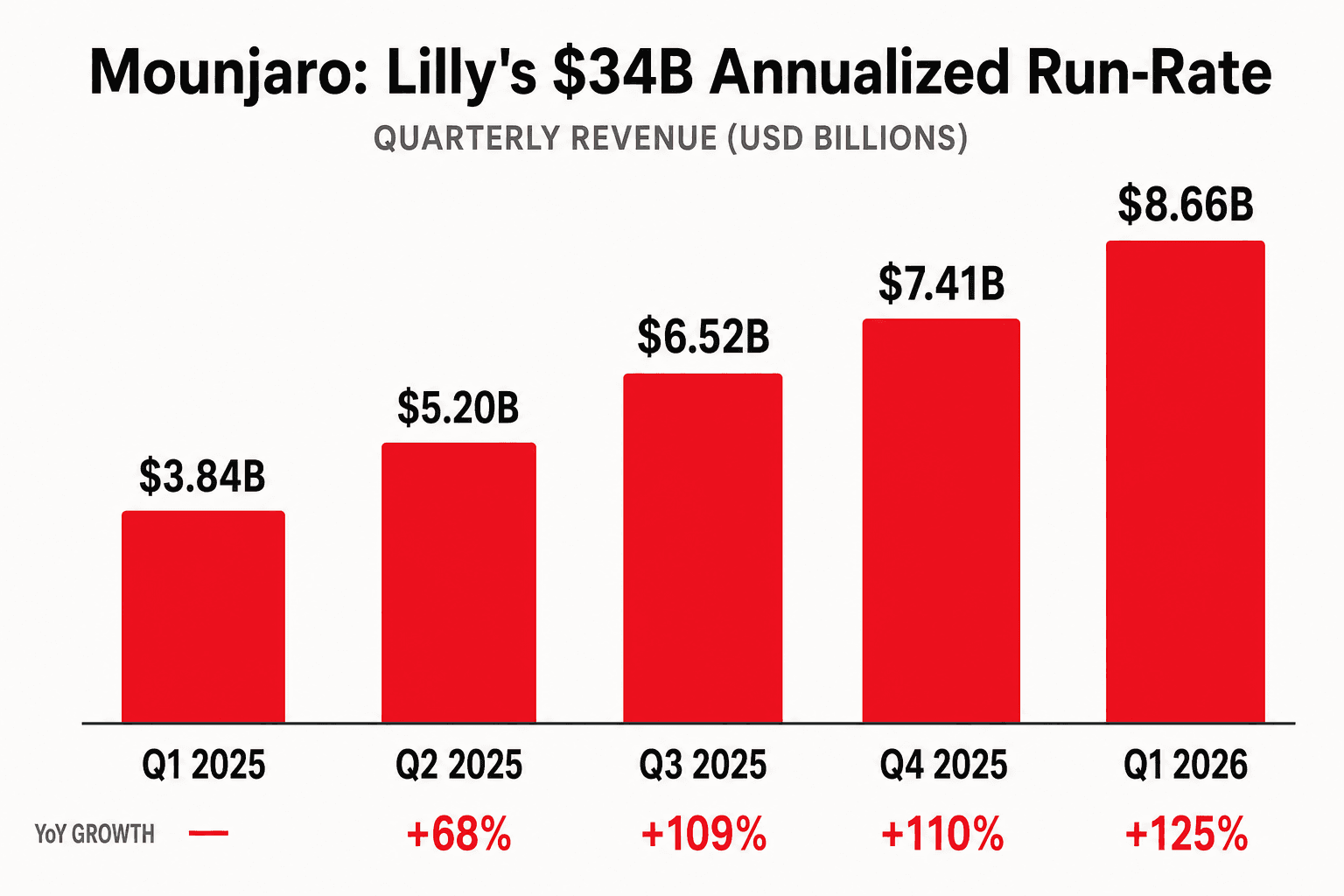
The $8.66B Q1 Mounjaro number is hard to put in context because there isn't a recent comparable in pharma history. KEYTRUDA — the prior gold-standard pharma franchise — took roughly seven years from launch to reach a similar quarterly run-rate. Mounjaro was approved in May 2022 and crossed $8B in a single quarter less than four years later.
The $8.66B beat the $7.26B Street consensus by $1.4 billion in a single line item. That delta alone is bigger than the entire quarterly revenue of most S&P 500 pharma companies. To use a different benchmark: the $8.66B Mounjaro line is approximately 70% of all of Bristol-Myers Squibb's Q4 2025 revenue.
The composition of the +125% YoY growth: U.S. revenue was $4.1B (+57%), reflecting strong demand partially offset by lower realized prices. Outside-US revenue was $4.6B (vs. $899M in Q1 2025). The China NRDL inclusion drives the ex-US price down 25% and volumes up 95% — but the absolute revenue contribution is still net positive.
Mounjaro plus Zepbound is the franchise
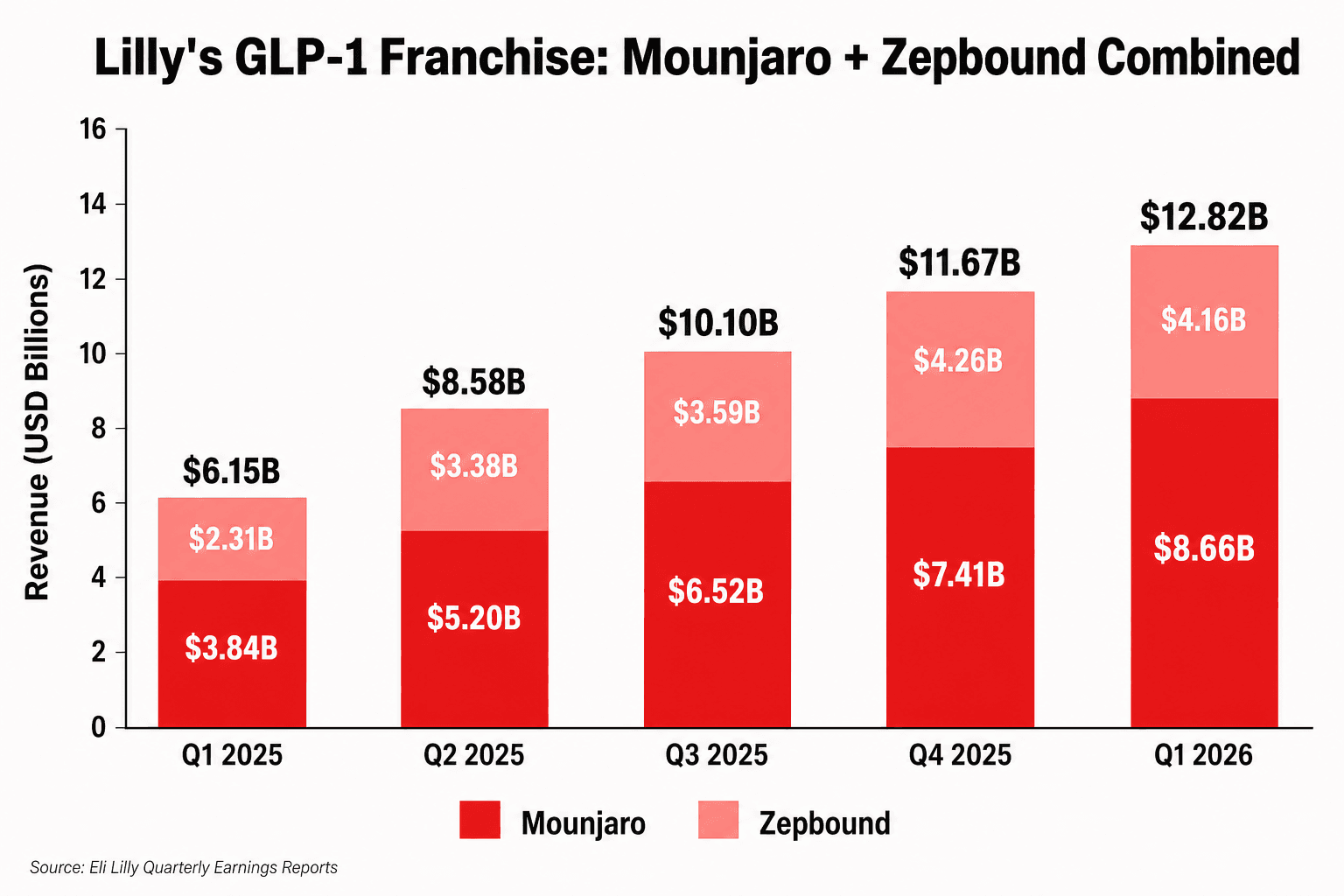
Zepbound (tirzepatide for obesity) was the only crack in an otherwise overwhelming print. Q1 2026 sales of $4.16B were down 2% sequentially from $4.26B in Q4 2025 — the first QoQ decline in Zepbound's history. Lilly's Patrik Jonsson (President of Diabetes & Obesity) told the call this reflected Q4 inventory normalization, not underlying demand softness. Underlying weekly Zepbound demand was up +35% YoY in Q1.
Combined, Mounjaro + Zepbound generated $12.82B in Q1 2026. Annualized: $51B. This single franchise (built on one molecule, tirzepatide, marketed under two brand names by indication) is now larger than the entire pharmaceutical revenue of most U.S. mid-cap pharma companies. Larger than all of Bristol-Myers's Q1 2025 revenue. Larger than every Apple product category except iPhone in FY26Q2.
The +9.9% sequential growth rate is decelerating from the +15-39% of prior quarters, which is mathematically inevitable as the base grows. The question for sell-side models isn't the growth rate — it's where the curve plateaus.
Foundayo — the asymmetric event
The single biggest pipeline event in the quarter was the FDA approval of Foundayo (orforglipron) — Lilly's oral GLP-1 pill — for adults with obesity, or overweight with weight-related comorbidities. This is the first oral GLP-1 approved without food/water restrictions. (Novo's existing oral semaglutide, Rybelsus, requires fasting + 30-minute wait before food.)
Why does this matter? Three reasons:
- Addressable patient population. A meaningful fraction of patients refuse weekly injectables. An oral pill collapses that barrier.
- International economics. No cold chain, no syringes, no specialty pharmacy logistics. The unit economics for global launches are dramatically better.
- Manufacturing. Small molecule synthesis instead of peptide injectable. The capacity ceiling for orals is dramatically higher than for injectables.
Foundayo launched in Q2 2026 (after Q1 quarter-end), so it's not in this print's revenue. Week 1 prescription run-rate was ~3,700/week, vs. analyst expectations near ~8,000/week. That's the only soft data point in the entire release.
Lilly's CSO Daniel Skovronsky was direct on the call: Week 1 reflects deliberate supply-led ramp constraints to ensure DTC channel execution and physician familiarity. He told the call to "expect step-changes in May and June."
The launch curve for Foundayo is, per CEO David Ricks, "the single most important variable in 2027 financial performance." The Week 1 number is noise. The week 12 and week 24 trajectories are the signal.
The $2B guide raise
Lilly's revised 2026 guide:
| Metric | Initial (Feb 2026) | Revised (Apr 2026) | Δ midpoint |
|---|---|---|---|
| Revenue | $80.0B – $83.0B | $82.0B – $85.0B | +$2.0B |
| Non-GAAP EPS | $33.50 – $35.00 | $35.50 – $37.00 | +$2.00 |
Two observations on the magnitude:
First, a $2B mid-point revenue raise after one quarter implies that Lilly is tracking to somewhere in the $85B+ range for the full year, given guidance philosophy is "deliberately conservative on launch-curve assumptions" per CFO Anat Ashkenazi. Sell-side models will model the high end.
Second, the EPS raise of $2.00 maps directly to the revenue raise. Lilly is not assuming meaningful operating leverage from higher volumes — gross margin guidance was held essentially flat. That's conservative; bulls see another lever to pull.
The Novo Nordisk problem (or: the binary trade)
The most striking peer move on April 30 was Novo Nordisk: -5.8% on the same day Lilly closed +10.3%. The two are now treated as a binary trade. Every dollar of Mounjaro upside reads as a dollar of Ozempic/Wegovy market-share loss. Every Foundayo Phase 3 win reads as an Rybelsus differentiation loss.
The China NRDL story was the proximate cause this quarter — Mounjaro's NRDL inclusion plus its volume ramp directly displaces semaglutide in the Chinese market. The Foundayo approval will compound the dynamic in 2027 in U.S. and EU markets.
Four acquisitions in one quarter
Lilly also announced agreements to acquire four companies in Q1 — Orna Therapeutics, Centessa Pharmaceuticals, Kelonia Therapeutics, and Ajax Therapeutics. The combined acquired IPR&D charge of $584M ($0.52/share) is built into the Non-GAAP EPS. The four deals diversify across circular RNA, orexin receptor agonists (sleep-wake), in-vivo gene therapy, and JAK2 inhibitors.
The strategic interpretation: Lilly is using the cash flow from the GLP-1 franchise to build out a non-GLP-1 portfolio that reduces concentration risk by 2030. None of the four are near-term revenue contributors.
What to watch into Q2 (early August 2026)
Three things will define the next print.
The first is Foundayo prescription run-rate trajectory. Week 1's ~3,700/week needs to scale to 15,000-20,000/week by August for 2027 sell-side models to hold. If it stalls below 10,000/week for several weeks, the launch-curve assumption gets revisited.
The second is Mounjaro China NRDL stabilization. The -25% ex-US price impact is now in the run-rate. Volumes should grow further. Whether the geographic mix-shift improves Mounjaro's blended ASP path matters for 2027 estimates.
The third is manufacturing capacity utilization commentary. Any supply-constraint mention on the Q2 call materially changes the 2027 revenue ceiling. Multiple analysts pushed CFO Ashkenazi on this; her response — "current capacity build supports >$120B revenue scenarios by 2028" — is the framing the buy-side is anchored to.
For now, the line that fits the data is the simple one: this is the largest single-product pharma franchise in history compounding into a much bigger base than it had 12 months ago. The only outstanding question is what the curve looks like at $25B/quarter — and whether Foundayo arrives in time to extend the runway.