Intel Q2 2026: Record Revenue, Data Center Surge
A record quarter wrapped inside a giant loss
Intel just posted the best revenue quarter in its history and, on the same page, an $11 billion loss. Both are true, and understanding why is the key to the whole report.
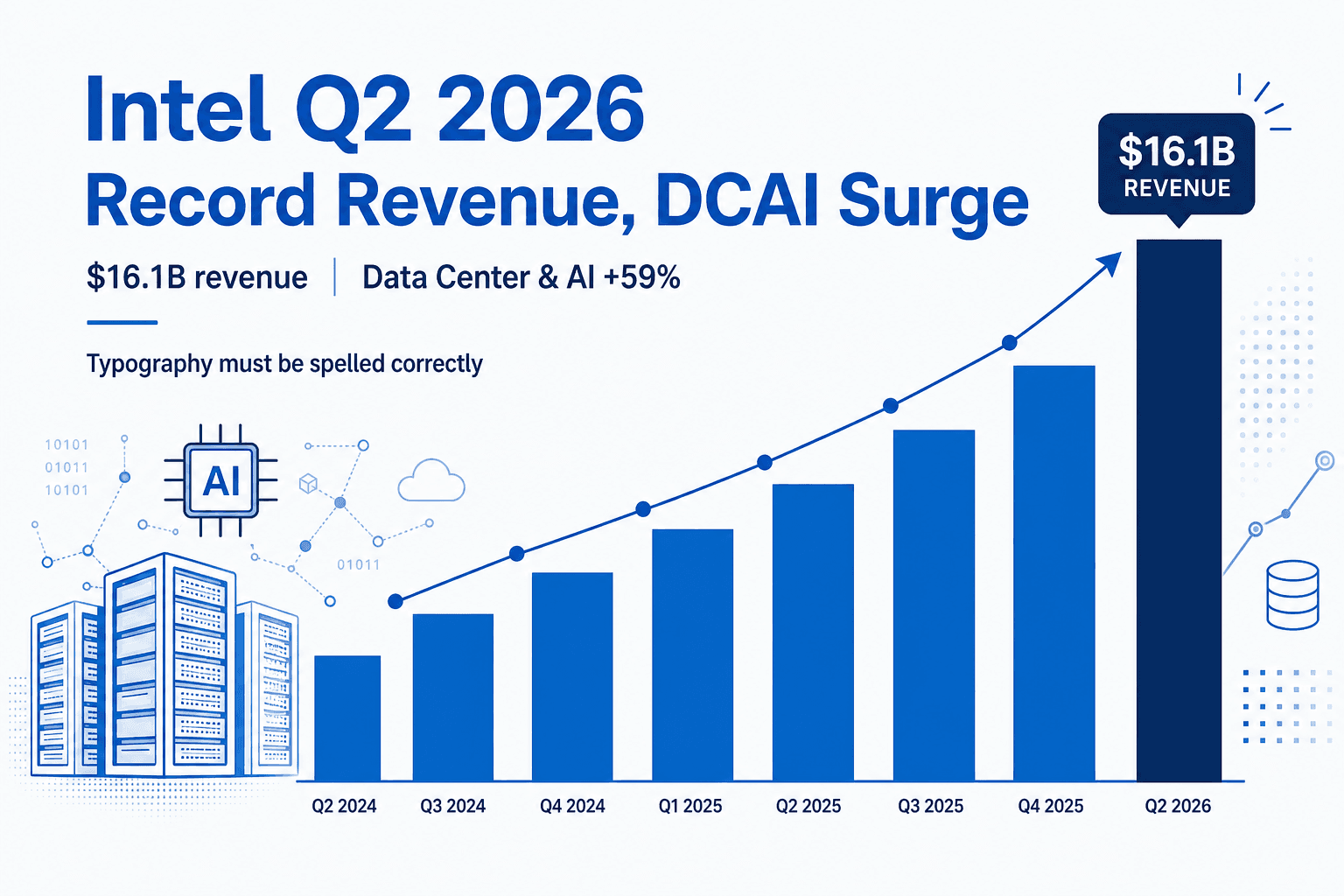
For the three months ended June 27, 2026, revenue rose 25.4% from a year earlier to a record $16.13B. That is Intel's fastest growth in more than 15 years and roughly $1.8B above the midpoint of its own guidance. The operating business turned a profit, gross margins reached multi-year highs, and non-GAAP earnings more than doubled what management had promised. Yet the headline GAAP net loss came to $11.0B, or $2.16 per share, because of a single non-cash charge that has nothing to do with selling chips. The chart above is a Sankey diagram, a flow chart whose ribbon widths are scaled to dollars, so the biggest revenue streams stand out at a glance.
CEO Lip-Bu Tan framed it simply on the call: this was Intel's seventh straight quarter of beating its own targets, and "strong demand for our products continue to outpace our growing supply."
The top line sets a record
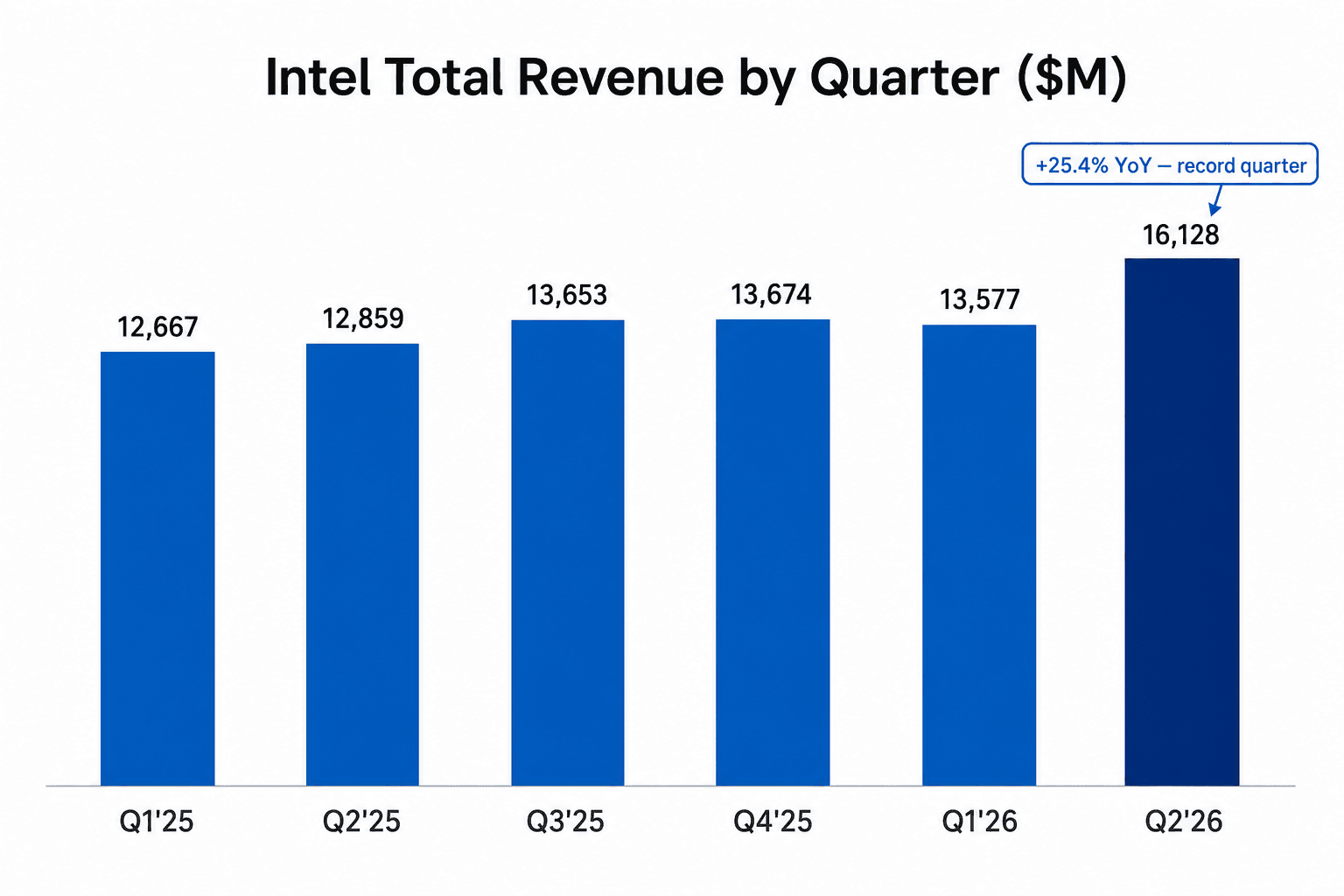
The revenue line does the talking. A year ago Intel booked $12.86B in the same quarter; this time it did $16.13B, an 18.8% jump from just the prior quarter. Growth was broad. Client Computing and Physical AI, the renamed PC-chip group, rose 12.8% to $8.88B, with AI PCs now making up about two-thirds of client revenue. Data Center & AI climbed 59% to $6.26B. Intel Foundry, the manufacturing arm, hit a new revenue high of $5.77B.
Zinsner credited the upside to "higher factory yields and improved cycle times," and that operating leverage carried down to margins. Non-GAAP gross margin came in at 41.8%, about 280 basis points above guidance and more than 12 points better than a year ago, while non-GAAP operating margin of 17.2% was Intel's best in years.
Data Center & AI is the engine
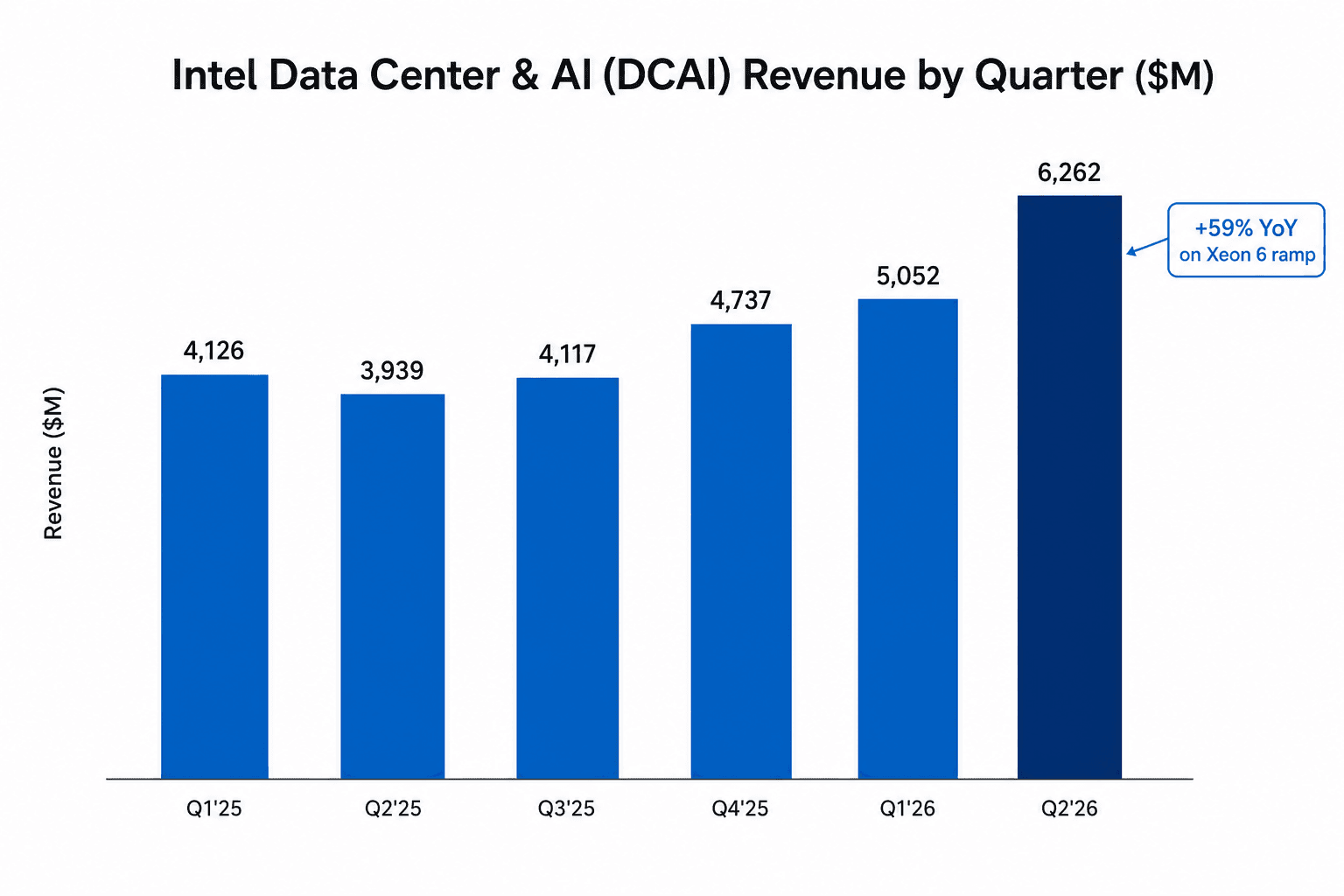
If one number defines the quarter, it is the 59% jump in Data Center & AI to $6.26B, which management called the strongest server growth in the company's history. The driver is Xeon 6, Intel's latest line of server processors, which Tan described as one of the fastest-ramping products Intel has ever shipped.
The profit story underneath is even better than the revenue. DCAI operating income nearly quadrupled from a year ago to $2.47B, pushing the segment's operating margin to about 39.5% from roughly 16% as higher-value chips and firmer pricing took hold. Zinsner said AI-driven businesses now account for about 70% of Intel's total revenue and are growing more than 70% year over year. Tan's argument for why this lasts: as AI moves from training models to running them, and then to autonomous "agentic" systems, the need for general-purpose server processors climbs alongside the GPUs everyone talks about, rather than being displaced by them.
Foundry losses keep narrowing
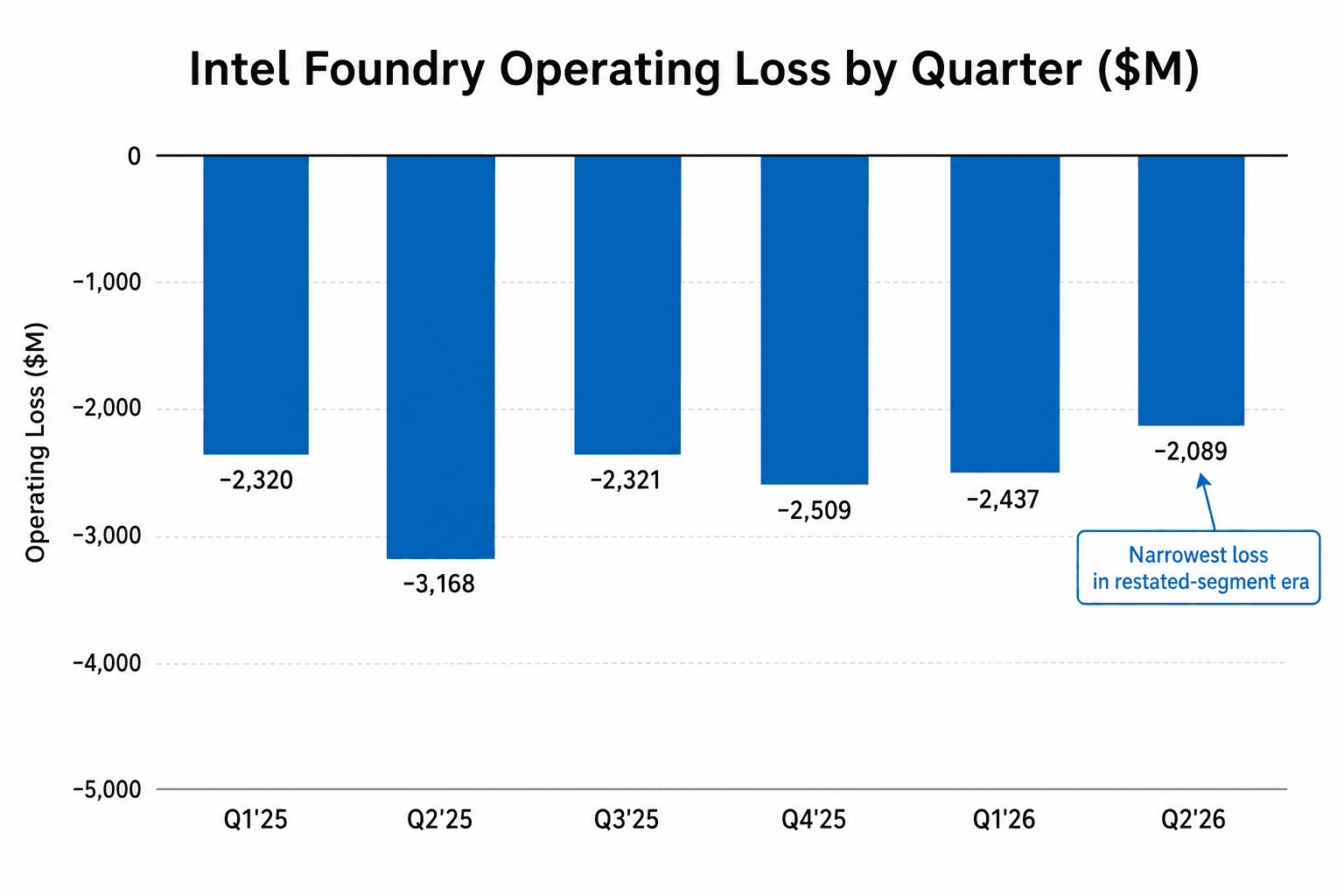
Intel Foundry, the business that actually manufactures chips for Intel's own designs and, increasingly, for outside customers, remains deep in the red, but the trajectory is what counts. The segment lost $2.09B in the quarter, an improvement of $348M from the prior quarter and about $1.08B from a year earlier, and its narrowest loss since Intel began reporting the division this way.
Most of that volume is still captive, meaning Intel making chips for Intel, but external foundry revenue roughly doubled to about $293M. The loss is shrinking as yields on the 18A process improve and unit costs on the new Panther Lake chips fall. Management said its next-generation 14A process is running ahead of schedule and voiced "growing confidence" that it will be competitive, with more outside-customer interest expected as yield data lands. A collaboration with Fortinet on custom security silicon was cited as a template for a purpose-built-chip opportunity Tan pegged at more than $100B.
The GAAP versus non-GAAP gap, explained
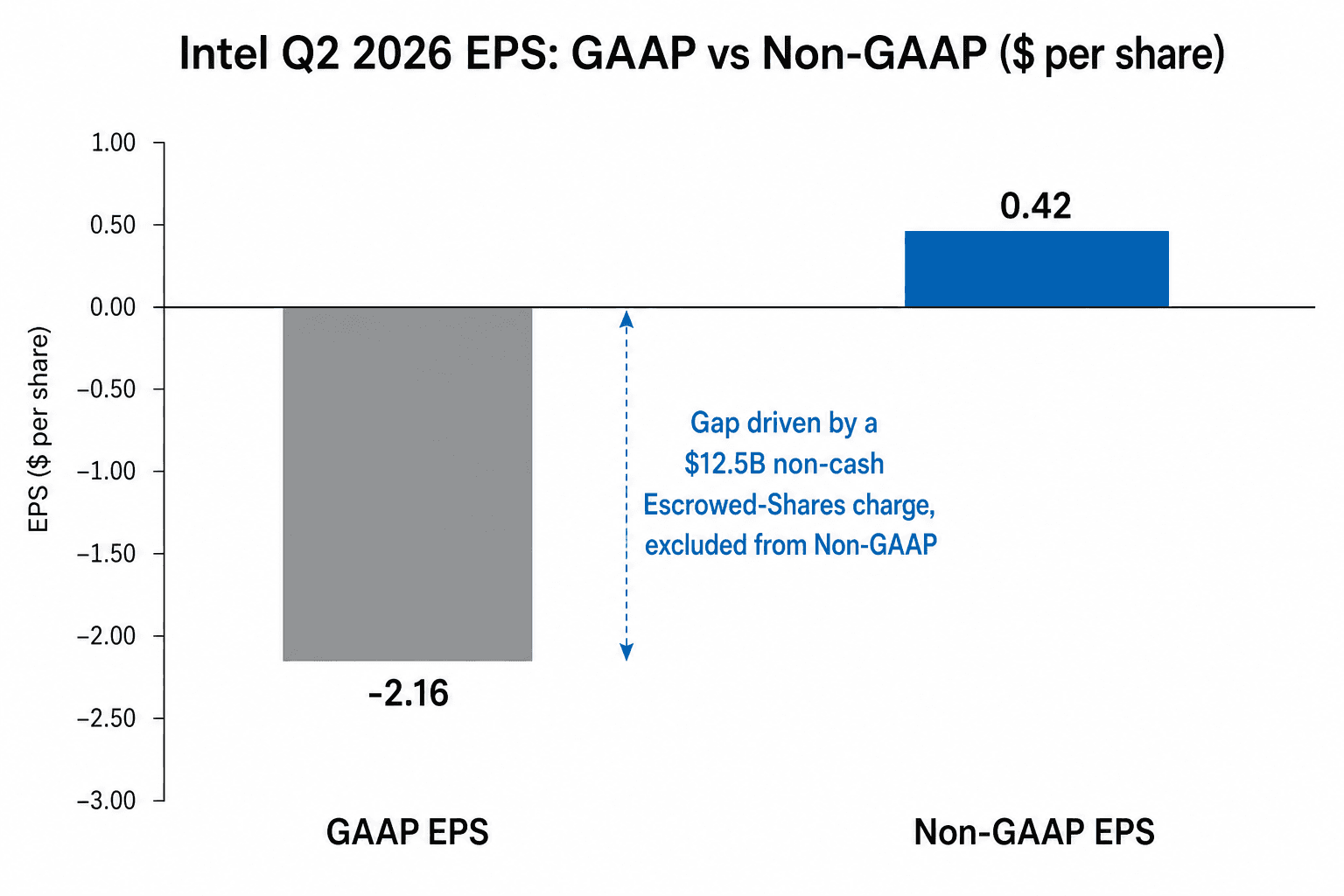
Here is the number that will confuse casual readers, so it is worth slowing down. Intel's GAAP earnings, the ones that follow standard accounting rules, showed a loss of $2.16 per share. Its non-GAAP earnings, which exclude items management deems unrepresentative, showed a $0.42 profit. That $0.42 more than doubled the roughly $0.20 Intel had guided.
The entire gulf between the two is one line item: a $12.5B non-cash charge on what Intel calls escrowed shares. Under a CHIPS Act agreement, a block of Intel stock is held in escrow for the U.S. government. Accounting rules treat that obligation as a derivative that has to be revalued every quarter. When Intel's share price rises, as it did sharply this year, the value of that obligation rises with it, and the increase is recorded as a loss even though Intel pays out nothing. It is real on the income statement but invisible in the cash flows, which is why management, and most analysts, look through it to the $0.42. GAAP EPS will keep lurching around for as long as the escrow sits on the books.
Cash, capex, and the supply squeeze
The cash statement carried its own split personality. Operating cash flow was a standout $7.0B, the strongest in years. Yet adjusted free cash flow came in at negative $8.4B, dragged down by a large distribution to a manufacturing-financing partner tied to Intel's Fab 34 arrangement. Intel still ended the quarter with about $29.7B in cash and short-term investments, up 40% from a year ago, plus an undrawn revolver and non-core assets it flagged as monetizable.
The forward spending is going up, not down. Intel raised its 2026 capital-expenditure outlook to more than $20B, with tooling spending up roughly 40%, and said 2027 would be "significantly above" that. The reason, per Tan, is that Intel cannot make enough. He described "one of the most severe supply constraints" the industry has seen across leading-edge chips, wafers, memory, and substrates, and warned they "will persist for the foreseeable future." Zinsner was blunter: Intel "will not catch up in the fourth quarter."
The Street raises targets but keeps its guard up
The market liked it. Shares jumped about 12% in after-hours trading, driven as much by the third-quarter outlook as by the beat, on top of a stock that had already run more than 160% during 2026.
Analysts responded in near-unison: raise the price target, keep the rating. Bulls such as HSBC (to a Street-high $200), Bank of America ($160), and KeyBanc ($155) leaned into the foundry and AI-server story, while Morgan Stanley, UBS, and TD Cowen lifted their numbers but stayed at Hold or Neutral on valuation. The spread is telling. Targets run from about $65 at the bearish end to $200 at the top, one of the widest gaps you will see on a large-cap name, and a clean measure of how divided the Street is on whether the foundry turnaround is durable.
The forward look
For the third quarter, Intel guided to revenue of $15.8B to $16.8B, a non-GAAP gross margin around 42%, and non-GAAP EPS of $0.38. The slight sequential dip in earnings reflects early-life production of the new 18A-based chips, which carry below-average margins until they mature, along with a PC market that management expects to run soft on rising memory prices.
The tension in this report is the tension in the stock. One reading is of a company firing on all cylinders, with a record top line, a data-center engine finally roaring, and a foundry loss on a clear path down. The other is of a business whose reported earnings are hostage to an accounting quirk, whose free cash flow just went sharply negative, and whose stock has already priced in a lot of good news. Whether Intel can turn "demand outpaces supply" from a constraint into delivered revenue will decide which reading wins.