Alphabet Q2 2026: Cloud Soars 82%, Capex Hits Record
A beat that the market treated like a warning
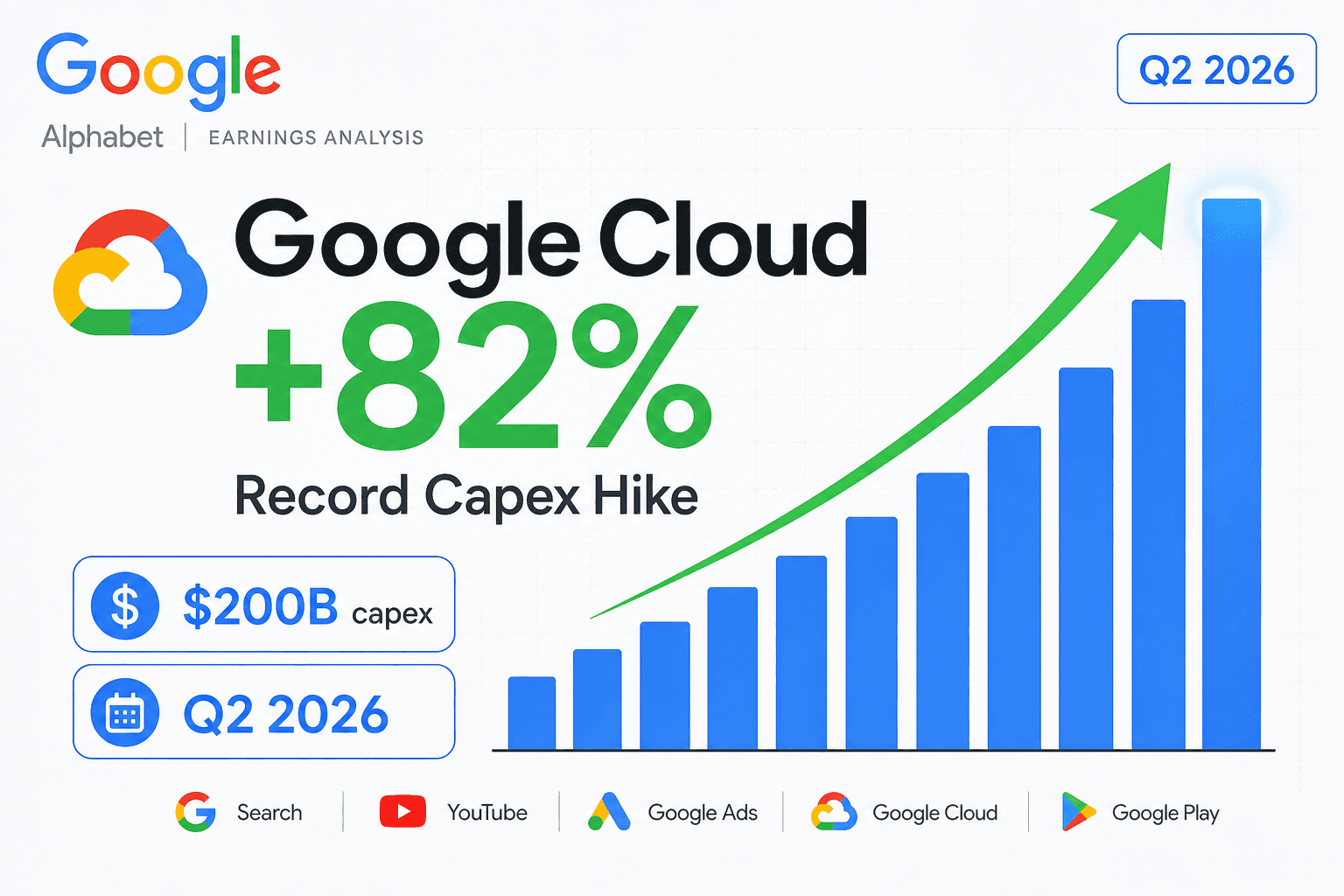
Alphabet delivered one of its strongest operating quarters in years and watched its stock fall for it. For the three months ended June 30, 2026, revenue rose 24.2% from a year earlier to $119.8B, the twelfth consecutive quarter of double-digit growth. Google Cloud accelerated to 82% growth. Operating income climbed 30% to $40.8B. On almost every measure of the underlying business, this was a blowout.
Then management got to the spending. On the earnings call, CFO Anat Ashkenazi raised full-year capital-expenditure guidance to a record $195-205B, up from the $180-190B range set only three months earlier, and said the figure would rise "significantly" again in 2027. Capital expenditure, or capex, is the money a company sinks into long-lived assets like data centers and chips. This quarter it hit $44.9B, roughly double a year ago, and for the first time it outran the cash the business generated, pushing free cash flow to negative $5.9B. The shares, which had closed the regular session around $342, fell roughly 3 to 5 percent after hours. The reaction was not a verdict on the business. It was a verdict on the bill.
Revenue: broad strength, led by Cloud and Search
The top line was healthy across the board. Google Services, the segment that houses Search, YouTube and Android, grew 14.5% to $94.5B. Within it, Google Search and other rose 16.8% to $63.3B, which management credited to AI Overviews and AI Mode drawing more queries rather than fewer, plus record Search usage during the FIFA World Cup. YouTube advertising reaccelerated to 12.9% growth at $11.1B. Other Bets, Alphabet's collection of long-shot ventures such as the Waymo self-driving unit, stayed tiny at $382M in revenue and a $1.8B operating loss.
But the engine of the quarter was Google Cloud, which grew 81.8% to $24.8B, a striking acceleration from 63% in the prior quarter and 48% at the end of 2025. The story of the print is concentrated in one segment.
The Cloud inflection: growth and profit at the same time
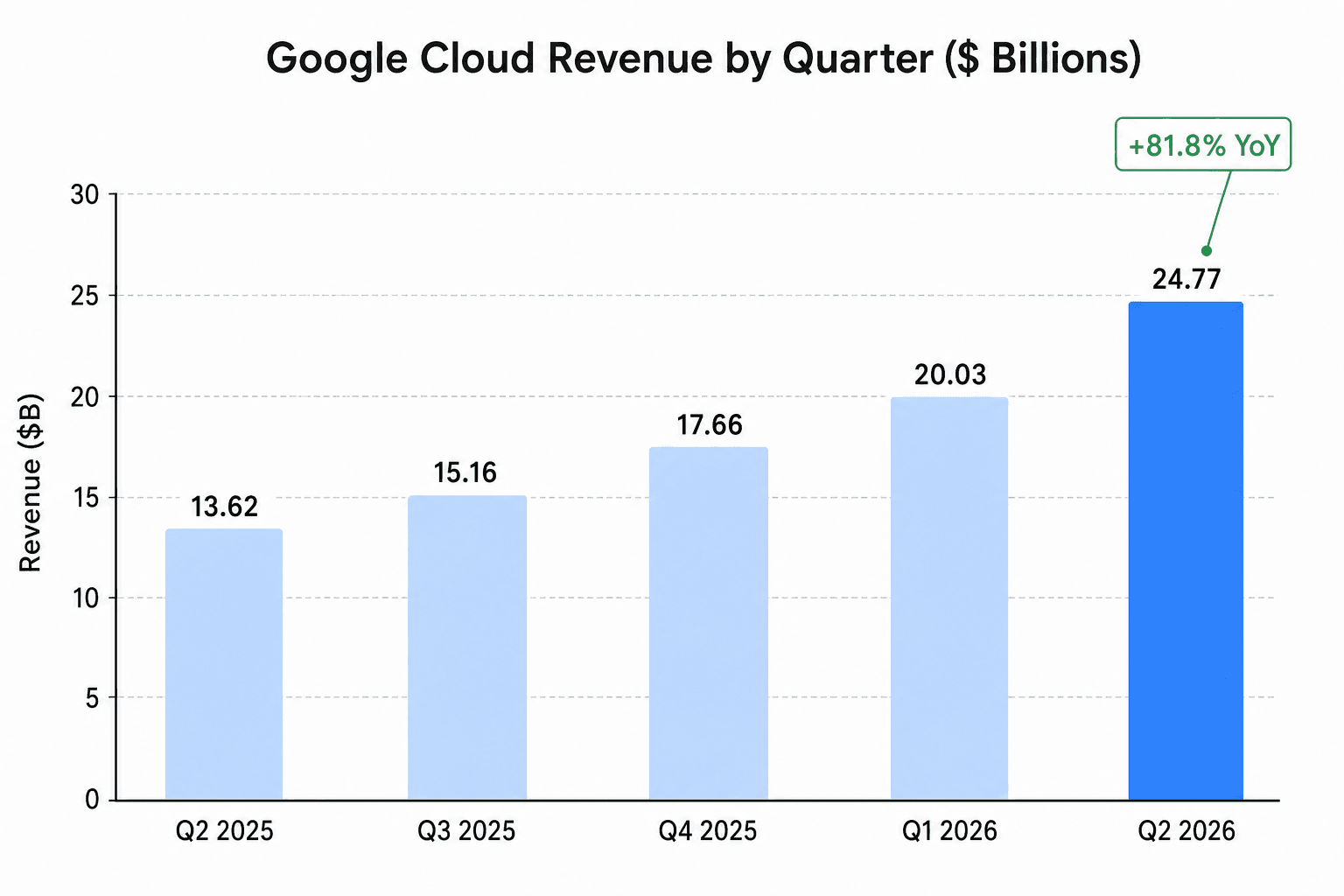
Fast growth alone is not new for Cloud. What changed is that the growth is now accelerating and getting far more profitable at the same time, a combination that is rare at this scale. Management pointed to demand coming from every direction: new-customer acquisition running at more than double last year's velocity, existing customers exceeding their contracted commitments by over 50%, and marketplace transactions up more than sevenfold. Nearly 500 customers each processed more than a trillion AI tokens over the past year. The quarter also booked, for the first time, revenue from selling Google's own TPU chip systems directly into customer data centers, a genuinely new revenue stream.
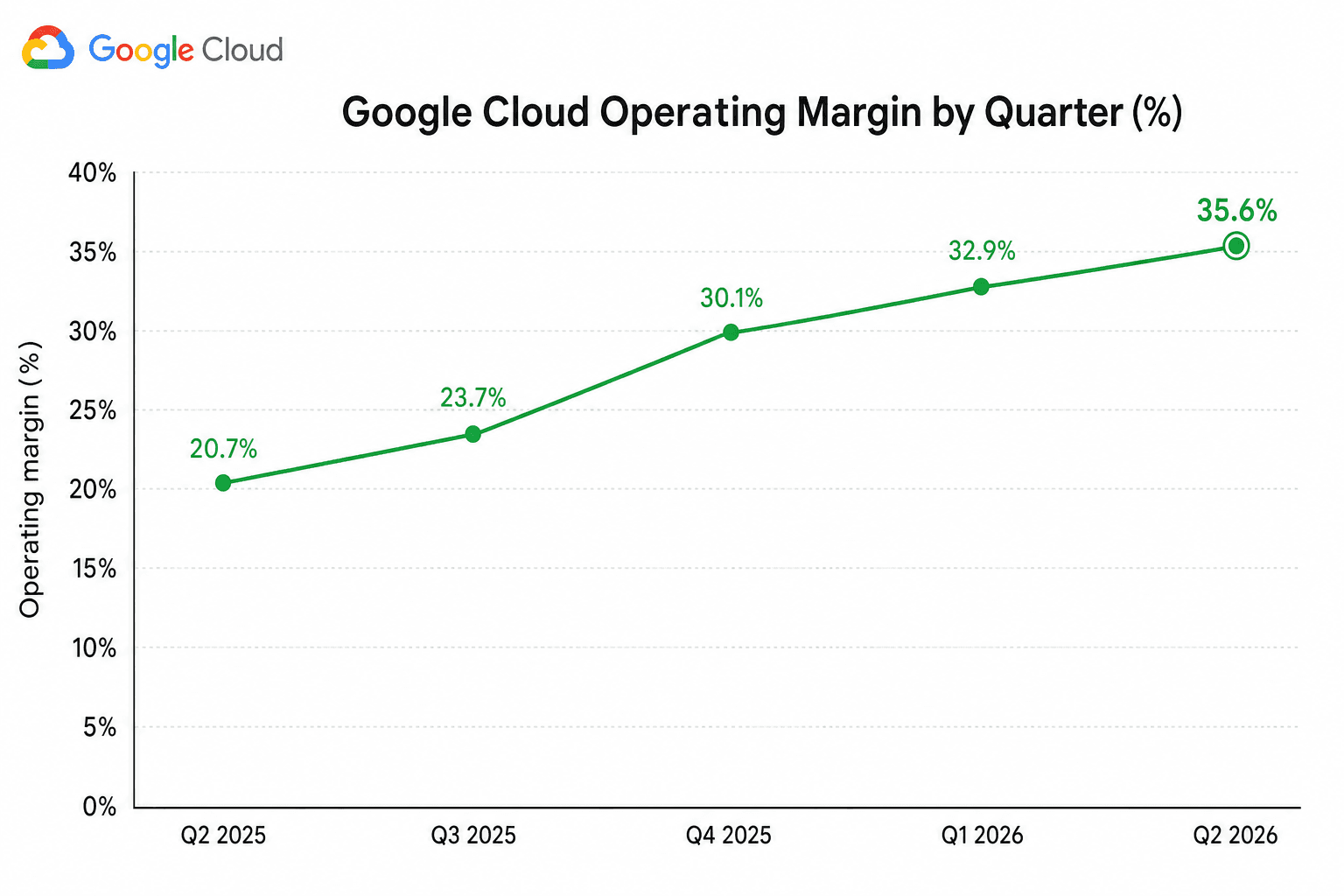
The margin story is the part that should reassure skeptics. Cloud's operating margin, the share of its revenue left as profit, jumped to 35.6% from 20.7% a year ago. Operating income more than tripled to $8.8B. A business that was barely profitable two years ago is now a meaningful earnings contributor, and it is scaling profitability as it grows, not sacrificing it. The one caveat management flagged: it will rent third-party capacity in the current quarter to meet demand it cannot yet serve itself, which will apply "modest near-term margin pressure."
The capex collision and why the stock fell
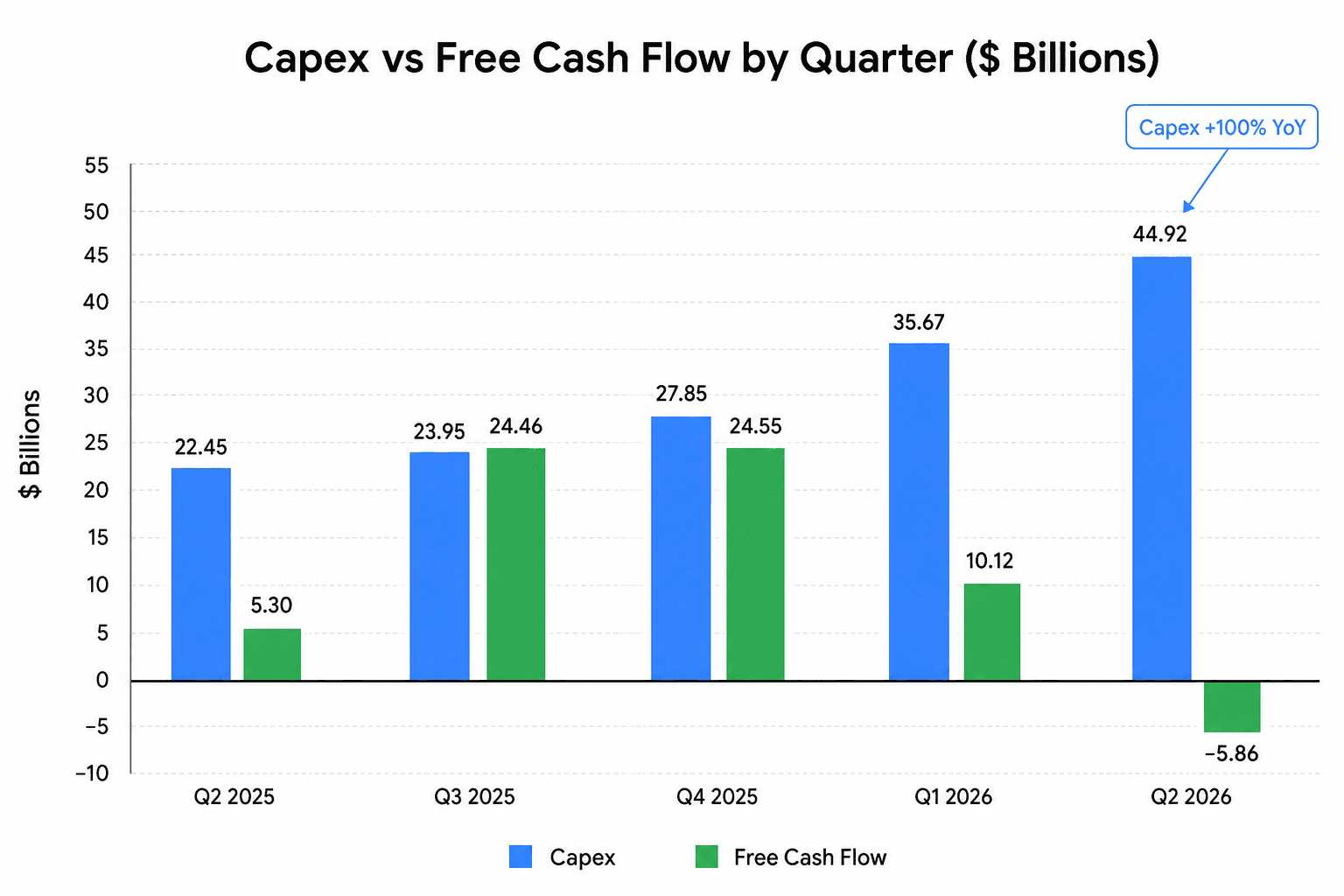
Here is the tension in one chart. Capex has more than tripled over two years and doubled in the last twelve months to $44.9B. Free cash flow, which had comfortably covered that spending in every recent quarter, flipped to negative $5.9B because the AI build-out now consumes more than the entire quarter's operating cash flow of $39.1B. Trailing-twelve-month free cash flow is still positive at $53.3B, so this is a single-quarter crossover, not a collapse. But direction matters to investors, and the direction is toward spending more, not less.
That is why a quarter with a 24% revenue beat and 82% Cloud growth still sent the stock down. The raise to $195-205B in full-year capex, on top of an identical raise a quarter earlier, told the market that the spending curve is still bending upward. Alphabet funded part of the gap with roughly $49.6B of new equity in June and about $20.3B of new debt, and it did no share buybacks this quarter, versus $13.2B a year ago. The company is spending like it is in an arms race, because it is.
The earnings-quality asterisk
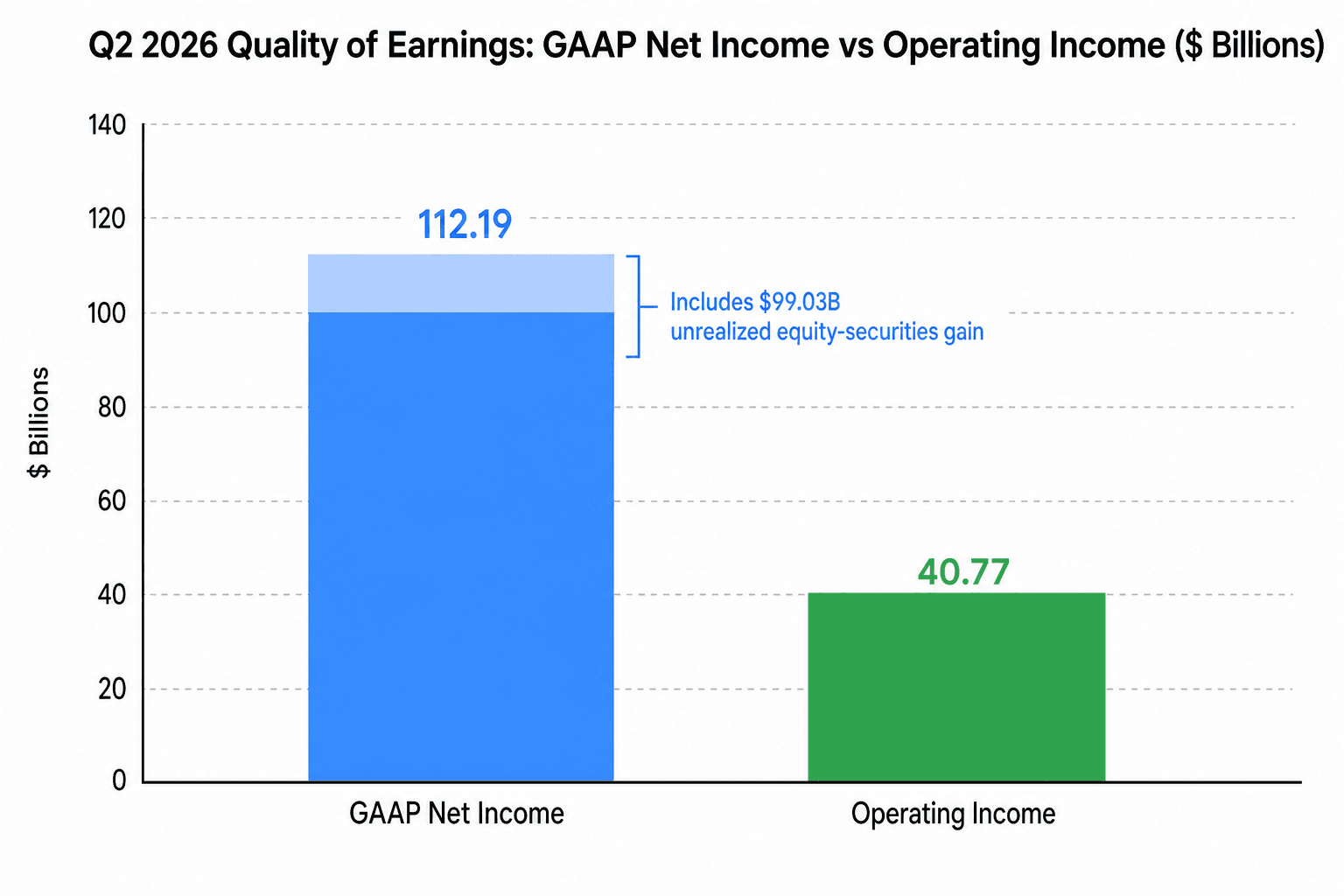
The headline number needs a warning label. GAAP net income of $112.2B and diluted EPS of $9.11 were up nearly 300% year over year, which sounds like a historic leap in profitability. It was not. Buried in "other income" was a roughly $99B gain on equity securities, the large majority of it unrealized, driven mostly by a revaluation of Alphabet's stake in the AI lab Anthropic. That paper gain added about $6.26 to diluted EPS after tax. Strip it out and operating-driven EPS was closer to $2.85, in line with the 30% growth in operating income. Because it is a mark on holdings Alphabet has not sold, the gain can reverse if valuations fall. The honest read on this quarter's profit is the $40.8B operating line, not the $112.2B headline.
What management is telling investors
Sundar Pichai framed the spending as a bet he is increasingly confident in, saying Alphabet is in the "very early innings" of an AI shift and has grown "more bullish" over the past year. The product momentum backs the confidence: the Gemini app reached 950 million monthly users with daily users tripling, model APIs now handle about 22 billion tokens a minute, and Alphabet has begun its "most ambitious pre-training run yet" for Gemini 4. On durability, Ashkenazi said Alphabet expects to recognize just over half of the $514B backlog as revenue within 24 months, which puts a floor under the growth story. The recurring analyst pushback was blunt: with free cash flow now negative, when does the payback arrive? Her answer was that the company remains supply-constrained and will keep investing "as long as it sees attractive returns."
The Street stays constructive, but the debate sharpens
Coming into the print, sell-side sentiment was near-unanimously positive: a consensus Strong Buy, with price targets clustered between roughly $410 and $515 and an average around $438, well above the pre-print price near $342. The operating results validated that bull case, and analysts including BMO, Wells Fargo and Bank of America had lifted targets into the print on Cloud momentum.
What the quarter did was sharpen the debate rather than settle it. The bull case is that 82% Cloud growth and a $514B backlog prove the AI investment is already converting into profit. The bear case is that a capex program approaching $200B a year, funded partly by fresh equity and debt, with negative free cash flow and higher 2027 spending promised, is outrunning the returns. Some outlets also flagged a slight Search-revenue miss and a reported delay to the Gemini 3.5 Pro model. Notably, the raised capex was read as bullish for AI-infrastructure suppliers such as Broadcom, Nvidia and the memory makers, even as it pressured Alphabet's own valuation.
The forward look
This report crystallizes the central question hanging over every hyperscaler right now: how long will investors fund an AI build-out that is still consuming more cash than it returns? Alphabet's operating business has rarely looked stronger. Cloud is compounding, Search is defending itself in the AI era, and the balance sheet is enormous. But the company just told the market that spending will keep climbing through 2027, and it has started tapping outside capital to pay for it.
For the rest of 2026, three things will decide how the stock reprices. Can Cloud sustain growth fast enough, and convert enough of that $514B backlog, to make the spending look prescient rather than reckless? Does free cash flow stabilize, or does the negative quarter become a trend? And can Alphabet keep its models at the frontier as it pushes toward a faster release cadence? Until those answers arrive, a quarter this strong will keep reading, to a nervous market, as an expensive one.