Alphabet's Q1 2026 Quietly Repriced the Cloud Wars
The print no one expected
For four straight years Alphabet's Cloud business has been the second-place argument in every analyst note — bigger than 2014, structurally smaller than AWS and Azure, perpetually one quarter away from the operating leverage that the bulls had been promising. Q1 2026 is the print where the second-place argument fell apart.
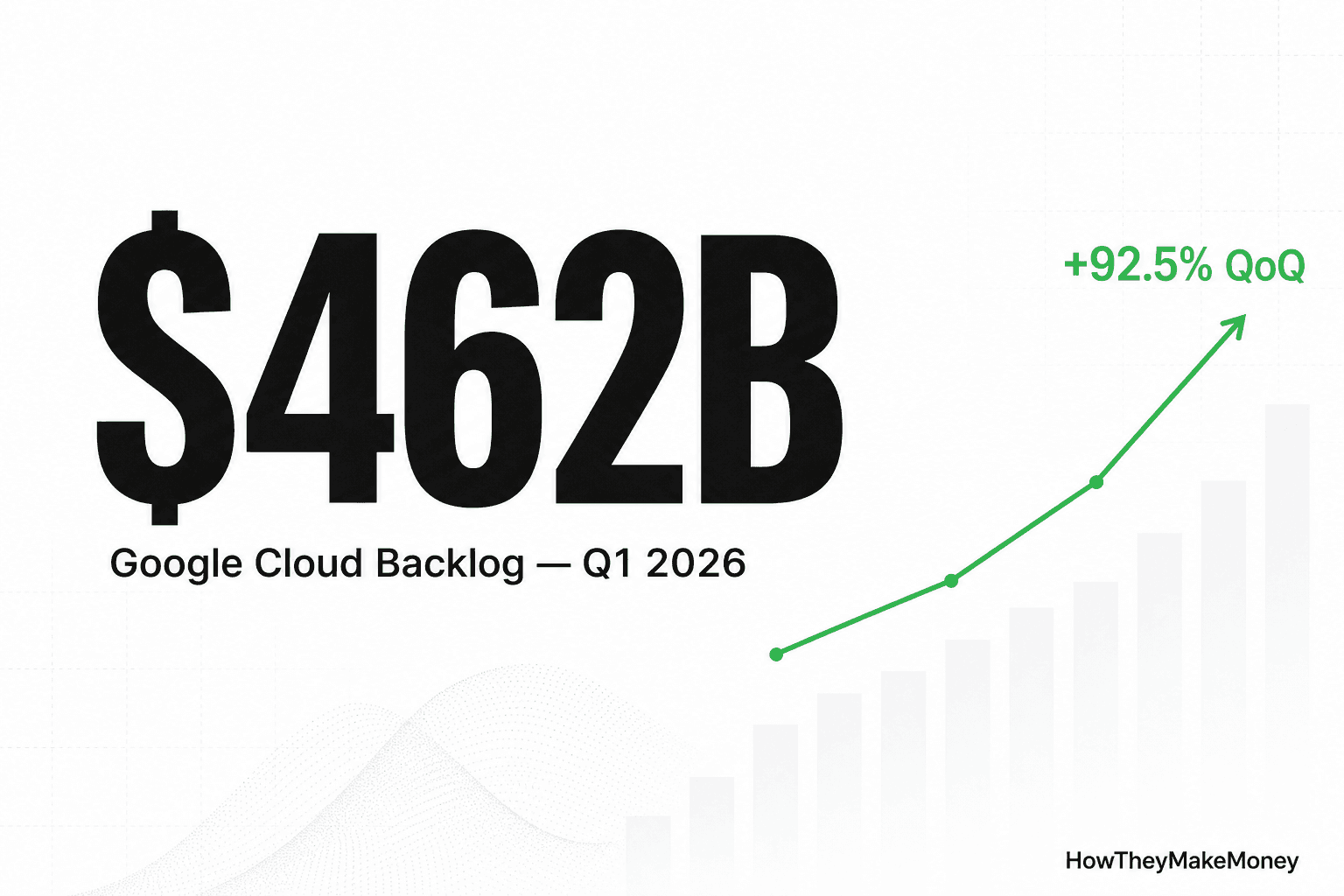
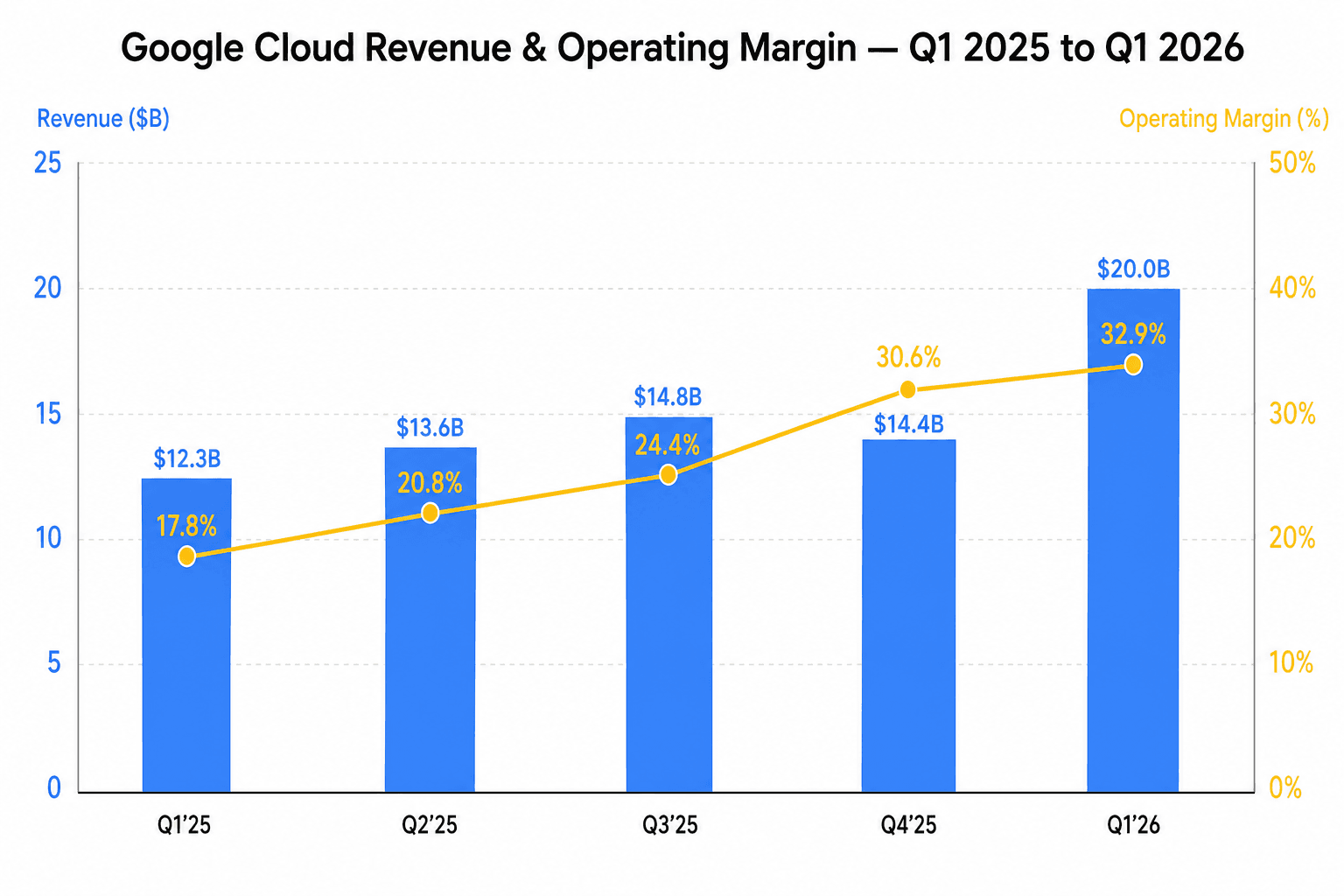
Cloud revenue: $20.03B, up 63% year-over-year. Cloud operating income: $6.59B, up from $2.18B a year ago — a 3.0x increase. Cloud operating margin: 32.9%, up from 17.8% a year ago. That is a +1,510 bps expansion in twelve months. Cloud backlog: $462B, up 92.5% quarter-over-quarter.
The acceleration is not narrow. Search & other ad revenue grew +19% YoY to $60.4B, the fastest Search growth in five quarters. YouTube Premium plus YouTube TV plus Google One pushed paid subscriptions to 350M. Total revenue grew +22% for the eleventh consecutive double-digit quarter. But Cloud is the line that just changed shape.
What is actually inside the $462B backlog
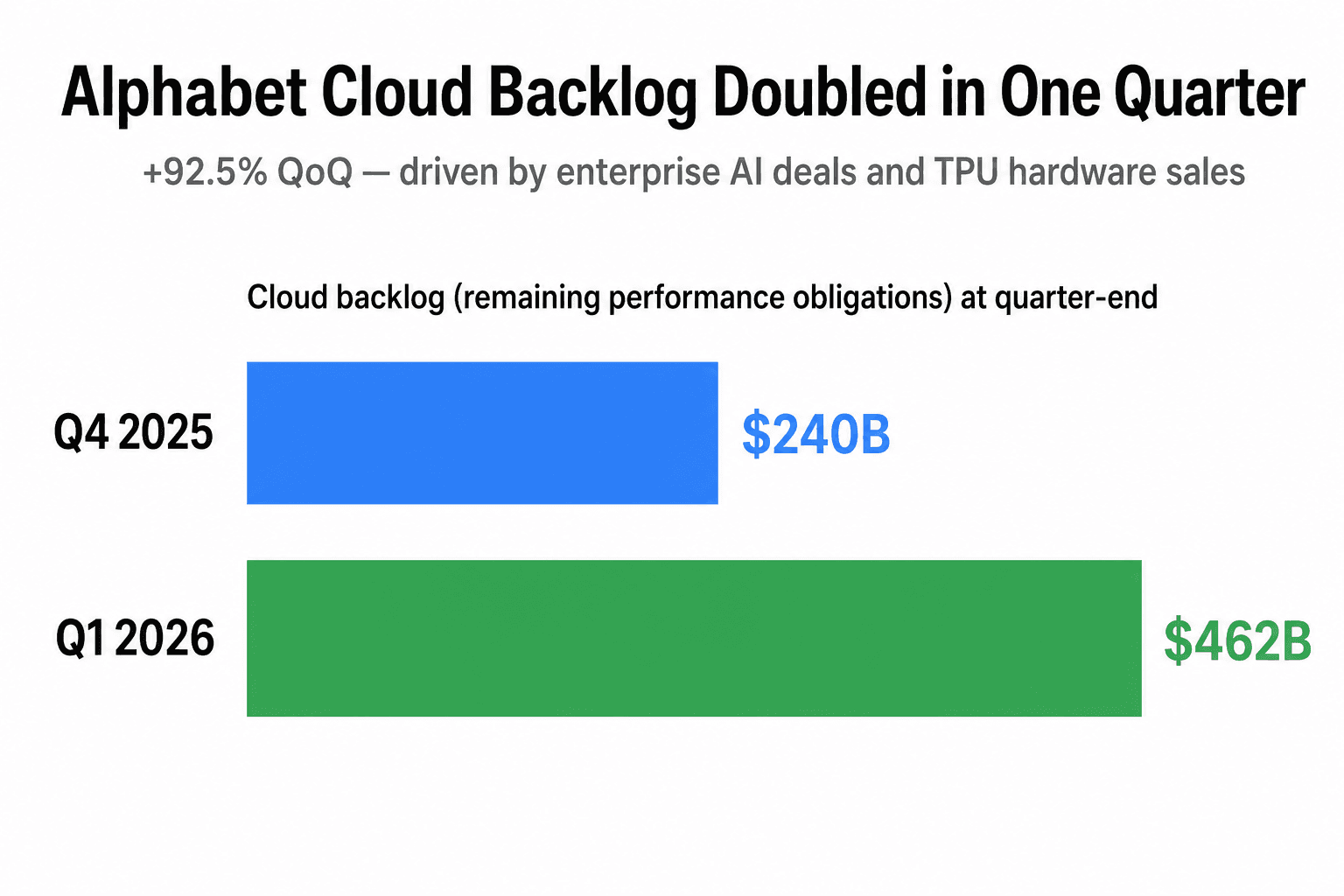
The number that broke the analyst spreadsheets is the backlog: $462B at quarter-end versus an estimated $240B at the end of Q4 2025. CFO Anat Ashkenazi attributed the jump to two things — enterprise AI deal flow and the inclusion of TPU hardware sales — and reported that customers are spending 45% more than initial contract commitments on average.
Three things to keep in mind when reading $462B:
- Backlog is not revenue. It is contracted, but unrecognized. The duration mix matters — multi-year TPU capacity commitments will revenue-recognize differently than annual SaaS contracts.
- TPU hardware sales are now in the segment. Alphabet has historically sold TPU capacity as a service. Bundling outright TPU hardware sales (to Anthropic, to large sovereign customers) into the segment changes the comparability of QoQ deltas.
- The number is concentrated. Multiple individual deals signed in-quarter were over $1B in TCV, and a recent classified Pentagon AI contract widely reported at $5B+ over five years contributed to the print.
That said, even after every one of those caveats, $462B is the largest quarter-over-quarter backlog growth in any hyperscaler's disclosure history. It is not the kind of number you trim by 30% and still move on.
Margin: tripled in one year
Every percentage-point of Cloud operating margin matters because the segment is on track to be the largest single contributor to Alphabet operating income within four to six quarters. Google Services still printed $40.6B in segment operating income (+24% YoY, 45.3% margin) — but the delta in operating income is now overwhelmingly Cloud.
The driver per Pichai on the call: utilization.
"When you ask 'why has Cloud margin tripled in a year', the answer is one word: utilization. Our TPUs are now running at industry-leading utilization rates, and we sell that capacity at industry-leading attach rates."
Utilization is a multiplier — the same fixed-cost data center serves more revenue. That works as long as demand keeps showing up. Capex guidance suggests management believes it will.
Capex: the bill
Here is the price of admission.
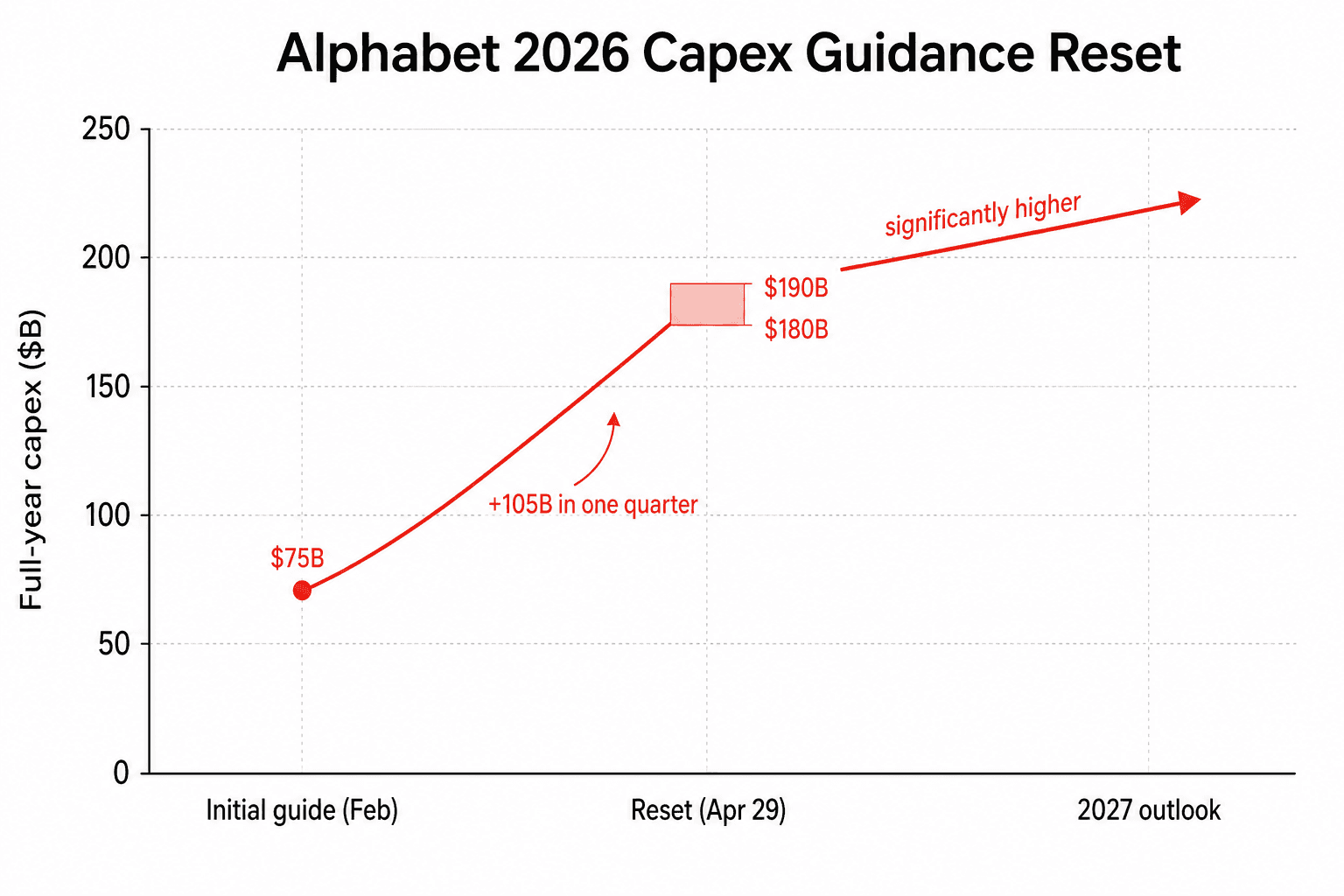
In Q1 2026 alone, Alphabet spent $35.7B on capital expenditures — +108% YoY and the single largest capex quarter in company history. The full-year 2026 guide is now $180-190B, against a starting guide three months ago of $75B.
Free cash flow has already moved. Q1 2026 FCF was $16.0B, down 16% YoY despite revenue +22%. Strip out the working-capital tailwind from the unusual GAAP net income gain and the underlying FCF compression is steeper. CFO Ashkenazi was direct on the call: capex is being "front-loaded into 2026" because demand is showing up faster than expected.
Add Microsoft ($190B 2026 capex disclosed the same day) and Meta ($125-145B raise) and the four largest hyperscalers — Alphabet, Microsoft, Meta, Amazon — will spend roughly $650-700B on capex in calendar 2026. That is more than the GDP of Norway.
The arithmetic for an investor is straightforward and uncomfortable. If 2026 capex compresses Alphabet FCF by $20-25B vs the original plan, and 2027 capex is "significantly higher" still, the ROI clock on AI infrastructure starts ticking at exactly the wrong time for a 12-month-PT analyst. Bernstein's $185 price target — the lowest on the Street — is built precisely on this concern.
What the bulls and bears actually fight about
Bull case: Cloud margin is structural, not cyclical. The +1,510 bps expansion came from utilization, and utilization comes from owning the silicon (TPU v6e, "Trillium 2") and selling it at vertical integration economics. If that holds, Cloud reaches $100B+ ARR before 2028 and prints 35-40% margins. The capex line item is the cost of building a permanent competitive moat against AWS and Azure.
Bear case: Backlog is a leading indicator that can also reverse. The $462B includes multi-year TPU commitments to customers who are themselves dependent on raising capital from the same enthusiasm cycle. A single major AI customer pulling its commitment would compress the backlog faster than it grew. Meanwhile capex is contracted; once paid, it is fixed. If the demand curve flattens before 2028, FCF takes years to recover.
The print itself does not resolve the debate. It just makes the size of the bet visible.
Forward look — what the Q2 2026 print will turn on
Three datapoints to track between now and the late-July Q2 print:
- Cloud revenue split. Alphabet has so far refused to break out TPU hardware sales from Cloud-as-a-service revenue. Pressure from sell-side will increase. A clean disclosure would let analysts separate "structural Cloud growth" from "one-time hardware deals."
- Backlog duration. A $462B backlog skewed to 5-7 year contracts is a different asset than one skewed to 1-2 years. The 10-Q will give a duration breakout.
- Q2 capex pacing. $35.7B in Q1 implies roughly $48-52B/quarter average for Q2-Q4 to hit the $180-190B guide. A Q2 print at $40B or below would suggest the guide is a ceiling; a print at $50B+ would validate it.
All financial figures sourced from Alphabet's Q1 2026 8-K Exhibit 99.1 (filed 2026-04-29) and the Q1 2026 earnings call transcript. Analyst quotes and price-target moves sourced from Marketbeat, Public.com, and TipRanks coverage.