GE Vernova Q2 2026: Orders Surge, Stock Falls
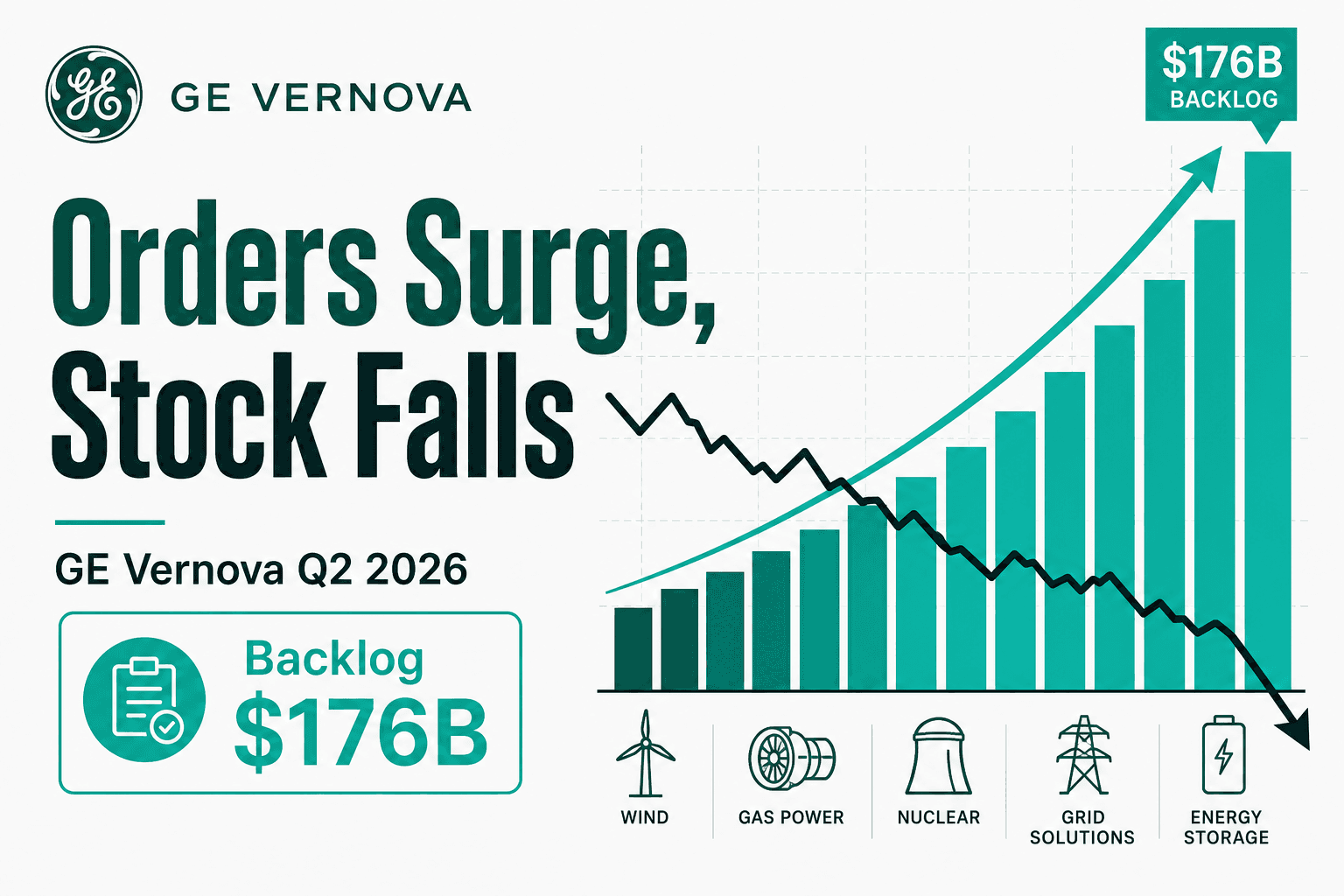
A record order book the market could not celebrate
GE Vernova delivered one of the strongest demand quarters in its short life as a standalone company, then watched its stock fall almost 9%. For the three months ended June 30, revenue rose 22% from a year earlier to $11.1 billion, orders surged, the backlog hit a record, and management raised full-year guidance for the second quarter in a row. On the operating story, this was close to everything the bulls wanted.
Investors focused elsewhere. GAAP diluted earnings of $2.47 per share landed well short of the roughly $3.04 to $3.18 that Wall Street had modeled, a miss of about 22%. The Wind unit lost money again, management flagged a fresh tariff cost, and warned that cash flow would slow in the back half. Against a stock that had already run about 60% for the year at nearly 59 times earnings, that combination was enough. Shares gapped down at the open and drifted lower all day to close at their session low of $985.03, off 8.69%. This is the paradox of a beat-and-raise that still sells off: when expectations are stretched, good news has to be great, and a headline profit miss becomes the story.
Orders and backlog break records
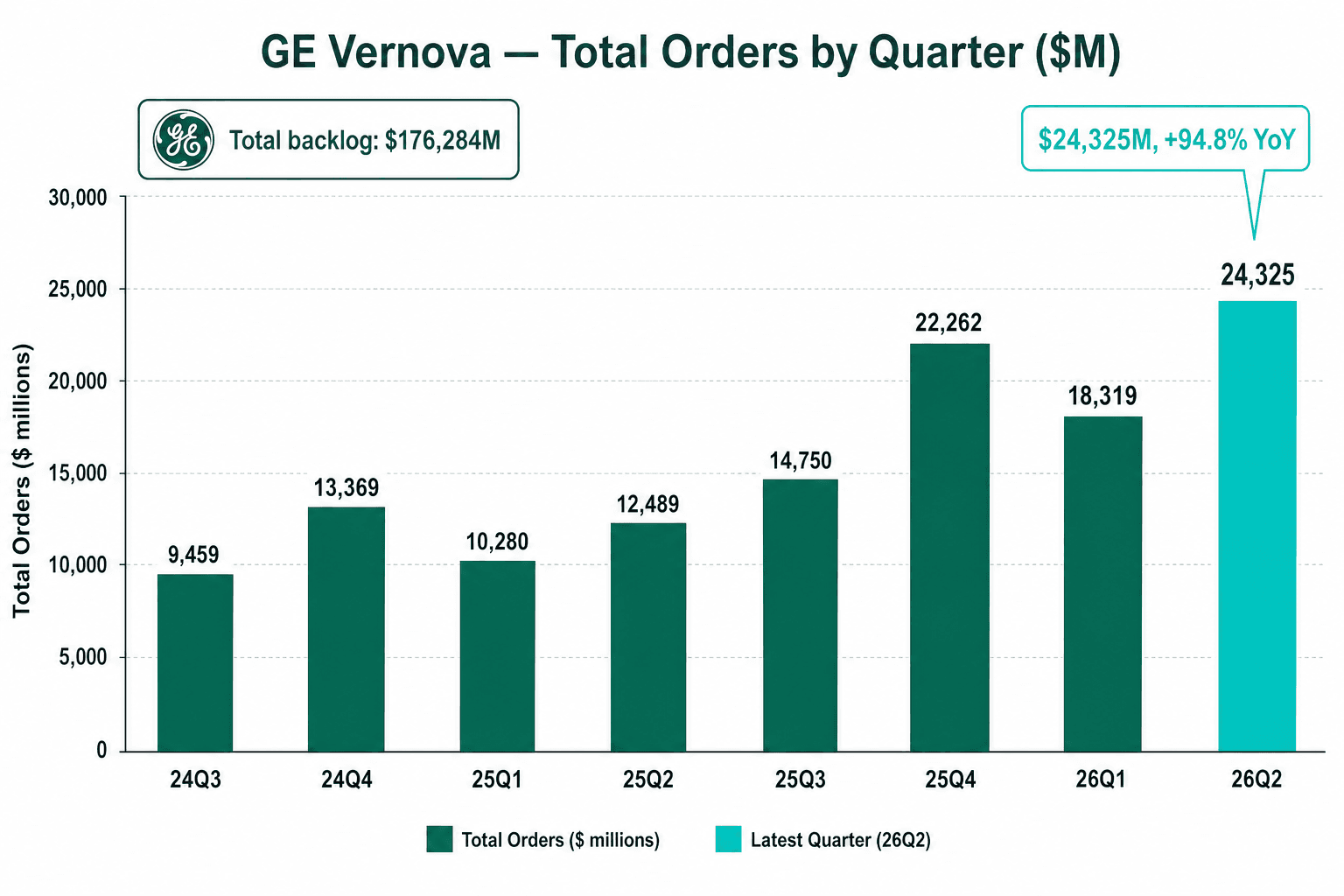
Orders are signed customer commitments booked before revenue is recognized, and they are the clearest read on future growth. GE Vernova's management led with plus 88% organic order growth, the rate that strips out the Prolec GE acquisition and currency to show the underlying business. On a reported basis, summing the segments, orders grew 94.8% to $24,325 million, the figure shown above. The difference is simply the acquired transformer business and foreign exchange. Either way, the direction is unambiguous: equipment orders more than doubled and service orders rose 15%.
That flow lifted the backlog, the value of work already booked but not yet delivered, to $176,284 million, up $13 billion in a single quarter and up 37% from a year earlier. The book splits almost evenly between equipment at $87,821 million and services at $88,463 million, a healthy balance because services carry higher margins and recur for decades. Management now targets a roughly $200 billion backlog in 2027.
Two engines running, one still stalling
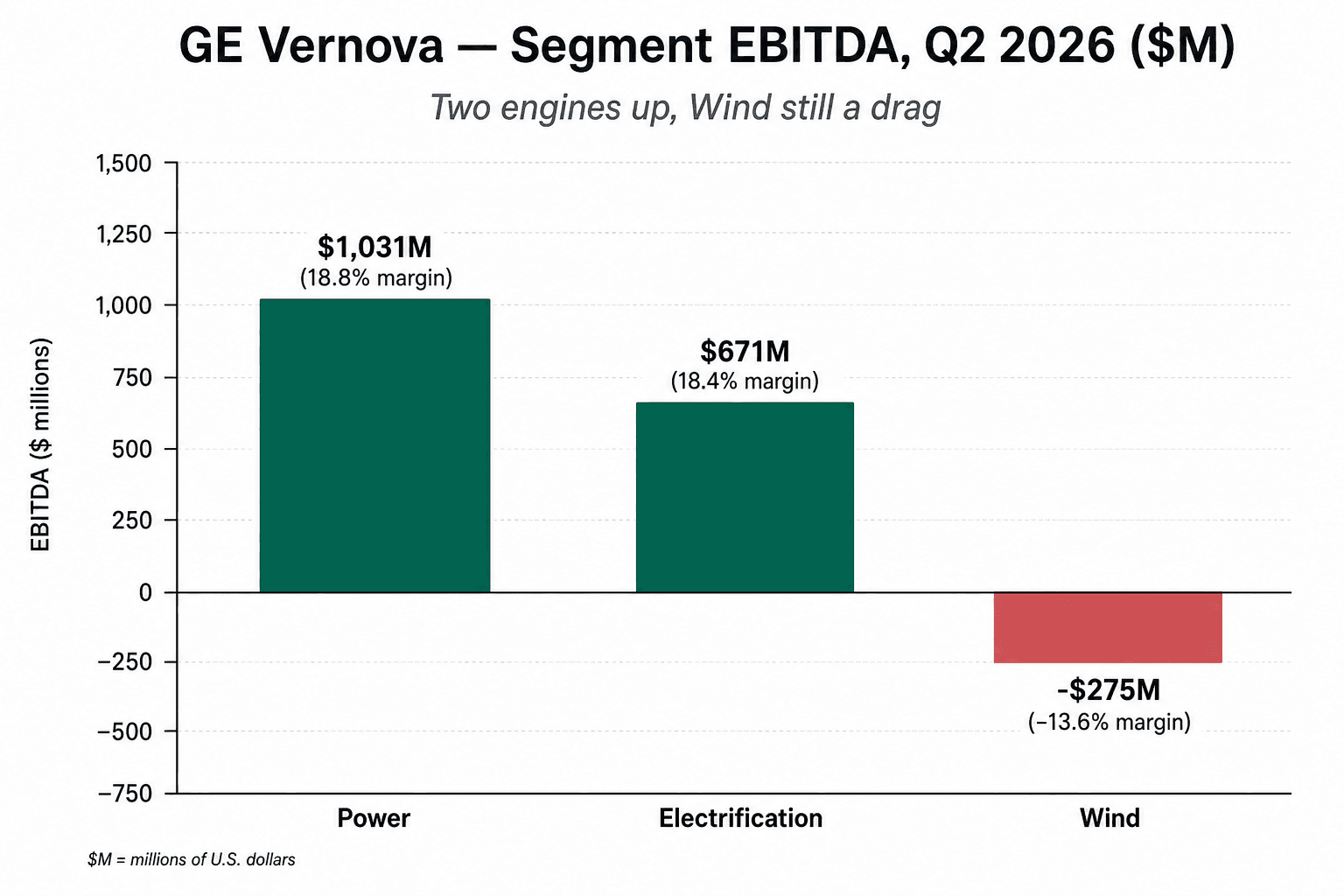
Segment EBITDA, a measure of each unit's operating profit before interest, taxes, depreciation, and amortization, shows a company pulling in two directions. Power delivered $1,031 million at an 18.8% margin, its highest quarterly segment margin on record, driven by gas-turbine volume and firmer pricing. Electrification, home to the transformers and grid gear that data centers need, earned $671 million at an 18.4% margin, with EBITDA more than doubling from a year ago.
Wind is the exception. It lost $275 million, a wider loss than the $165 million a year earlier, on lower onshore equipment deliveries and higher offshore project costs. The U.S. onshore market for new turbines is soft, and the company is managing the business for profitable services rather than chasing volume. Management guides Wind to roughly a $400 million segment loss for the year, so it stays a visible drag even as the other two engines set records.
Revenue keeps climbing
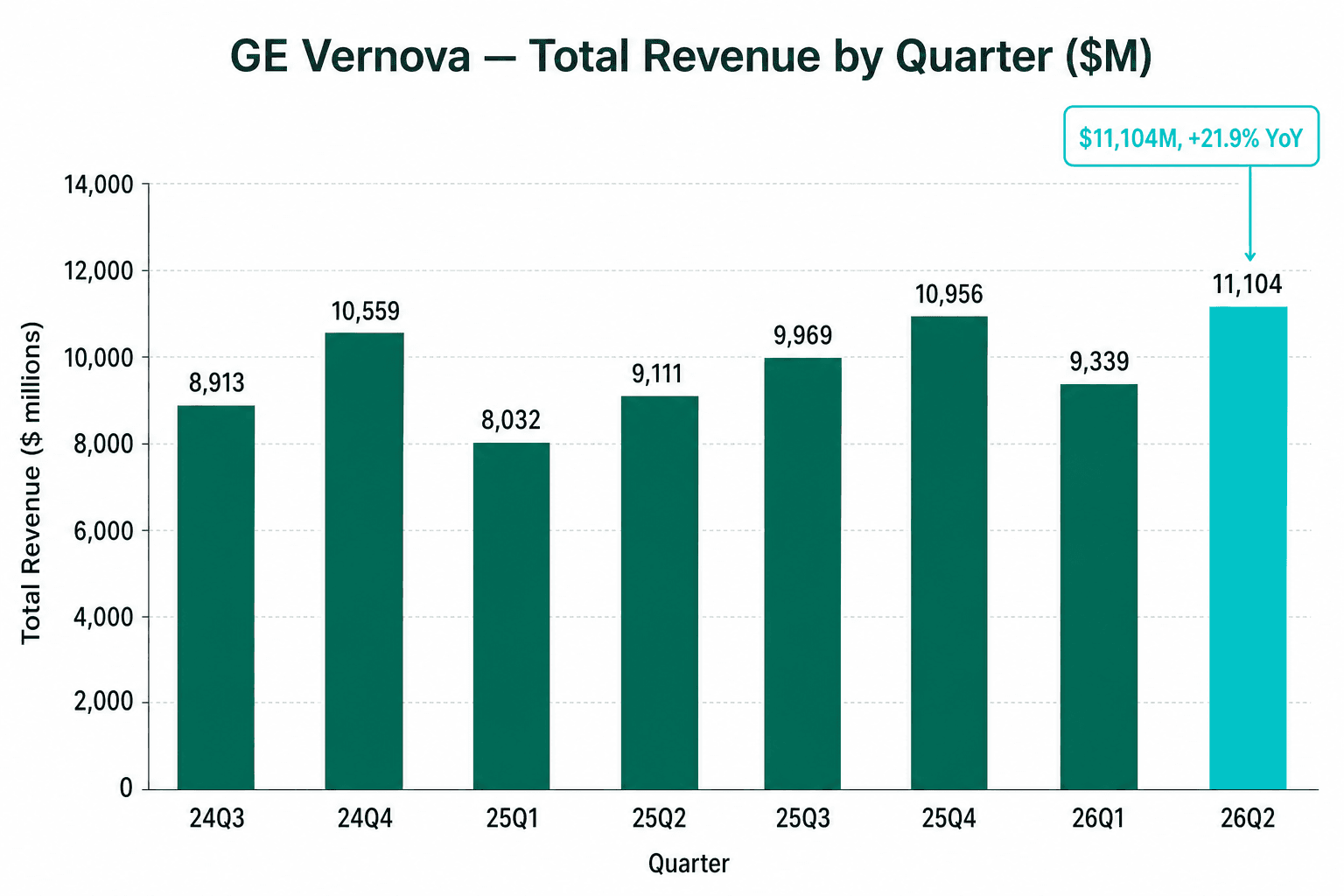
The top line rose 21.9% to $11,104 million, its second-highest quarterly figure ever and short only of the seasonally strong fourth quarters. Growth was led by Electrification, up 65%, and Power, up 15%, with Wind down about 10%. GAAP net income was $649 million. Note that headline net income is a noisy comparison this year: the first quarter of 2026 was inflated by roughly $4.5 billion of one-time gains tied to the Prolec buyout, and a segment realignment took effect on January 1, so adjusted EBITDA is the cleaner read on underlying profit.
Margins expand, but watch the cash timing
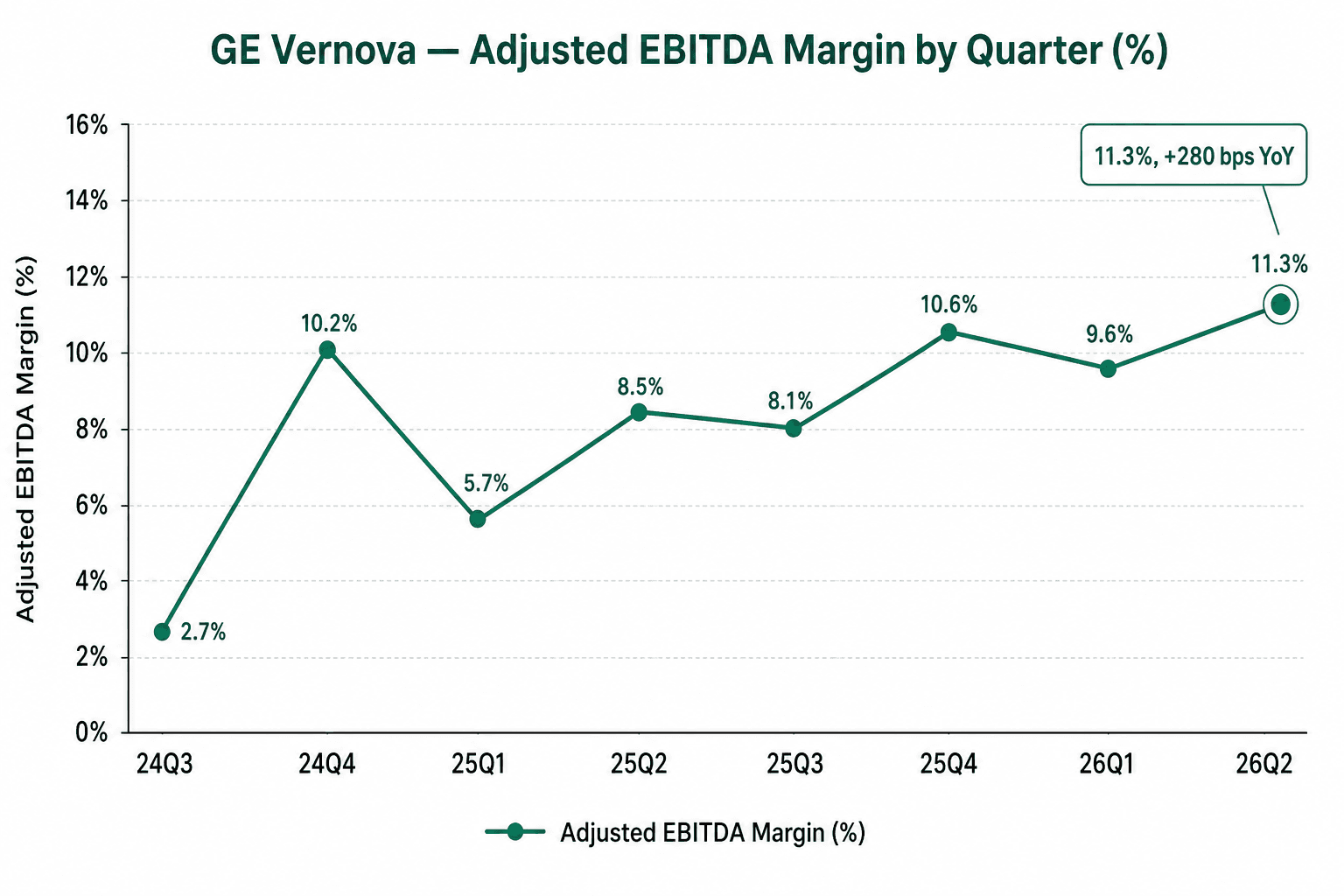
Adjusted EBITDA margin, the share of revenue left as operating profit after adjusting for one-off items, rose to 11.3%, up 280 basis points from a year earlier, as adjusted EBITDA reached $1,250 million. That is genuine operating leverage from volume, price, and productivity in Power and Electrification.
Cash is where the fine print matters. Free cash flow, the operating cash left after capital spending, was $5,107 million in the quarter, and the company ended with $13,120 million in cash. But management was careful to explain that first-half cash flow was inflated by down payments on gas-turbine slot reservation agreements, essentially deposits to hold future factory capacity. As those reservations convert to firm orders, the deposits stop, and second-half free cash flow will be materially lower. The full-year guide already reflects that shape.
Why the stock fell
Strip away the noise and the sell-off comes down to three things. First, the headline miss: GAAP EPS of $2.47 against consensus near $3.04 to $3.18 is the number that hit the tape and the algorithms. Second, new cost warnings: management guided to $100 to $200 million of net tariff costs in 2026 and reminded investors that Wind would keep losing money. Third, valuation: after nearly doubling in a year, the stock had a consensus price target that already sat below its market price, leaving little room for anything less than perfection.
On the call, CEO Scott Strazik leaned into demand, framing the moment as "the early stages of a multi-decade growth opportunity" powered by gas turbines, data-center electrification, and eventually nuclear. CFO Ken Parks paired the optimism with the cash-timing caution and raised the numbers that matter for the long run.
The raised outlook and the Street's response
For all the one-day pain, the guidance moved the right way. GE Vernova lifted full-year revenue to $45.5 to $46.5 billion and, most strikingly, nearly doubled its free cash flow guide to $11.5 to $12.5 billion, while keeping the adjusted EBITDA margin target at 12% to 14%. The company also expects at least 125 gigawatts of gas capacity under contract by year-end.
The sell side stayed constructive. Standing price targets clustered around $1,210 to $1,328, well above the $985 close, and J.P. Morgan called the sector-wide drop "unwarranted," citing confirmed orders and demand running through 2028. The most direct comparison, Siemens Energy, fell about 8.8% in sympathy, while GE Aerospace and Vertiv barely moved, suggesting the reaction was largely specific to GE Vernova's print rather than a broad rethink of the power trade.
The forward look
The tension in the report is the tension in the stock. One reading is of a company at the front of an electricity supercycle, with a record backlog, expanding margins, and pricing power in gas and grid equipment that compounds for years. The other is of a richly valued stock that has to keep clearing a very high bar, where a Wind loss, a tariff line, and a quarter of GAAP earnings below consensus are enough to trigger a reset.
Both can be true. For the rest of 2026, the questions that decide which view wins are whether Power and Electrification margins hold as equipment volume ramps, whether the tariff and Wind headwinds stay contained, and whether the enormous order book converts to profitable revenue on schedule. Until those answers arrive, a record-setting quarter can still, to a wary market, look like an expensive one.