Cisco's $9.3B AI order year — and why the stock fell
Cisco's fiscal fourth quarter had almost everything a bull could ask for, and the stock fell anyway. The gap between the results and the reaction is the whole story.
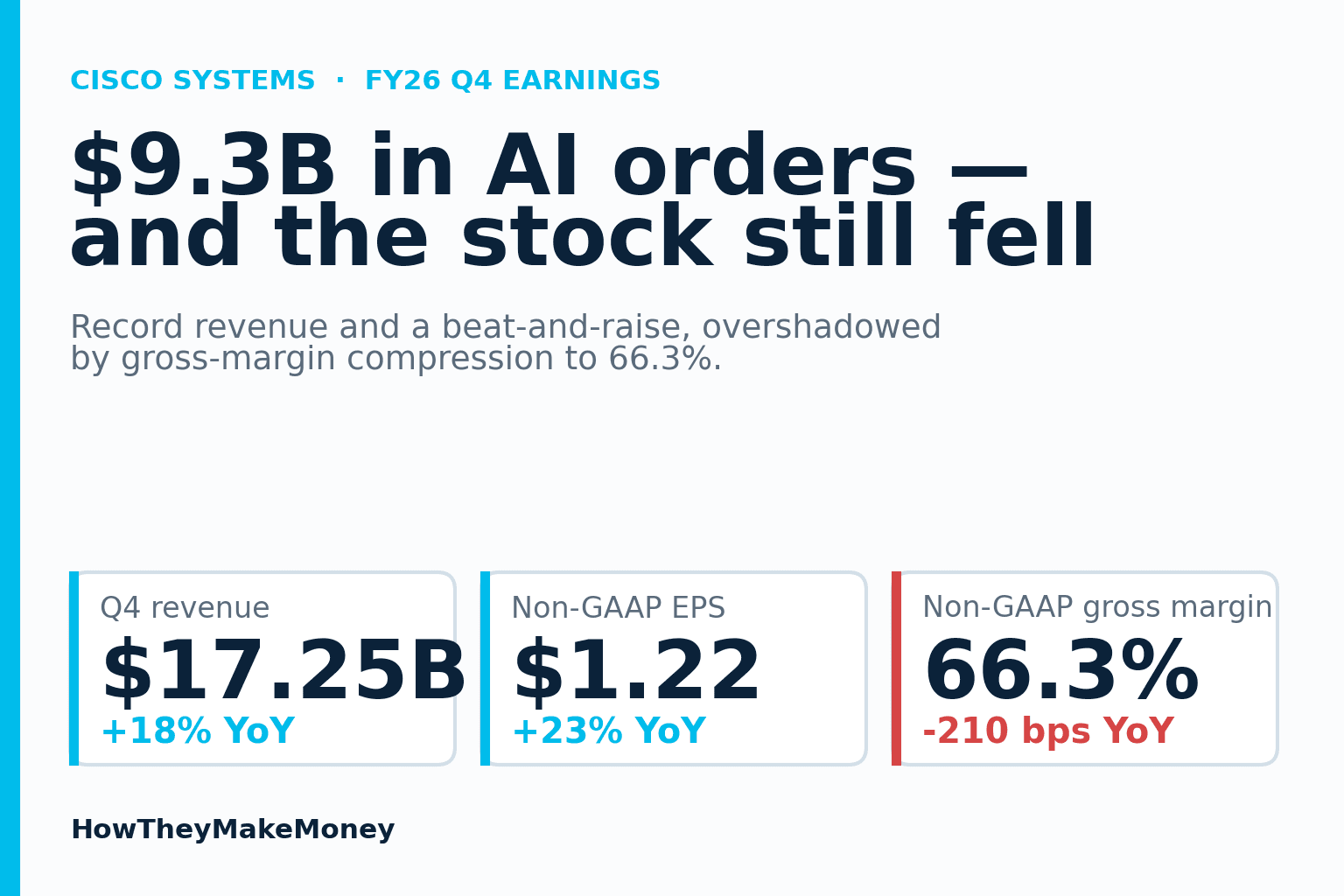
The company closed FY2026 with record Q4 revenue of $17.25 billion, up 18% from a year ago and its fastest growth in years. Non-GAAP earnings came in at $1.22 a share, up 23% and about nine cents ahead of the roughly $1.13 the Street expected. GAAP earnings jumped to $0.97, up 52%. Hyperscaler AI orders (the cloud giants buying networking gear to wire up AI data centers) reached $4 billion in the quarter and $9.3 billion for the full year, about 4.5 times FY25 and past the $9 billion target management had set. The FY27 guide landed above consensus. On almost any scorecard, this was a clean beat-and-raise.
Then the stock dropped. After spiking above $132 on the headline, shares reversed during the call to roughly $118, down about 5%, and closed the next session near $120.43, off about 2.8% from the pre-print close of $123.95. The culprit was one number that went the wrong way: non-GAAP gross margin.
The order book that beat its own target
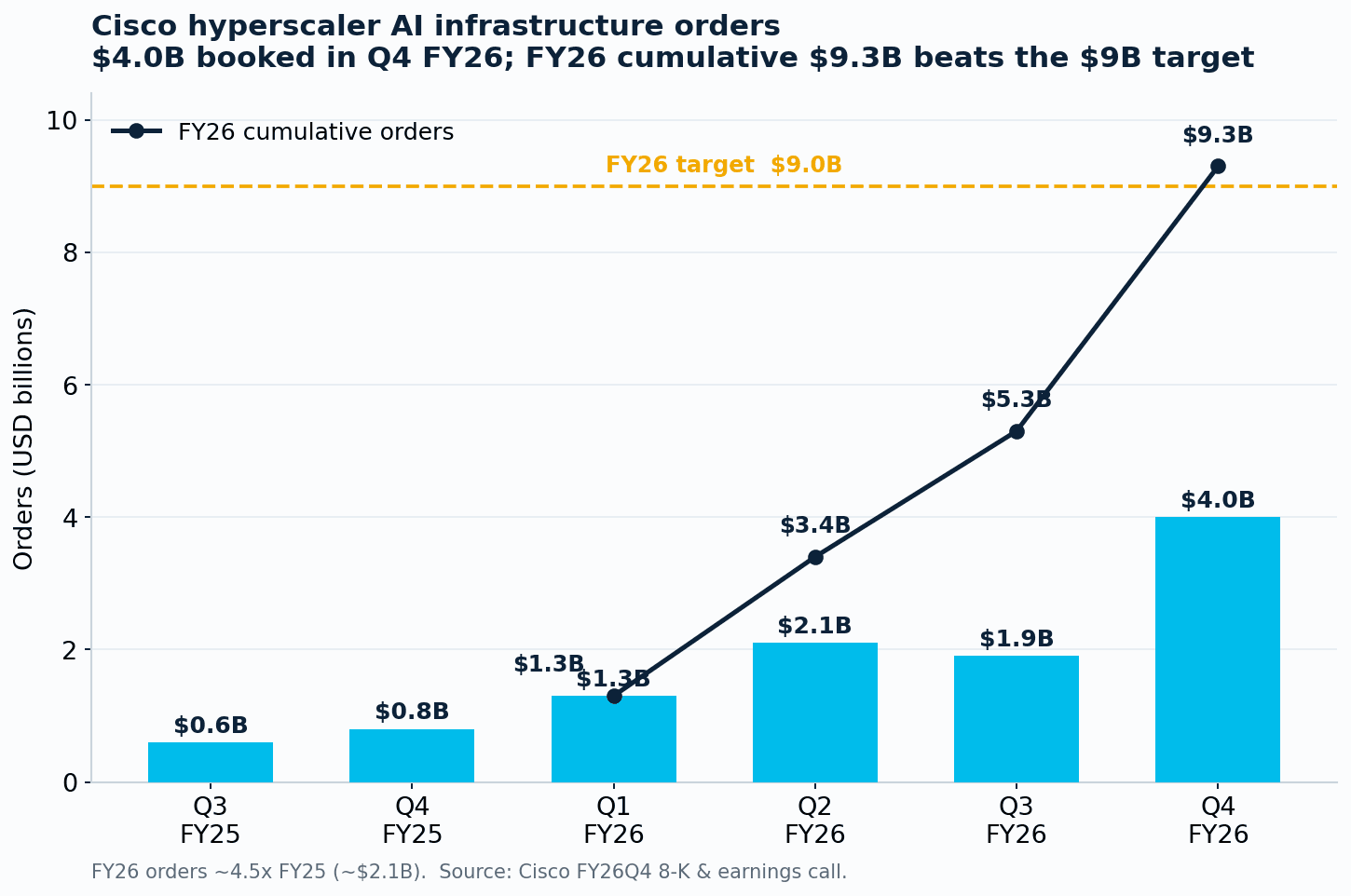
Start with the number that made the bull case. Cisco booked $4 billion of hyperscaler AI infrastructure orders in Q4 alone, more than double the roughly $1.9 billion it took in Q3. That brought the FY26 total to $9.3 billion, about 4.5 times the ~$2.1 billion booked in FY25 and comfortably past the $9 billion target management had raised to only one quarter earlier.
The mix runs roughly 60% Silicon One systems (Cisco's in-house networking chips) and 40% optics, with the Acacia optics unit alone booking more than $1 billion of orders in the quarter. Cisco also landed three new hyperscaler design wins, including a third "scale-across" win for its P200 chip spread across three separate hyperscalers.
The important part is that orders are running well ahead of revenue. Cisco recognized only about $4 billion of AI infrastructure revenue in FY26, roughly 6% of the total, up from under 2% a year earlier. That backlog is why management guides FY27 to about $7.5 billion of AI infrastructure revenue and, in a telling change, is switching its public target from an order number to a revenue number. On the call, CFO Mark Patterson pushed back on analysts who called $7.5 billion too conservative given the backlog: hyperscaler orders are "non-linear," placed well ahead of delivery, and $7.5 billion is "a good prudent guide."
It is not only AI
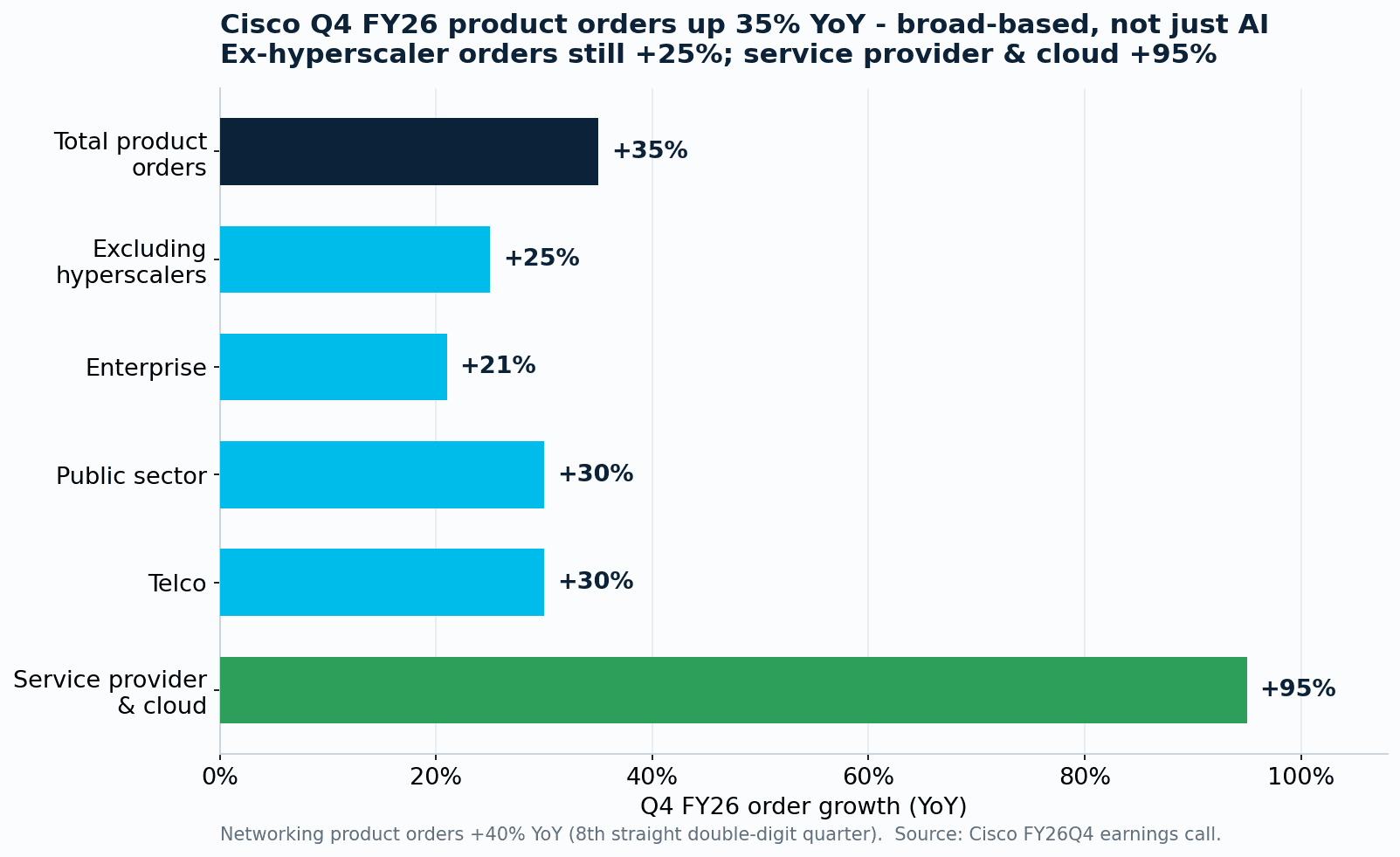
The easy read is that this is purely an AI story. The order book says it is broader. Total product orders grew 35% year over year, and stripping out the hyperscalers entirely, the rest of the book still grew 25%. Enterprise orders rose 21%, public sector 30% (led by U.S. federal), and telco 30%. Service provider and cloud, where the hyperscalers sit, grew 95%.
Networking, Cisco's core, produced $9.79 billion of revenue, up 28%, with product orders up 40% for the eighth straight quarter of double-digit growth. Even the quieter segments woke up. Collaboration had its best quarter in seven years, up 12%, and security jumped 14%, though management flagged that a few unusually large on-premise Splunk deals inflated that figure and the mix should normalize toward cloud over time.
CEO Chuck Robbins framed all of this as a "networking super cycle" driven by the spread of agentic AI, and was careful to say Cisco is not an "accidental recipient" of the build-out. It spent six years growing the hyperscaler business from near zero.
The number that sank the stock
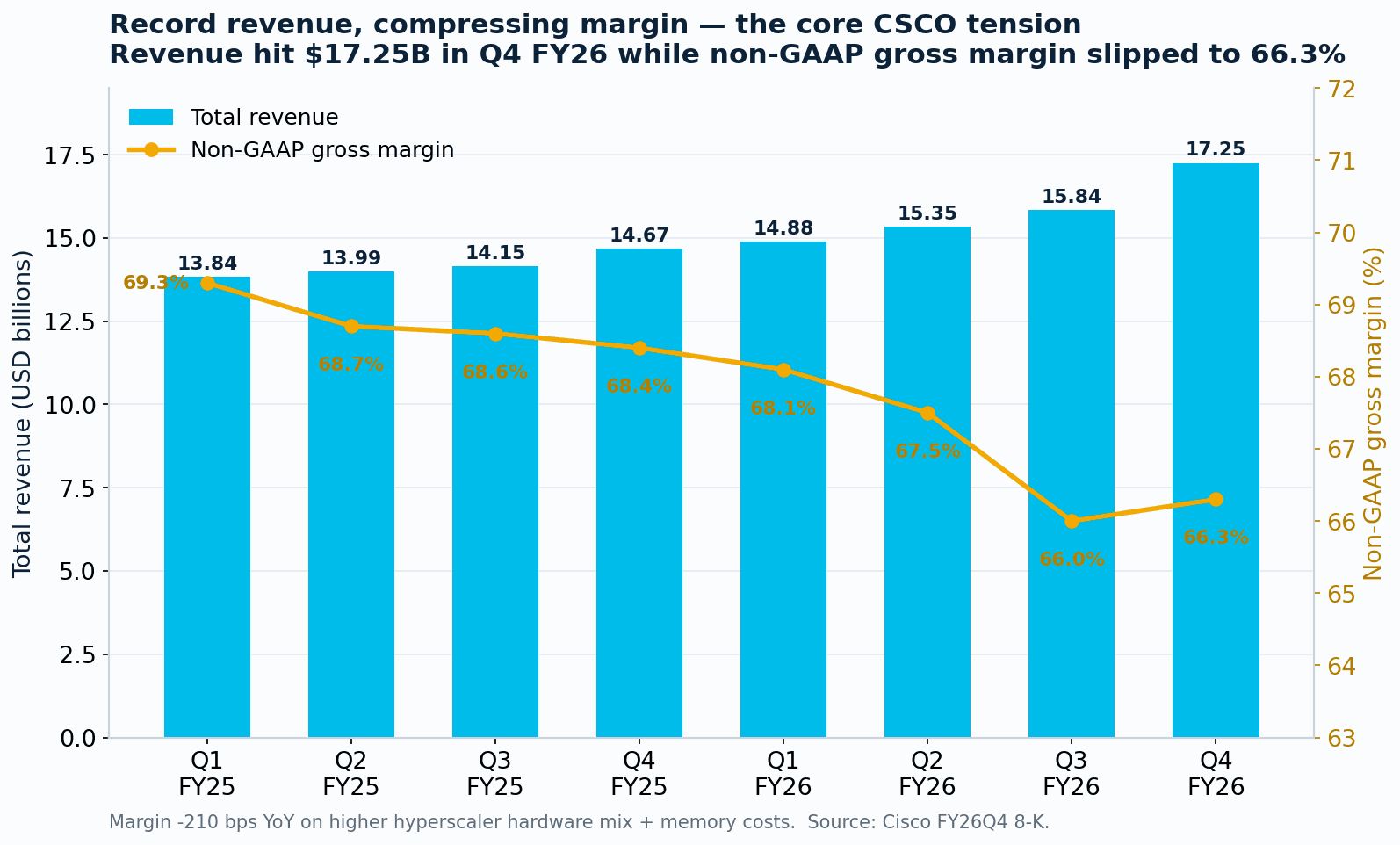
Here is the catch. Non-GAAP gross margin fell to 66.3%, down 210 basis points from a year ago. Product gross margin dropped even more, off 270 basis points to 64.8%. The reason is structural. Hyperscaler AI hardware carries lower margins than Cisco's enterprise switching, so as that business grows, the blended margin compresses. Memory-cost inflation added to the pressure, and price increases contributed about five points to Q4 revenue growth as a partial offset.
For a stock that had run about 77% over the prior year and was trading near 40 times trailing earnings into the print, the margin slip was enough. Options had priced roughly an 8% move, and the reaction used most of it. Volume ran about 35 million shares against a 20 million average.
Management's rebuttal is that both margin dollars and operating margin moved the other way. Non-GAAP operating margin hit a record 35.9%, up 160 basis points, because operating expenses fell about 3.7 points as a share of revenue. Patterson called operating margin "a better indicator of our profitability" and guided FY27 to about 35%, a level he described as a "high watermark." In plain terms, the hyperscaler business earns less per dollar of hardware, but it costs Cisco very little extra to serve, so it still drops more profit to the operating line.
The FY27 setup
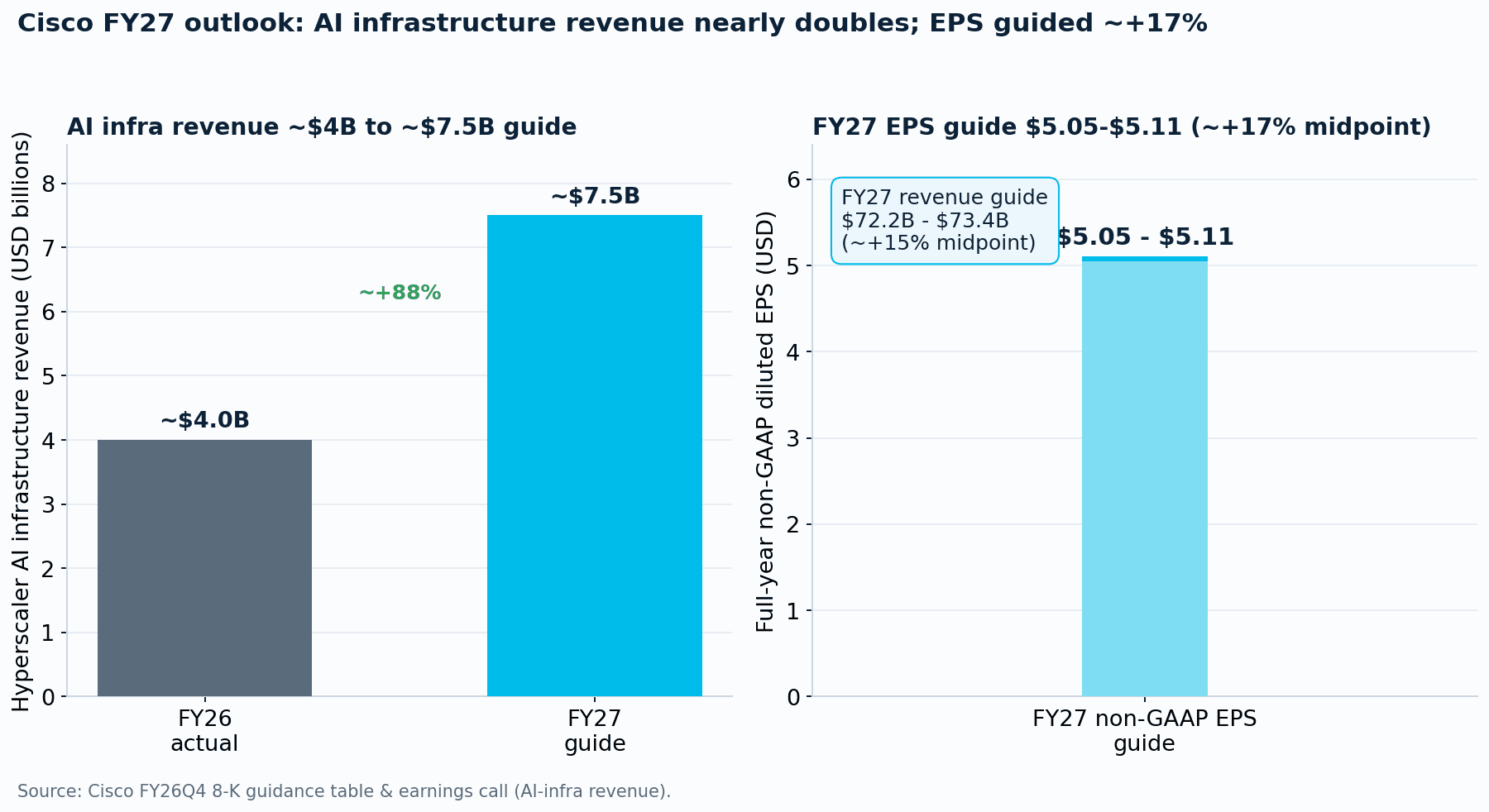
The guide is the bull's answer to the margin bears. Cisco expects FY27 revenue of $72.2 billion to $73.4 billion, up about 15% at the midpoint, and non-GAAP EPS of $5.05 to $5.11, up about 17%. Both sit above where the Street was modeling. The company also returned $12.7 billion to shareholders in FY26, about 99% of free cash flow, and raised the dividend for a 15th straight year.
Wall Street stayed constructive but split on valuation. After the print, JPMorgan reiterated Overweight and lifted its target to $145, while Goldman Sachs held Neutral at $125, calling the stock full at around 40 times earnings. The median target sits near $130, and there were no sell ratings across roughly 26 covering analysts.
The tension is easy to state. Cisco is converting the AI build-out into real orders faster than almost anyone expected, and it is doing so without inflating its cost base. But every dollar of that growth dilutes the gross margin investors spent a decade treating as untouchable. Q4 was the quarter both sides of that argument got their evidence.