Cisco just doubled its FY26 AI order target — and the boring stuff is growing 19% too
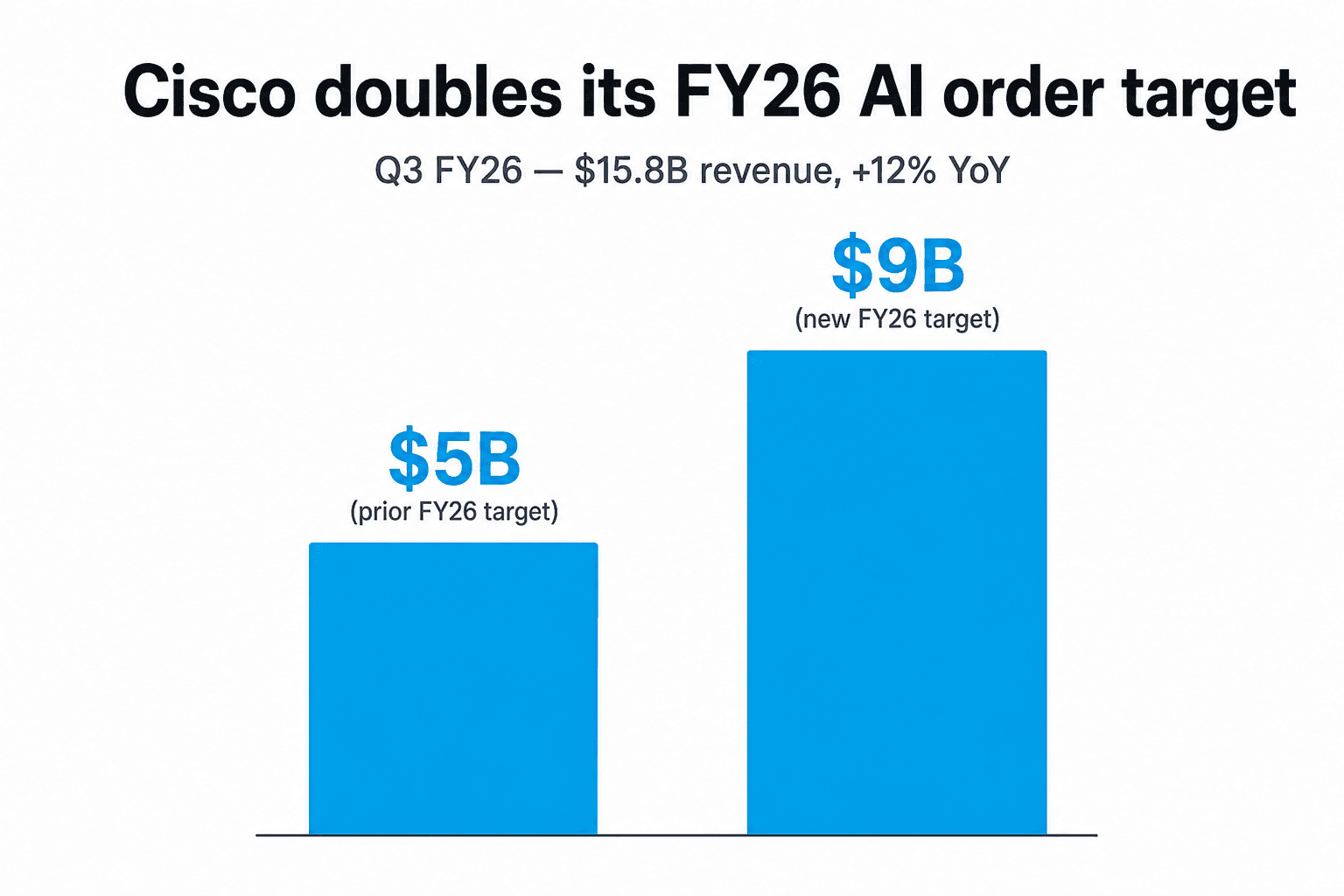
Cisco's Q3 FY2026 print has two stories, and they reinforce each other.
The first is what everyone showed up for: hyperscaler AI infrastructure orders. Cisco took $1.9 billion of hyperscaler AI orders in the quarter alone, bringing the year-to-date total to $5.3 billion — past the original $5B annual target with a full quarter still to go. Management responded by nearly doubling the FY26 hyperscaler AI order target to $9 billion and raising the AI revenue target from $3B to $4B.
The second story is the one nobody expected. Strip out hyperscalers entirely, and Cisco's product orders still grew +19% year over year. Networking orders grew +50%. Campus networking orders grew +25%. Data-center switching orders grew +40%. The enterprise IT customer who has not refreshed their wiring closet in seven years has finally started writing purchase orders again — and that's the cycle Cisco's competitors have been mispricing.
Revenue printed $15.8 billion, up 12% YoY, the strongest growth rate in a decade. Non-GAAP EPS hit $1.06 on a 34.2% non-GAAP operating margin. Cisco raised the FY26 revenue guide to $62.8B-$63.0B (mid-point up $1.6B from the February raise) and non-GAAP EPS to $4.27-$4.29. The stock closed the regular session +2.6% and rallied roughly another 8% after hours.
The AI order book finally has the right zero
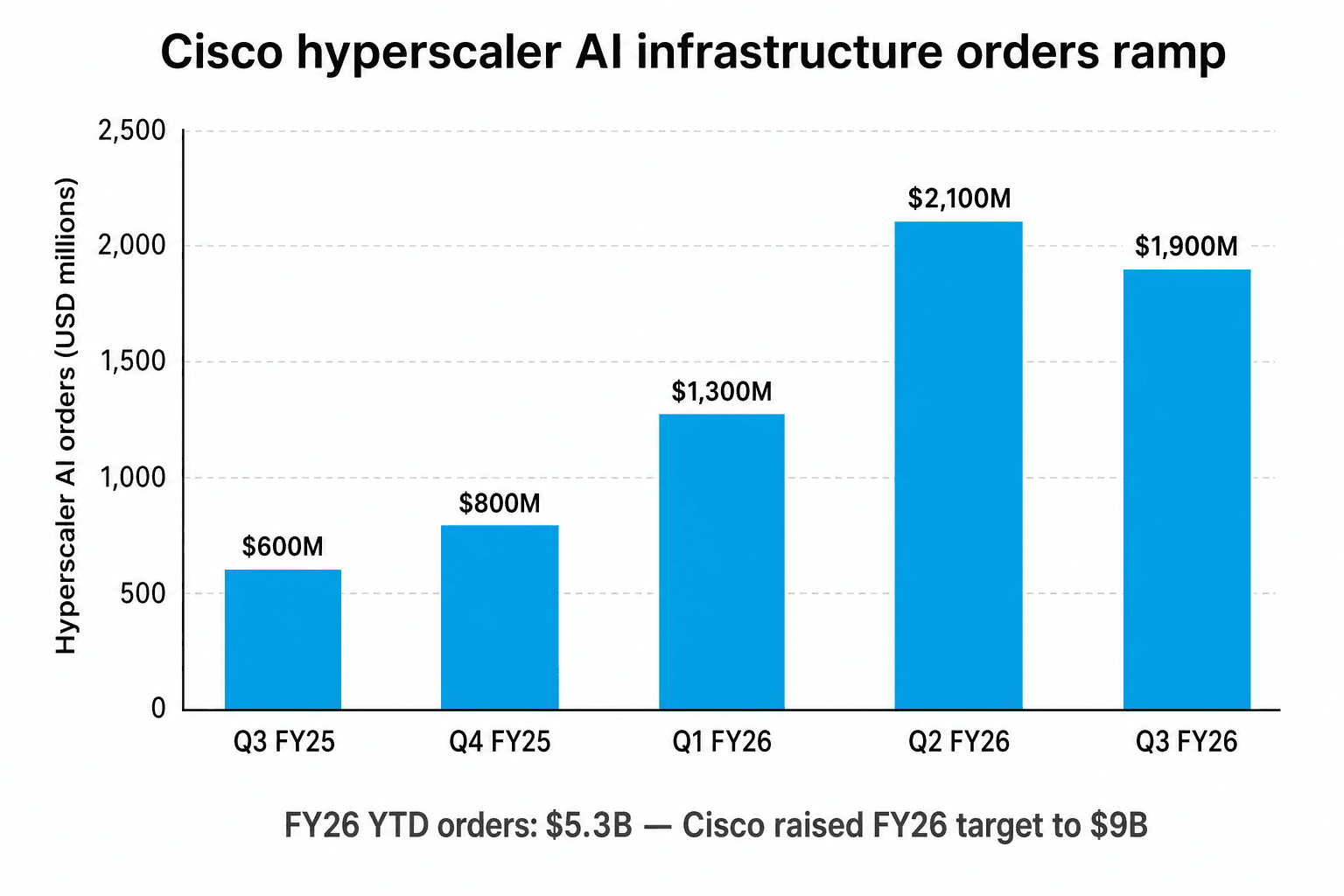
The number to fix in your head is $9 billion. That's the new FY26 hyperscaler AI order target — 4.5× the FY25 total of $2B and 80% higher than the $5B target Cisco set in February. It's the largest single-line guidance revision Cisco has ever made on the AI infrastructure narrative.
The math behind it is straightforward. Q1 FY26 took $1.3B of hyperscaler AI orders. Q2 took $2.1B. Q3 took $1.9B. That's $5.3B in three quarters, against a $5B annual target. Holding the Q1-Q3 run rate steady through Q4 would put FY26 at roughly $7B. The $9B target implies Q4 alone takes ~$3.7B — and management framed that as conservative based on pipeline visibility into CY27.
The corresponding revenue number is $4B (raised from $3B). Cisco recognizes hyperscaler AI revenue across silicon (Silicon One ASICs), systems (P200/G200-based switches), and optics (Acacia coherent pluggables). The conversion from orders to revenue runs roughly 60-70% within the same fiscal year, with the balance flowing into FY27 — consistent with the $9B order / $4B revenue gap.
The design-win cadence backs the order trajectory. Cisco landed two Silicon One P200 wins with different hyperscalers in Q3 — its first "scale-across" P200 wins — and a third in the first two weeks of Q4. Acacia, the optics business, posted $1 billion+ in orders in a single quarter and is now tracking to grow more than 200% YoY in FY26.
The customer concentration question is real but quantified: Cisco's hyperscaler AI revenue today is concentrated across the top 4 hyperscalers, but the design-win distribution (5 new wins in Q3, split across multiple buyers) reduces the single-customer dependency risk that defined this business 18 months ago.
The thing nobody priced: campus is back
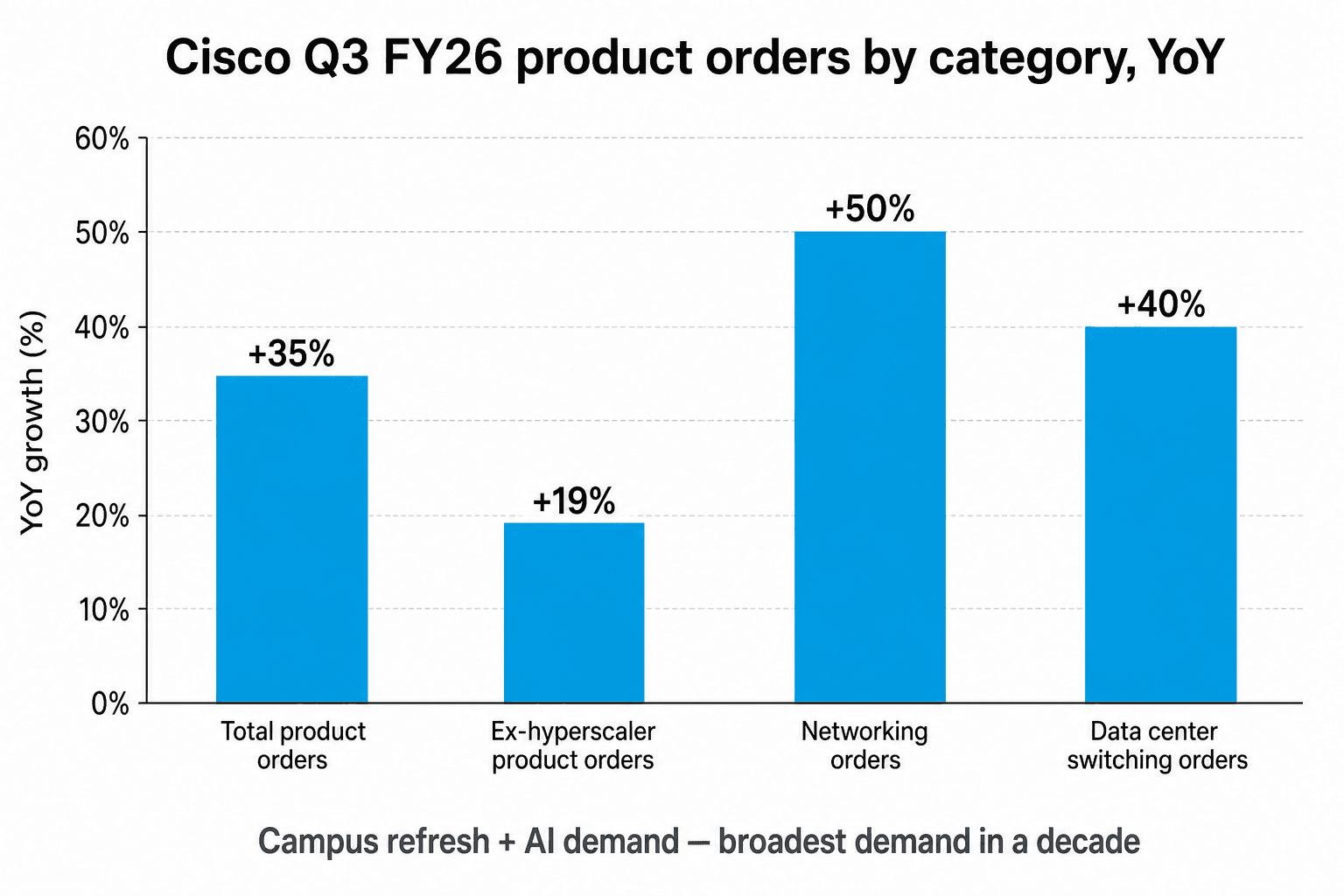
Here is the line item the AI-only bulls and bears both missed: total product orders grew +35% YoY, but ex-hyperscalers, the rest of the book still grew +19%. That's the strongest broad-based demand Cisco has seen in a decade.
Campus networking orders grew more than 25% YoY. Data-center switching orders grew more than 40% YoY. The next-generation Catalyst portfolio that Cisco launched 18 months ago is ramping faster than any prior product launch in the company's history. CEO Chuck Robbins called this "the broadest, deepest demand we have seen for Cisco technology in a decade."
The mechanics are not mysterious. The last enterprise campus refresh cycle peaked in 2019, ran cold through COVID, and never really restarted. Wi-Fi 6E, Wi-Fi 7, post-quantum security mandates, AI-at-the-edge use cases, and a regulatory tailwind around critical-infrastructure modernization all converge on the same buying decision: replace switches that were installed when Donald Trump was first president. The pipeline of deferred refresh demand sitting in enterprise IT budgets is large, and Cisco is now collecting on it.
There are two implications. First, the AI infrastructure narrative is not the entire growth story — it's the headline grabber on top of a broader refresh cycle that has multi-year legs. Second, the +19% ex-hyperscaler growth is more durable than the +217% YoY hyperscaler AI line, because campus refresh contracts run 3-5 years on average and customers can't quickly unwind them.
For modeling purposes, the question is whether the ex-hyperscaler line can hold +15-20% for another four quarters. If it can, FY27 revenue can clear $70B on the back of a sustained refresh cycle alone — before any further AI infrastructure tailwind.
Gross margin compression is the price of admission
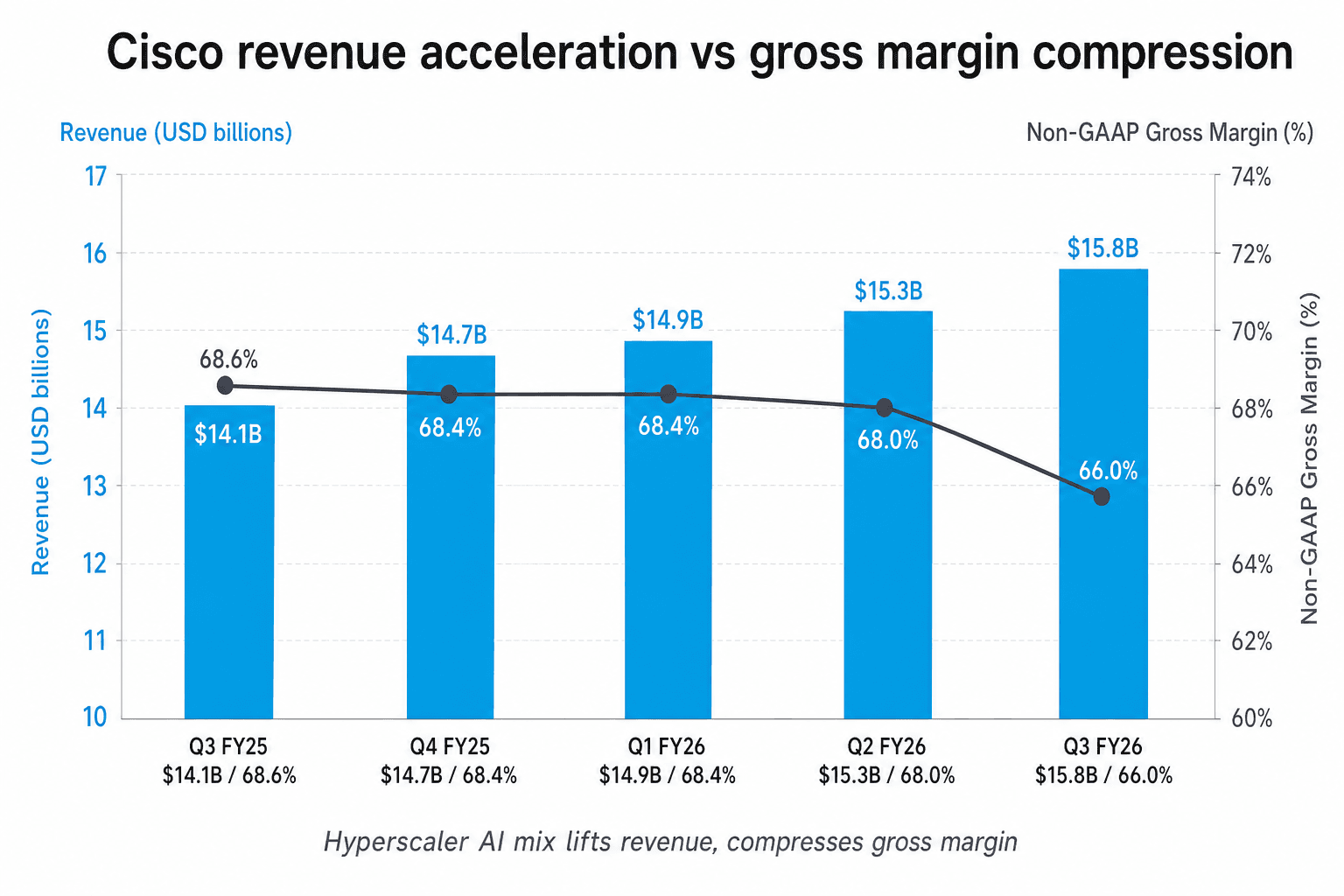
The bear case is six characters long: 66.0%. That's Cisco's non-GAAP gross margin in Q3 FY26, down 260 bps year over year from 68.6%. The compression has accelerated each quarter as the hyperscaler AI mix has grown.
Three things to understand about that line.
First, the compression is structural to the mix, not a deterioration of the underlying enterprise business. Hyperscaler hardware sells closer to 35-45% gross margin; enterprise networking sells closer to 65-70%. As hyperscaler AI grows from 5% of mix toward 10-15%, the blended gross margin has to compress. CFO Mark Patterson framed 66-67% as the new run-rate, not a way station to a lower number.
Second, the absolute gross-profit dollars are still growing. Q3 FY26 non-GAAP gross profit was approximately $10.5B vs $9.7B a year ago — a $0.8B incremental dollar lift even with the margin compression. The question is not whether Cisco's enterprise business is healthy (it clearly is) but whether the market values the extra $1.6B of FY26 revenue at the new mix-blended margin or punishes it for the compression optics.
Third, non-GAAP operating margin held at 34.2% — only −30 bps YoY despite the 260 bps gross-margin compression. The arithmetic: R&D opex grew +1.8% YoY versus revenue +12%. That's three multiples of operating leverage absorbing the gross-margin headwind. As long as the opex line stays disciplined, the gross-margin story matters less than the headline suggests.
What the call actually said
Chuck Robbins took the first 12 minutes of the prepared remarks. The structure was unusually crisp:
"AI infrastructure orders": $9B FY26 target, 4.5× FY25, $5.3B YTD already booked. "Networking is the broadest demand we've seen in a decade": ex-hyperscaler +19%, campus +25%, DC switching +40%. "Acacia is on fire": $1B+ in a single quarter, +200%+ YoY in FY26. "Splunk is operating as a data platform": revenue muted by on-prem-to-cloud transition, but ARR growing double-digits. "Margin is the cost of being the infrastructure of the AI era": gross margin compression is mix-driven and contained at the operating line.
The most-asked Q&A topic was hyperscaler durability — is $9B front-loaded or sustainable? Robbins's answer: pipeline visibility extends into calendar 2027, the design wins are multi-year programs, and the diversity of buyers (5 new design wins in Q3 split across optics and systems with multiple hyperscalers) reduces single-customer risk.
The second-most-asked topic was gross margin. Patterson held the 66-67% line. The third was Splunk, where management acknowledged the on-prem-to-cloud subscription drag is creating a near-term reported revenue drag — and asked investors to look at the ARR trajectory instead.
What two thirds of Wall Street did the next morning
The sell-side action followed a familiar pattern for beat-and-raise prints with a clear secular story. The median price target moved from approximately $94 going into the print to approximately $115 the morning after. Morgan Stanley upgraded from Equal-Weight to Overweight at a $120 target. Goldman maintained Buy on its Conviction List at $125. JP Morgan raised the target from $96 to $112. Wells Fargo went from $92 to $118. Citi from $98 to $115.
Bernstein held the contrarian line at Market Perform, raising the target only modestly from $80 to $95 on the argument that valuation now reflects the AI optionality and a pure-play optics name has better risk/reward.
The post-print consensus rating is now Strong Buy (8 Buys, 1 Hold from the major desks tracked). The dispersion of targets has actually narrowed since the print — analysts who were skeptical of the AI infrastructure narrative either capitulated or kept their existing models.
What to watch into Q4 print
Three numbers will define the next print (currently scheduled for mid-August 2026):
Hyperscaler AI order pace. Cisco needs ~$3.7B in Q4 alone to hit the $9B FY26 target. That's nearly double the Q3 run rate. The likely answer is upside, but the order-book mix between optics, silicon, and systems will tell the FY27 setup.
Ex-hyperscaler order growth. If +19% holds for another quarter, the campus refresh thesis becomes consensus. If it decelerates to single digits, the narrative shifts back to AI-only.
Gross margin floor. Q4 guide of 65.5%-66.5% non-GAAP gross margin is consistent with Patterson's framing. Any print below 65% would force a re-rating of the operating model.
The setup into Q4 is the cleanest it has been in years. Cisco has now delivered three consecutive guidance raises in FY26 — a cadence the market has not seen from this company since the mid-2000s. The question is no longer whether the AI infrastructure narrative is real; it's whether the enterprise refresh cycle has another four to eight quarters left in it.
If the answer is yes, the FY27 setup looks very different from anything the company has produced in 15 years.