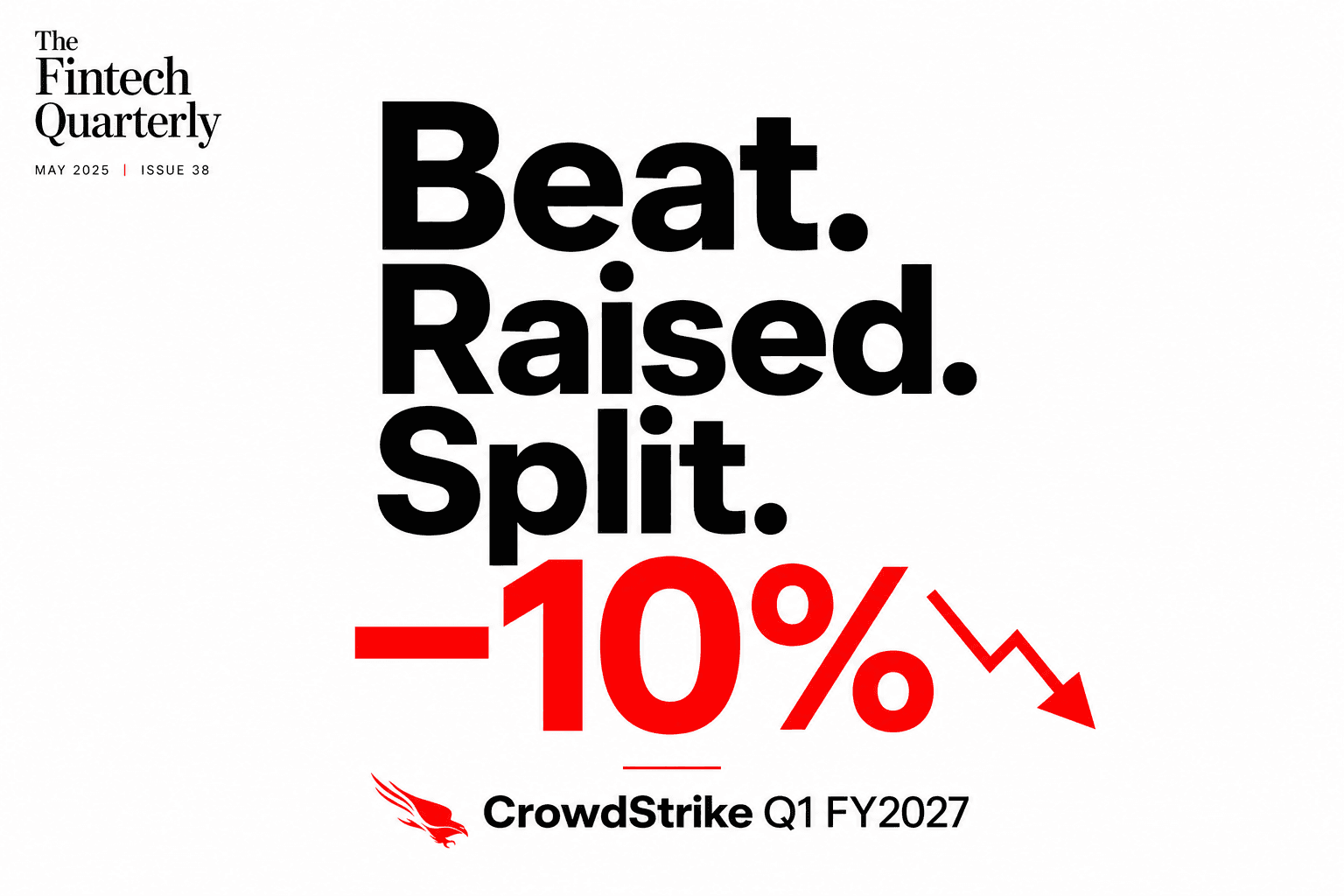
CrowdStrike Beat, Raised Guidance, and Split Its Stock 4-for-1 — and Still Fell 10%
A beat-and-raise that the market treated like a miss
CrowdStrike did almost everything right in Q1 FY27. Non-GAAP EPS of $1.10 beat the ~$1.07 the Street wanted. Revenue of $1.39B (+26% YoY) beat the ~$1.36B estimate. Net new ARR was a Q1 record at $256M, +32% YoY. Free cash flow hit a record $468M at a 34% margin. GAAP net income turned positive for the first time in over a year. Management raised full-year net-new-ARR growth guidance by 520 basis points to 27.7%. And to top it off, the board announced a four-for-one stock split.
The stock fell about 10%.
That gap is the whole story. There was nothing wrong with the quarter. There was something "wrong" with the setup: CrowdStrike went into the print at roughly 25x forward sales, having rallied (+5% the session before) on a parade of pre-print price-target hikes — JPMorgan to $800, Jefferies to $775, Evercore to $710. When a stock is priced that richly, "good" is the new "bad." The market wasn't grading the quarter; it was grading the quarter against perfection.
The metric that did it: net new ARR
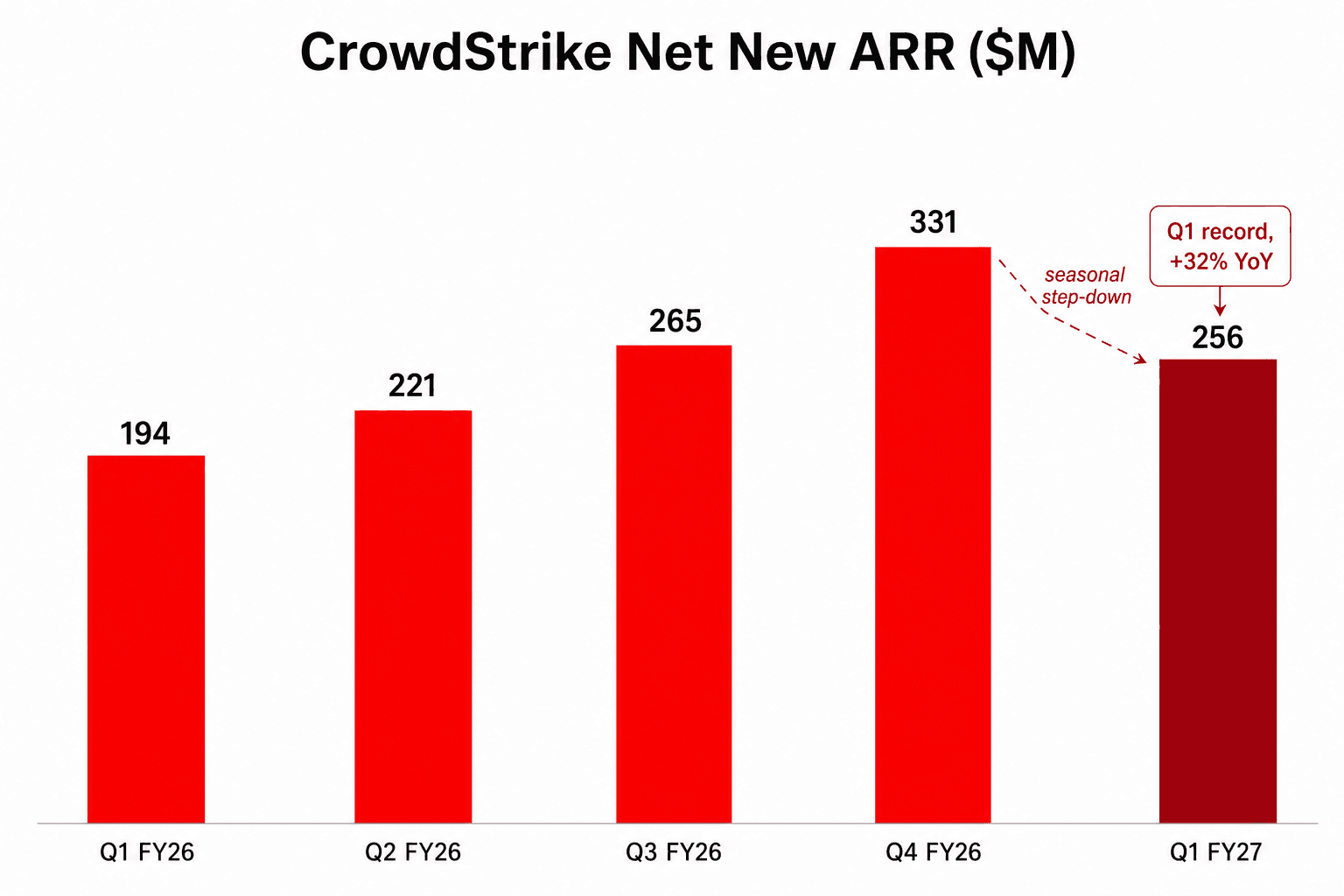
Net new ARR is the number the entire CrowdStrike bull case hangs on, because it measures how much new recurring revenue the platform is adding each quarter. The $256M print was genuinely good on the axis that matters most for a subscription business — +32% year-over-year, the fastest Q1 net-new-ARR growth in years, and the basis for management's raised full-year guide.
But it was down 22.6% sequentially from Q4's $330.7M. That step-down is seasonal — Q4 is always CrowdStrike's biggest bookings quarter and Q1 always gives some back — and the year-over-year comparison is the honest one. The market, primed for a blowout, fixated on the sequence anyway. Total ARR reached $5.51B (+24% YoY), the fourth straight quarter of growth holding in the +23–24% band even as the base scaled past $5 billion. That's the kind of durability that's hard to find at this size — but durability isn't the same as acceleration, and acceleration is what a 25x multiple demands.
The cash story is the real story
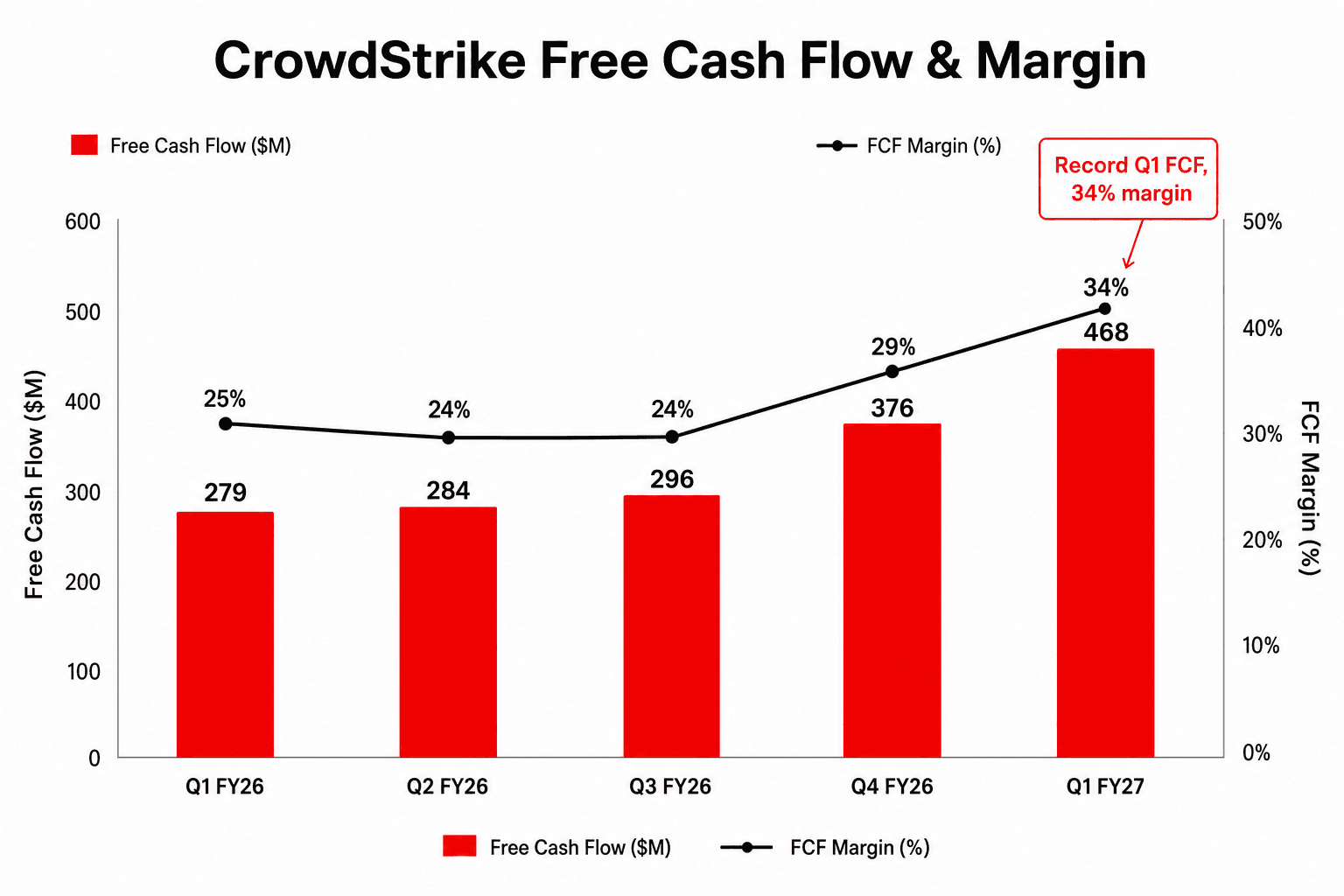
If net new ARR was the bearish hook, free cash flow was the bullish anchor. CrowdStrike generated record free cash flow of $468M, up 68% YoY, at a 34% margin — up nine points from a year ago. Operating cash flow was a record $591M. Non-GAAP operating margin expanded to 24%, up six points YoY.
This is the part of the model that's quietly compounding. CrowdStrike is past the worst of the July 19, 2024 incident: related costs fell to $18.1M this quarter, down 54% YoY, removing a drag that distorted GAAP results all through fiscal 2026. With that headwind fading, the leverage in the model is finally visible in the GAAP numbers — hence the return to GAAP profitability ($27.8M net income, $0.11 EPS, versus a $104.3M loss a year ago).
One asterisk: cash on the balance sheet fell about $0.68B sequentially, to $4.55B. That wasn't operational — the quarter included $881M of business acquisitions (goodwill nearly doubled, from $1.36B to $2.27B) plus $176M of buybacks. The cash engine is running; the cash balance just funded M&A.
The "AI inflection" pitch
Founder-CEO George Kurtz spent the call framing Q1 as the quarter "the worlds of cybersecurity and frontier AI collided" — what he called "the Mythos moment" — positioning CrowdStrike as "AI security infrastructure, critical to successful AI adoption." The substance behind the slogan: Project QuiltWorks, a coalition launched with OpenAI and Anthropic; selection as a launch partner in both Anthropic's Project Glasswing and OpenAI's Trusted Access for Cyber program; the Charlotte AI AgentWorks Ecosystem built with AWS, NVIDIA, and OpenAI; and a new Agentic MDR offering.
This is the new ARR vector the raised guidance leans on. Module adoption is already deep — 25% of customers now run eight or more Falcon modules, up from ~22% a year ago — and the agentic-AI products are the next expansion layer. The bull read is that CrowdStrike monetizes AI adoption as a security tax on everyone else's AI buildout. The bear read is that none of it shows up in the numbers yet, and the guidance raise is asking investors to pay today for ARR that arrives later.
The split, and what it signals
A four-for-one split (record date 2026-06-25, split-adjusted trading from 2026-07-02) changes nothing fundamental — it quarters the share price and quadruples the share count. What it signals is confidence and a bid for retail accessibility at a ~$750 pre-split price. Bears read the timing — announced alongside a guidance raise into a richly valued stock — as sentiment management. Bulls read it as a company comfortable enough with its trajectory to make the optical move. Either way, $750 / 4 ≈ $187 doesn't change the enterprise value by a dollar.
What the bulls and bears still fight about
Bull case: net new ARR re-accelerated to +32% YoY, guidance went up (FY27 net-new-ARR growth raised 520 bps to 27.7%), free cash flow margin hit 34%, GAAP profit returned, and the AI-security vector is real and early. This is a best-of-breed platform compounding leverage.
Bear case: none of that justified a ~25x forward-sales multiple going into the print, the sequential net-new-ARR step-down gave the selloff its excuse, the raised guide implies a second-half re-acceleration that must now be delivered, and an $881M acquisition muddies the organic-vs-inorganic ARR picture.
Forward look — what Q2 turns on
Three things to watch into the late-August Q2 print: (1) net new ARR re-acceleration — the raised FY27 guide bakes in a stronger back half, and Q2 needs to show the trajectory; (2) AI-product monetization — any disclosed ARR contribution from Charlotte AI / Agentic MDR / QuiltWorks would convert narrative into numbers; (3) margin durability — whether the 34% FCF margin holds while absorbing the new acquisition and rising stock-based comp.
All financial figures sourced from CrowdStrike's Q1 FY2027 earnings release (filed with the SEC on 2026-06-03) and prior quarterly releases. Analyst price-target moves and the market reaction sourced from CNBC, Benzinga, and Public.com coverage.