Salesforce Q1 FY27: Agentforce Hit $1.2B ARR. The Stock Fell Anyway.
The cleanest beat Salesforce has printed in years — and the market shrugged
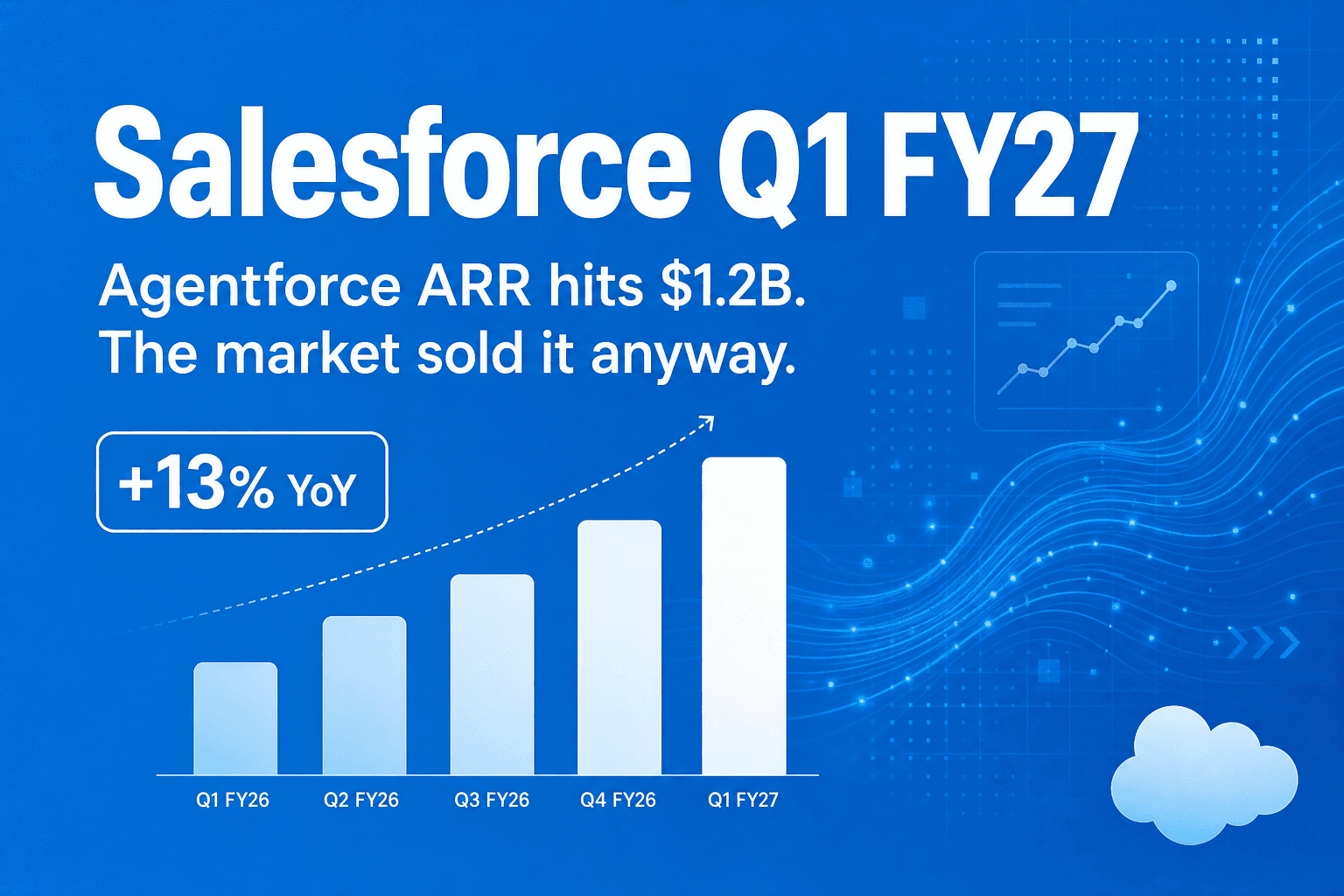
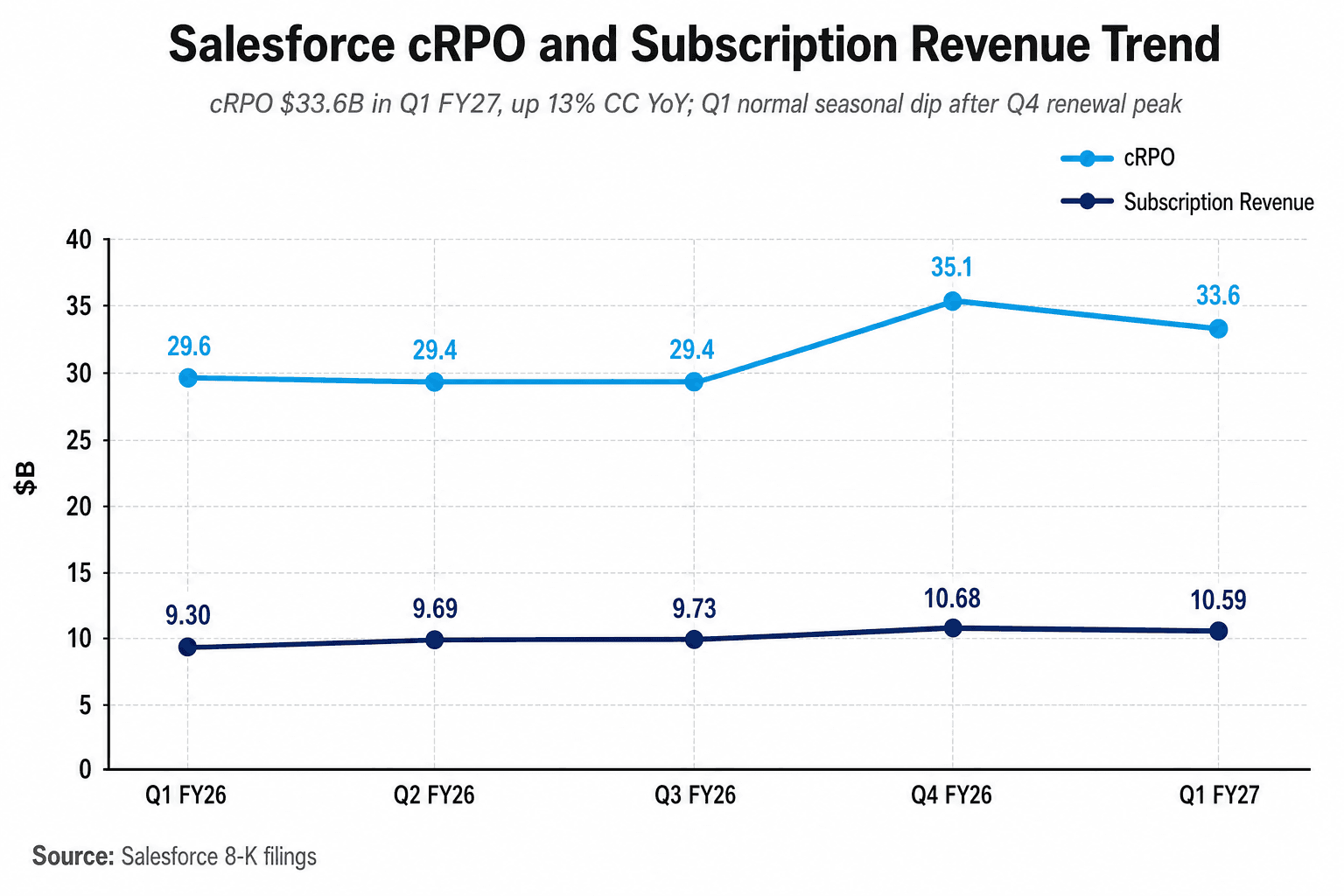
By every number that matters in a SaaS print, Salesforce's Q1 FY27 was a beat. Revenue of $11.13B grew 13% YoY (+12% in constant currency), clearing consensus by ~$70M. Non-GAAP EPS of $3.88 crushed the $3.13 Street estimate by roughly 24%. Current RPO of $33.6B beat by ~$1B and grew 13% in constant currency — accelerating two points from the FY26 run-rate. Agentforce ARR crossed the $1.2 billion mark, up 205% YoY. Combined AI and Data 360 ARR reached $3.4 billion, up more than 200% YoY.
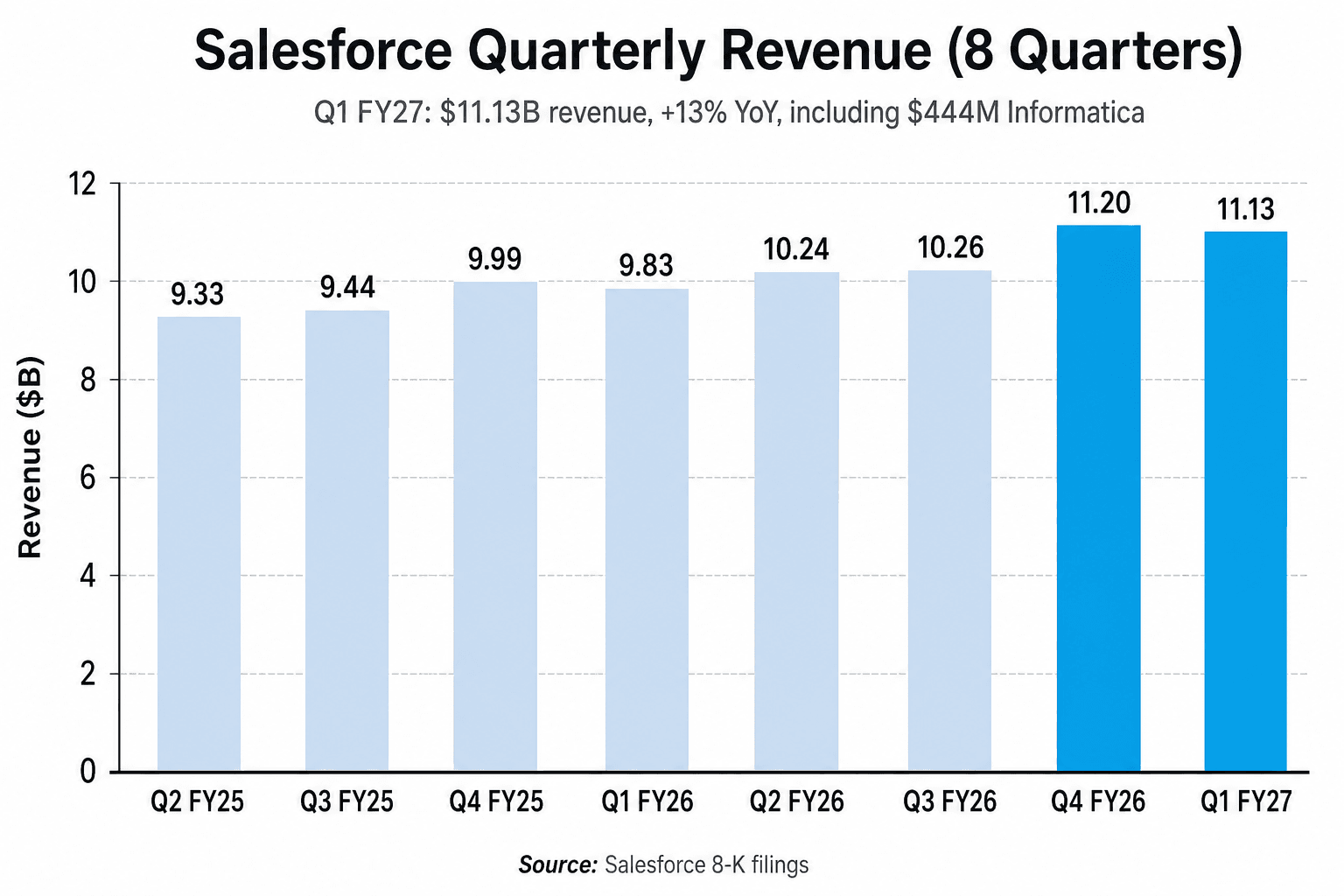
Then the stock fell ~3% after-hours and another ~3% in regular trading on May 28. Year-to-date, CRM is now down roughly 35%.
What actually broke the print
This is the rare quarter where every single bullet on the press release was a positive — and the market still found the one number that ruined it. That number was Q2 revenue guidance.
Q2 FY27 revenue guide: $11.27B to $11.35B. Midpoint $11.31B. Consensus going in was ~$11.40B. The miss is $90M — under one percent of revenue — but the direction is what mattered. Salesforce has spent the last four quarters guiding cautiously and beating; this is the first quarter where the explicit guide for the next period sits below where the Street has its model. That's a different kind of signal.
CFO Robin Washington was clear about the components: continued momentum in Agentforce, Data 360 and Slack, partially offset by "ongoing weakness in Marketing and Commerce, and increased softness in Tableau bookings and renewals." Tableau has now missed its internal bookings plan for two consecutive quarters. That's not transitory anymore.
The second drag was the free cash flow guide. Salesforce funded a $25B accelerated share repurchase (ASR) by issuing $24.8B in new long-term debt in Q1. That debt carries cash interest — and the FY27 FCF growth guide came down to ~4–5%, from prior expectations of high-single-digits. The mechanical EPS accretion from a 7% lower share count is real, but DCF-anchored investors saw the cash flow line slow, not accelerate, and reacted accordingly.
Agentforce is finally a material line
The Agentforce ARR milestone is the strongest piece of forward signal in the print. Six months ago, this was a demo-led narrative. Today it's a $1.2B annualized run-rate growing 205% YoY. The supporting consumption data is more striking than the dollar figure:
- 3.8 billion cumulative Agentic Work Units (AWUs) delivered, up 111% QoQ
- 28.6 trillion tokens processed, up 152% QoQ
- ~1 trillion API calls across Core products in Q1 alone
- Public Sector AWUs up nearly 400% QoQ — the fastest-adopting vertical
- Bookings from premium Agentforce SKUs grew ~60% YoY
- >50% of Agentforce and Data 360 bookings came from existing customers
The "consumption is compounding" pattern looks healthier than the bookings number alone implies. AWUs grew 111% sequentially. Tokens grew 152% sequentially. Both are leading indicators for the ARR line — usage runs ahead of monetization on Flex Credit contracts.
The reorganization of the subscription line is the second piece of signal. Salesforce now reports two buckets: Agentforce Apps ($6.91B, +7% CC) and Data 360, Headless Platform, Other ($3.68B, +23% CC). The growth divergence between the two is the real story — and it is exactly the kind of cross-sell engine the Informatica deal was supposed to create.
The Informatica acid test
Informatica closed in March 2026 — partway through Q1 — and contributed $444M of revenue ($428M of it subscription) and $1.1B of Cloud ARR in its first partial quarter inside Salesforce. The cash purchase was ~$1.45B net of cash acquired (reflected in Q1 investing cash flows).
The strategic logic: Informatica owns the integration / data quality / governance layer that grounds enterprise data before it can be safely fed to an AI agent. Agentforce without grounded data is a hallucination engine; Agentforce on top of Informatica + Data 360 is a defensible enterprise architecture. The Zero Copy share of Data 360 ingestion — now ~67% (35T of 52T records) — is the cleanest read on whether that architecture is being adopted.
The acid test isn't whether Informatica adds revenue (it does — about 4 points to Q1 and 3 points to FY27). It's whether the cross-sell motion materializes: does Informatica's Cloud ARR grow faster as a Salesforce asset than it did as a standalone? Management said it's running ahead of cost synergy targets but offered no organic-growth datapoint yet. Q2 will be the first quarter where the comparison gets cleaner.
The margin and capital-return picture
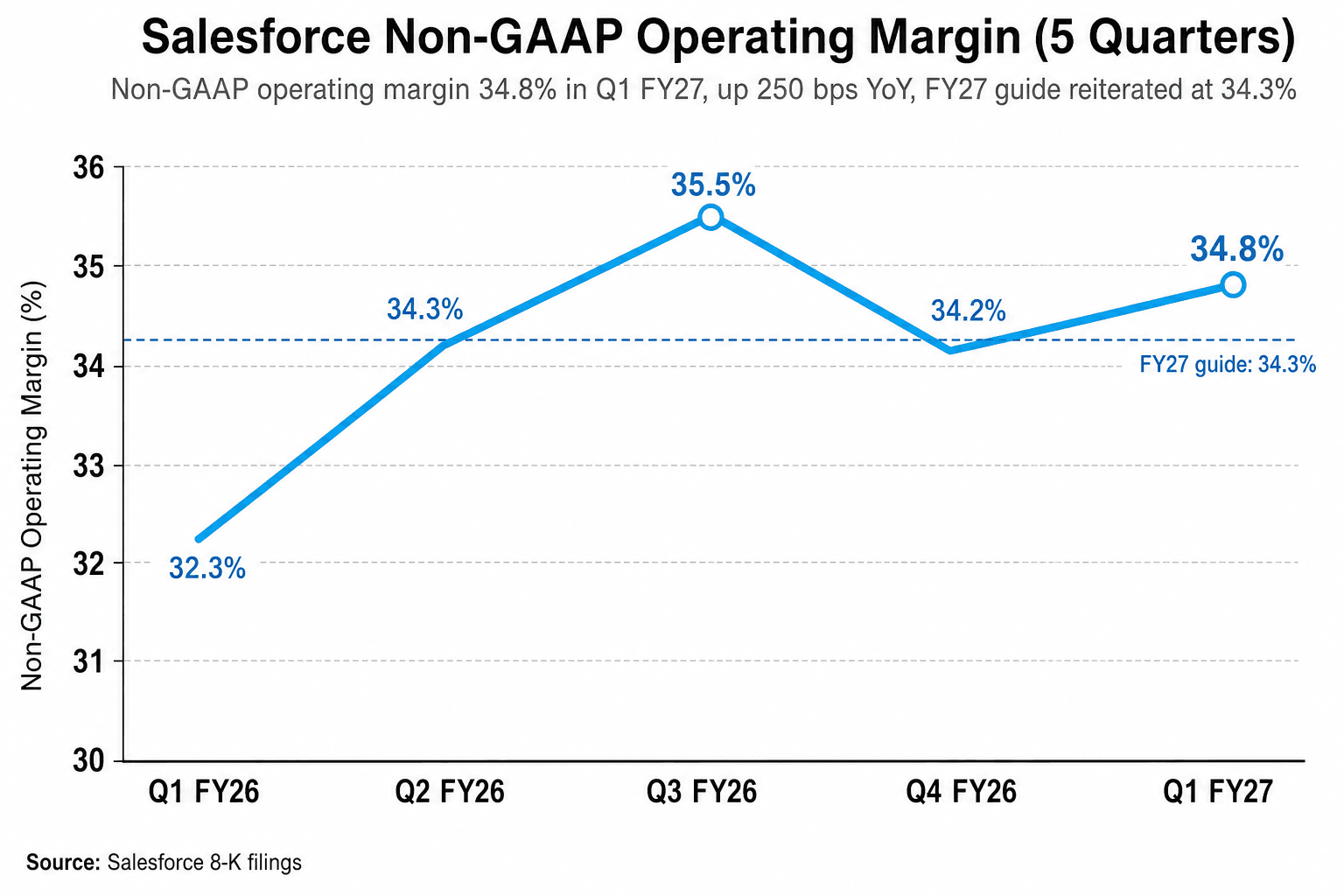
Non-GAAP operating margin of 34.8% was up 250 bps YoY and 60 bps QoQ. The FY27 guide of 34.3% was maintained, which is the more important number: Salesforce is absorbing the Informatica dilution (Informatica standalone runs ~25% non-GAAP op margin) without flexing the full-year framework. Self-service deflection driven by internal Agentforce deployment is the lever management credits — support and engineering productivity above and beyond the headline.
The capital return choice is the other half of the story. The $25B accelerated share repurchase is the largest single buyback in Salesforce's history. 103 million shares (~80% of total expected) delivered upfront in Q1; diluted share count dropped from 940M (Q4) to 871M (Q1), a 7.3% QoQ reduction. Final ASR settlement is expected in Q3 FY27.
The mechanical EPS effect is significant — but Washington's framing on the call mattered more: this is "a bridge to the FY30 target, not a substitute for revenue growth. We are doing both." That sentence is the bull case in one line. The bear case is that companies financing buybacks with debt at the bottom of a growth cycle don't always look smart twelve months later.
What I'm watching into Q2
- Tableau bookings cadence. The single highest-conviction drag on the FY27 model. If Q2 prints a third consecutive miss against internal plan, the H2 reacceleration story breaks.
- Agentforce ARR sequential add. $1.2B less ~$800M in Q4 = $400M sequential add in Q1. If Q2 doesn't deliver another $300M+ step-up, the +205% YoY growth narrative starts to lose its asymptote.
- Organic cRPO growth ex-Informatica. Reported 13% CC, ~9% organic. Management's H2 reacceleration thesis needs that organic number to step up to low-double-digits by Q4.
- Slack MCP monetization. 1 million active users in 6 weeks is the kind of viral curve Salesforce hasn't owned in a decade. The question is whether the MCP traffic converts into paid Agentforce seats inside Slack — that's the next earnings cycle's KPI.
The investor math right now
Pre-print sell-side ratings: Buy / Overweight on 12 of 15 covering shops. Post-print: same ratings, lower price targets. Median PT cut ~8.5%; consensus moved from ~$280 to ~$262. BofA stayed at Underperform with a $160 target — the lonely bear on the desk.
The asymmetry is what's interesting. Fundamentals were good. Price action was bad. Either the multiple compression cycle isn't done yet and CRM is the marginal SaaS name that hasn't fully de-rated, or the Q2 guide is the first concrete signal of a real deceleration that the bullish desks haven't priced in.
Q1 FY27 didn't settle that argument. Q2 will.
For now, Salesforce trades at roughly 16x forward non-GAAP EPS and a sub-5% FCF yield — the cheapest the stock has been on either metric in five years. The cRPO line is healthy, Agentforce is compounding, and the share count is shrinking 10%+ YoY. That's the bull setup.
The bear setup is that mid-single-digit organic Customer 360 growth at a 16% organic Agentforce-plus-Data-360 bucket eventually averages to a high-single-digit business — and high-single-digit growers don't trade at 16x. Both of those things can be true. They are, today.