Circle Q2 2026: A Bank Charter, and a Sold-Off Beat
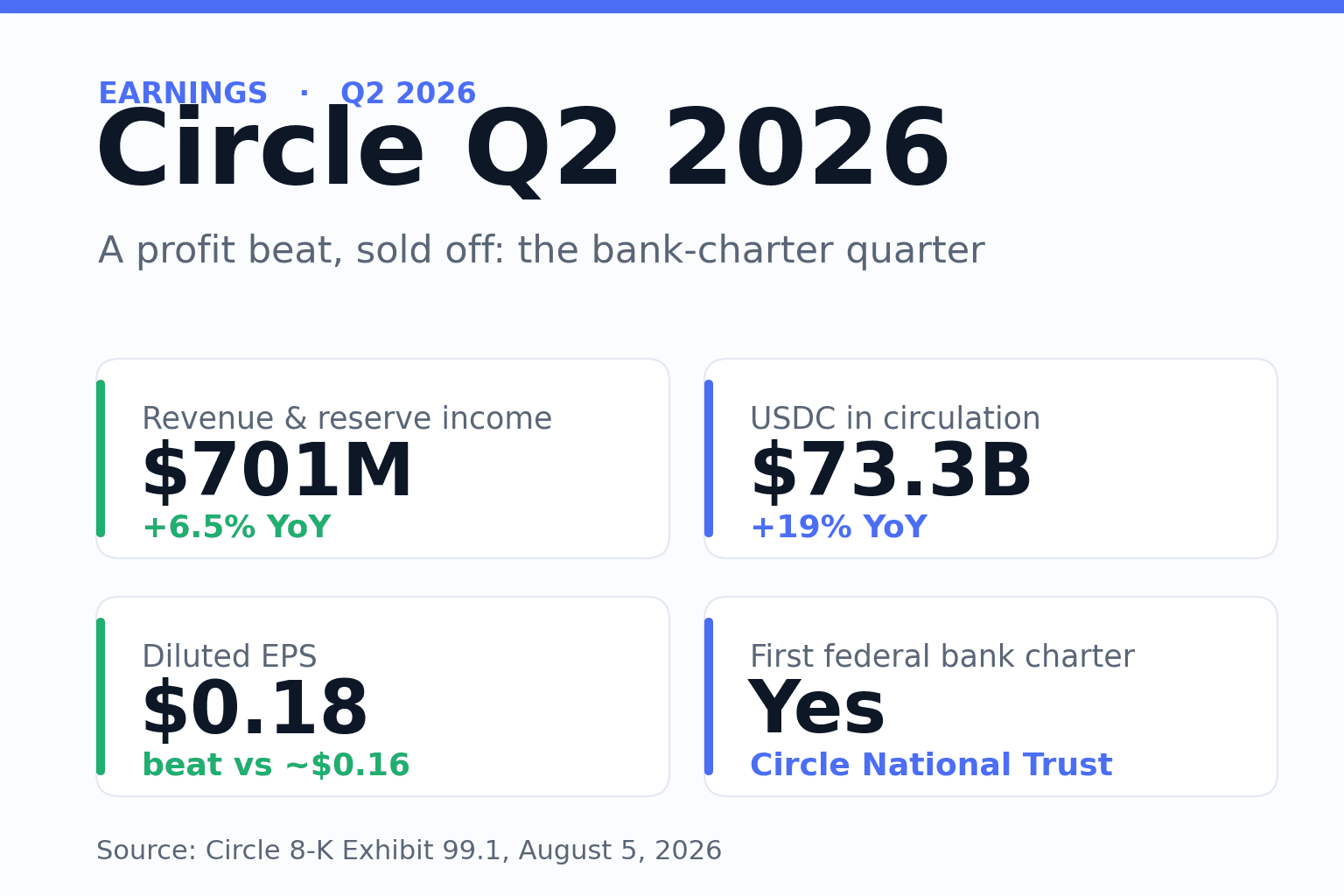
A profit beat that the market refused to buy
Circle Internet Group delivered a quarter that looked, on paper, like vindication. It beat on profit, won a landmark federal bank charter, and raised its full-year guidance. The stock still fell. Shares spiked roughly 7% premarket to about $64 as the headline earnings beat crossed the wire, then reversed through the session to close down about 3.75%. This is the textbook shape of a "sell the news" print: a green number on the top line of the release that could not outweigh what investors found underneath it.
The tension runs through the entire report. Circle is the issuer of USDC, a stablecoin, meaning a digital token designed to hold a steady value of one US dollar and backed by real cash and Treasuries. Its business is straightforward in principle: it earns interest on those reserves and shares part of that yield with partners who distribute the coin. When interest rates drift down and the amount of USDC in circulation shrinks, both levers move against it at once. That is what Q2 showed, even as the strategic wins piled up.
The financials: a beat and a slight miss in the same release
Total revenue and reserve income was $701M, up 6.5% year over year but a touch below the roughly $713 to $717M analysts expected. Reserve income, the interest Circle earns on the assets backing USDC, was $668M, up 5.4%. Other revenue, from subscriptions and services, was $34M, up 41%. Diluted earnings per share came in at $0.18, ahead of the ~$0.16 consensus, and net income from continuing operations was $48M. Adjusted EBITDA, a profit measure that strips out interest, taxes, depreciation and stock compensation to approximate cash operating earnings, was $143M, up about 8%.
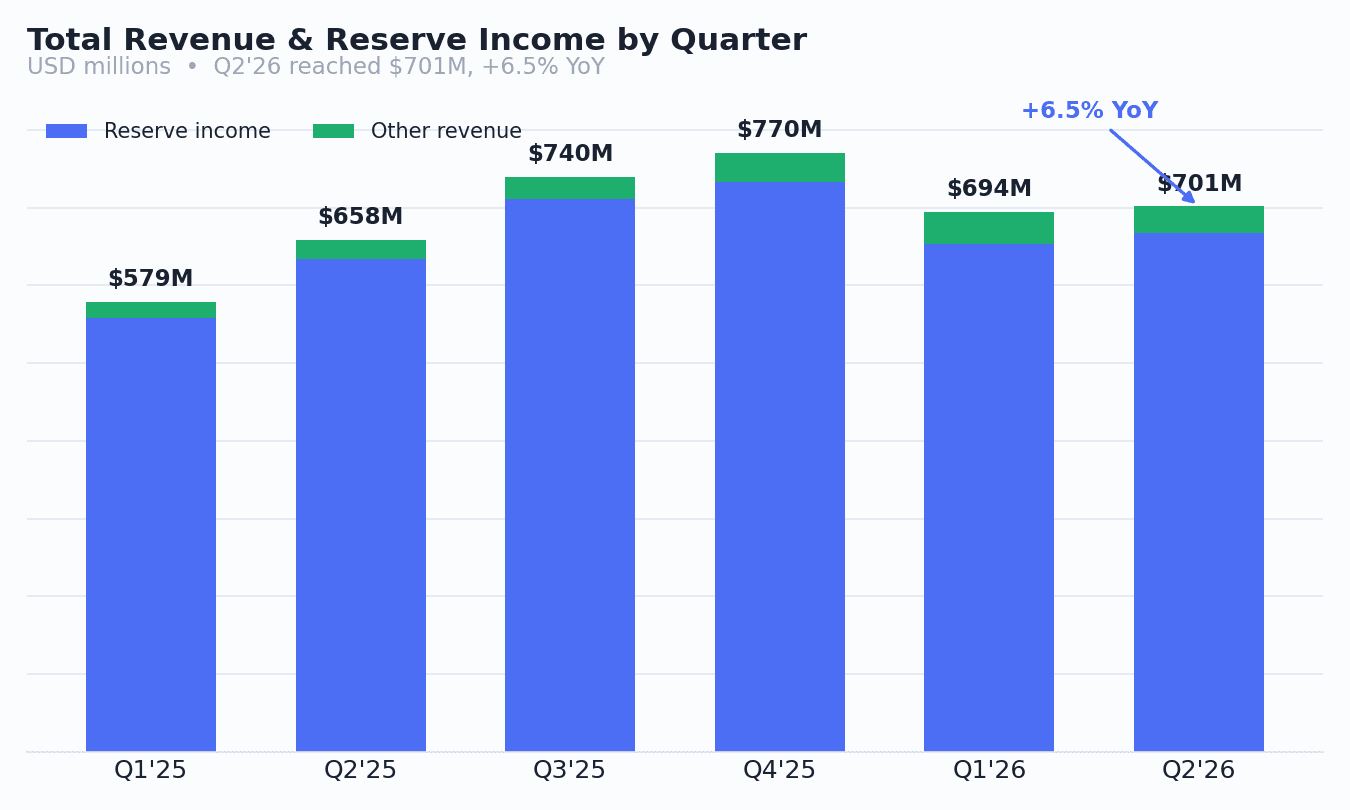
The split matters. The EPS beat was helped by cost discipline and by the absence of the one-time IPO stock-compensation charge that had distorted the year-ago quarter. The revenue miss, by contrast, pointed at the engine itself: the reserve return rate fell to about 3.5%, down 66 basis points year over year, as Federal Reserve cuts worked their way through the short-term rates Circle earns on. Growth in the coin supply had been the offset. This quarter, that offset weakened.
The number that spooked investors: USDC shrank
USDC in circulation ended the quarter at $73.3B, up 19% from a year earlier but down 4.8% from $77.0B at the end of March, and off a 2026 peak near $80B. For a company whose revenue scales with the size of its coin float, a sequential decline is the last thing the bull case wants to see.
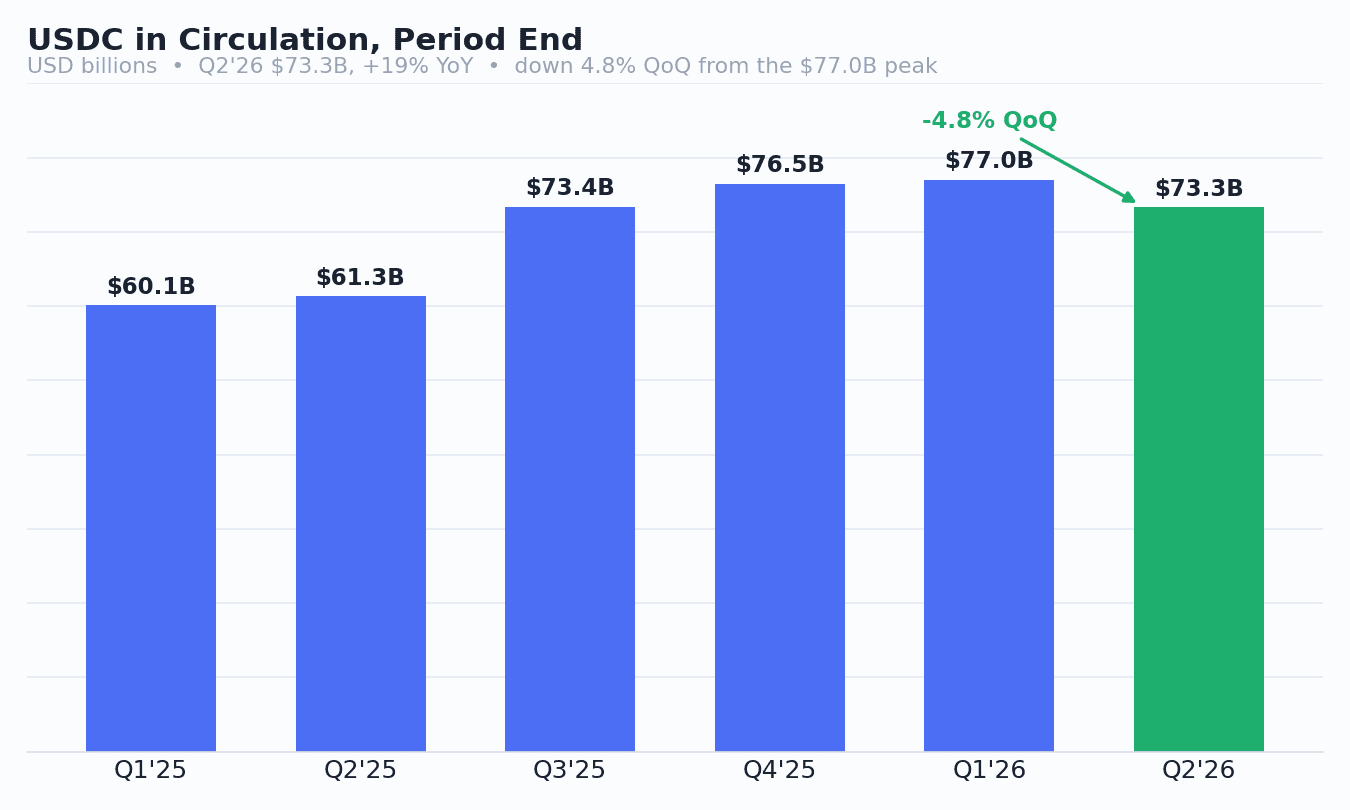
Allaire pinned the drop on forces outside Circle's control, "the current rate environment and a crypto market that has slowed," and told the call that "digital asset markets themselves have continued to see significant weakness." There is a real distinction hiding in the numbers that supports him. End-of-period circulation fell, but average circulation over the quarter still rose 1.7% sequentially and 25% year over year. The float dipped late in the period rather than eroding throughout. Circle reaffirmed its target of roughly 40% multi-year growth in circulation. Whether that holds is now the central question for the stock.
Onchain volume tells a different story
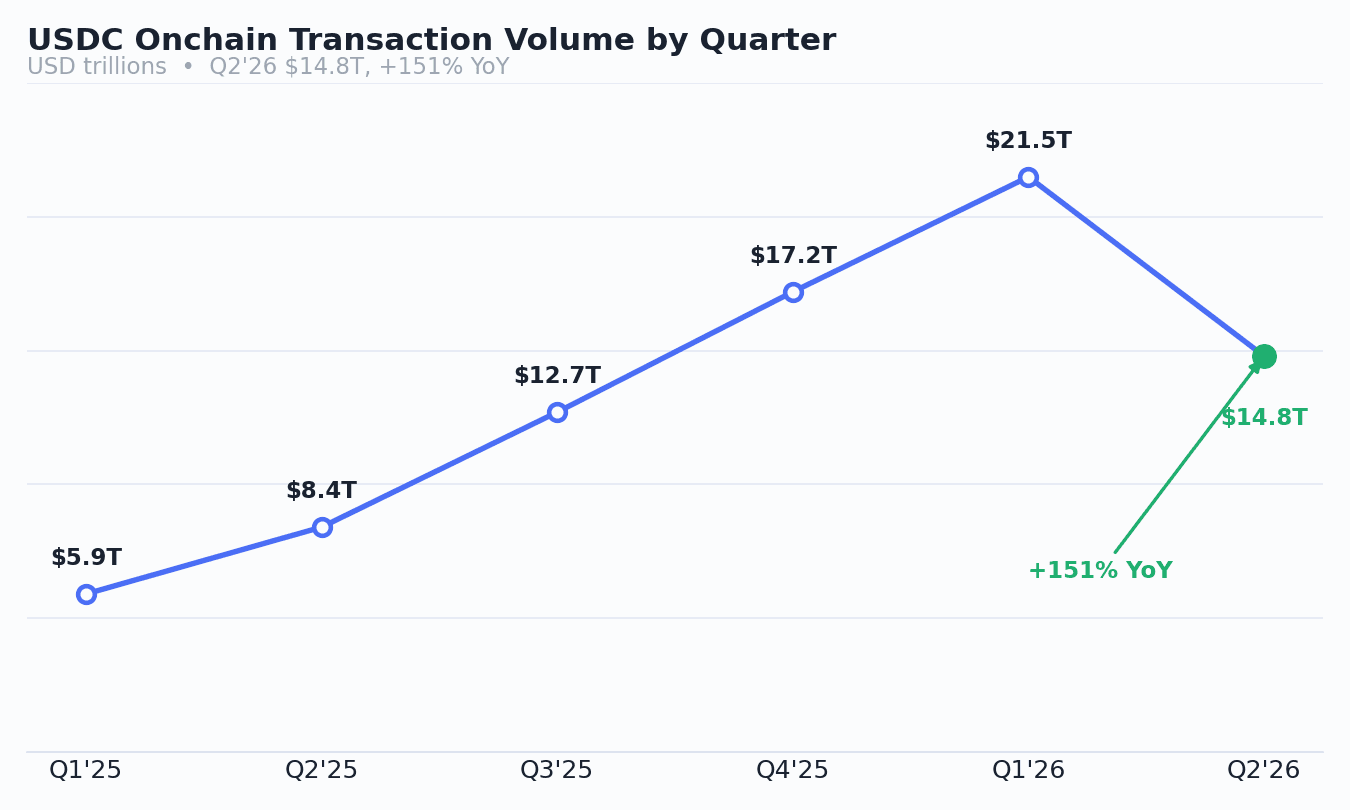
If circulation was the bearish data point, onchain transaction volume was the bullish counter. USDC settled $14.8T of onchain volume in the quarter, up 151% year over year, a sign that the coin is being used more heavily even as the outstanding supply dipped. Management said USDC reached roughly 70% of stablecoin transaction volume in June, up from about 36% a year earlier.
Utility growth also feeds margin. A rising share of USDC now sits "on platform," inside Circle's own products, where none of the reserve yield is paid away to distribution partners. That on-platform slice reached 19.5% of circulation on a daily-weighted basis. Partly as a result, distribution and transaction costs fell to 61.4% of reserve income, down 260 basis points year over year, the structural tailwind under Circle's margins.
CPN and the network build-out
The fastest-scaling non-reserve business is the Circle Payments Network, or CPN, which lets banks and payment firms send and receive stablecoin payments without having to manage the licensing, liquidity and custody themselves. Annualized transaction volume, measured on a trailing 30-day basis, reached $14.7B, up 76% from the prior quarter, with 175 financial institutions enrolled, up 29%.
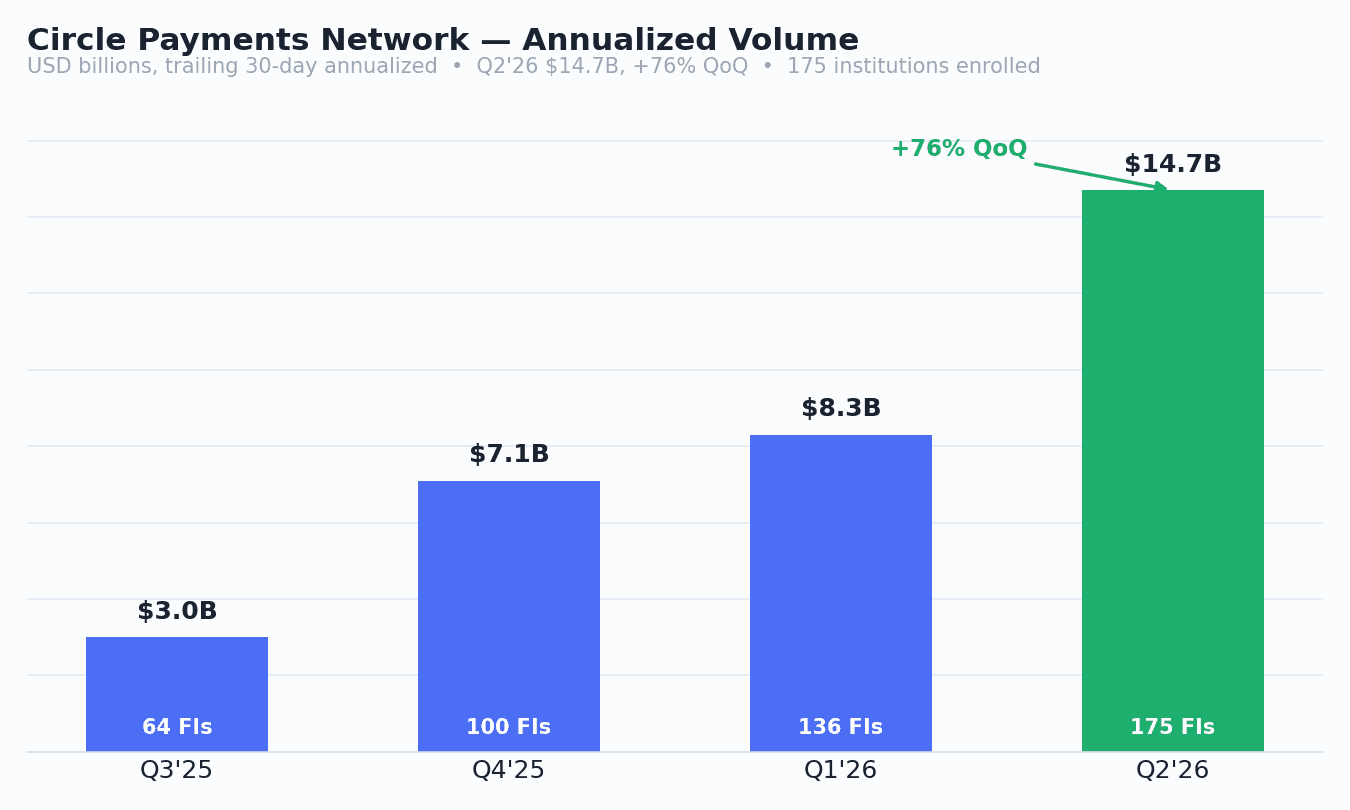
Around CPN sits a widening roster of commercial wins the company detailed on the call, from JCB in Japan and Kakao in Korea to Nium settling across 190-plus countries. Circle also said its Agent Stack, launched in May, already hosts more than 900 paid services, with 99.3% of agent-payment volume on the x402 protocol settling in USDC. These lines are still small in dollar terms, but they are what Circle wants investors to price when reserve income stalls.
The landmark charter and a raised guide
The quarter's genuine milestone was regulatory. The Office of the Comptroller of the Currency granted final approval for Circle National Trust, making Circle one of the first stablecoin issuers to hold a US federal trust bank charter. In plain terms, a bank charter is a federal license to operate as a regulated financial institution, and this one lets Circle provide federally regulated custody of digital assets and, over time, manage the USDC reserve itself rather than relying entirely on outside banks.
Alongside it, Circle raised its full-year outlook. It lifted FY26 other revenue guidance to $310 to $330M, roughly double the prior $150 to $170M range, and raised its RLDC margin guidance, the share of revenue left after distribution costs, to 41.7 to 43.7% from 38 to 40%. Both increases stem from recognized revenue tied to the Arc token presale, which earlier guidance had excluded. Adjusted operating expense guidance held at $570 to $585M.
Why the beat did not hold
The bears got the tape. Two days before the print, Morgan Stanley's James Faucette downgraded Circle to Underweight and slashed his price target to $38 from $106, arguing that shrinking USDC exposes how sensitive reserve income is to both coin supply and rates, with the mix shifting toward lower-margin transaction revenue. Mizuho reiterated an Underperform at $45, pointing to the sequential decline in USDC, the 31% quarter-over-quarter drop in onchain volume and compressing EBITDA margin as weak operating signals beneath the EPS beat.
The bulls did not go away, but they trimmed. Bernstein stayed Outperform yet cut its target to $140 from $190; Goldman Sachs held Neutral and lowered its target to $96; TD Cowen initiated at Buy with an $82 target. The result is an unusually wide dispersion, from $38 to $140-plus, that captures the disagreement exactly. Is Circle a rate-sensitive yield business whose product is contracting, or the emerging settlement layer for tokenized finance? The current price cannot be right for both.
The forward look
The near-term calendar is dense. Arc, Circle's own blockchain built for payments and tokenized real-world assets, launches its public mainnet on September 16, with a founding validator cohort that reads like a who's who of finance: BlackRock, Visa, Mastercard, DTCC and ICE among them. Allaire called it "a cohort of network validators no other network can match." BlackRock is expected to deploy its tokenized BUIDL fund on Arc, and DTCC plans to enable tokenization of the assets it custodies.
That is the crux of the split verdict. Circle spent the quarter assembling the institutional plumbing for a tokenized financial system while its core coin supply and reserve yield both moved the wrong way. The charter, the validator roster and the raised guide are real. So is the shrinking float and the 3.5% reserve rate. Whether USDC circulation turns back up over the next two quarters will decide which story the market was right to price.