Circle Q1 2026: USDC Just Quietly Took Majority Utility Share
A Revenue Miss That Looks Nothing Like a Revenue Miss
Circle reported its first quarter as a public company that wasn't dominated by IPO noise on May 11, 2026. The print, on paper, was uninspiring. Revenue of $694M missed consensus by roughly $20M. Net income fell 15% YoY. Operating expenses grew 76%.
Then the stock closed up 17%.
The market's reaction was right. Behind the messy GAAP line items, Q1 2026 was the quarter Circle quietly became the dominant settlement layer for onchain dollars — and the structural mix shifts inside the print are worth far more than any single quarter's revenue print.
Three numbers tell the story:
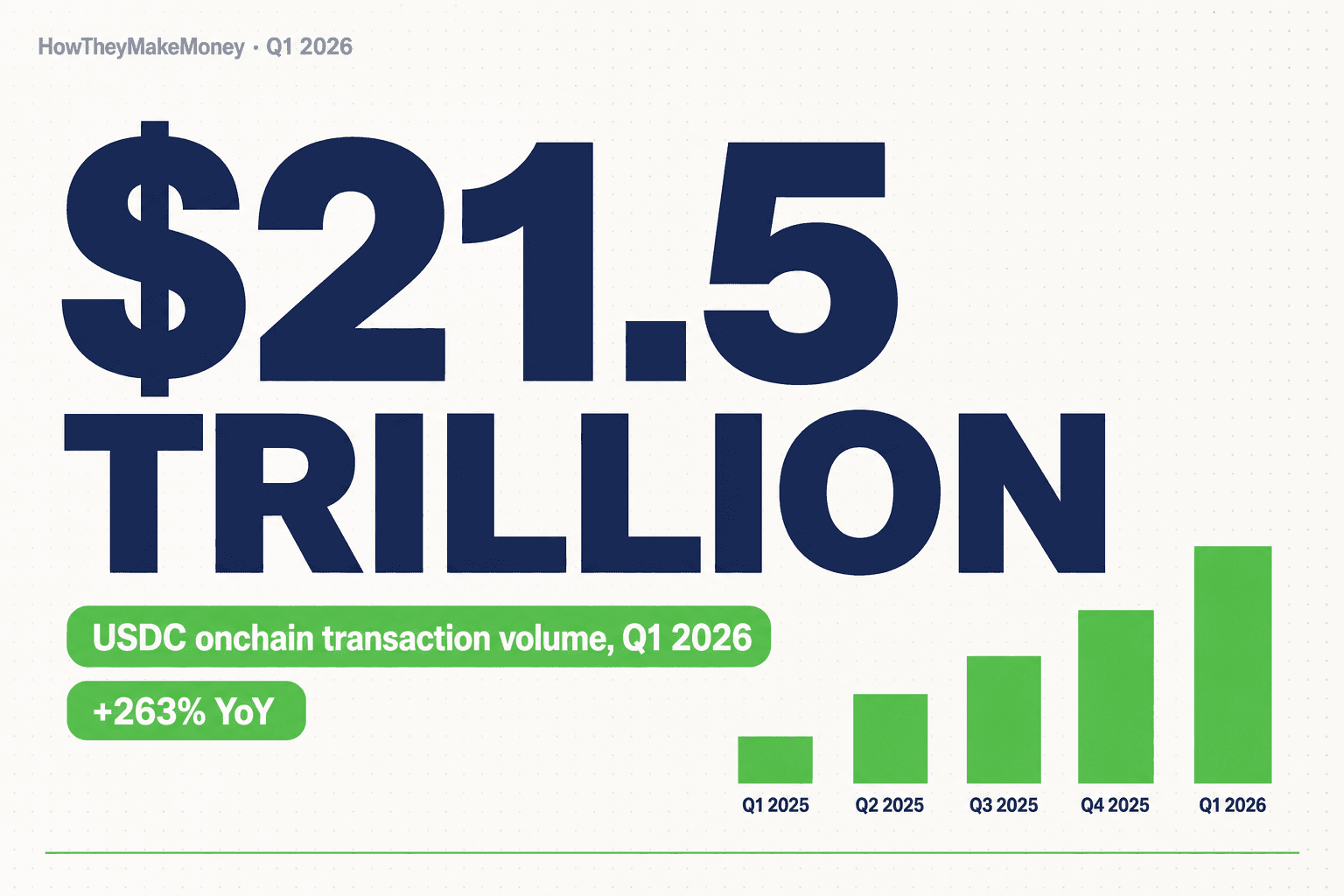
- USDC = ~80% of onchain dollar transactions (including Solana data), per CEO Jeremy Allaire on the call. Per Visa Onchain Analytics, USDC is 63% of all fiat-backed stablecoin transaction volume. Q1 2026 was the first quarter ever in which USDC crossed majority-utility-share.
- On-platform USDC: 17.2% of total circulation, up from 5.7% one year ago. This is the slice Circle controls directly — and Circle keeps 100% of the reserve yield on it, with no distribution-cost giveback.
- RLDC margin: 41.4%, up 130 bps QoQ and 150 bps YoY — despite a 47-bp QoQ drag from a falling reserve return rate.
The Margin Walk Almost No One Talked About
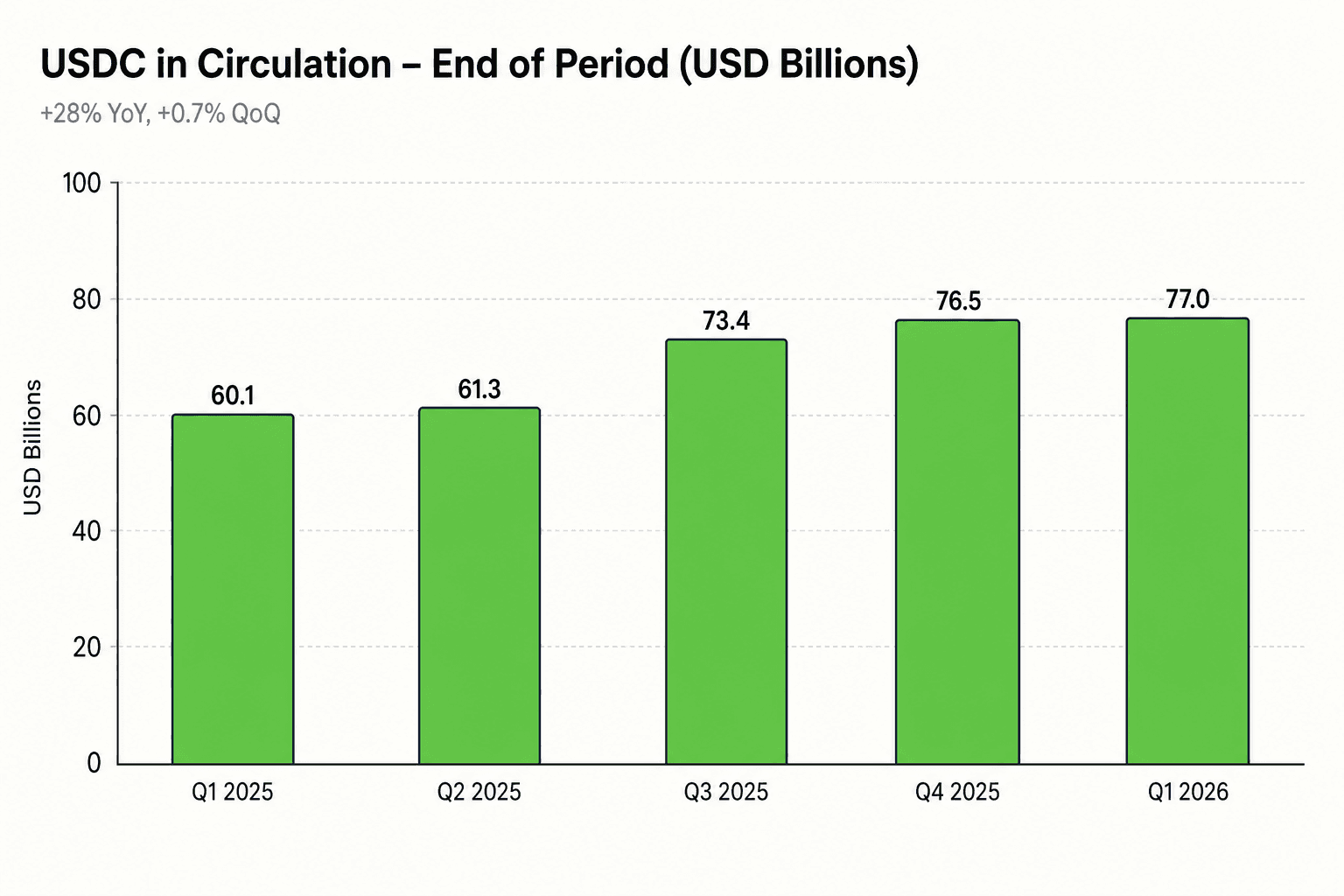
Circle's business model has one math equation everybody needs to keep in front of them. Reserve income (the yield Circle earns on the $77B of customer deposits backing USDC) flows in. Distribution costs (paid mostly to Coinbase, which splits the yield ~50/50 on its slice of USDC) flow out. The difference — Revenue Less Distribution Costs, or RLDC — is what Circle actually gets to keep.
For five quarters running, that RLDC margin has been doing something quietly impressive: it has expanded in three of the last four quarters even though the Fed has been cutting rates. The reason is mix.
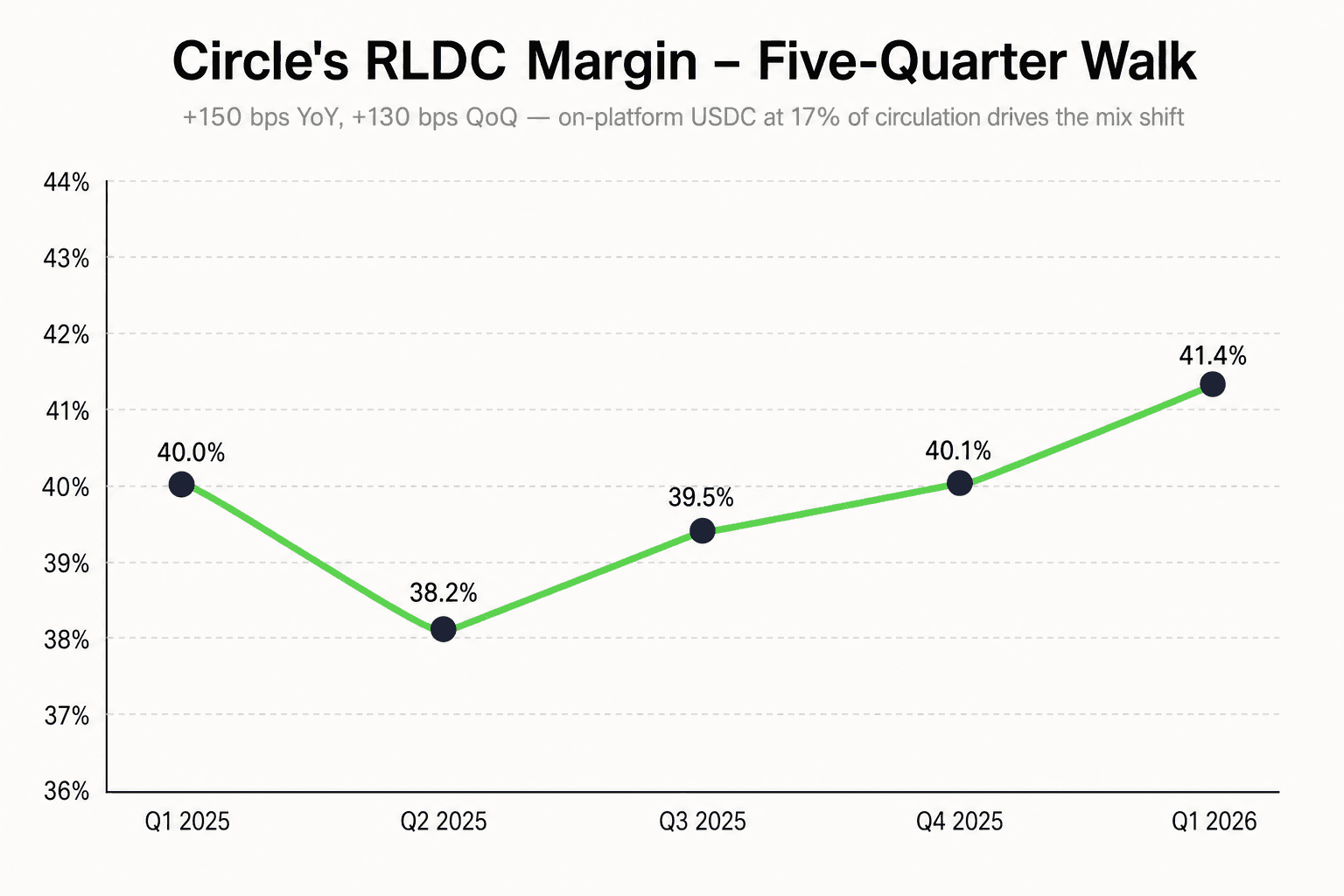
CFO Jeremy Fox-Geen walked through the components on the call:
- + Other revenue scaled to $42M (+13.5% QoQ, +100% YoY) — and roughly 100% of that drops to RLDC because there's no distribution-cost line attached.
- + On-platform USDC reached 17.2% of total circulation. Circle keeps 100% of the reserve yield on this slice.
- + "Modest pullback in certain other highly incentivized channels." Mizuho's Dan Dolev floated Binance directly on the call. Allaire declined to confirm. The math doesn't really care — the pullback helped margin.
- − Coinbase's share of USDC circulation grew in the last month of the quarter. Coinbase economics drag the QoQ margin walk in the other direction.
Net of all that, Circle delivered the highest RLDC margin in its public history while the reserve rate fell. That's the kind of mix shift that doesn't reverse on a single Fed decision.
The On-Platform Inflection Is the Whole Thesis
Here is the chart that matters more than any other on this print.
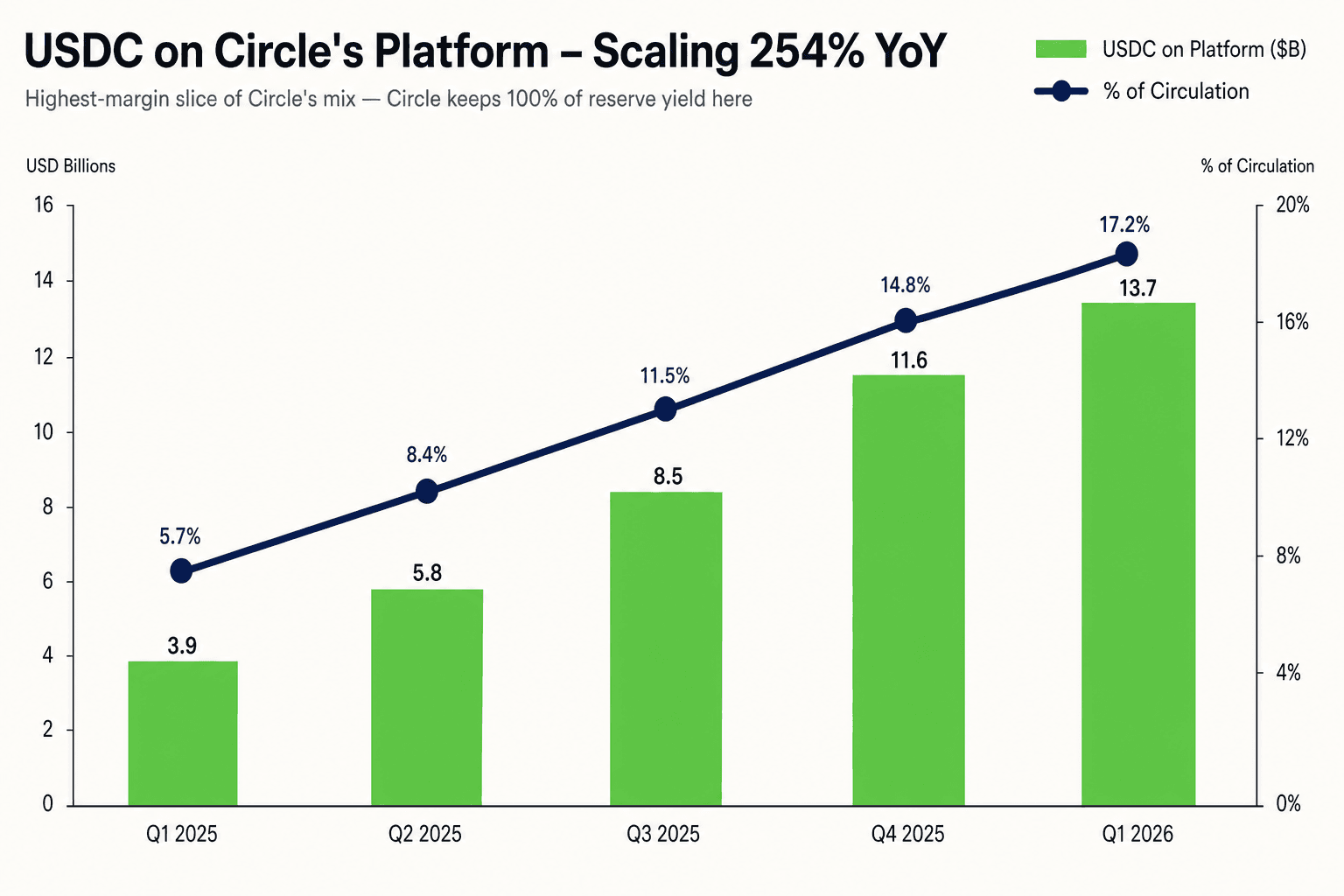
For most of Circle's history, the company's economics were a hostage situation. USDC sat predominantly inside Coinbase, Binance, and a handful of other exchanges. Circle earned the reserve yield, but had to split it (Coinbase) or pay aggressive incentives (others) to keep the float there. The model worked, but the marginal economics were ugly.
The Circle Payments Network (CPN), Circle Mint, Circle Gateway, and the new Agent Stack are all part of one strategy: make USDC sticky inside Circle-controlled infrastructure. When a Kyriba treasury team accesses USDC liquidity through Circle's enterprise APIs, or a DoorDash driver gets paid in USDC through Circle's payout rails, or an AI agent spends USDC via Circle's Agent Wallets and Nanopayments — that balance never touches a partner who splits the yield. It just sits on Circle's books, earning 3.5% all the way to Circle's RLDC line.
In Q1 2025, that "platform slice" was 5.7% of circulation. Twelve months later, it's 17.2%. If the trajectory continues — and the company laid out roadmap moves (CPN Managed Payments launched in April, Agent Stack launched on the print day) that suggest acceleration, not deceleration — Circle's blended distribution cost ratio drops, RLDC margin expands, and the FY26 RLDC band of 38–40% starts looking conservative.
Reserve Income Still Grew. The Fed Tried to Stop It.
The reserve income line is the cleanest illustration of why the circulation story matters more than the rate story.
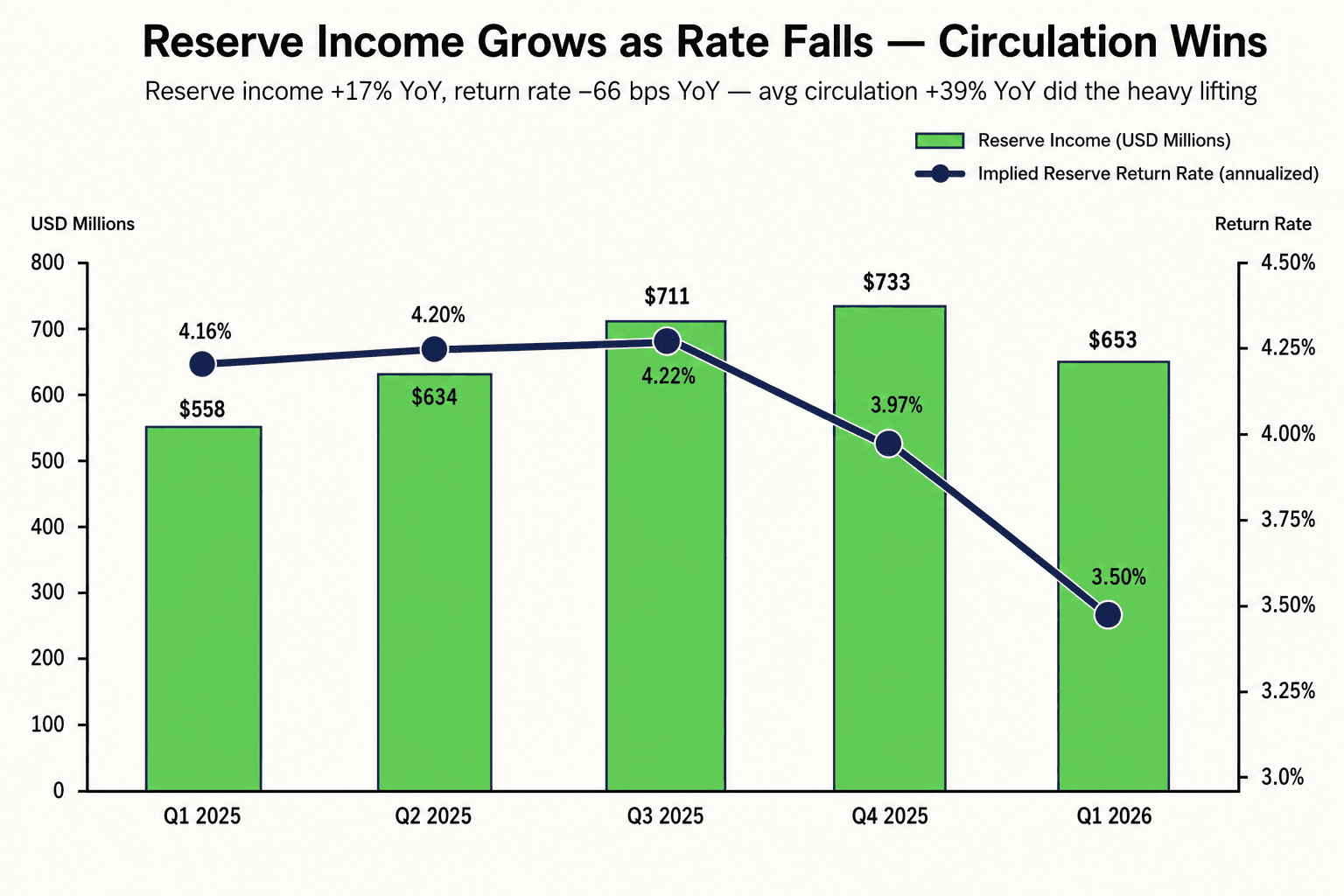
Quick arithmetic: $75.2B average circulation × 3.5% return rate = ~$2.63B annualized reserve income. If the Fed cuts another 100 bps in 2026, that line drops by ~$750M annually — meaningful. But if average circulation grows 30% on top of that, reserve income still rises in absolute dollars. Allaire's framing on the call — "trillions in digital dollars" as the long-term destination — is the bull case in one phrase. Until the circulation curve breaks, the rate curve doesn't matter that much.
The ARC Token: A Whole New Revenue Line, Not Yet in Guidance
The eyebrow-raiser on the print wasn't Q1's numbers. It was the side announcement: Circle closed a $222M ARC Token presale at a $3B fully diluted valuation. Lead investor a16z crypto. Other names: Apollo Funds, Ark Invest, BlackRock, Bullish, General Catalyst, Haun Ventures, Intercontinental Exchange, IDG Capital, Janus Henderson, Marshall Wace, SBI Group, Standard Chartered Ventures.
The mechanics, per Fox-Geen on the call: Circle retains 25% of total ARC supply, carried at $0 cost basis. 60% is earmarked for ecosystem grants, airdrops, and incentives. As Circle meets delivery obligations against the presale and incentive programs, the value of the tokens released gets recognized as "other revenue" — the same high-margin line that already grew 100% YoY on this print. Incentive grants get an offsetting "other cost," so the net P&L impact depends on the spread between booked token value and grant value at recognition.
Three things to keep in mind:
- None of this is in FY26 guidance. Circle explicitly excluded ARC presale, incentive programs, and post-launch revenue streams from the unchanged $570–585M Adjusted Operating Expenses and 38–40% RLDC Margin guide. The model gets a new line item on the Q2 print or the Q3 print, depending on Arc mainnet timing.
- Arc mainnet is "imminent." Allaire said testnet was successful and mainnet launch is "coming soon" with post-quantum security at day one. No date was given.
- The token economics are the test, not the float. A $3B FDV plus a 25% Circle holding equals $750M of token value — if Circle eventually monetizes through validator economics, ecosystem allocations, and direct sales, that's a year of operating income at current run-rates.
CPN Quietly Doubled
A second underappreciated number from the call. The Circle Payments Network ended Q1 at $8.3B annualized payment volume on a trailing-30-day basis — up 17% QoQ. Allaire then volunteered that as of May 7 (five weeks after quarter-end), the run-rate had moved to roughly $10B annualized — +75% from the last reported figure. Driving the move: April's launch of CPN Managed Payments, which lets banks plug into stablecoin payments without managing licensing, liquidity, custody, or compliance themselves. 136 financial institutions enrolled, +36% QoQ.
CPN is the analog to Visa or Mastercard for stablecoin settlement — and like those networks, the economics are mostly take-rate on transaction volume, not float yield. If CPN keeps doubling, it becomes a material non-reserve revenue line within four to six quarters.
The Bottom Line
Strip out the IPO noise, the post-IPO stock-based-comp opex bulge, and the Fed-cut headwind, and Q1 2026 is one of the cleanest structural prints Circle has delivered. USDC is no longer the second-largest stablecoin trying to win share — it's the majority-utility stablecoin that owns the onchain dollar transaction layer. The on-platform mix has tripled in 12 months. RLDC margin is making new highs. The ARC token gives Circle a second revenue engine starting next quarter or the one after. And the CPN ramp adds a third leg.
The bear case — Compass Point's sell rating, Morgan Stanley's $80 PT — leans on two real risks: regulatory friction as CPN scales, and the cliff in reserve income if circulation growth ever stalls during a Fed-cut cycle. Both are valid. But Q1's data went the other way on both. Circulation kept growing (slower, but still growing). RLDC margin kept expanding (despite the rate cliff doing exactly what bears feared).
You don't get many quarters where the structural mix shift is this big and the headline number is this distracting. May 11 was one of them.
What to Watch Going Into Q2 2026
- Coinbase share trajectory. If Coinbase keeps gaining share of USDC circulation, the RLDC margin walk gets harder. Watch for any disclosure of platform-mix dynamics on the Q2 call.
- Reserve return rate. A floor of 3.0%–3.2% is plausible if the Fed cuts another 50 bps. Below 3.0% is where reserve income could go negative QoQ even with healthy circulation growth.
- ARC mainnet date + token recognition. First quarter of "other revenue" with an ARC contribution will reset Street numbers materially.
- CPN run-rate. The $8.3B → $10B walk in five weeks is the trajectory to track. By Q3, $15B+ annualized would validate the Visa/Mastercard analog framing.
- EURC. Doubled YoY to EUR 358M. Still small but the European banking distribution wedge is what makes EURC matter.
Circle's first "normal" quarter as a public company suggested the boring print, exciting structural shifts pattern is just getting started.