Broadcom's AI Chip Revenue Grew 143% to $10.8B and Guided Q3 to $16B — and the Stock Still Slipped
A record on every line — and a 3% dip
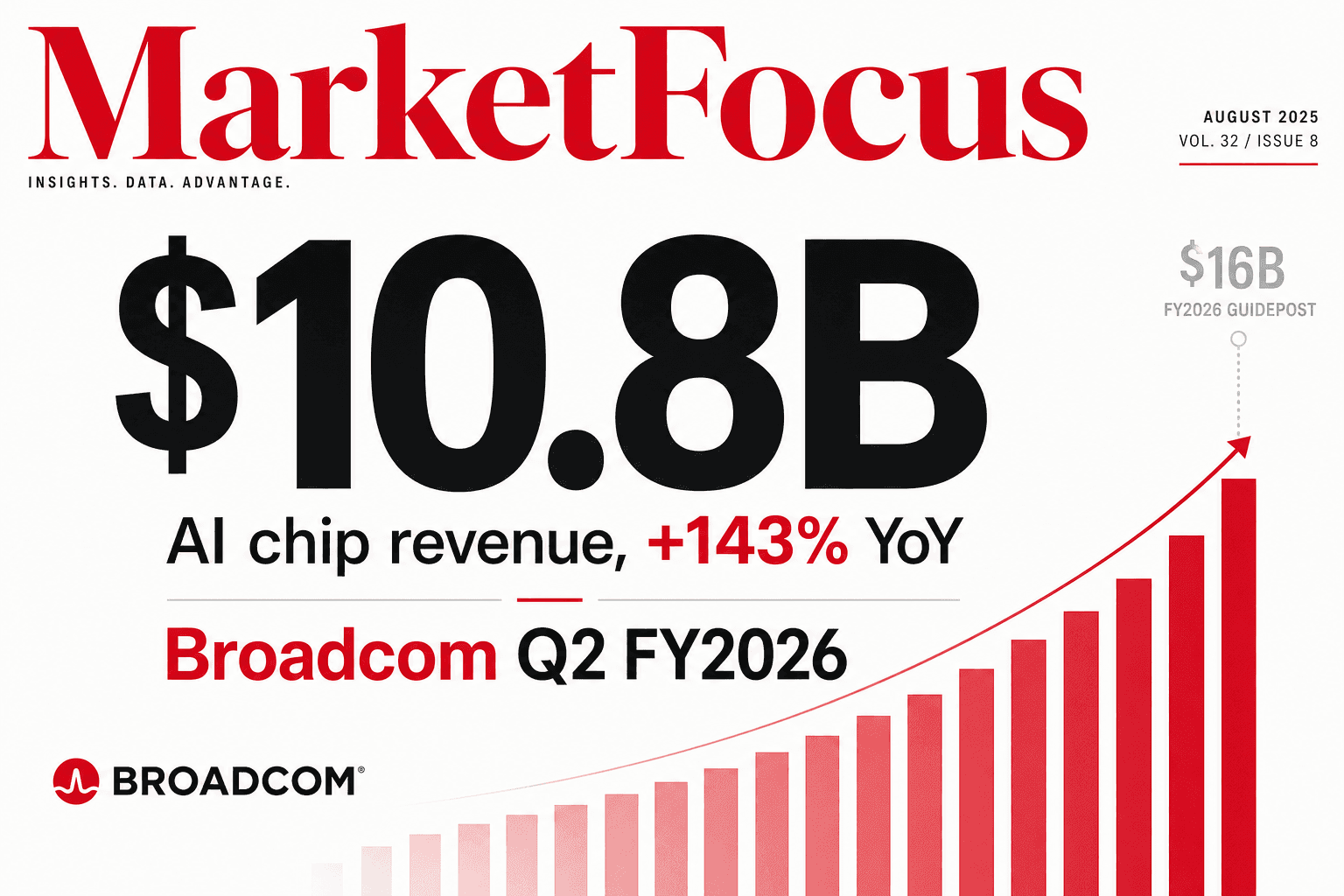
Broadcom's Q2 FY26 was, by the numbers, one of the cleanest blowouts in the AI-silicon complex. Revenue of $22.2B, +48% YoY — a record. AI semiconductor revenue of $10.8B, +143% YoY — above the company's own forecast. Adjusted EBITDA of $15.2B at a 69% margin. Free cash flow of $10.3B at a 46% margin. Non-GAAP EPS of $2.44 beat the ~$2.32 the Street wanted. And the Q3 guide was extraordinary: $29.4B in revenue (+84% YoY), with AI semiconductor revenue guided to $16.0B (+200% YoY).
The stock dipped about 3% after hours.
The reason isn't in the print — it's in the expectations. Broadcom is valued on AI optionality, and the market had pre-loaded a "raise the target" trade. CEO Hock Tan reaffirmed the FY27 AI revenue target of "in excess of $100 billion." Reaffirmed — not raised. For a stock priced on the slope of the AI curve, holding the number steady reads as a soft ceiling. Add infrastructure software coming in a touch below the higher whisper, and a record quarter that merely met an elevated bar got sold.
The engine: AI semiconductor revenue
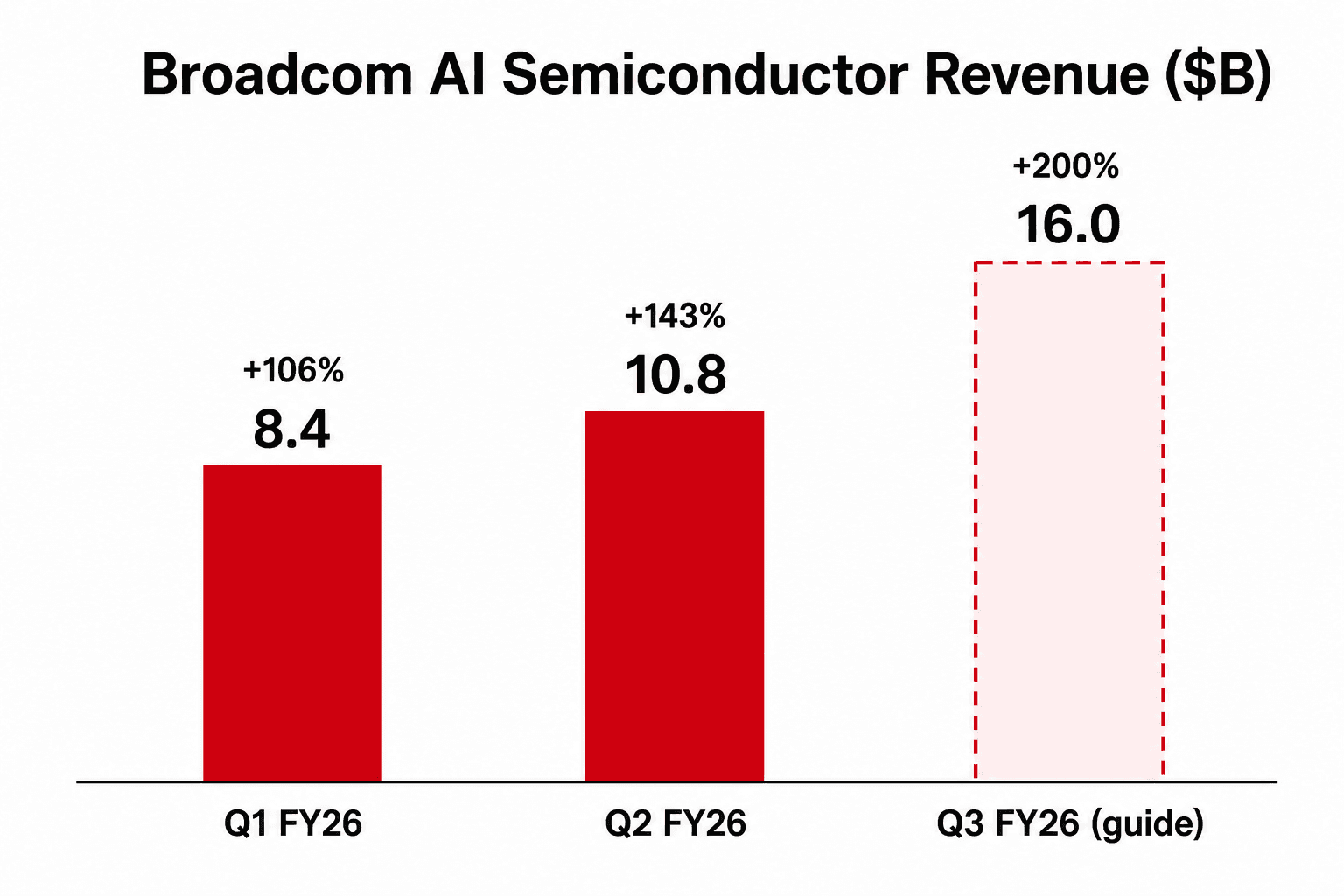
This is the only chart that matters. AI semiconductor revenue of $10.8B is now roughly 49% of total company revenue and about 72% of semiconductor revenue. It grew 143% YoY, above Broadcom's own forecast, driven by two engines: custom AI accelerators (XPUs) built for hyperscaler customers, and AI networking (Broadcom's Ethernet switching silicon that stitches accelerator clusters together).
Then look at the third bar. Q3 is guided to $16.0B in AI revenue, +200% YoY — a sequential jump of roughly $5.2B in a single quarter. That is not a company decelerating. The acceleration in the guide is steeper than the acceleration in the print. In any other context this is the headline of the year — which is exactly why the muted stock reaction is a story about positioning, not fundamentals.
The mix shift is structural
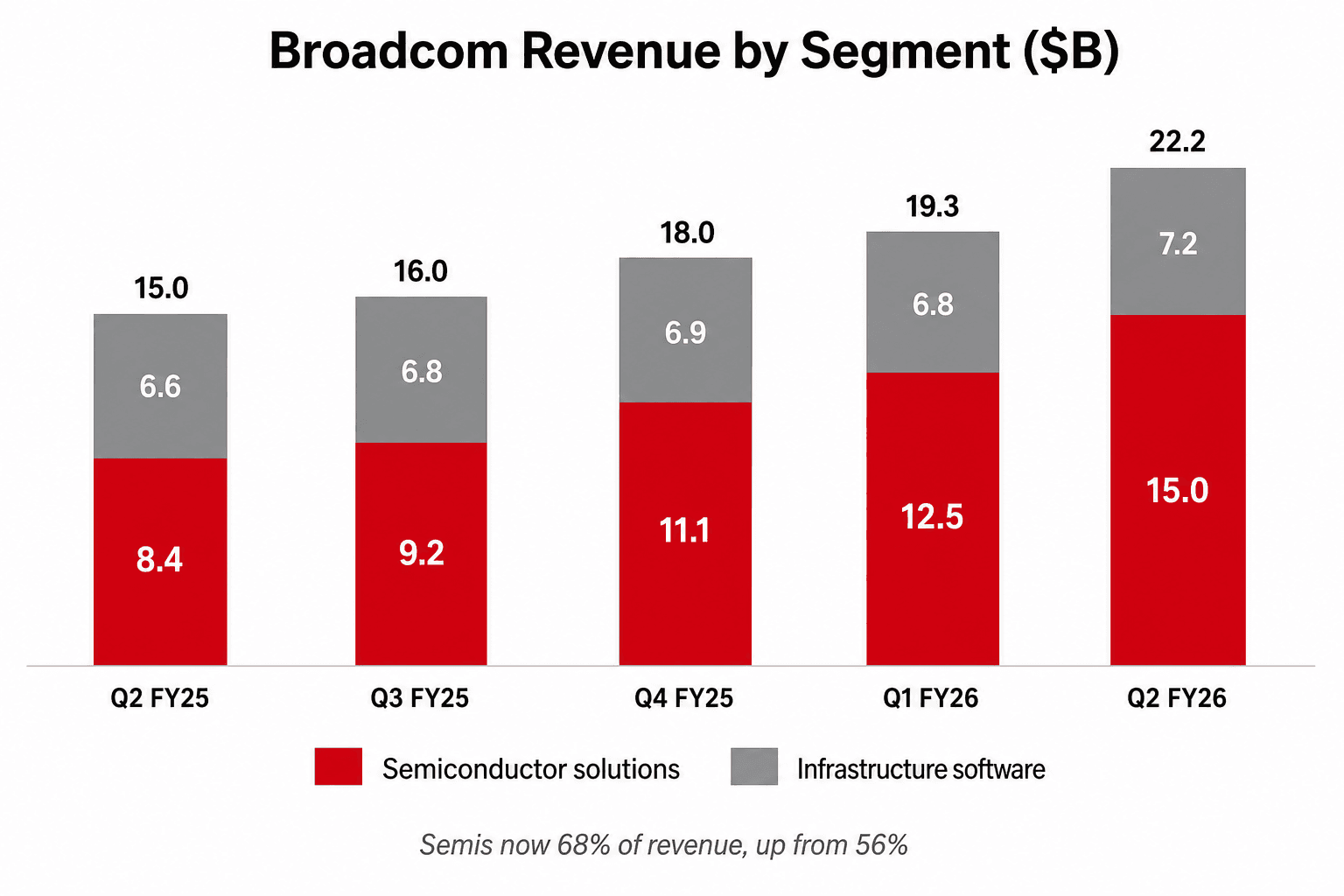
Broadcom is re-mixing in real time. Four quarters ago, semiconductors were 56% of revenue and software was 44%. In Q2 FY26, semiconductors are 68% and software is 32%. Semiconductor solutions revenue of $15.0B grew 79% YoY; infrastructure software (the VMware-led recurring base) grew a steady 8.8% YoY to $7.18B.
Here's the tension in that picture. The semiconductor side is doing exactly what bulls want — compounding at a triple-digit AI pace. But the software side, the part that was supposed to be the stable, high-margin annuity after the VMware acquisition, grew single digits and came in slightly soft versus the whisper. With the AI number already known to be huge, the marginal disappointment landed on the one line that wasn't a blowout. That's how a +48% quarter generates a red after-hours tape.
The cash machine
The part that's easy to under-appreciate is the conversion. Broadcom generated $10.3B of free cash flow at a 46% margin on just $231M of capex — capex is roughly 1% of revenue. This is the fabless model at full tilt: the heavy manufacturing sits at foundry partners, so almost every incremental AI dollar flows toward cash rather than into plant and equipment.
That cash funds a $0.65/share dividend, ongoing buybacks ($0.6B in Q2), and continued debt paydown (net debt is declining even as the business scales). One forward-looking tell on the balance sheet: inventory climbed to $4.33B, up ~91% since fiscal year-end. That's not a glut — it's Broadcom pre-positioning supply for the guided Q3 surge. Management is putting working capital behind the $16B AI number.
What Hock Tan actually said
The call was a study in confident understatement. Tan: "Q2 semiconductor revenue from AI of $10.8 billion grew 143% year-over-year, above our forecast... The momentum continues and in Q3 we expect semiconductor revenue from AI to grow over 200 percent year-over-year to $16.0 billion." CFO Kirsten Spears framed the leverage: "In Q3 we expect consolidated revenue growth to increase 84% year-over-year to $29.4 billion, with non-GAAP operating margin stable at 67%."
The Q&A circled one question repeatedly: why not raise the $100B FY27 target? With Q3 AI already guided to $16B — implying an annualized run-rate near $64B exiting FY26 — analysts wanted the FY27 number moved up. Tan held it. The bull interpretation: he's leaving himself room to beat and raise later. The bear interpretation: $100B is the number, and the buy-side had penciled in more.
What the bulls and bears fight about
Bull case: AI revenue is accelerating, not peaking — Q3's $16B guide is a $5.2B sequential step-up at +200% YoY. The FY27 target of >$100B is reaffirmed and HSBC already models $100.2B (26% above Street). Economics are best-in-class: 69% EBITDA margin, 46% FCF margin, ~1% capex intensity. AI is now half the company and re-mixing toward high-margin silicon every quarter.
Bear case: the stock fell because the target wasn't raised — when a name is priced on AI optionality, "reaffirm" is a disappointment. Software's +9% YoY shows the non-AI engine maturing. Customer concentration in a few hyperscaler XPU programs means the $16B Q3 guide has little margin for slippage, and the inventory build raises the stakes on the ramp landing on schedule.
Forward look — what Q3 turns on
Three things to watch into the early-September Q3 print: (1) does the $16B AI guide land? — a clean hit (or beat) re-rates the FY27 target debate in the bulls' favor; (2) the FY27 number — whether Tan finally raises above $100B once Q3 is in the bag; (3) software stabilization — whether infrastructure software re-accelerates or settles into a high-single-digit annuity.
All financial figures sourced from Broadcom's Q2 FY2026 earnings release (filed with the SEC on 2026-06-03) and prior quarterly releases. Analyst price-target moves and the market reaction sourced from CNBC, Benzinga, TheStreet, and StockAnalysis coverage.