Broadcom Q3 FY26: AI is now most of what it sells
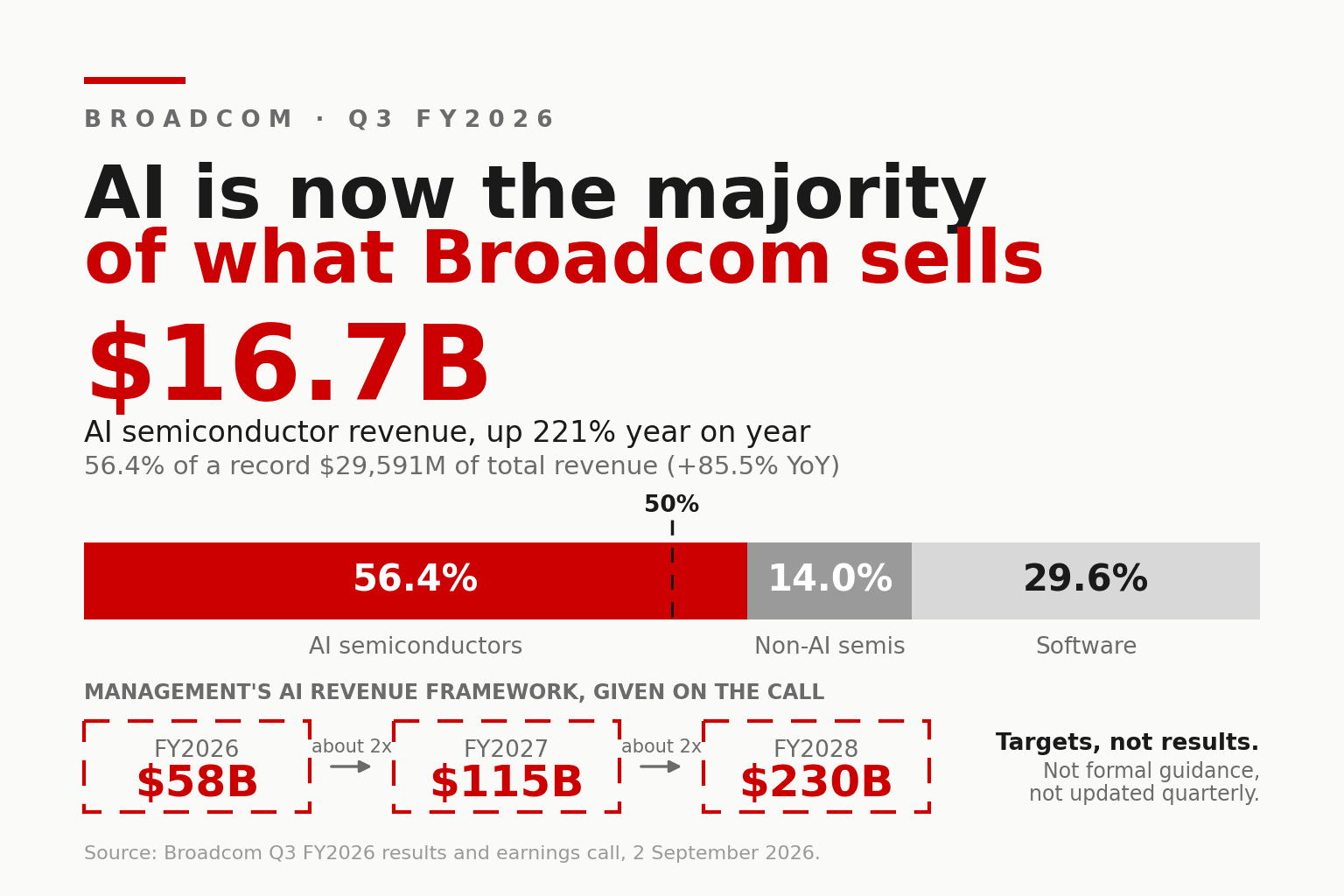
Broadcom crossed a line on Wednesday evening that it is unlikely to cross back. For the first time, more than half of everything the company sold in a quarter was AI silicon.
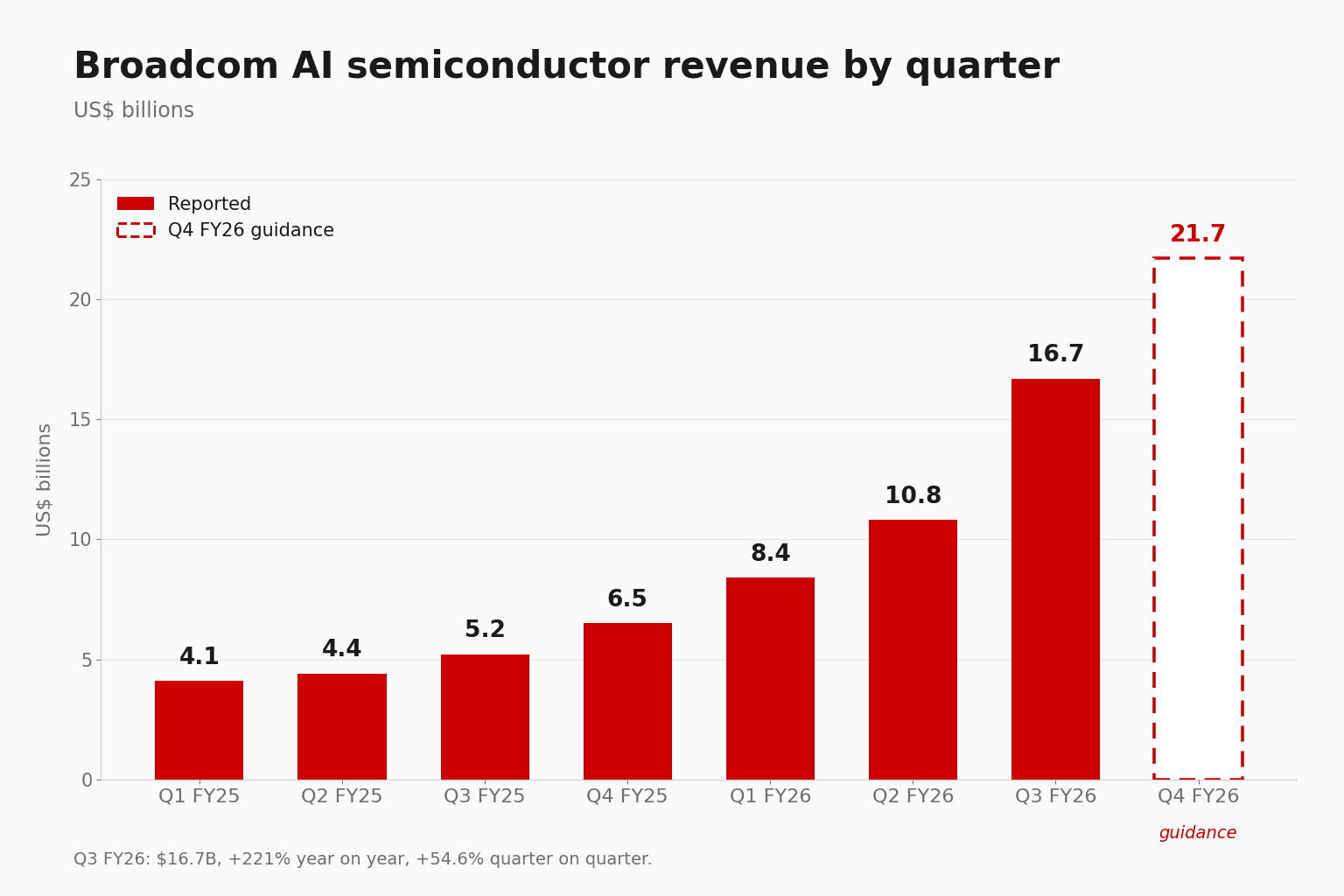
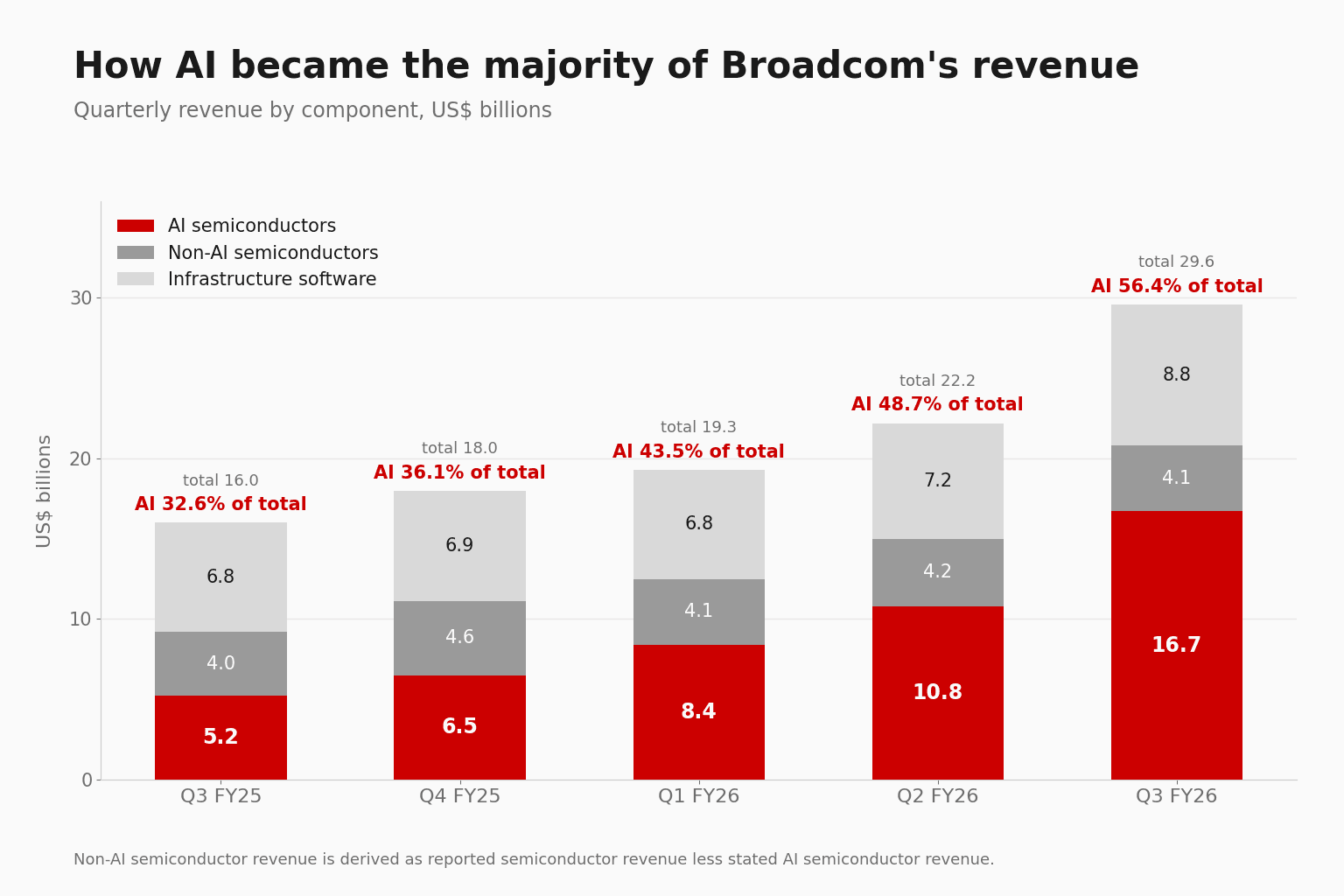
AI semiconductor revenue was $16.7 billion, up 221% on the year and 54.6% in three months, against total revenue of $29,591 million. That puts AI at 56.4% of the company. It has stopped being a growth line inside Broadcom's business and become the business.
The market's first instinct was to sell it: within two minutes the stock was down about 6%. Then management started talking, and by the end of the evening most of that was gone. By the close of the next session it was back, and Broadcom finished 2.74% lower — in a semiconductor sector that closed slightly up.
The quarter itself
Revenue rose 85.5% year over year and 33.4% sequentially, a record, and roughly $191 million above the approximately $29.4 billion Broadcom guided in June.
Semiconductor Solutions did $20,839 million, up 127.4%, and is now 70.4% of the company. Infrastructure software, mostly VMware, did $8,752 million, up 29.0% on the year and 21.9% on the quarter, its strongest showing since the acquisition closed. Management put recurring revenue growth at 15% and credited VMware Cloud Foundation renewals plus a new Private AI Cloud product. Q4 is guided back down to about $8.7 billion, so some of that spike looks like renewal timing rather than a new run rate.
Non-GAAP diluted earnings were $3.32 a share, up 96.4%. (Non-GAAP strips out share-based pay and acquisition accounting; it is the figure management guides to and the Street models. On the stricter GAAP basis it was $2.68.) Free cash flow, cash from operations after capital spending, was a record $13,665 million, or 46.2% of revenue.
Note what did not do the work: Broadcom repurchased no stock and the diluted share count is flat on the year, so none of the per-share growth is buyback arithmetic.
Revenue grew 86%. Costs grew 2.5%.
The operating leverage is the underreported part. Revenue grew 85.5% while non-GAAP operating expense grew 2.5%, and GAAP research and development spending actually fell 5.1%. Operating expense is down to 7.1% of revenue from 12.8% a year ago.
That is why non-GAAP operating income of $20,095 million grew faster than revenue, at 92.2%, and why the operating margin of 67.9% is a company record, above the roughly 67% guided. Broadcom is adding revenue that costs it almost nothing extra to run.
Inside the $16.7 billion
Management gave the split on the call. Custom accelerators, which Broadcom calls XPUs, were 73% of AI revenue, implying roughly $12.2 billion, with AI networking the remaining 27%, about $4.5 billion. An XPU is a chip co-designed to one customer's specification rather than a catalogue part sold to everyone. XPU shipments were up more than three and a half times on the year, networking more than two and a half.
Six XPU customers, four of them named. Google took Ironwood (TPU v7) in high volume and began taking TPU v8i in production, under a new long-term agreement CEO Hock Tan sized at "multi tens of billions of dollars of TPUs annually over the next several years." Anthropic has 1 GW deploying this year, another 5 GW in 2027 and "clear line of sight" to an incremental 10 GW in 2028, which would make it the largest XPU customer next year. OpenAI's first in-house accelerator, Jalapeño, is shipping now, with 1.3 GW planned for 2027. Meta starts production shipments of its MTIA chip in Q4.
Everything else is standing still. The non-AI business, meaning broadband, server storage, wireless and industrial, works out at roughly $4.1 billion, a figure derived by subtraction because Broadcom does not report it. It has sat in a $4.0 to $4.6 billion band for nine quarters while the company doubled.
What the mix costs
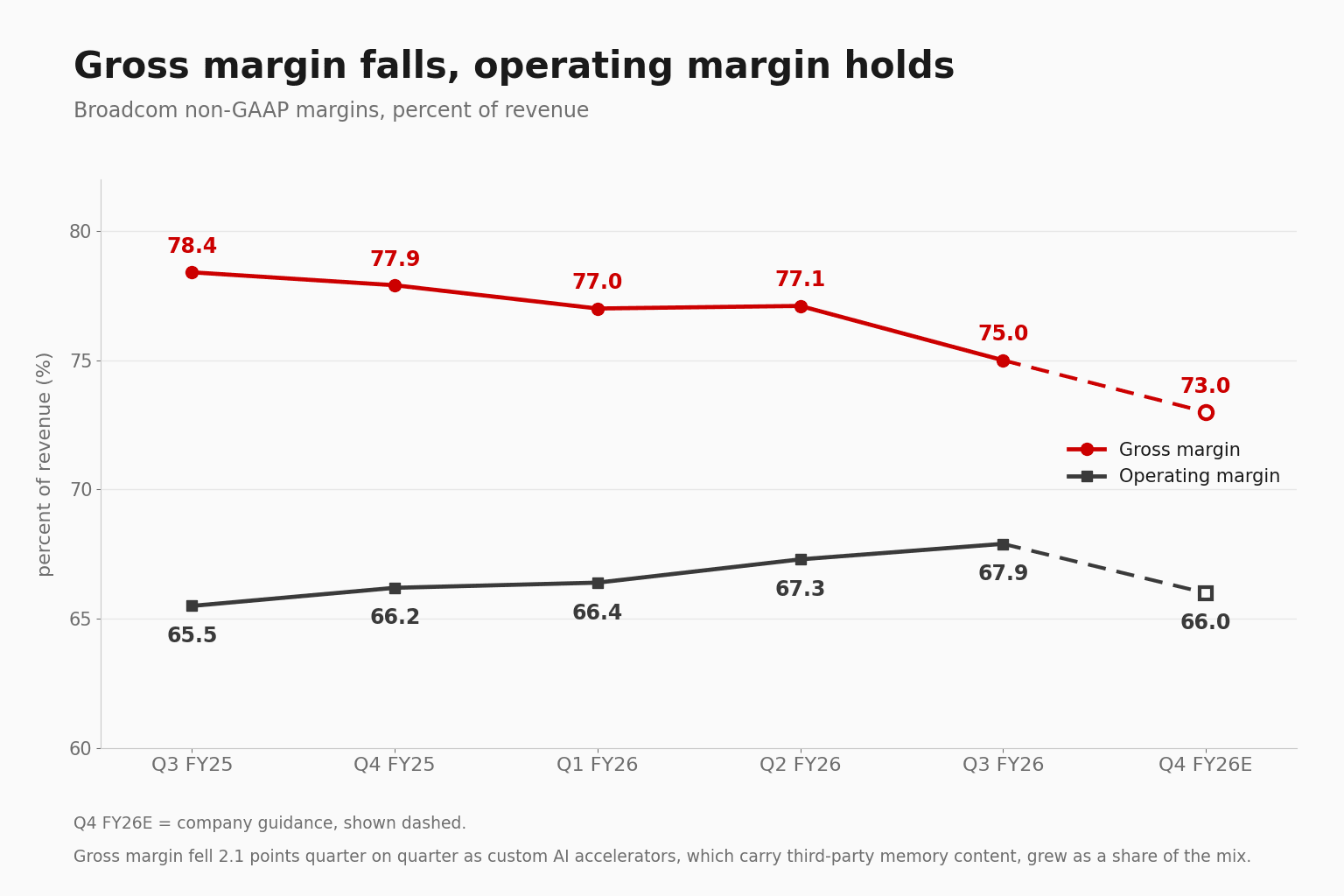
Non-GAAP gross margin fell to 75.0%, down 211 basis points sequentially and 335 on the year, although still above the roughly 74% guided. Q4 is guided to about 73%, against 78% a year earlier.
The mechanism is simple. Custom accelerators carry large amounts of third-party memory that passes through Broadcom's cost of revenue; networking silicon does not. XPUs were 73% of AI revenue and AI 56% of the company, so the dilution shows up at once.
Asked by Bank of America what that does to margins in 2027 and 2028, CFO Amie Thuener declined to guide beyond one quarter, and Tan cut in with the line management wanted to land: "stop focusing on gross margin is what we're saying. Look at where it matters: operating margin at the end of the day, because the growth in revenue far out surpasses the growth in opex."
Thuener is in her first quarter in the job, succeeding Kirsten Spears. She attributed the Q4 guide to "the increasing mix of XPUs with their increasing memory content" while holding operating margin flat at about 66%.
One disclosure quietly disappeared: Broadcom stopped reporting adjusted EBITDA with this release, having carried the metric and a forward guide for it every quarter back through fiscal 2023.
The numbers that turned the evening around
Q4 revenue is guided to about $34.8 billion, up 93%, with AI semiconductors at about $21.7 billion, up 236%. Against roughly $35.0 billion of consensus that is a small shortfall, and it is what the tape sold on.
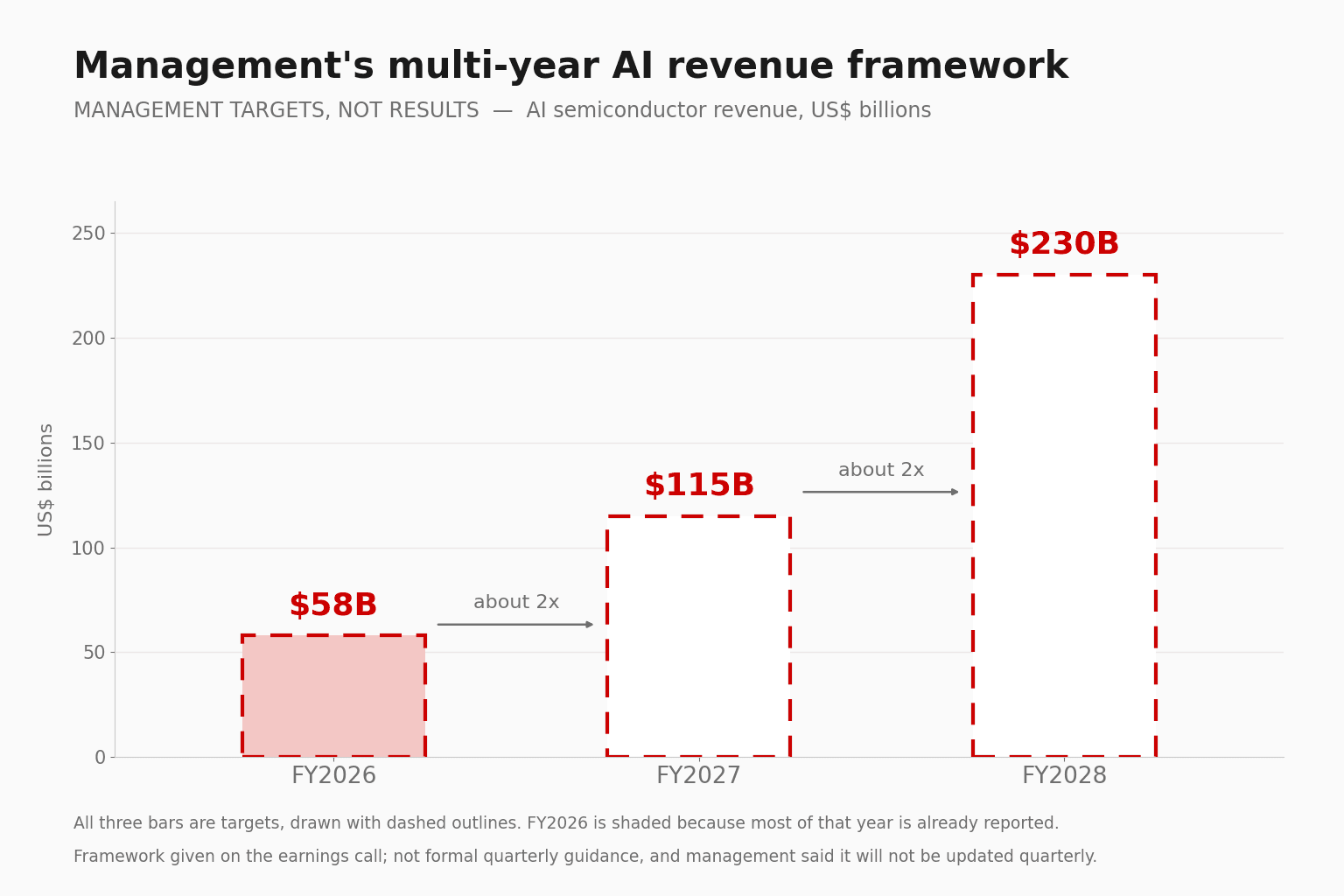
Then came the framework. In June, management had reaffirmed but not raised a fiscal 2027 AI target of "in excess of $100 billion", and the stock lost 12.6% the following session. This time Tan put a number on it: approximately $115 billion in fiscal 2027, with supply "secured" and demand that "actually exceeds this outlook." He added fiscal 2028 at approximately $230 billion, then an earnings anchor: "we are very much on target to exceed $30 in earnings per share in fiscal 2028." Fiscal 2026 AI revenue went to about $58 billion from $56 billion.
The framing is unusual: Broadcom is describing a supply number, not a demand number, and said it will not update the figures quarterly. Pressed by Bernstein on the gigawatt arithmetic, Tan confirmed roughly 30 GW of named deployments across 2027 and 2028 but declined to assume all of it converts inside those two years, restating it as "$350 billion of AI semiconductors to these customers in the next two years."
What the market actually did
The evening looked like a save. The morning disagreed.
The release hit at 16:15 ET on 2 September. By 16:17 the stock was down about 6% on the Q4 guide. By the opening hour of the evening session it was down 0.3%, under the headline "Broadcom reverses decline on AI revenue view", and the last after-hours print at 19:59 ET was $364.23, down 0.82%.
That turned out to be a bad guide to the following morning. Broadcom opened on 3 September at $351.74, down 4.2%, and kept falling to $342.33, down 6.8% — roughly 86% of the 7.8% move options had priced in beforehand. The after-hours quote had understated the eventual gap by about five times, which is a useful reminder of how little a thin evening session tells you.
Then it climbed back. Broadcom closed at $357.16, down 2.74%, on volume about 1.55 times the previous day's, finishing 4.3% above the low and at 87% of the day's range. The settled loss was less than half the worst of the drawdown. This was a rejected gap-down rather than a rout.
The more telling number is the comparison. On the same session Nvidia rose 1.80%, Marvell 1.14%, TSMC 0.36%, AMD slipped 0.20%, and the iShares Semiconductor ETF closed up 0.15%. Broadcom underperformed its own sector by nearly three percentage points. Every one of those peers also gapped down at the open and dipped intraday before recovering, so the complex did test the read-across and then rejected it. The market priced this as a Broadcom problem, not an AI problem.
Barron's put the drag on "concerns about data-center financing and Google's deal with rival chip maker Marvell" overshadowing solid results. Note the irony in the second half of that: the sell side spent the day publishing notes that preferred Broadcom to Marvell, and Marvell outperformed it anyway.
Position explains why the damage stopped where it did. Broadcom went into the print up about 6.5% year to date against roughly 65% for the semiconductor ETF, some 26% below its 52-week high of $495.00, on a forward price-to-earnings ratio of about 21. That is not a stock priced for perfection, which is why a $200 million shortfall on a $35 billion guide cost it 2.7% rather than the near-10% it has averaged on recent prints.
The analysts could not agree either
Fourteen sell-side notes landed on 3 September, and they went in both directions on the same set of facts: six price-target raises, five cuts, two reiterations, one upgrade, no downgrades.
At the top, Cantor Fitzgerald went to $600 from $525 and BMO to $575 from $455. Macquarie was the only rating change, upgrading to Outperform on the view that the Google-insourcing risk is now priced in. Goldman raised to $540, arguing the binding constraint on fiscal 2027 is customers finding land, power and buildings rather than anything Broadcom controls.
At the bottom, Bank of America cut to $460 from $530, the largest reduction, while raising its estimates — a vote on the multiple, not the business. D.A. Davidson stayed at Hold and cut to $350, a target that sat below where the stock closed.
So the range of published fair values on this quarter runs from $350 to $600, a span of about 71%, and the consensus target rose to $532.26 even as the stock fell. When a print leaves the professionals that far apart, the disagreement is not really about the quarter. It is about whether anyone knows how to underwrite $230 billion of revenue two years out.
What the print did not settle
Concentration, first. Six customers, no new name. Analyst Patrick Moorhead called the quarter "strong, but not flawless", unresolved on concentration, Google multi-sourcing and the bridge to fiscal 2027. Broadcom disclosed no backlog figure either; forward visibility rests on secured supply and line of sight.
Financing, second. Two of the six are funded through a vehicle Broadcom set up in June with Apollo and Blackstone, targeting more than 20 GW for OpenAI and Anthropic by the end of 2028, with a first $35 billion tranche closed. Asked about the maximum off-balance-sheet exposure on the backstops attached to it, Thuener said there was nothing to announce. That is the largest unquantified number in the story.
Capital intensity, third. Capex was $532 million, more than double the prior quarter, and is guided to about $1.4 billion in Q4 for substrate capacity in Singapore and laser fabs Broadcom is more than tripling. The asset-light story is being traded for supply security.
Whether the framework is conservative, last. Mizuho held Buy and $530 while modelling fiscal 2027 AI revenue at $129 billion and fiscal 2028 at $235 billion — above Broadcom's own numbers. Management describes the targets as secured supply against demand that exceeds them, which is an unusual way to set expectations and leaves genuine room for argument in either direction.
Broadcom told the market two things at once: the gross margin is going down, and the revenue is going to double twice. Both are probably true. The stock trades on which one investors weight more heavily, and on the first full session they had to decide, they marked it down 2.74% while leaving the average price target higher than it was. That is not a verdict. It is a company whose next two years the market has not worked out how to value.