AWS reaccelerates to 37% in Amazon's first $200B quarter
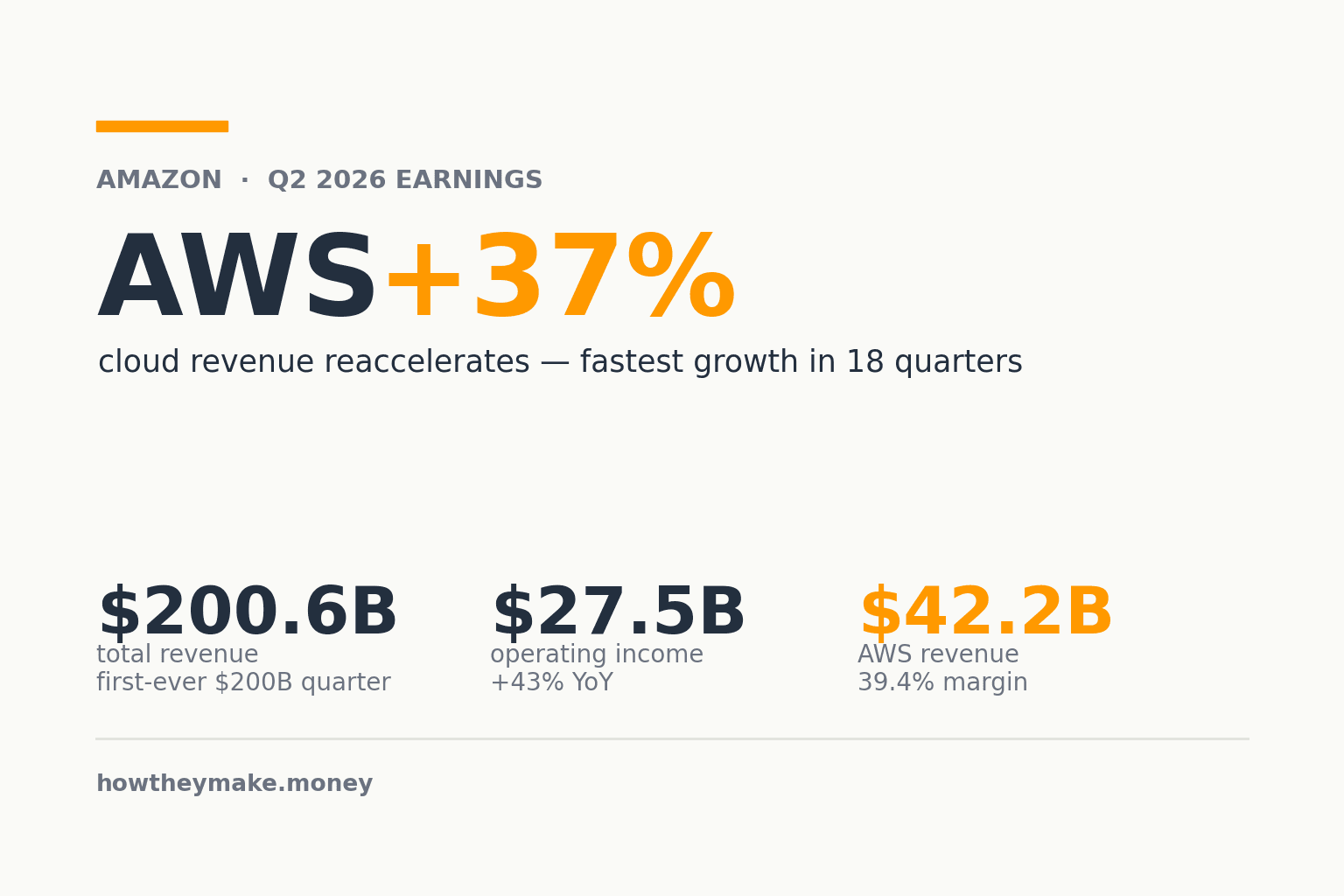
For two years the knock on Amazon was that its cloud business had lost a step to Microsoft and Google just as the AI cycle got interesting. Q2 2026 retired that argument. AWS grew 36.8% year over year to $42.2 billion, its fastest expansion in 18 quarters, and carried total company revenue past $200 billion for the first time in any quarter that isn't the December holiday period. The stock jumped roughly 9% after hours.
The headline figure is $200.6 billion in net sales, up 19.6% year over year. But the number that moved the stock sits inside it. AWS is now growing faster than it has since 2021, and it is doing so while getting more profitable, not less. That combination is what the market had been waiting to see from a hyperscaler pouring tens of billions into AI data centers.
The reacceleration is the whole story
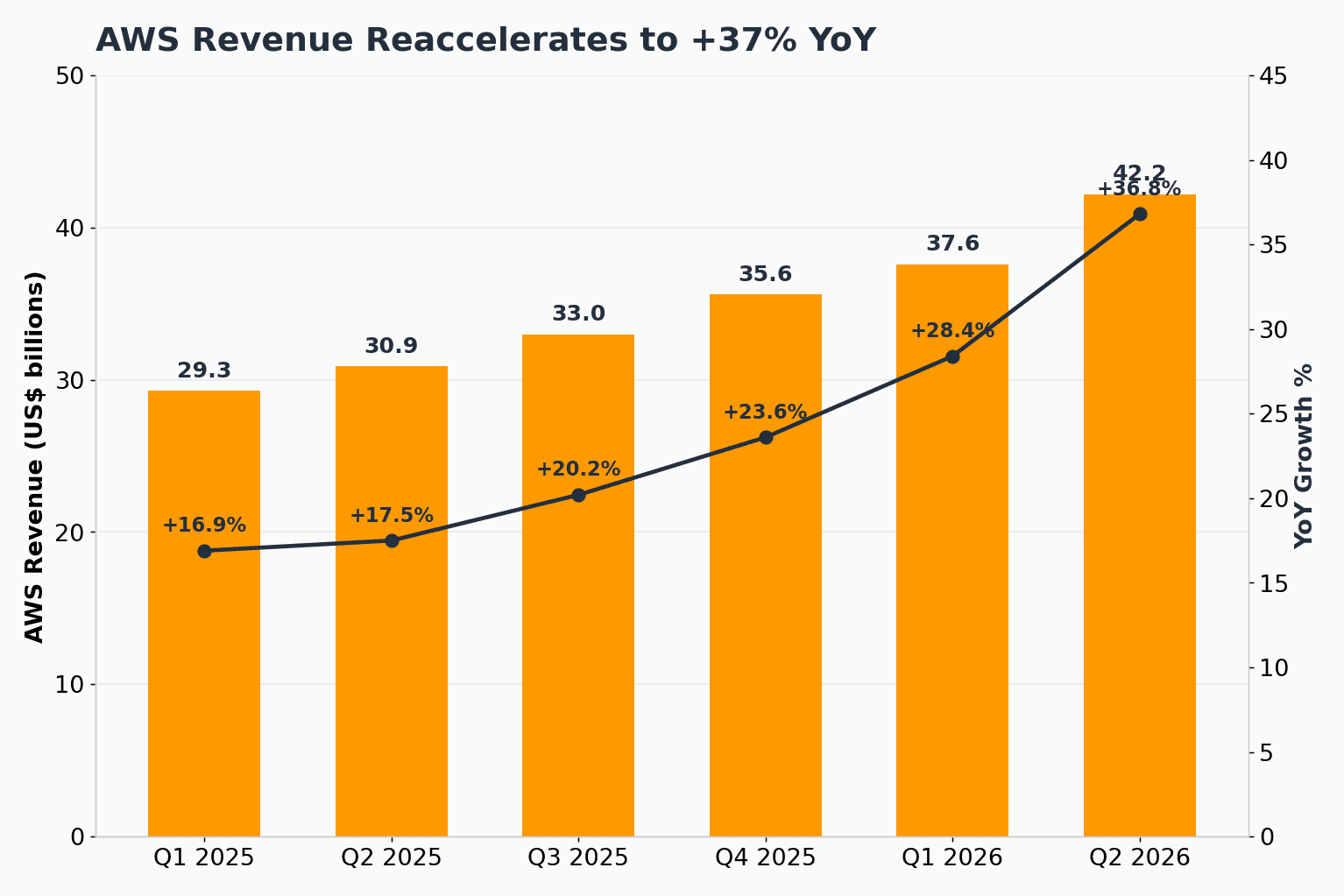
AWS growth has now accelerated for five consecutive quarters: roughly 17%, 17%, 20%, 24%, 28% and 37%. That is not a bounce off an easy comparison. It is a steady re-rating of demand, and CEO Andy Jassy framed it plainly on the call: "AWS is booming." At $42.2 billion a quarter, the business is running at about a $169 billion annualized rate, which Jassy noted would rank 24th on the Fortune 500 as a standalone company.
Underneath the top line, the backlog tells the forward story. Remaining performance obligations reached roughly $496 billion, up triple digits year over year and about 2.5 times the level of a year earlier. Amazon also disclosed that its AI business and its custom-chip business (Graviton, Trainium and Nitro) each cleared a $25 billion annualized run rate, both growing triple digits. The constraint now is physical: management said it will not have enough capacity to meet demand in 2026, and probably 2027, even after raising spend. Amazon is on pace to double its power capacity by the end of 2027 versus 2025, with most of that 2027 capacity already reserved.
AWS is the profit engine
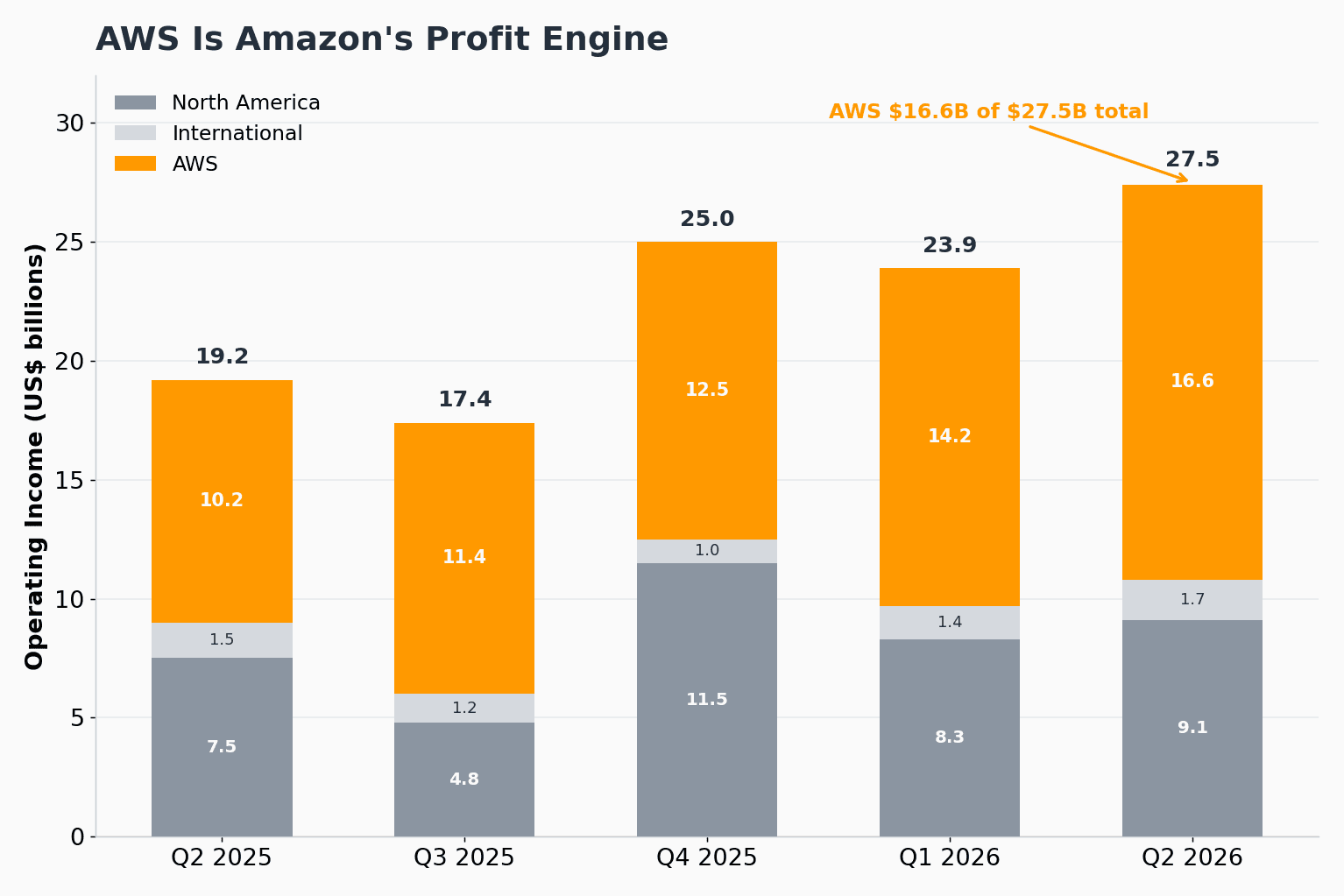
Consolidated operating income was $27.5 billion, up 43% year over year and a company record. AWS produced $16.6 billion of that, up 64%, which means the cloud unit generated roughly 60% of Amazon's profit on about 21% of its revenue. The two retail segments are healthier than they were, but they operate on much thinner margins. North America earned $9.1 billion at a 7.9% margin, and International earned $1.7 billion at 4.1%, the latter a meaningful recovery from the thin-to-negative margins the segment ran two years ago.
The math is stark: a single AWS dollar of revenue drops far more to operating income than a retail dollar does. That is why the AWS growth rate, not the consolidated top line, is the number that determines where the stock trades.
Advertising keeps compounding
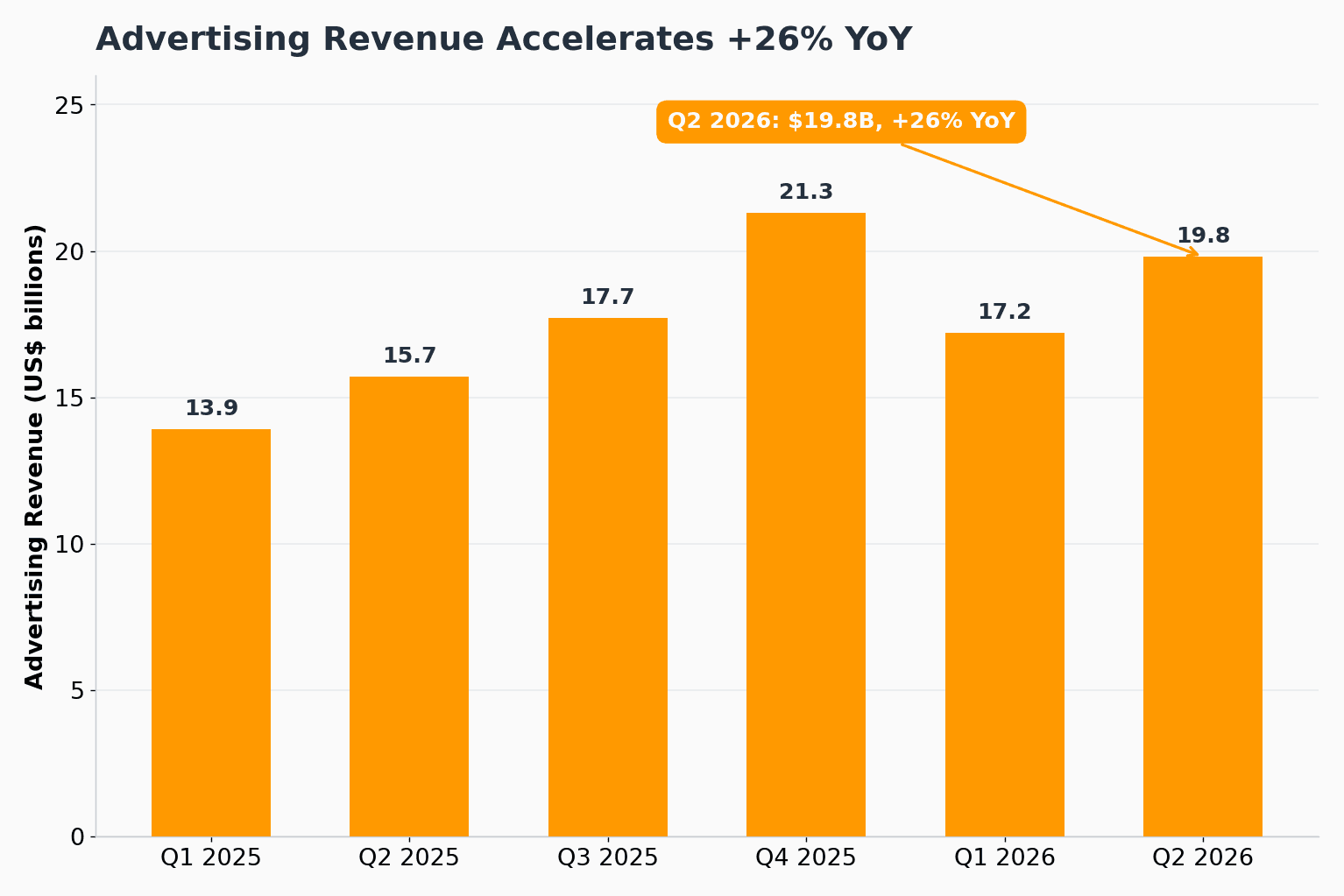
The quieter standout is advertising, which grew 26% to $19.8 billion, an acceleration from about 23% a year ago and the fastest print in the series. On a trailing basis the ad business now clears $70 billion, a scale that would be a large standalone company. Management credited Prime Video ads, live sports including the NBA on Prime Video, and AI ad tooling that it says lowers advertisers' cost per impression by about 8% and cost per acquisition by about 6%. Advertising matters to the profit story because it carries retail-adjacent margins that are far richer than selling physical goods, so its growth quietly lifts North America's economics.
Rising spend, wider cloud margins
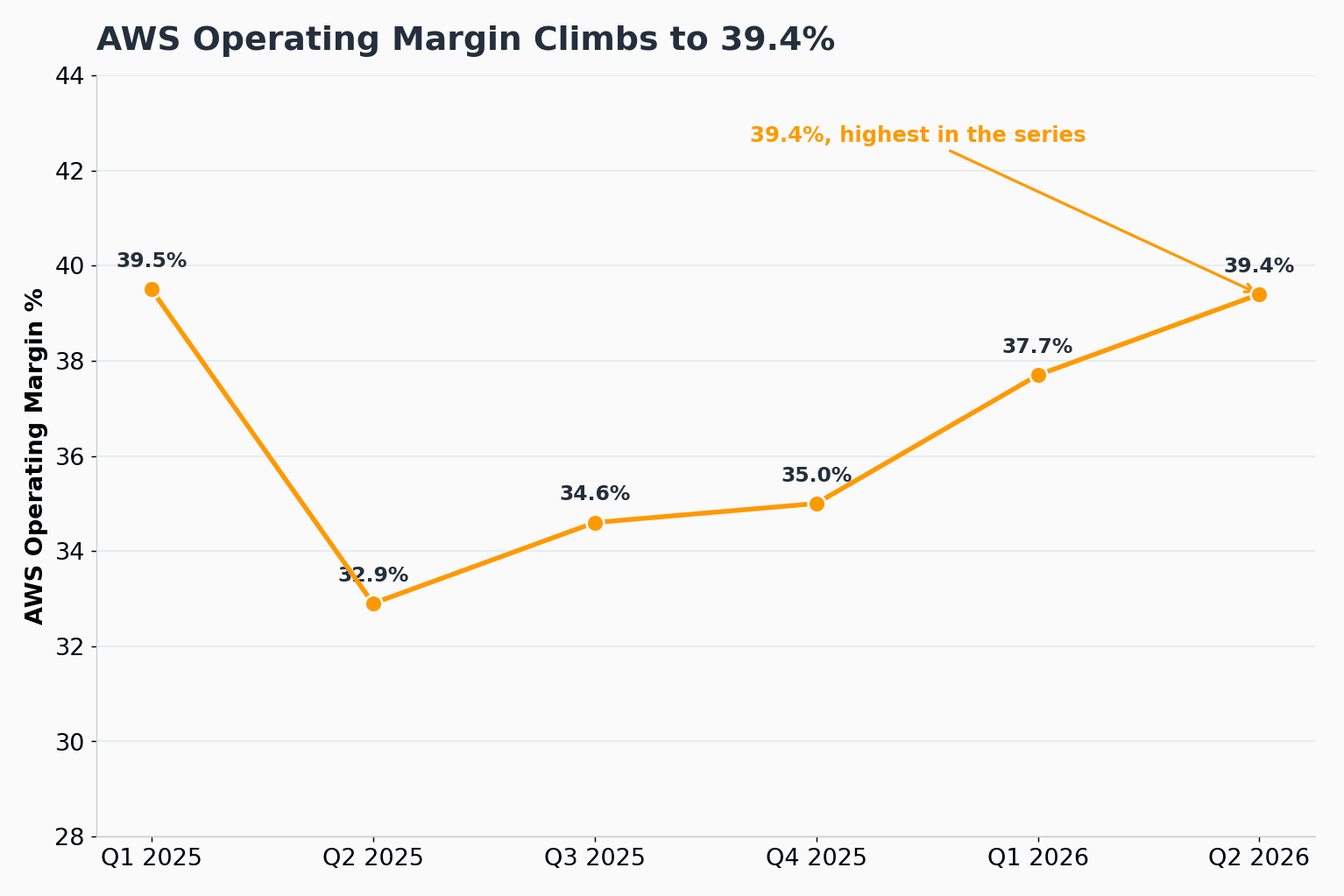
The counterintuitive part is that AWS got more profitable while capital spending soared. AWS operating margin hit 39.4%, the highest in the series and up about 650 basis points year over year, or roughly 520 basis points excluding a favorable energy-derivative accounting item. Management attributed the gain to efficiency, capacity optimization and tight fixed-cost control, while cautioning that margins "will fluctuate."
That improvement runs alongside a spending surge. Amazon raised its 2026 capital-expenditure plan to about $220 billion, up from roughly $200 billion, blaming higher memory-chip prices. Cash capex was about $53 billion in the quarter alone. The bill shows up in cash flow: trailing free cash flow flipped to negative $7.6 billion, from a positive $18.2 billion a year earlier, as capex of roughly $169 billion outran a record $161 billion of operating cash flow. For now, investors are treating that as the price of admission to the AI market rather than a red flag.
The net income number needs an asterisk
GAAP net income was $62.6 billion, and diluted EPS was $5.75, both up more than 240% year over year. Ignore those figures as a measure of the business. The quarter included roughly $53.4 billion of non-operating, pre-tax "other income," primarily a mark-up of Amazon's stake in Anthropic. The gain is largely non-cash and carried a large deferred tax, so it flatters reported earnings without reflecting anything the operating business did. Strip it out and underlying net income was closer to the mid-$20 billions, consistent with the operating trajectory. The number that measures the company is operating income of $27.5 billion, up 43%.
The guide looks soft, but only optically
Amazon guided Q3 net sales to $197 billion to $202 billion, or +9% to +12% year over year, and operating income to $22.5 billion to $26.5 billion against $17.4 billion last year. The revenue growth looks like a step down from Q2's 20%, but much of the gap is mechanical: Prime Day shifted into Q2 this year, pulling volume forward, and management assumed about 80 basis points of FX headwind. Adjusting for the Prime Day timing, the underlying growth rate would be roughly 400 basis points higher.
Analysts leaned in
The sell-side reaction was a wave of price-target raises with ratings held at Buy or Overweight. BMO's Brian Pitz went to $360, calling the AWS backlog and custom-silicon inflection the cleanest AI-infrastructure datapoint in the group. KeyBanc and Goldman Sachs moved to $335, with Goldman's Eric Sheridan arguing the AWS reacceleration re-rates the cloud multiple, and Bank of America lifted its forward AWS growth assumption toward 33%. The lone caution came from UBS, which trimmed its target to $305, still a Buy, on capex intensity and the near-term free-cash-flow drag. Amazon's beat also landed well against peers: Microsoft rose about 9% on Azure growth of 43%, Alphabet's Google Cloud had grown 82% the week before, and Meta fell about 7% on capex worries the AWS print helped rebut.
What to watch
Three things will decide whether the reacceleration narrative holds. First, capacity: Amazon says it is capacity-constrained into 2027, so the near-term AWS growth ceiling is set by how fast it can bring power and chips online, not by demand. Second, free cash flow: at roughly $220 billion of annual capex, the negative free-cash-flow line will stay in focus, and patience depends on AWS margins holding near current levels. Third, demand concentration: much of the AI run rate leans on Anthropic- and OpenAI-linked workloads, so the durability of that demand, and Amazon's own effort to build a competitive frontier model, are the swing factors for the multiple from here.