Amazon's Q1 2026 Was Three Records in One Print — and a $225B Backlog Nobody Saw Coming
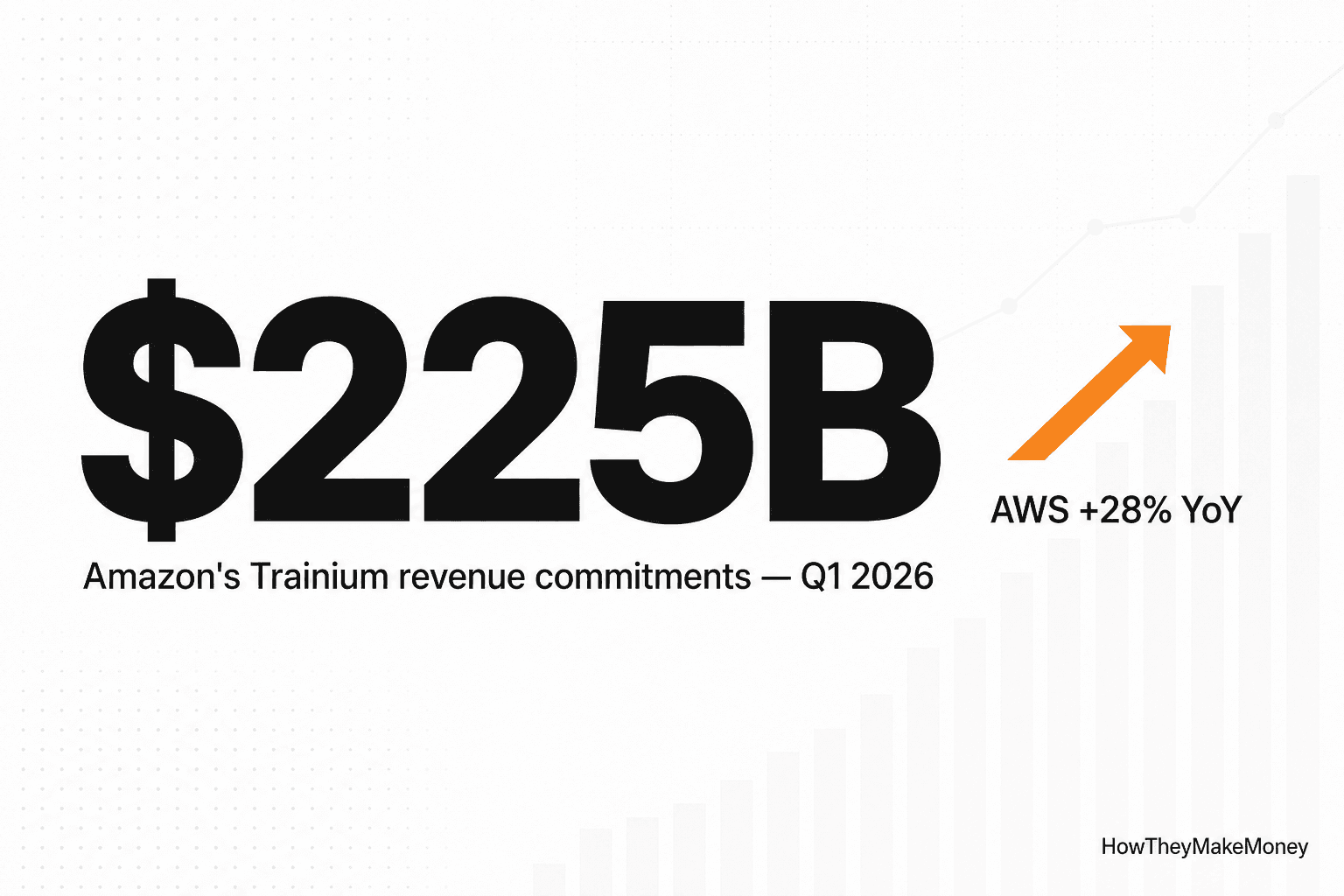
Three records, one print
Q1 2026 is the cleanest beat Amazon has produced in this cycle. Revenue $181.5B (+17% YoY). Diluted EPS $2.78 versus the $1.64 consensus — a 70% beat against the Street's number. Three operating records inside the print, any one of which would have been the headline on a normal quarter:
- AWS revenue $37.59B, +28% YoY — the fastest YoY growth in 15 quarters.
- North America retail operating margin 7.9% — the highest the segment has ever printed.
- Advertising trailing-12-month revenue crossed $70B, growing +24% YoY.
The market gave it +2% on the day. Not because the print was small — it was the most operationally impressive print in Big Tech's 4/29 window — but because GOOG (Cloud +63%) and META (capex shock -7%) ate most of the airtime. The structural story is bigger than the same-day move.
AWS finally turned
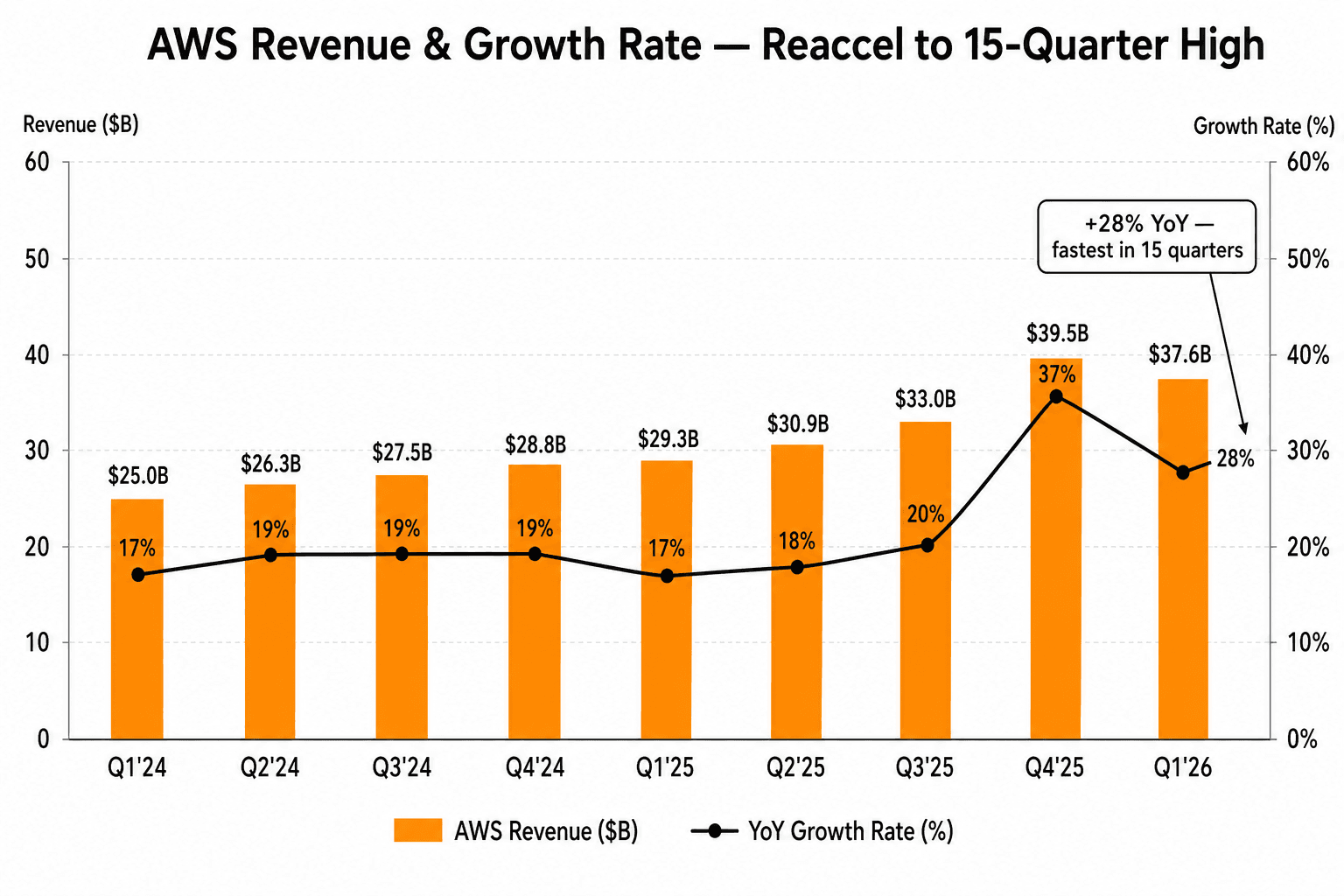
Through 2024 AWS was the segment that kept analysts asking "is the cloud reaccel already priced in?" The answer turned out to be: not even close. Five straight quarters of YoY acceleration, capped by a Q1 2026 print at +28% and an annualized run-rate of $150B. AWS AI revenue alone is now a $15B+ run-rate business growing triple digits inside that.
The reaccel matters more than the absolute number. Andy Jassy said on the call that AWS is "still capacity-constrained on AI workloads" — meaning the +28% is what the company can ship, not what customers are asking for. Adding capacity through 2026 and 2027 is what the $44.2B Q1 capex bill is paying for.
Two narrative consequences:
First, the post-2022 cloud-decel story is over. AWS, Azure (+40%), and GCP (+63%) are all printing structural reaccel into Q1 2026. The hyperscaler triopoly is back to compounding off a much larger base.
Second, the AWS-vs-GCP growth-rate gap (28% vs 63%) is real — but the AWS-vs-Azure gap is essentially closed in absolute dollar terms. Azure +40% on roughly half of AWS's revenue base translates to a similar quarterly-dollar increment. The cloud share-shift narrative is no longer "GCP is taking everyone." It's "GCP is growing fastest, AWS is the largest and reaccelerating, Azure is supply-constrained and pricing power."
Trainium: the line nobody saw coming
The single most important sentence on the call was Andy Jassy's:
"We have over $225 billion in revenue commitments for Trainium, anchored by Anthropic and OpenAI but with broadening enterprise adoption."
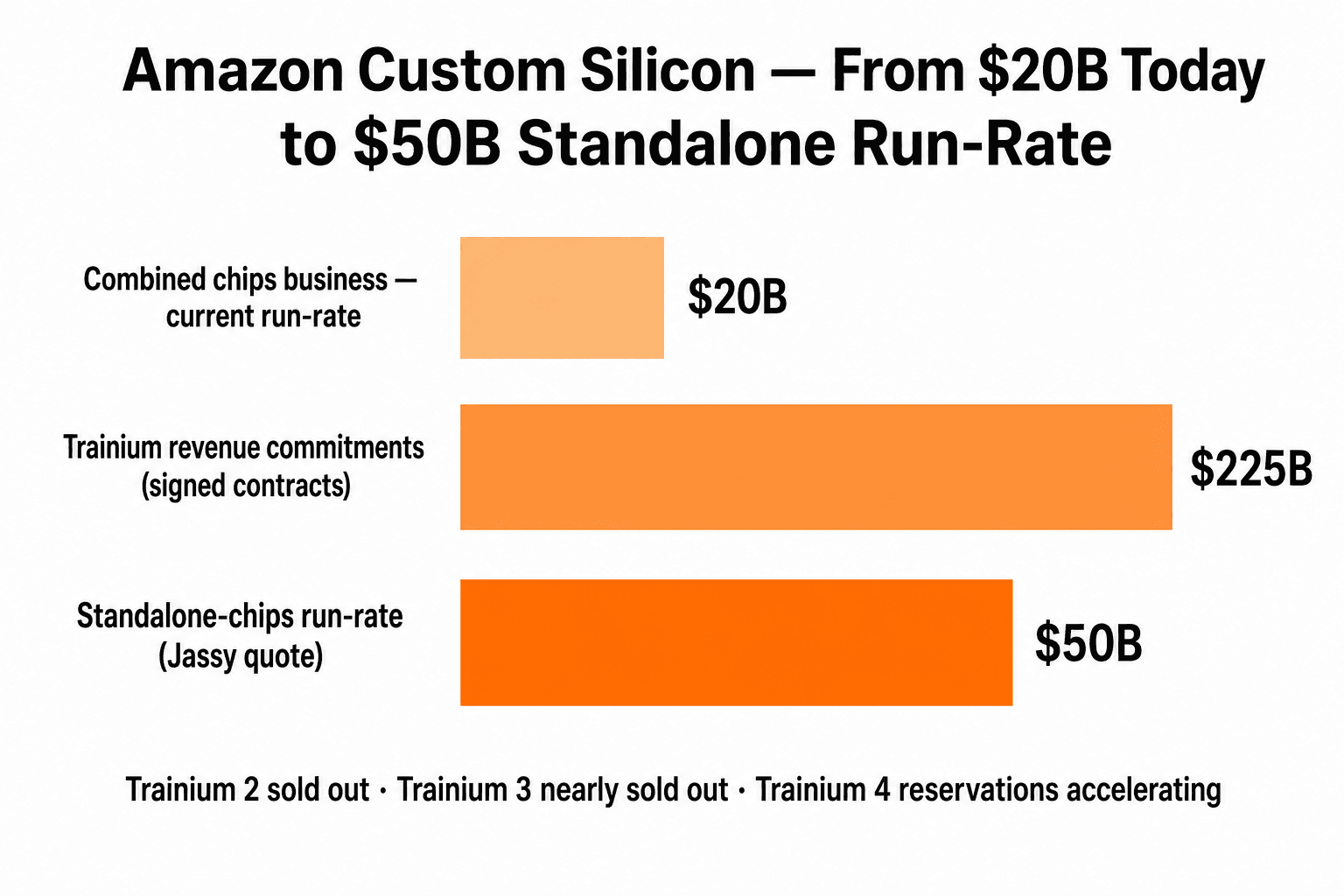
Three things to understand about the $225B figure:
First, it is contracted backlog, not a forecast. Multi-year, signed agreements. Anthropic and OpenAI account for the bulk; Uber and "more than 50 customers" round out the list per Jassy.
Second, Trainium 2 is "largely sold out" and Trainium 3 is "nearly fully subscribed" — that is current-generation product. Trainium 4, still 18 months from broad availability, "has much already reserved." The backlog is forward-loaded.
Third, the standalone-economics framing is new. Jassy's "$50B if standalone at full transfer pricing" line gives sell-side a way to model Trainium as a separate business — which it isn't, but the math is what matters for valuation. A $50B run-rate custom-silicon business growing triple digits would be worth roughly half of AVGO's market cap in isolation.
The negative read-across is NVDA: Jassy's claim that Trainium 2 has "30% better price-performance than comparable GPUs" and Trainium 3 is "30-40% better than Trainium 2" puts Amazon's silicon at parity-to-better with NVIDIA on price/perf for inference workloads — at a moment when NVIDIA has been pricing on scarcity. Bear-case AVPN realized: an AI-infrastructure customer of NVIDIA's size building competitive silicon at scale.
Retail finally earned its margin
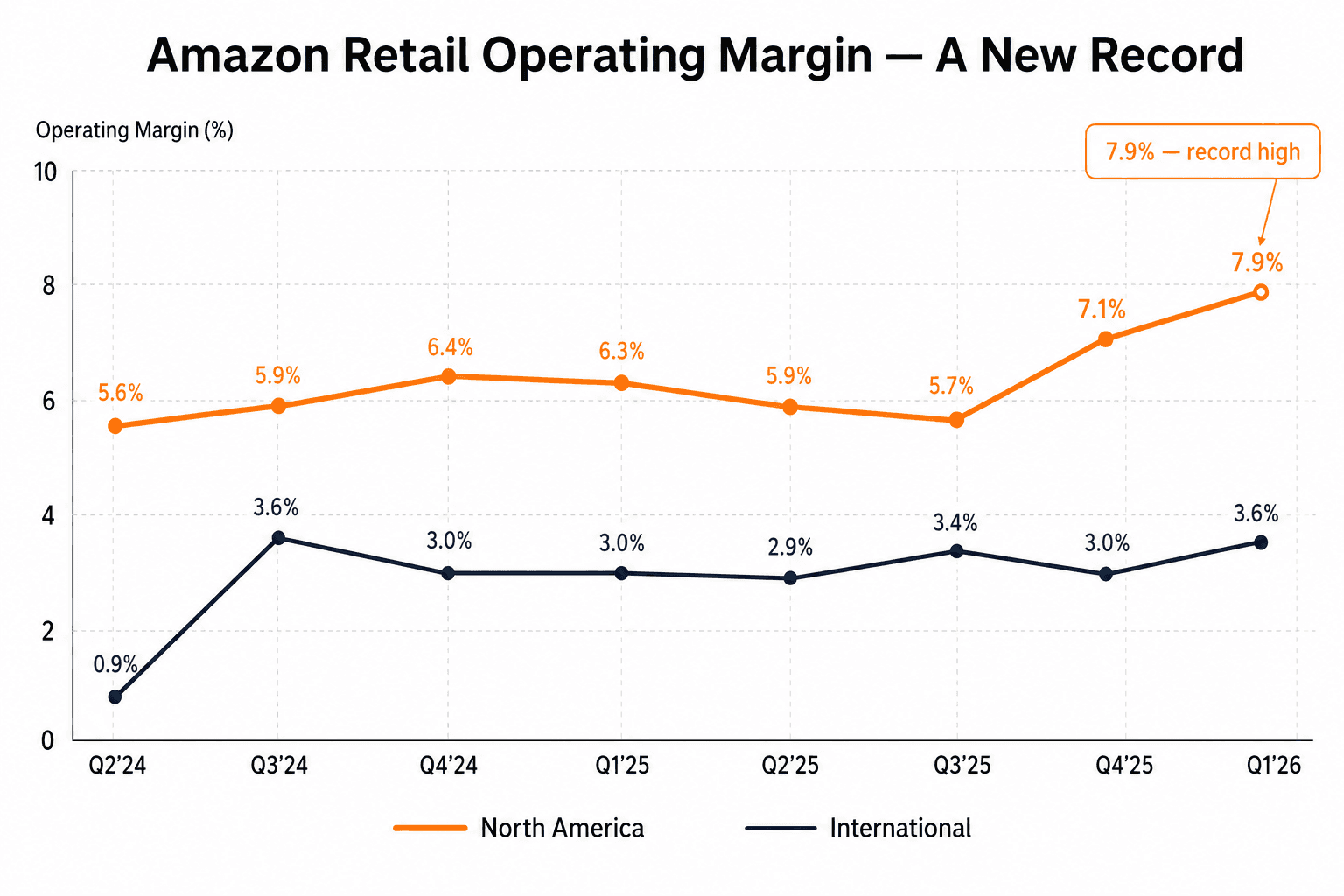
Lost in the AWS noise: NA retail printed a 7.9% operating margin, an all-time record. International printed 3.6%, the highest since 2021. Brian Olsavsky framed both as structural:
"We expect to operate at this margin level or higher going forward, with seasonal swings."
The drivers are mechanical, not cyclical. The Regional Fulfillment Network (RFN) is fully rolled out — meaning shorter inbound-to-outbound legs, fewer cross-region sortation steps. Sequoia and Proteus robots are deployed at scale across new fulfillment centers, taking peak labor cost out of the per-package equation. Middle-mile and last-mile efficiency keep compounding because Amazon owns the network.
If 7.9% is the new floor instead of a peak, the implied operating income from NA retail at the current revenue run-rate is ~$33B/year — by itself larger than Tesla's full-year 2025 operating income.
The capex bill — and why it lands different than META's
Q1 2026 capex was $44.2B, +77% YoY — the largest single-quarter capex print in Amazon's history. Annualized, that is roughly $200B for 2026, joining MSFT ($190B), GOOG ($180-190B), and META ($125-145B) in the same league.
Brian Olsavsky declined to give a formal 2026 capex number on the call. He said only: "We expect 2026 capital investment to be very meaningfully higher than 2025." That is the same language Susan Li used at META and Anat Ashkenazi used at GOOG.
The difference at AMZN is the quality of the offsetting disclosure. META reset capex to $145B and refused to bound 2027 — the market sold it 7%. AMZN spent $44B in Q1 and disclosed $225B in signed Trainium commitments — the market gave it +2%. The capex bill is the same shape; the backlog underwriting it is what changes the multiple.
TTM free cash flow has compressed from $25.9B a year ago to just $1.2B today. That number alone would be a panic in any other context. Investors are looking past it because they can see the contract that will produce the FCF on the other side.
What the bulls and bears actually fight about
Bull case: AMZN is the only Big Tech that just printed three operating records simultaneously in segments that are structurally independent. AWS reaccel at $150B run-rate. Custom silicon at $20B run-rate with $225B in contracted demand. Retail at 7.9% margin with robotics-driven cost compression still ramping. Advertising at $70B+ TTM, faster than any peer ad business. Capex is the cost of building permanent infrastructure for a multi-decade compute and logistics moat.
Bear case: The cash-conversion math is broken. TTM FCF $1.2B against $200B/year capex is unsustainable absent the backlog actually converting. Trainium customer concentration is real — Anthropic and OpenAI together are most of the $225B, and either is one funding round away from re-architecting their compute strategy. Tariff regime escalation in H2 2026 could pressure 1P retail margin even if the structural drivers hold.
The print does not resolve the debate. It just gives the bull case a $225B number to point at.
Forward look — what the Q2 2026 print will turn on
Three datapoints to track between now and the late-July Q2 print:
- AWS YoY growth durability. +28% in Q1 was supported by partial Trainium revenue recognition. The question is whether core-AWS-ex-Trainium is +20% or +25%. A Q2 print at +30% would suggest the reaccel still has room.
- Q2 capex. $44.2B in Q1 implies $176B annualized. Q2 needs to print at least $42B to validate the run-rate — and $48B+ would suggest the 2026 number lands closer to $220B.
- NA retail margin durability. 7.9% is the record. Holding above 7% in Q2 (which includes Prime Day and elevated promotional spend) would prove it is structural, not a Q1 timing artefact.
All financial figures sourced from Amazon's Q1 2026 Earnings Release (filed 2026-04-29) and the Q1 2026 earnings call transcript. Analyst quotes and price-target moves sourced from Marketbeat, Public.com, and TipRanks coverage.