AMD Q2 2026: A Record Beat That the Market Still Sold Off
A record quarter that the tape hated
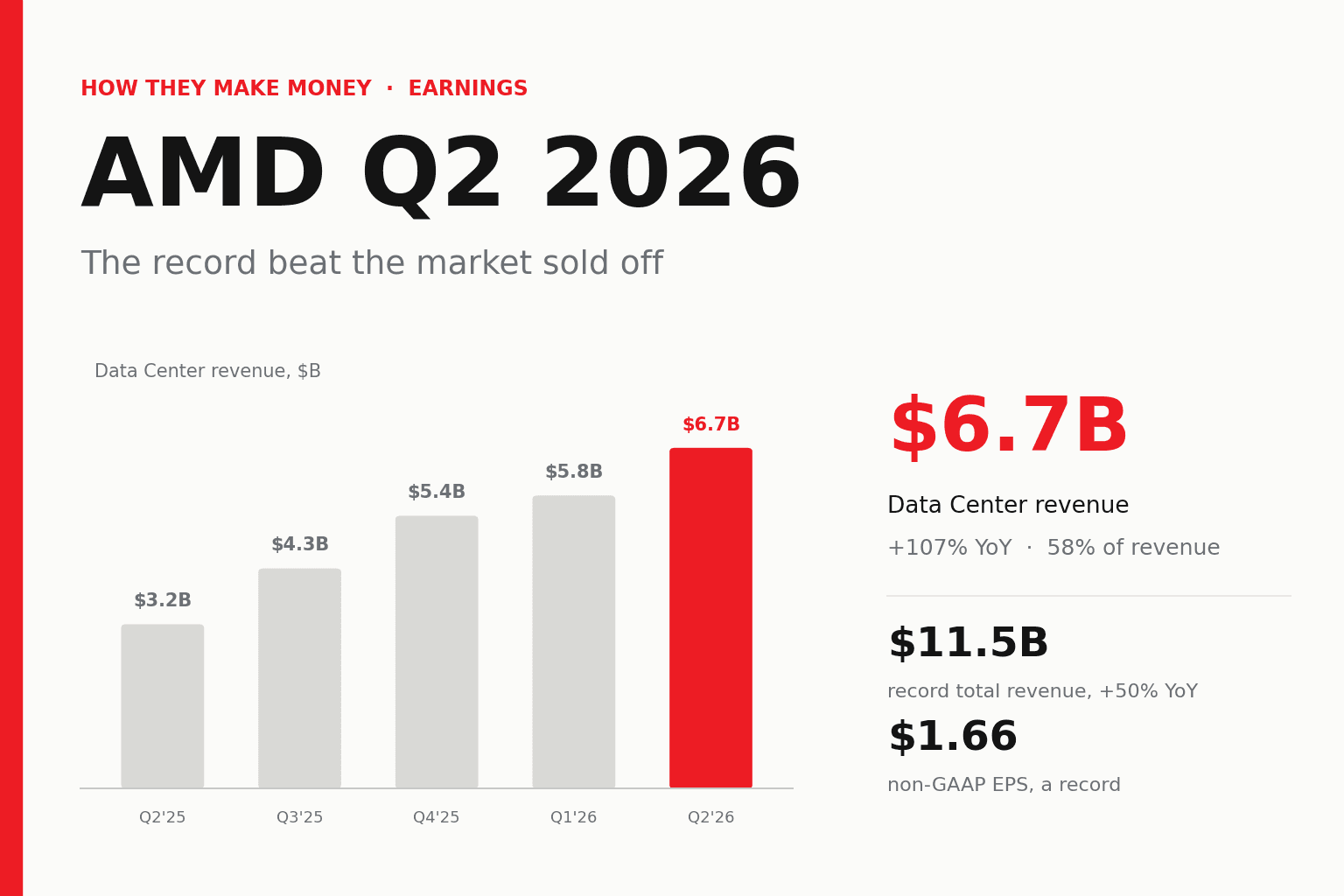
AMD did almost everything right in the second quarter of 2026 and the stock fell anyway. Revenue hit a record $11,536M, up 50% year-over-year (YoY, versus the same quarter a year earlier) and 13% from the prior quarter. Non-GAAP earnings per share (a company-adjusted profit figure that strips out items like stock compensation) reached a record $1.66, beating the roughly $1.62 the Street expected. AMD then guided the September quarter to about $13B, ahead of consensus near $12.5B. A clean beat-and-raise.
The market's verdict was blunt. AMD had climbed 7% during the regular session to close at $518.58. After the release, it fell about 8.8% to $472.94, wiping out the day's gain and then some. The setup explains most of it: the stock was up roughly 140% for the year going into the print, so a lot of good news was already priced. The rest is a story about cash, which we get to below.
Data Center is now the whole company
The number that anchors this quarter is Data Center. AMD's Data Center segment, which sells EPYC server processors and Instinct AI accelerators (the GPU-style chips that train and run AI models), posted record revenue of $6,718M, up 107% YoY and 16% from the prior quarter.
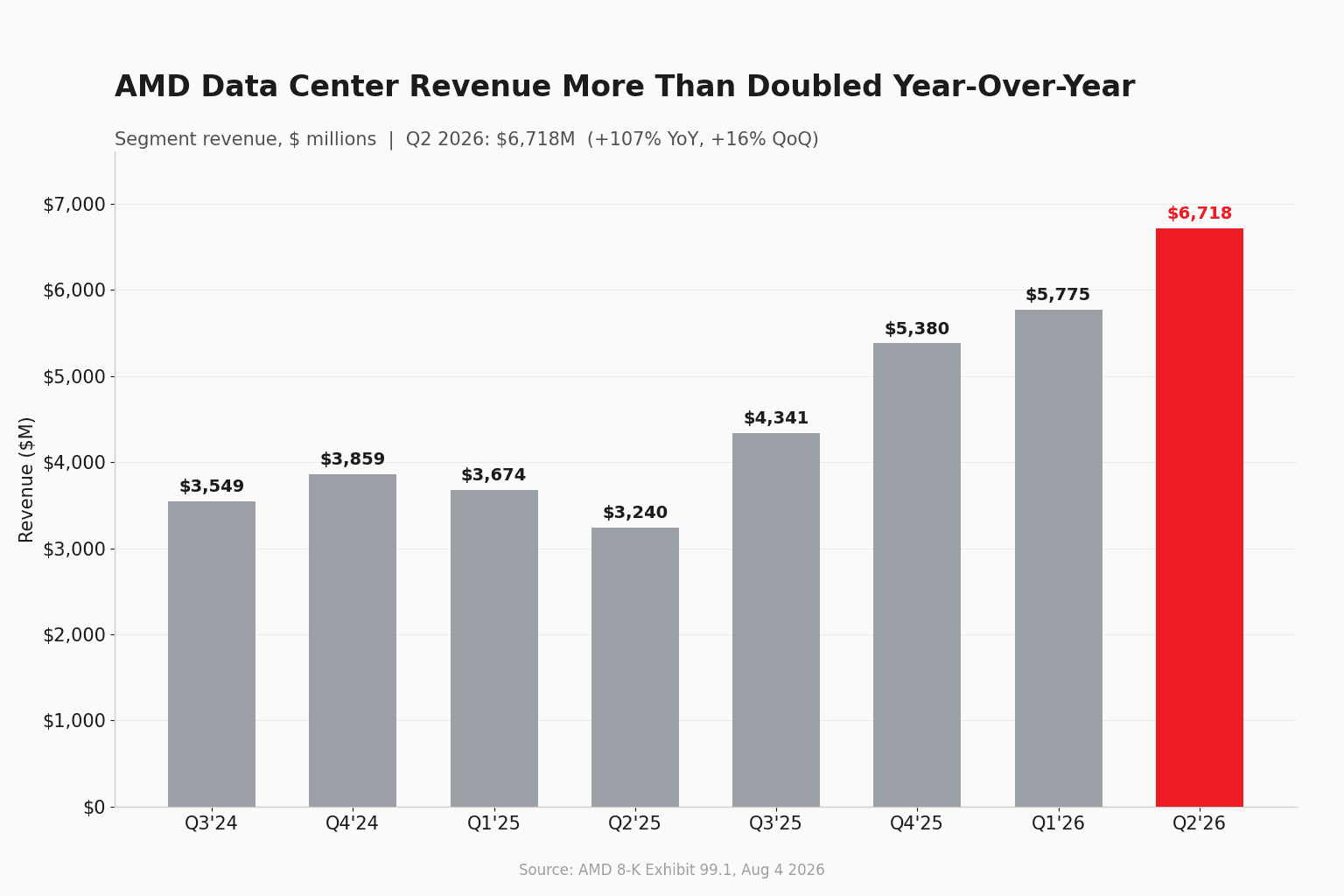
Segment operating income was $2,103M at a 31.3% margin, up about 370 basis points from the prior quarter, so this growth is profitable, not bought. And unlike the fourth quarter of 2025, which carried roughly $390M of one-time MI308 revenue tied to a temporary China export license, Q2's step-up came from underlying EPYC and Instinct volume.
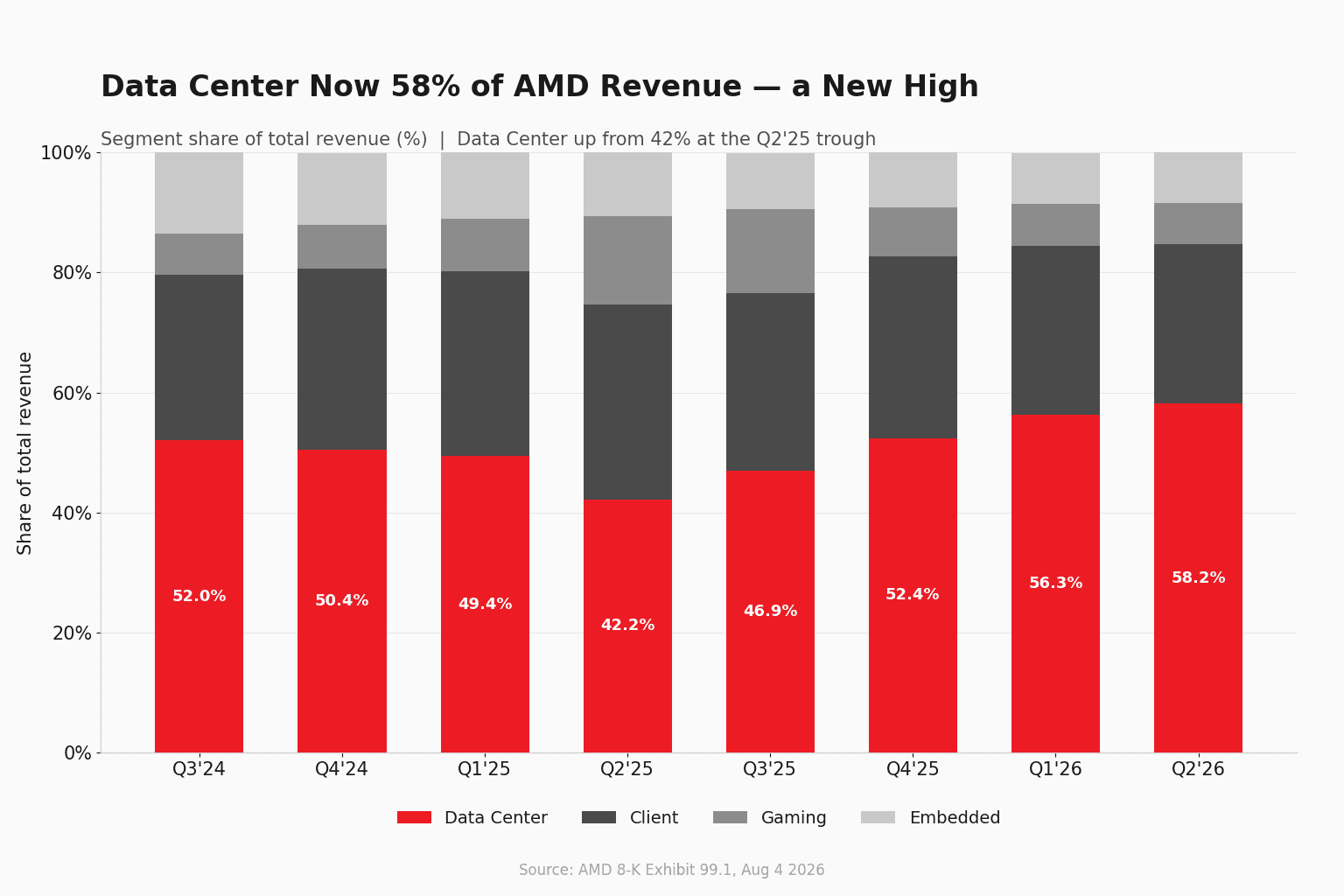
The mix shift is the part investors underrate. Data Center is now 58.2% of total revenue, a new high, up from 42% a year ago when an $800M export-control charge on MI308 chips depressed the base.
The other three segments, briefly
Client revenue, the PC and notebook processor business, rose 22.5% YoY to $3,062M on strong Ryzen demand and record mobile processor sales, with AMD still taking CPU unit share. Gaming fell 30.6% YoY to $779M as the console cycle softened and graphics component costs rose, though it ticked up 8% off the seasonal low. Embedded, the chips that go into industrial gear, networking and automotive, grew 18.6% YoY to $977M, its best growth in more than three years, backed by more than $18B of new design wins.
The read is that AMD's other franchises are healthy but no longer the story. Management even flagged a softer PC market in the back half of 2026 on higher memory and component costs, a reminder that the Client tailwind has limits.
Margins and profit hit records
Profitability moved with the mix. Non-GAAP gross margin (the share of revenue left after the direct cost of making the chips, on an adjusted basis) was 56.2%, up about 80 basis points sequentially on the richer Data Center mix. Non-GAAP operating margin reached 26.8%. Non-GAAP EPS of $1.66 set a record, up 21% from the prior quarter.
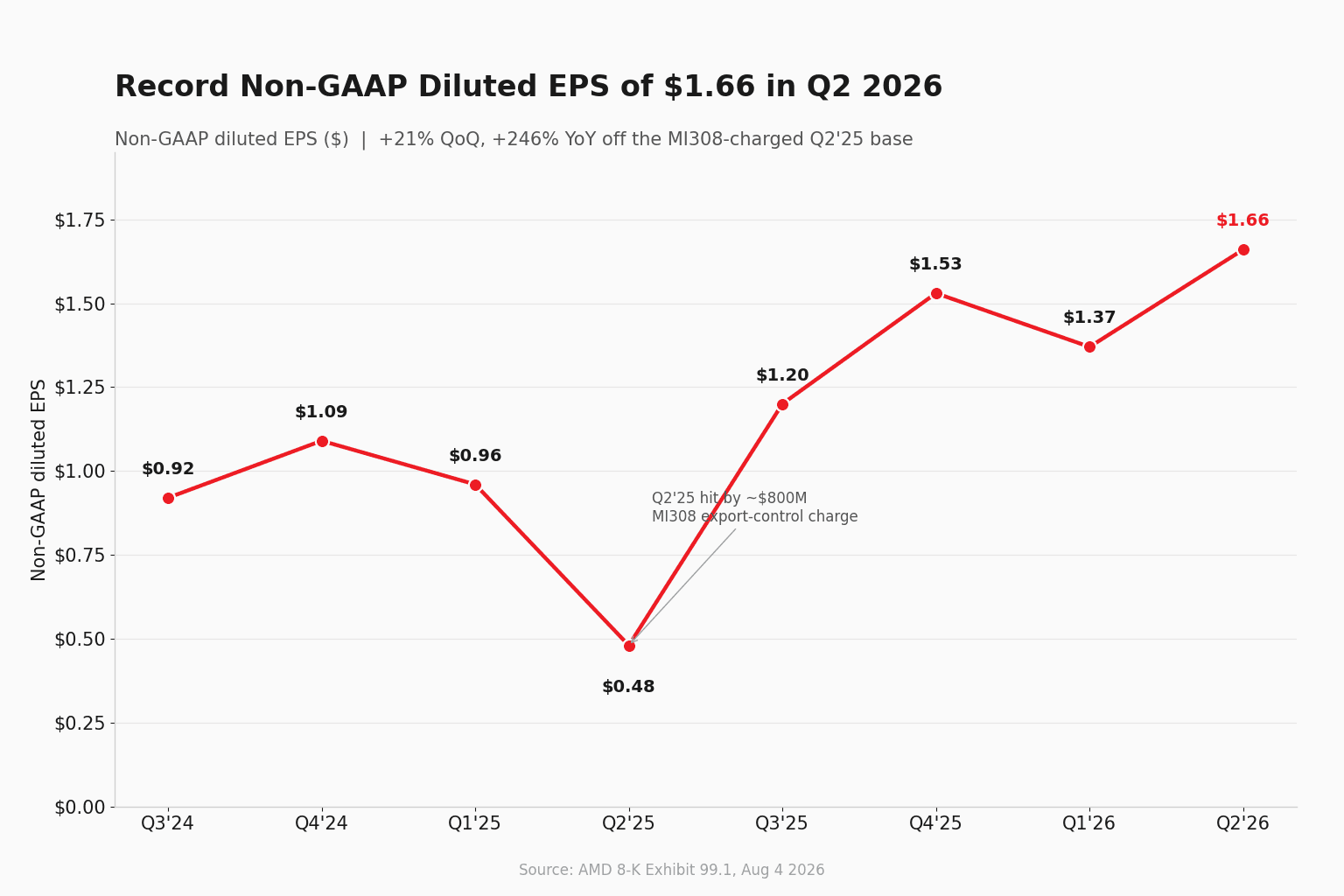
One caveat worth flagging: GAAP net income of $2,297M and GAAP EPS of $1.38 were flattered by a roughly $483M pre-tax gain on investments. The non-GAAP figures strip that out, which is why they are the cleaner read on operating performance.
Why the beat sold off: follow the cash
Here is the crux. AMD's capital expenditure, the money it spends on equipment, advanced packaging capacity and facilities, more than doubled to $808M from $389M the prior quarter and $282M a year earlier. That is about 7% of revenue, up from under 4%. Combined with a large receivables build, free cash flow (operating cash flow minus capex, the cash a business actually generates) dropped to $1,558M, a 14% margin, down from $2,566M and a 25% margin in the prior quarter.
None of this is broken. Operating cash flow was still $2,366M, cash and short-term investments rose to $13.1B, and adjusted EBITDA set a record at $3,315M. The spending is deliberate: AMD is pre-positioning supply for the Helios rack-scale AI system and the 2027 Data Center ramp. But a market braced for a blowout saw capex double and free cash flow fall, and it sold first.
Independent analysts made the same point. Futurum's Daniel Newman said the earnings "were good" but the market wanted a bigger Helios-driven guide, Moor Insights' Patrick Moorhead noted Helios has not even started contributing yet, and Futurum Equities' Shay Boloor said the market "fixated on capex more than doubling from $389M to $808M." The sell-side targets that framed the setup all pre-dated the print and ran high, from Citi's $575 to UBS's $730, with the average near $579.
The guide and the 2027 setup
AMD guided the September quarter to roughly $13B, plus or minus $300M, about 41% YoY growth at the midpoint, with non-GAAP gross margin around 56%.
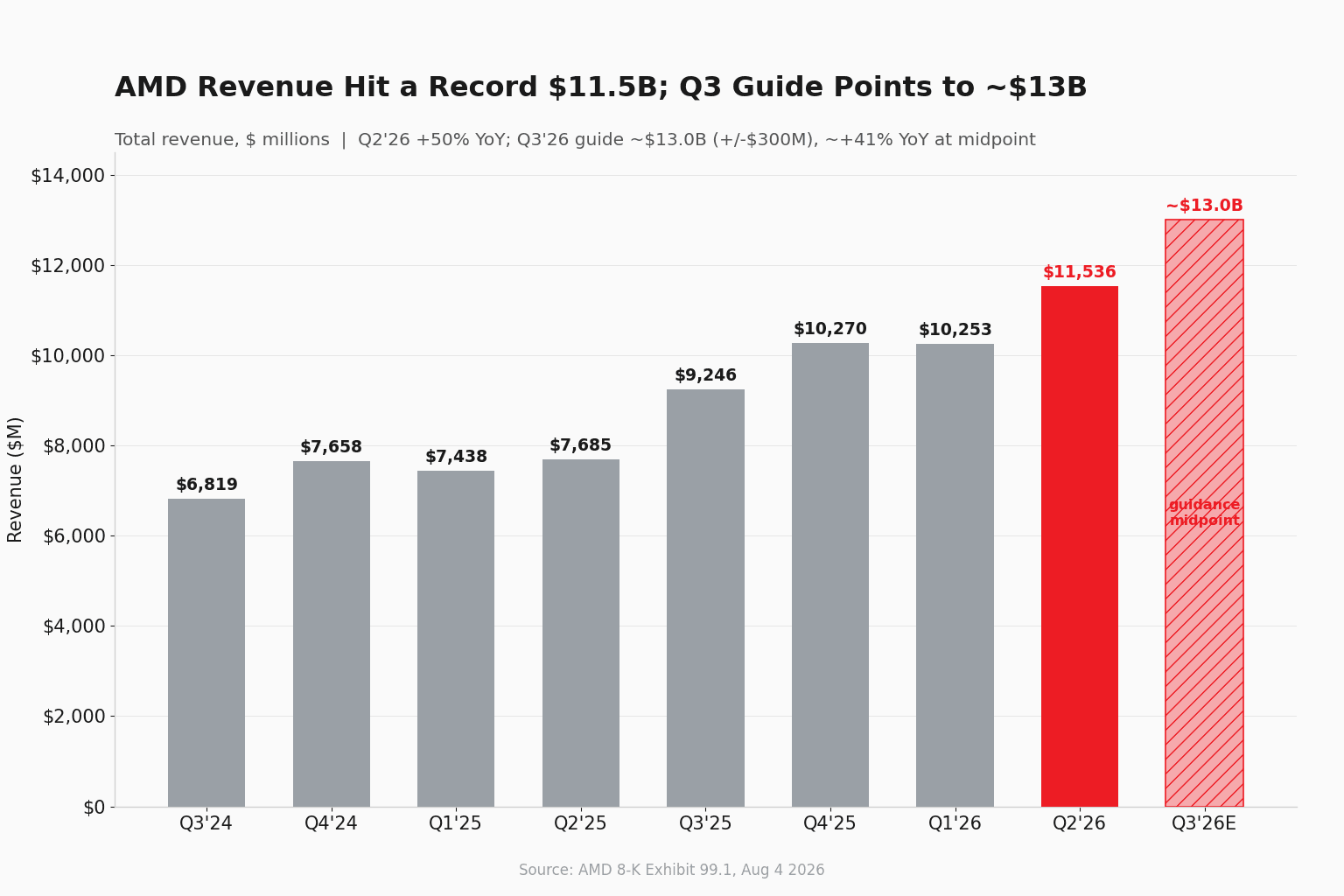
The forward framework is where the bull case lives. Management expects the Data Center segment to more than double YoY in 2027, with server-CPU revenue up more than 70% and Data Center AI up well over 100%. It also raised its long-term market estimates, to roughly $1.4 trillion for AI accelerators and $220 billion for server CPUs by 2030. The named 2027 demand is real: Anthropic committed to up to 2 gigawatts of MI450-series GPUs in Helios racks, and Microsoft is deploying Helios at scale on Azure.
The risks are equally concrete. Server-CPU supply was tight through the first half of 2026, Data Center AI margins run slightly below the corporate average as Helios scales, and the valuation now prices in a chunk of that 2027 promise.
The takeaway
Q2 2026 was, on the numbers, one of AMD's strongest quarters ever: record revenue, Data Center past 58% of sales, record EPS, and a guide above consensus. The sell-off was not a verdict on the business. It was the market repricing a stock that had already run 140% and then balking at a capex bill that doubled before the Helios revenue arrives. The question for the next few quarters is simple: can AMD convert that spending into the 2027 Data Center numbers it just promised? If it can, this print will read as a buying opportunity. If the ramp slips, the same capex line becomes the bear case.