AMD Q1 2026: Data Center Becomes The Engine — 56% of Revenue, +57% YoY, $11.2B Q2 Guide
A quarter that reframes the share-of-wallet debate
For most of 2024 and the first half of 2025, the question on AMD was: can it actually compete with Nvidia at scale in AI compute? The MI300X ramp answered that question commercially but not strategically — bears argued AMD had one big customer (OpenAI), one shipping product (MI300/325X), and a margin profile that compressed under the weight of Instinct mix.
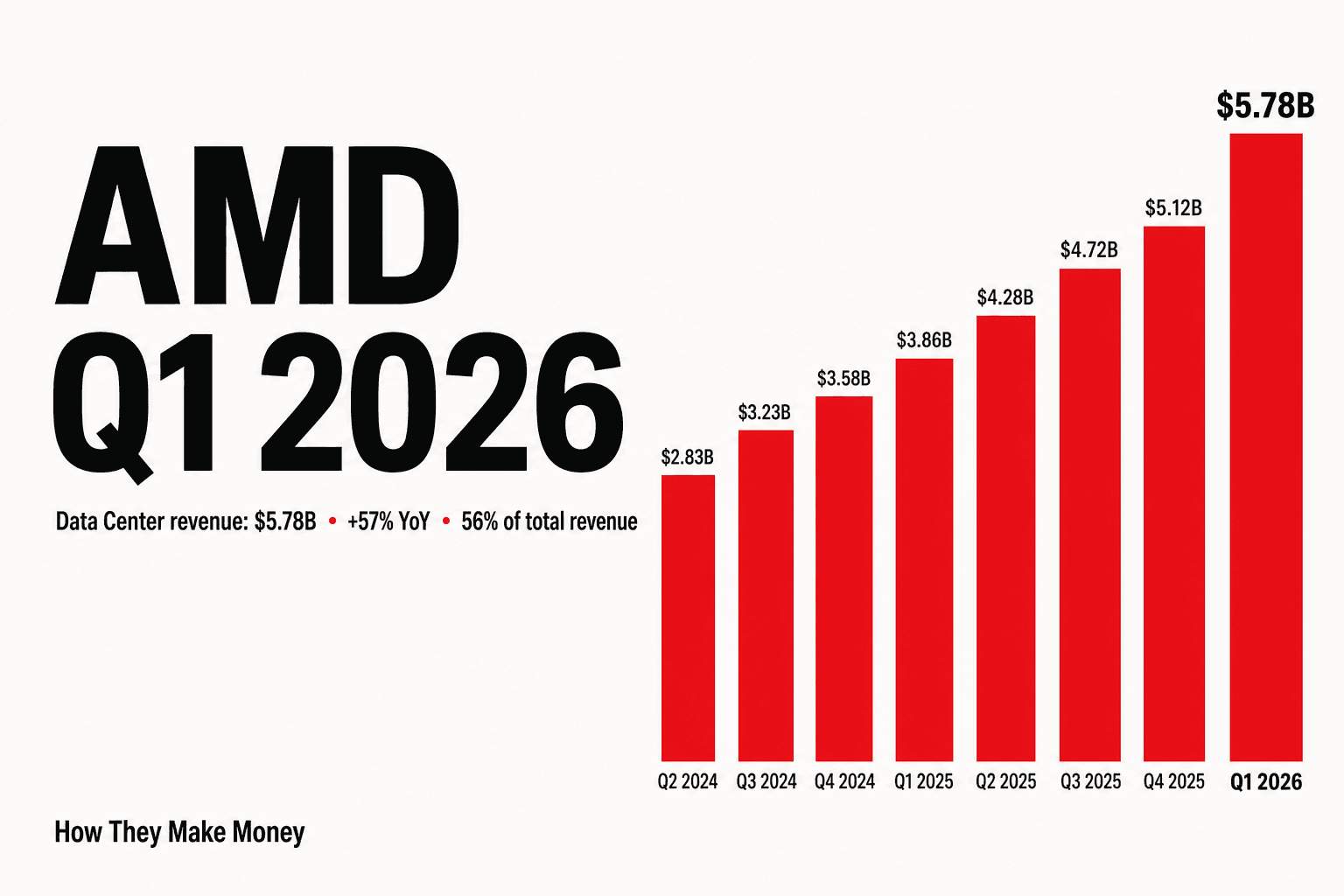
Q1 2026 changes the question. Revenue: $10.25B, +38% YoY. Data Center revenue: $5.78B, +57% YoY, 56.3% of the consolidated top line — the first quarter Data Center has crossed the 56% line at AMD. Non-GAAP EPS $1.37 beat the $1.29 Street. Q2 guide $11.2B beat the $10.4B Street. Server CPU revenue guided to >70% YoY in Q2. Free cash flow $2.57B, a 25% FCF margin — both records.
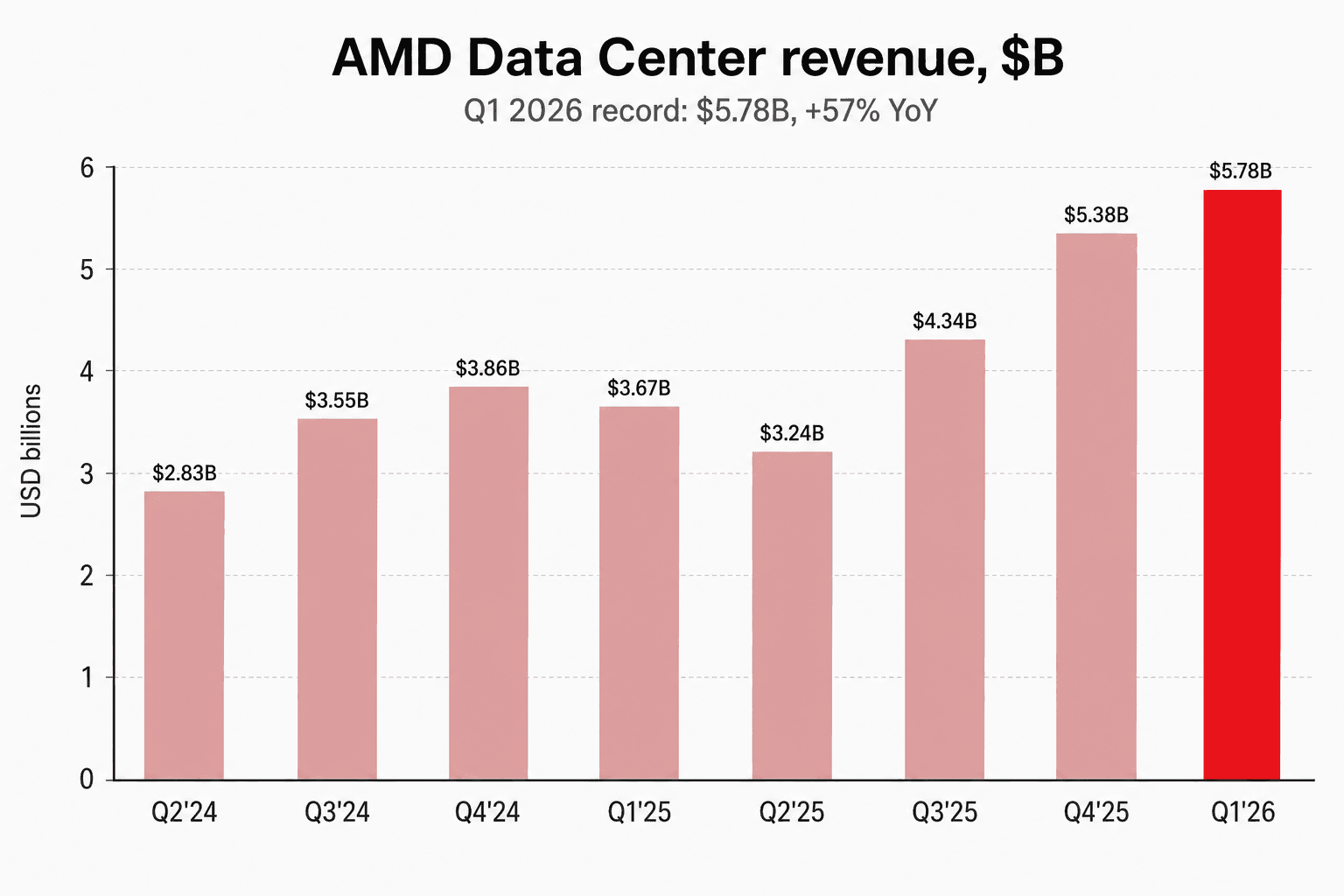
The single chart that reframes the debate is above. Eight quarters ago, AMD's Data Center segment did $2.83B. Q1 2026 did $5.78B — more than double. Underneath, the composition flipped: in Q2 2024, Data Center was driven by 4th-Gen "Genoa" EPYC server CPUs with a small MI200 GPU contribution; in Q1 2026, it's a ramping 5th-Gen "Turin" EPYC franchise (4 consecutive quarters of record server-CPU revenue, +50%+ YoY) plus a multi-billion-dollar Instinct GPU run-rate plus a Pensando networking and FPGA tail. That's three distinct AI-infrastructure businesses inside one segment, all growing.
Data Center is now the company
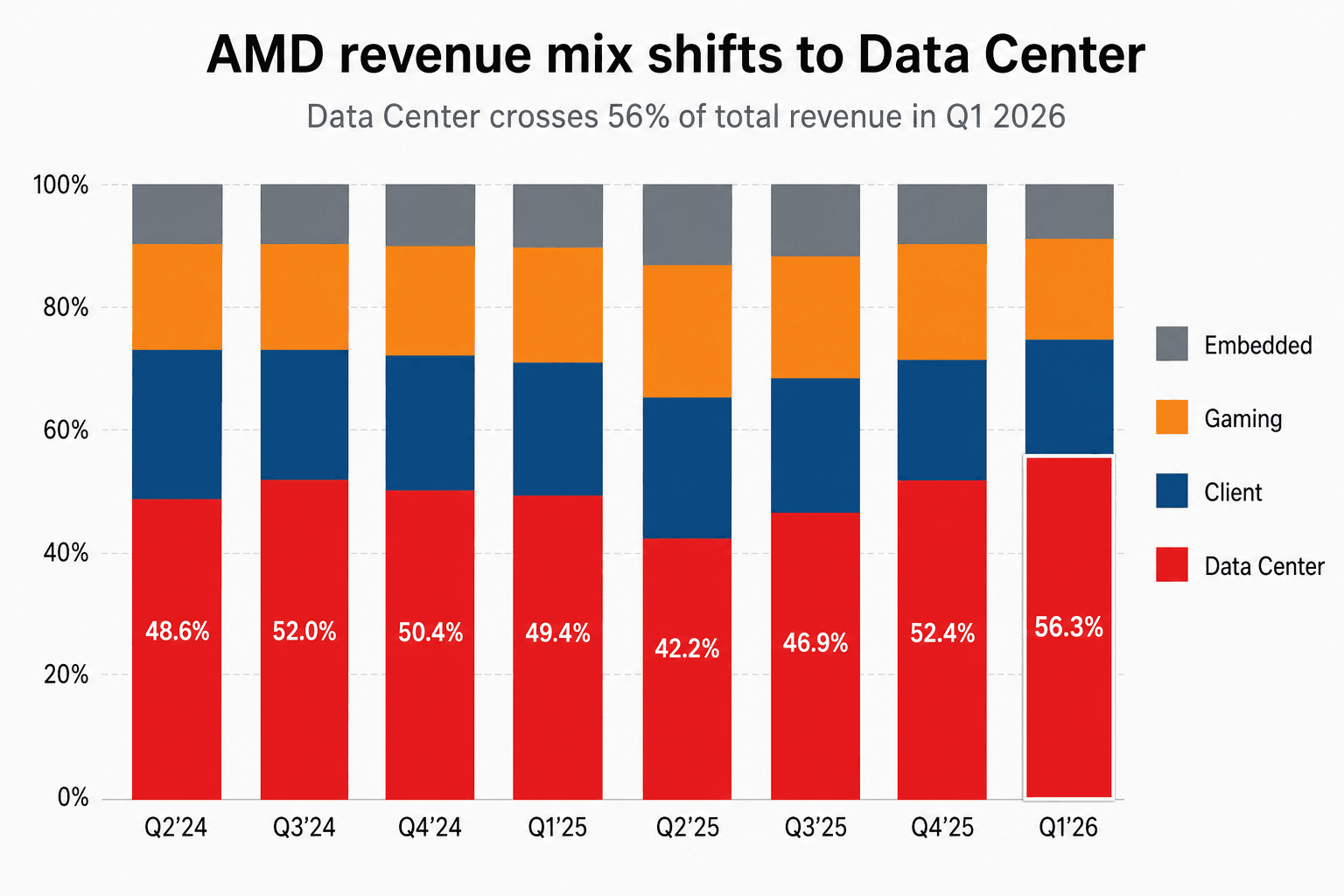
The mix shift is the most underappreciated number in the print. Data Center as a share of total revenue:
- Q2 2024: 48.6%
- Q1 2025: 49.4%
- Q2 2025: 42.2% — the MI308 China export-control hit
- Q3 2025: 46.9%
- Q4 2025: 52.4%
- Q1 2026: 56.3%
Three things matter. First, Data Center mix is now structurally above 50%, and the trajectory through 2026 is clearly higher. Second, Q1 is seasonally weak for Client (-6.8% QoQ as Ryzen-PC demand normalises after the holiday quarter) and weak for Gaming (-14.6% QoQ as the console cycle softens), so the mix shift is partly because the other segments are seasonally lower — but the absolute Data Center number is also up, +7.3% QoQ. Third, the Q4 2025 print included roughly $390M of one-time MI308 China revenue from a temporary export-license relief; ex-China, Data Center grew sequentially closer to +16% rather than the headline +7%. The underlying ramp is even stronger than the reported series.
Server CPU is still the unsung pillar
AMD doesn't break out server-CPU revenue cleanly, but the disclosure on the call matters: server CPU revenue grew more than 50% YoY in Q1 2026 — the fourth consecutive quarter of record server-CPU revenue — and is guided to grow more than 70% YoY in Q2. That implies AMD is taking server-CPU share at an accelerating pace, not a decelerating one, six quarters into the 5th-Gen "Turin" cycle. With 6th-Gen "Venice" (Zen 6, 2nm) launching later in 2026 and Meta announced as a Venice lead customer, the server CPU step-function is set to repeat.
The narrative shorthand for AMD's last three years was "AI GPU story." The truth is that AMD has run two share-gain stories in parallel: server CPU plus AI GPU. Q1 2026 made that explicit by guiding both higher.
Meta 6 GW: the second hyperscaler anchor tenant
The most market-moving sentence of the press release was Meta's commitment: up to 6 gigawatts of AMD Instinct GPUs spanning multiple generations, with the first 1 GW powered by a custom MI450-based GPU that AMD designs for Meta. Meta also signed up as a lead customer for 6th-Gen EPYC (Venice / Verano).
For perspective: 6 GW of GPU deployment, at current rack densities, implies a meaningful five-figure annual GPU shipment commitment over multiple years. Stitched together with the OpenAI 6 GW commitment from October 2025, AMD now has two announced multi-gigawatt anchor tenants. The bear case ("AMD has only one big customer") is now a strawman.
The custom-silicon framing also matters. Meta-MTIA, AWS Trainium, and Google TPU are all internal hyperscaler ASIC programs that compete with merchant accelerators like Instinct. Meta choosing to do its custom GPU with AMD means AMD is converting hyperscaler ASIC budgets into AMD revenue rather than losing it. Lisa Su explicitly said on the call: "We're seeing more, not fewer, RFQs for similar custom-Instinct programs from other hyperscalers."
Free cash flow inflects
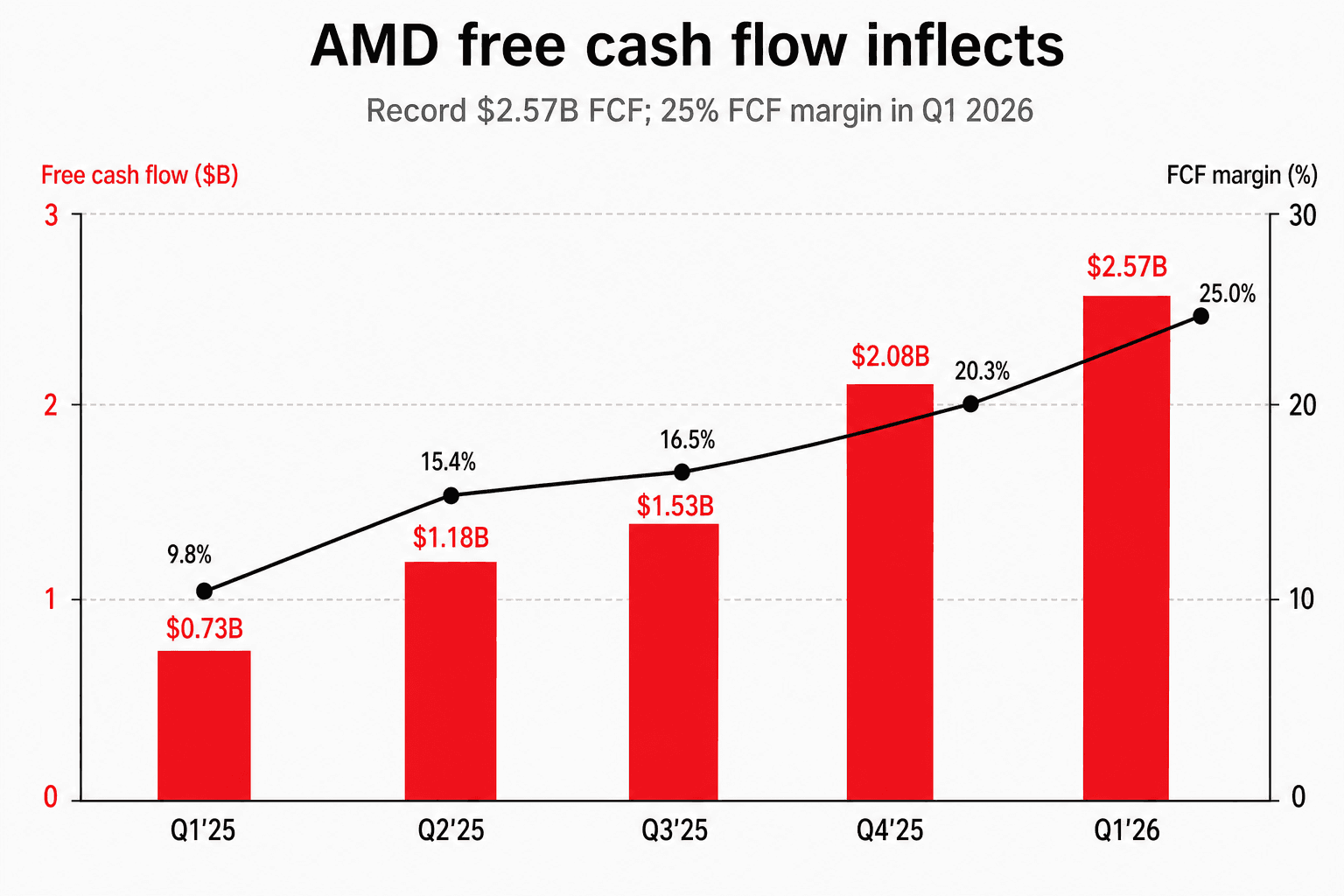
Free cash flow has inflected. Q1 2025 was $0.73B at a 9.8% FCF margin. Q1 2026 is $2.57B at a 25.0% FCF margin — a 3.5x increase in absolute dollars in twelve months. Operating cash flow margin reached 29% (vs. 13% a year ago). The Q1 number isn't a one-off: Q4 2025 was $2.08B at 20.3%, and the trajectory is monotonic across the last five quarters.
This matters for the valuation framework because the longest-running bear argument on AMD has been "high revenue growth, low cash conversion." That bear argument is now empirically broken. AMD ended Q1 with $12.3B in cash and short-term investments, up from $10.6B at year-end, against $3.2B of total debt. Net cash is roughly $9B, providing room to fund the Helios ramp + Venice launch without dilution.
Capex stepped up to $389M in Q1, a 75% sequential increase, reflecting investment in advanced-packaging capacity (CoWoS-L allocation), AI-system bring-up labs, and 2nm Venice infrastructure. Even with capex up, FCF margin still printed a record 25% — so the cash-generation story isn't being eroded by the capex cycle, it's expanding through it.
The Q2 guide and the 2027 commitment
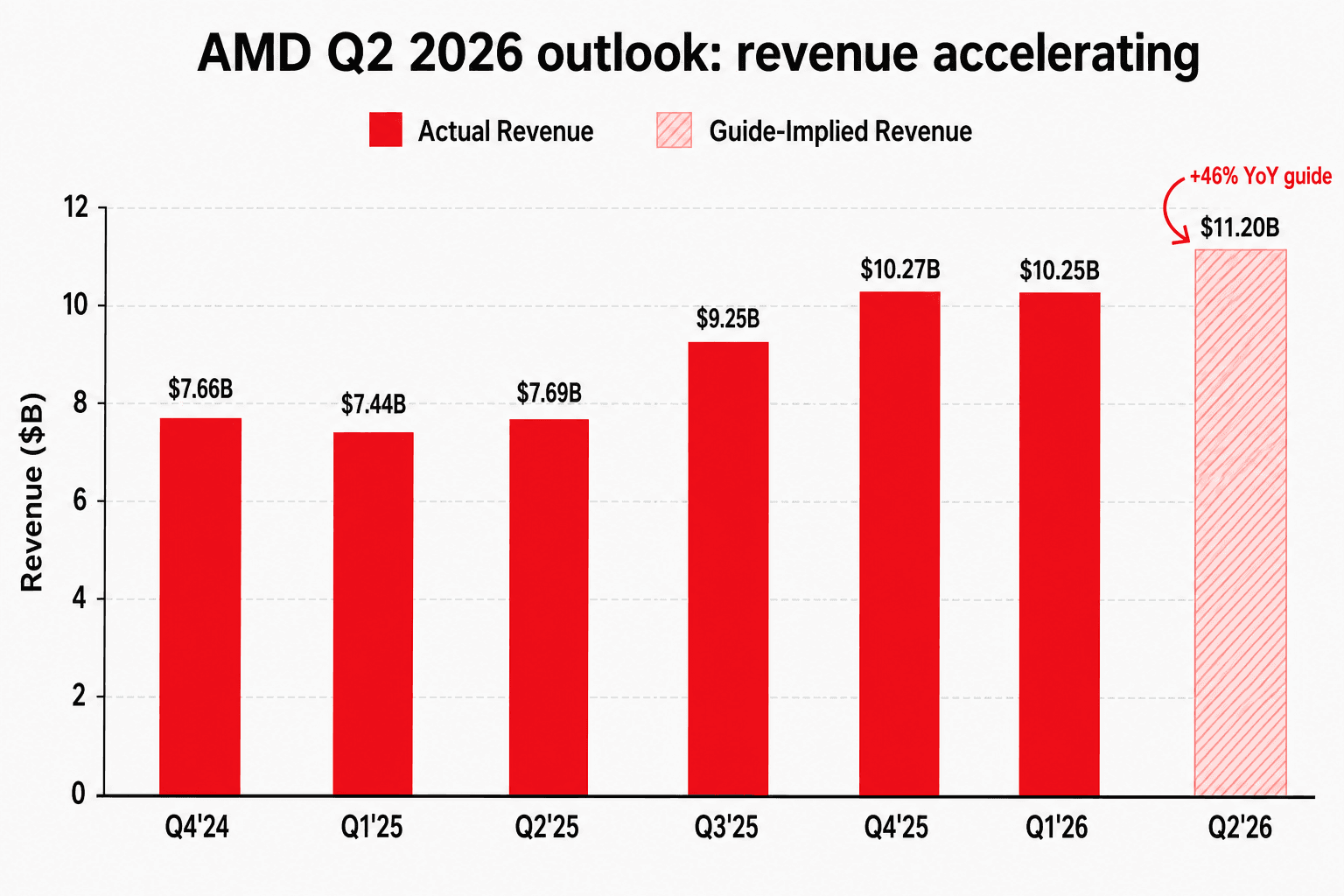
Q2 guidance: revenue ~$11.2B (±$300M) — implying +46% YoY, accelerating from the +38% YoY in Q1. Non-GAAP gross margin ~56%, up sequentially. Server CPU revenue >70% YoY.
But the more important number was Lisa Su's 2027 commitment in Q&A: "tens of billions of dollars in annual Data Center AI revenue in 2027." "Tens of billions" — minimum $20B, plausibly $30B+ — implies AI accelerator revenue alone scaling to multiples of where it sits today. Combined with a server-CPU franchise compounding through Venice, AMD's 2027 Data Center segment could plausibly exceed $50B annually. Against a current Data Center run-rate of ~$23B (annualised Q1), that's roughly a doubling in 18 months.
The post-print analyst PT moves reflect that re-rating, not the Q1 EPS beat:
- Morgan Stanley: $255 → $360 (+41%)
- Bank of America: $280 → $310 (+11%)
- Bernstein: $235 → $265 (+13%)
A +$105 PT raise from one bank in 24 hours is not what an EPS beat does — it's what a multi-year share-of-wallet recalibration does.
Risks
Three to keep in view:
(1) China / MI308. Q4 2025 included ~$390M of one-time MI308 China revenue under temporary export-license relief. Q1 2026 had only nominal China contribution. AMD framed China as "off the run-rate," so the 2026 guide doesn't lean on it — but a future regulatory tightening would still hit Instinct mix and gross margin.
(2) Capex intensity is climbing. Q1 capex was up 75% QoQ at $389M, reflecting the Helios ramp + Venice tape-out cycle. The FCF margin still printed 25%, so the cash story is intact, but capex is now scaling faster than revenue. If the AI infrastructure cycle plateaus before AMD can monetise the capacity build, the FCF margin trajectory inverts.
(3) Valuation. Post-print, AMD's share price prices in not just 2026 execution but a meaningful chunk of the 2027 commitment. The "tens of billions" DC AI line is now in the multiple. Any quarter where Helios production slips or MI450 ramp underwhelms triggers material multiple compression. The bull case has graduated from "AMD can compete" to "AMD's 2027 share is bigger than people think" — and that's a higher bar to clear quarter-after-quarter.
The takeaway
Q1 2026 isn't a beat-and-raise. It's a re-rating. Three structural signals stacked in one print: Data Center crossing 56% of total revenue, free cash flow margin hitting 25%, and Lisa Su committing to "tens of billions" of 2027 DC AI revenue. The market has now repriced AMD as the second AI compute platform of consequence, not just the cheaper Nvidia alternative.
The bear case has retreated to capacity execution and valuation. The bull case has graduated from "can AMD execute?" to "how big is AMD's 2027 slice of AI compute?" That second question is the one that will drive the stock for the next four quarters — and Q1 2026 is the print that finally made it the right question to ask.