Airbnb Q2 2026: Hotels Grow 3x Faster Than Homes
A record quarter with a more interesting subplot
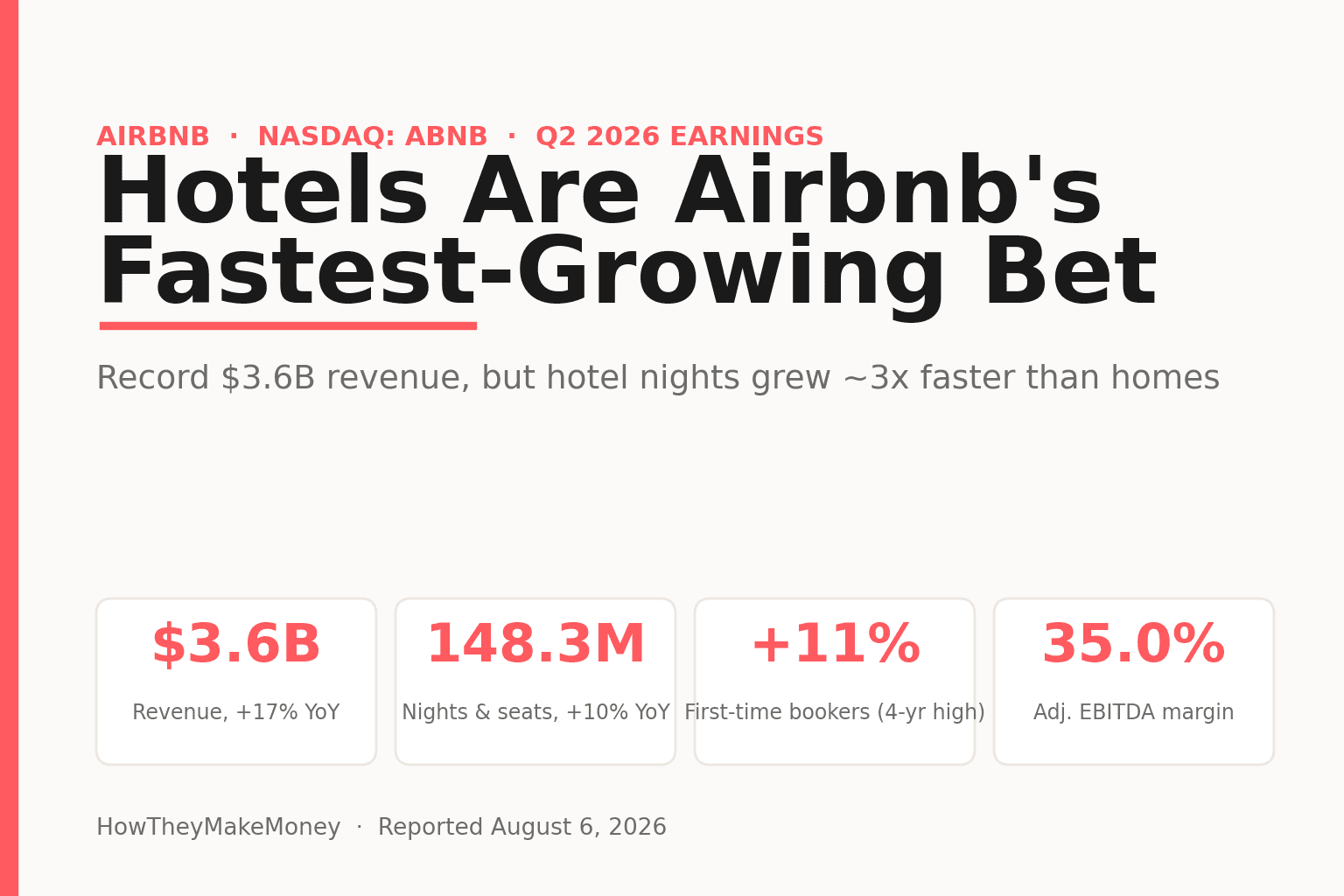
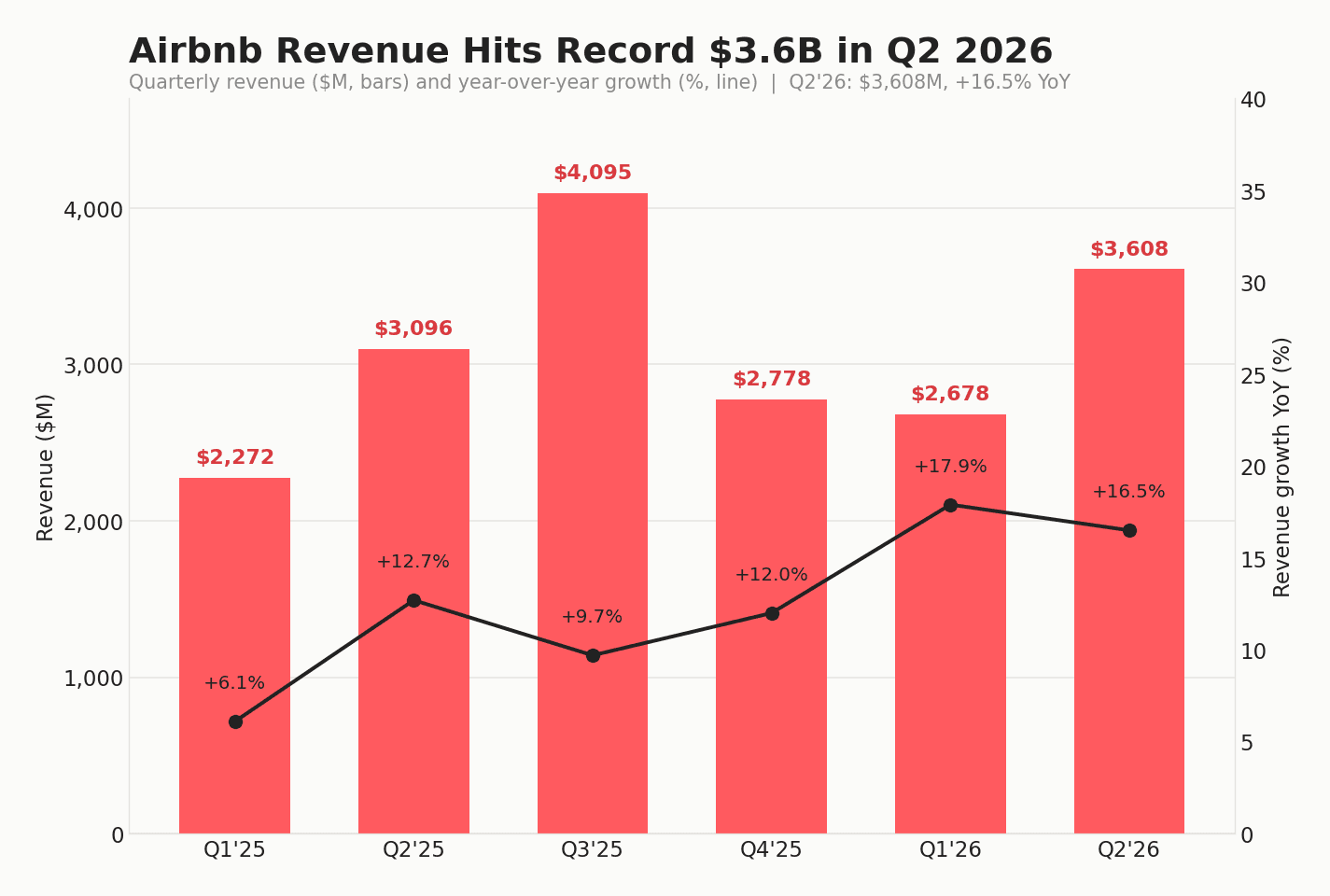
Airbnb closed the books on its best three months ever. Second-quarter revenue reached a record $3.6 billion, up 17% year over year (13% excluding currency swings), and the company beat where it counts: adjusted earnings of $1.37 per share topped the roughly $1.25 Wall Street penciled in. Shares jumped somewhere between 9% and 11% after the close.
The headline is a clean beat-and-raise. The more durable story is buried in the operating details, and it is about which parts of the business are growing fastest.
Hotels are the fastest-growing bet
Airbnb is still, overwhelmingly, a marketplace for homes. But management pointed to a corner of the business that is quietly compounding: hotel nights booked grew roughly three times as fast as the core homes business. Hotels remain a single-digit percentage of total nights, so they barely move revenue today. The reason to care is the funnel.
About 35% of first-time hotel guests came back to book a home. That is the whole strategic point. Boutique and independent hotels, now added across more than 20 destinations, act as a cheap on-ramp that pulls in travelers who might not have thought of Airbnb, and roughly a third of them convert into the higher-value home stays that pay the bills. Add in the 2026 Summer Release, which extended Airbnb Services into grocery delivery, car rentals, airport pickups, luggage storage, and resort passes, and Experiences supply up about 80% year over year, and the shape of the plan is clear. Airbnb is widening the top of its funnel so the core business keeps filling.
New travelers are showing up, and staying on the app
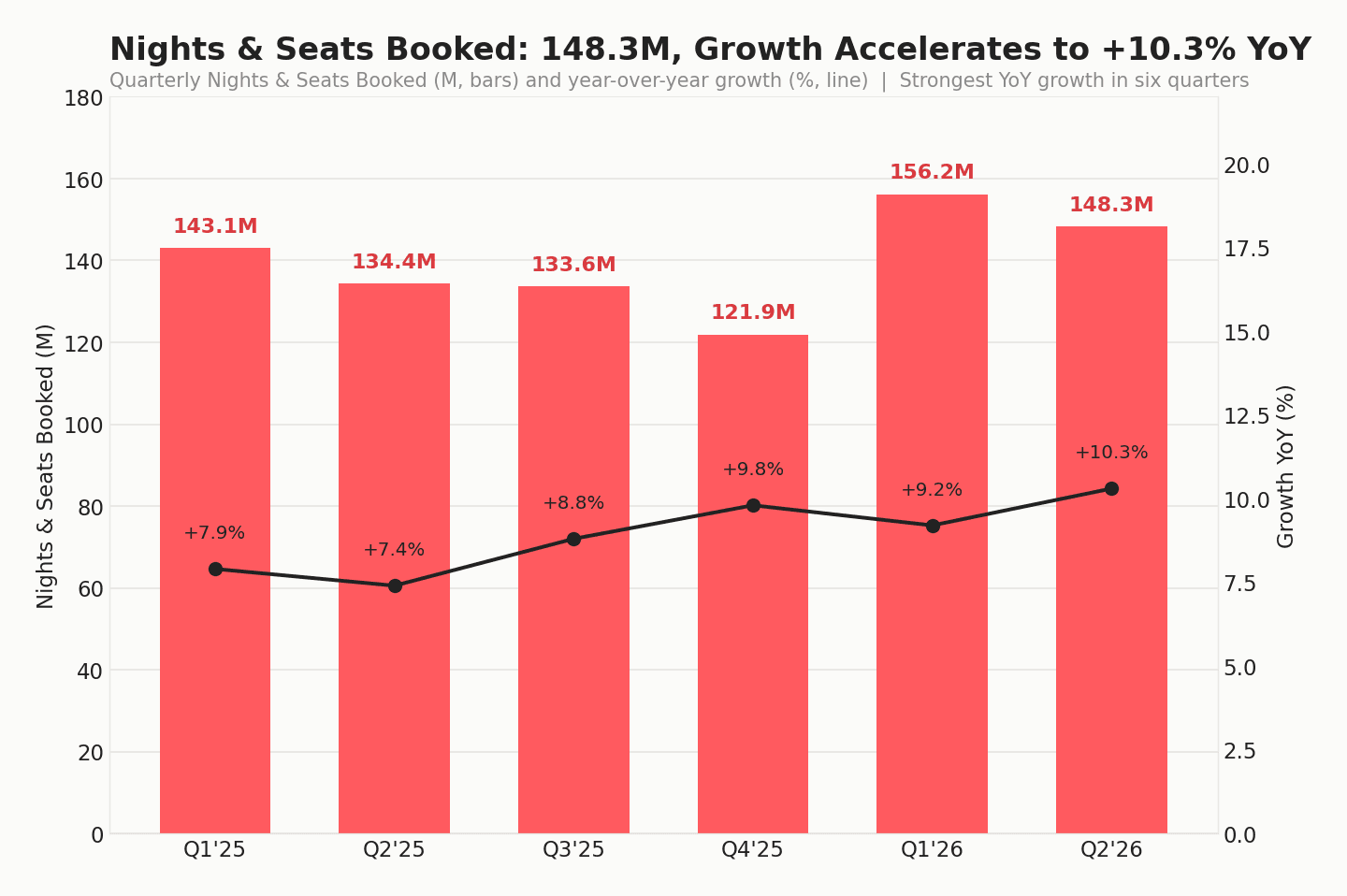
The demand signals back this up. Nights and Seats Booked reached 148.3 million, up 10% year over year and accelerating from the first quarter. That is the strongest year-over-year growth in the six quarters shown here, which matters because slowing nights growth had been the loudest knock on the stock.
Underneath the volume, the mix of who is booking is shifting in Airbnb's favor. First-time booker growth accelerated to 11% year over year, the fastest in four years. Those new users are landing in the app rather than the website: app nights grew 23% year over year and now make up 64% of all nights, up from 59% a year ago. Geographically the growth is broadening beyond the emerging markets that carried recent quarters. Latin America grew around 20% and Asia Pacific in the high teens, with India origin nights up more than 60%, but management also flagged that core markets including the United States, France, the United Kingdom, and Australia accelerated. Growth that is both faster and more widely spread is harder to dismiss as a one-region fluke.
Bookings and profitability both went the right way
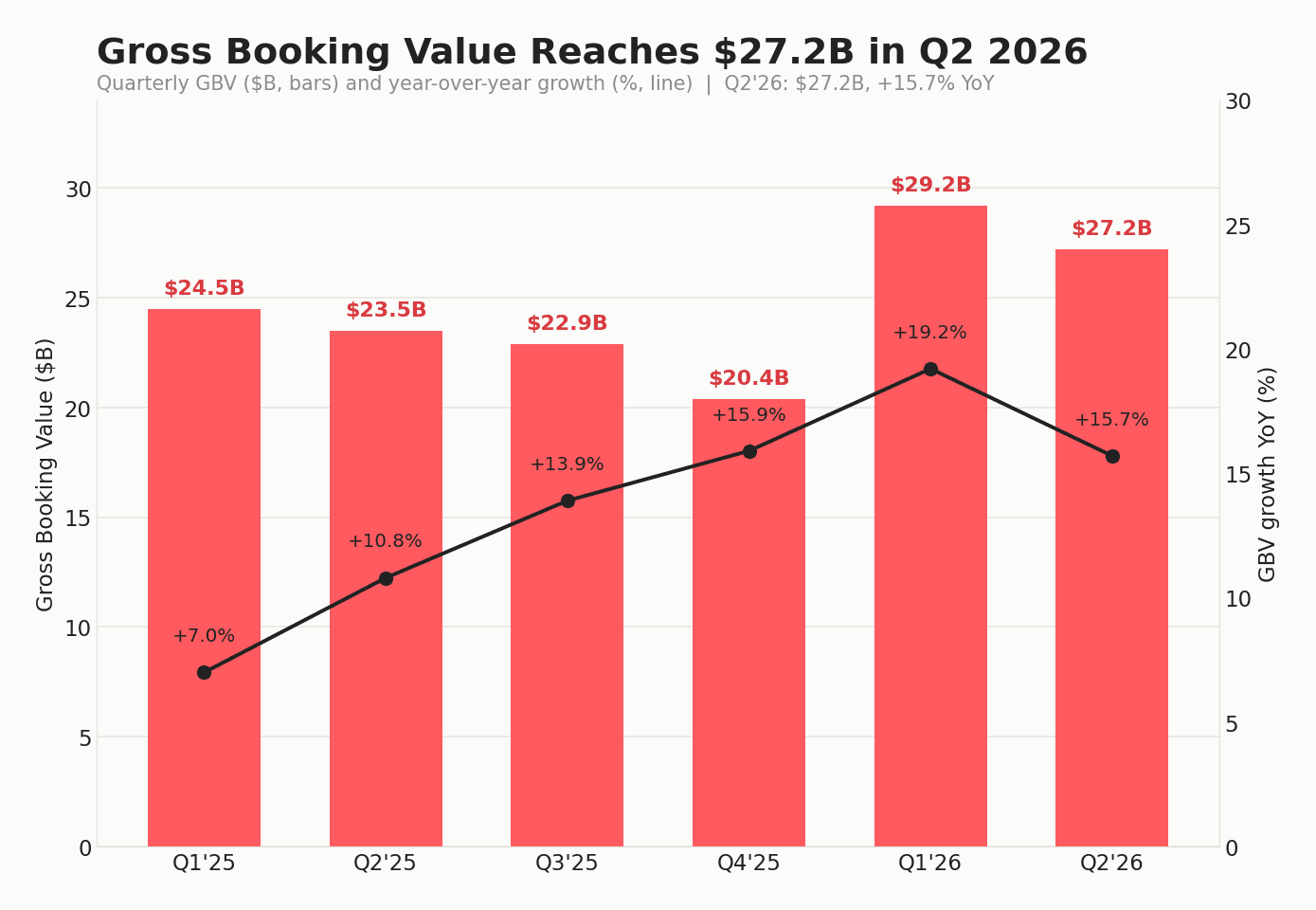
Gross Booking Value, the total dollar value flowing through the platform, reached $27.2 billion, up 16% year over year. That was powered by the faster nights growth plus a 5% rise in the average daily rate to $183.73, helped by a mix shift toward larger, entire-home listings. Bedroom nights booked grew more than 12%, and Airbnb passed one billion bedroom nights over the trailing twelve months for the first time.
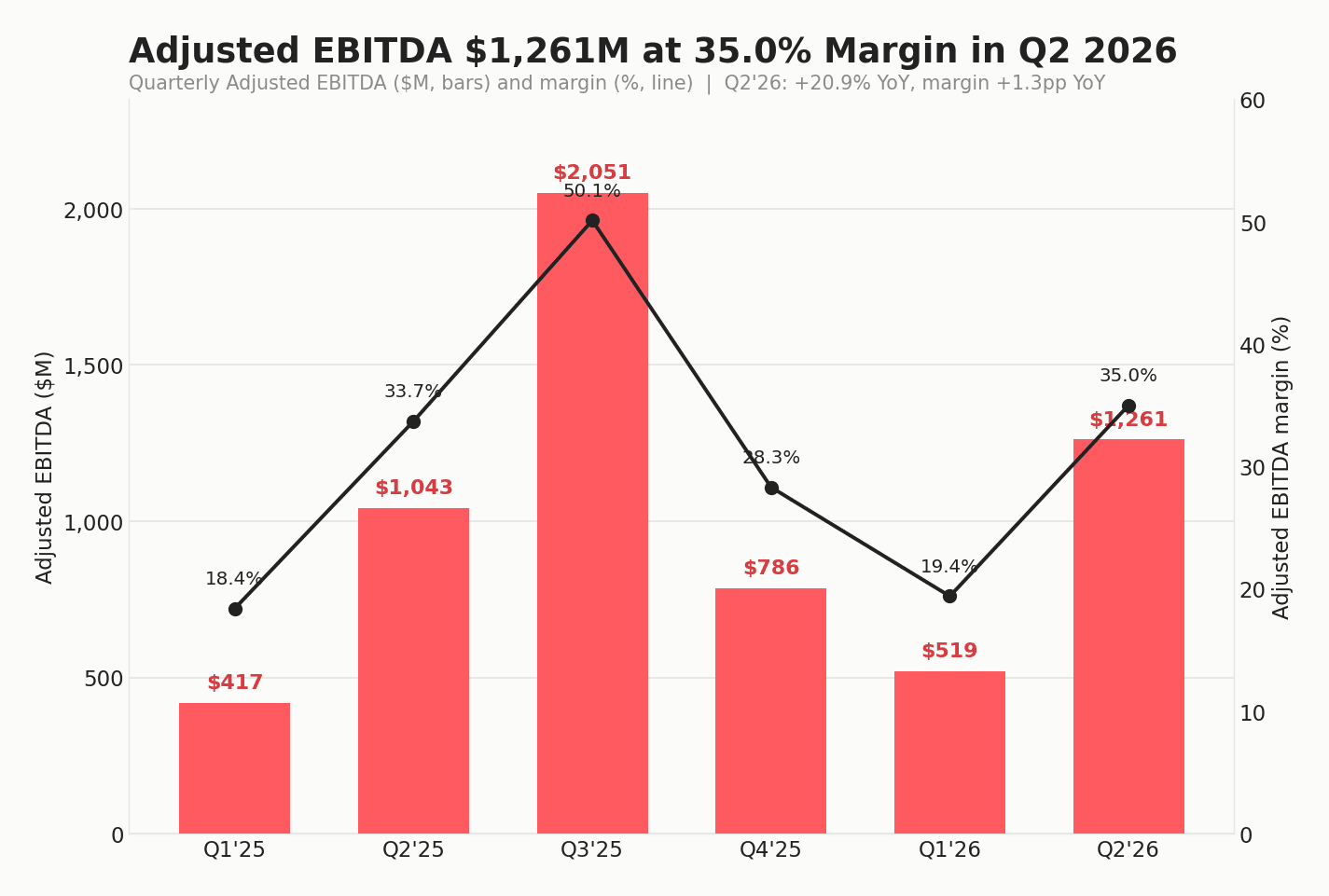
Profitability expanded alongside the top line. Adjusted EBITDA rose 21% to $1.26 billion, lifting the margin to 35.0%, up 1.3 points from a year ago. GAAP net income was $816 million, a 22.6% margin, though that figure includes a $77 million tax benefit tied to newly published guidance on prior-year taxes. Free cash flow was $1.25 billion at a 35% margin, and Airbnb converted almost all of it to cash on just $17 million of capital spending. The company bought back $1.1 billion of stock in the quarter, has $3.4 billion of buyback authorization left, and has cut its fully diluted share count by about 10% since repurchases began in late 2022.
Some of this efficiency is a story management wants investors to notice. Airbnb described itself as rebuilt to be an "AI-native" company, and put numbers behind it: an AI support assistant now covers 50-plus languages and resolves about 45% of issues without a human agent, which helped push customer-support cost per booking down roughly 16% year over year.
The raise, the reaction, and the pushback
Airbnb lifted its full-year outlook, guiding revenue growth to at least the mid-teens and raising the adjusted EBITDA margin floor to at least 35.5%, up from at least 35%. For the third quarter it guided revenue of $4.69 billion to $4.77 billion, above the roughly $4.61 billion analysts expected, though it noted margin would tick down slightly versus a year ago on the timing of marketing and technology spending.
The reaction was decisively positive. The stock, which had drifted to a $151.64 close before the report, traded near $167.50 the next day, about 10% higher. Sell-side sentiment had already been building into the print, with price-target raises from Jefferies (to $175), UBS (to $163), and Baird (to $160), plus upgrades from Oppenheimer and Cantor Fitzgerald.
The bear case did not disappear. Morgan Stanley remains the lone Underweight, with a $125 target that frames Airbnb's premium multiple, near 37 times earnings and above Booking Holdings, as unsupported by near-term growth. US demand deceleration is the recurring worry, and heavy insider selling ahead of the quarter, including large sales by the co-founders and the chief executive, is a sentiment overhang that has nothing to do with the fundamentals.
The takeaway
The record revenue is the headline that moved the stock, but it is not the most interesting thing Airbnb reported. The company is showing that it can bring in new travelers cheaply, through hotels and services and a better app, and convert them into the home stays that generate its profit. Hotels growing three times faster than homes, a third of hotel guests migrating to homes, and the fastest first-time booker growth in four years are all pointing the same direction. Whether the premium valuation holds will depend on the US demand trend and how much of the AI-driven efficiency reaches the bottom line. For a fuller look, Airbnb's Q2 2026 shareholder letter and its investor relations site have the details.