Apple's record June quarter, and the sell-off that followed
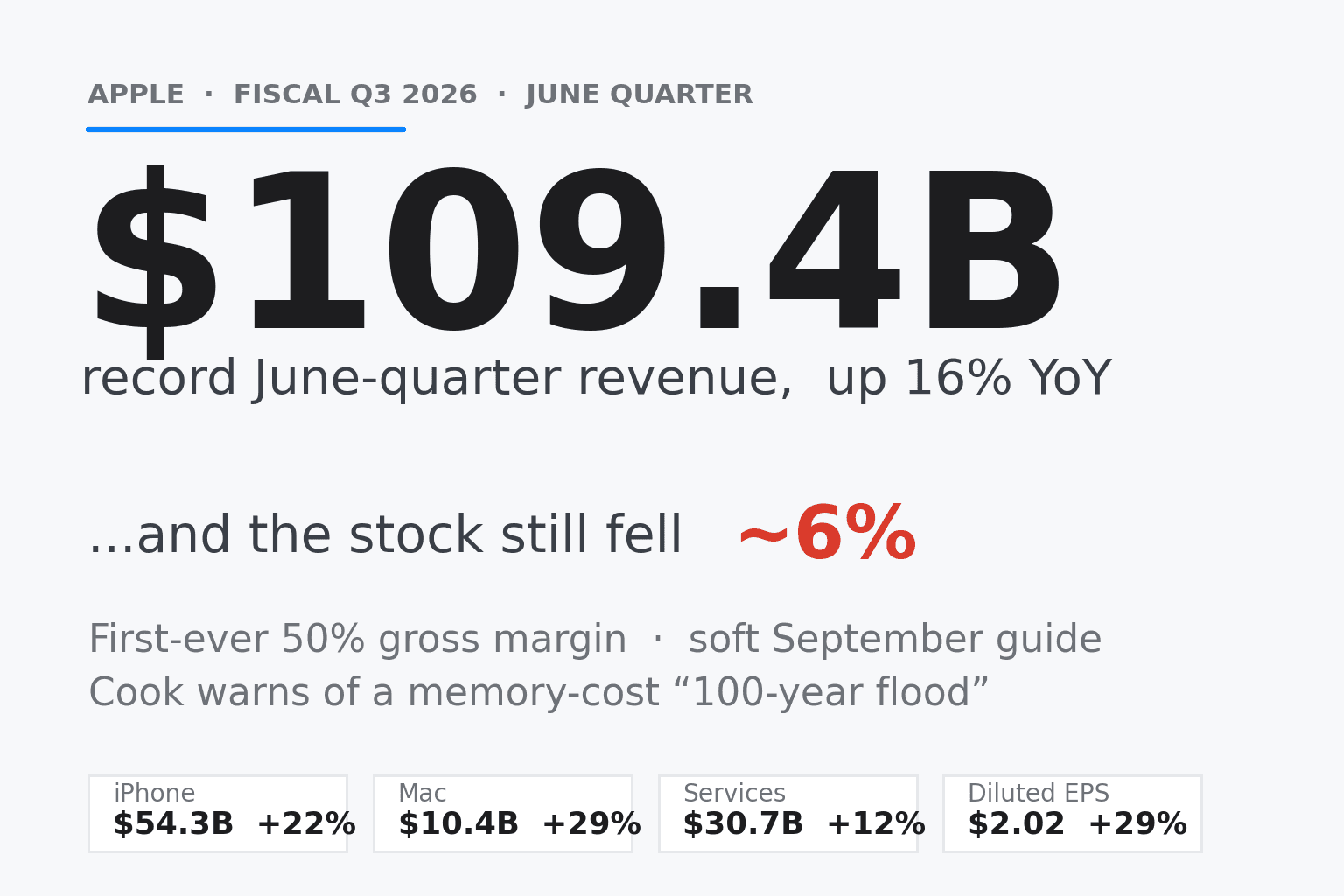
Apple just did something it had never done in a June quarter, and the market punished it for what comes next.
The trailing numbers were close to flawless. Total revenue of $109.4 billion, up 16% year over year, the strongest June quarter in the company's history. Diluted EPS of $2.02, up 29%. Gross margin of 50.06%, the first time Apple has ever cleared 50% on a reported basis. iPhone at $54.3 billion, up 22%. Mac at $10.4 billion, up 29%. Both beat what analysts had modeled.
And the stock fell about 6% in after-hours trading, shedding something like $390 billion of market value in an hour. This was Tim Cook's last earnings call as CEO, and he spent part of it warning shareholders about a shortage nobody wanted to hear about.
A record quarter, on almost every line
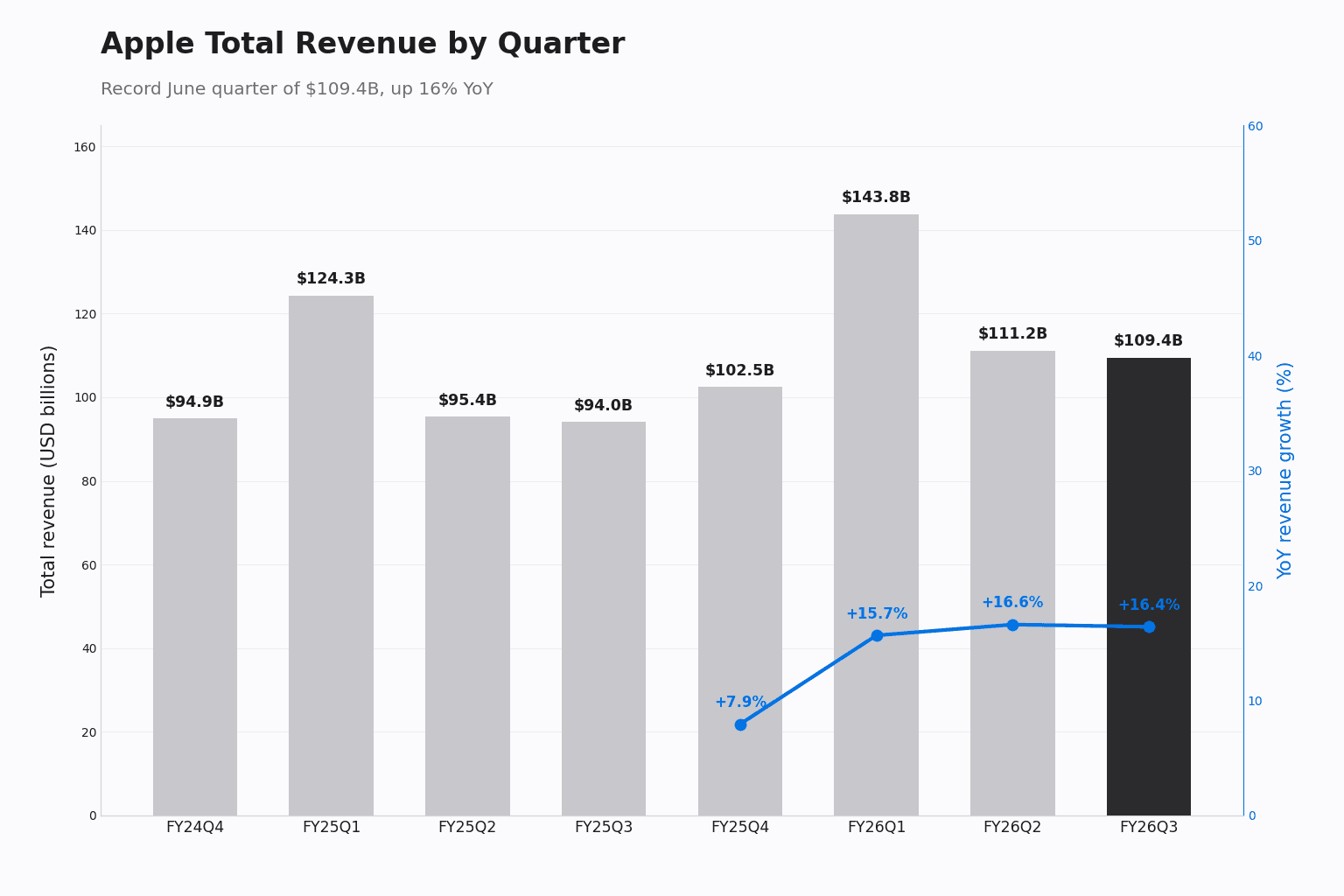
Apple's revenue swings hard by season, so the honest comparison is year over year rather than against the December holiday peak. On that basis, $109.4 billion versus $94.0 billion a year ago is a 16.4% gain, and the growth is broad. Every geographic segment grew double digits. iPhone, Mac and Services each set a new June-quarter record. Operating cash flow hit a June-quarter record of about $34.4 billion.
EPS of $2.02 beat the roughly $1.89 the Street expected, and revenue cleared the ~$108.9 billion consensus. On the trailing quarter alone, there was very little to complain about. The problem is that "the trailing quarter" is not what moved the stock.
iPhone and Mac carry it; iPad is the soft spot
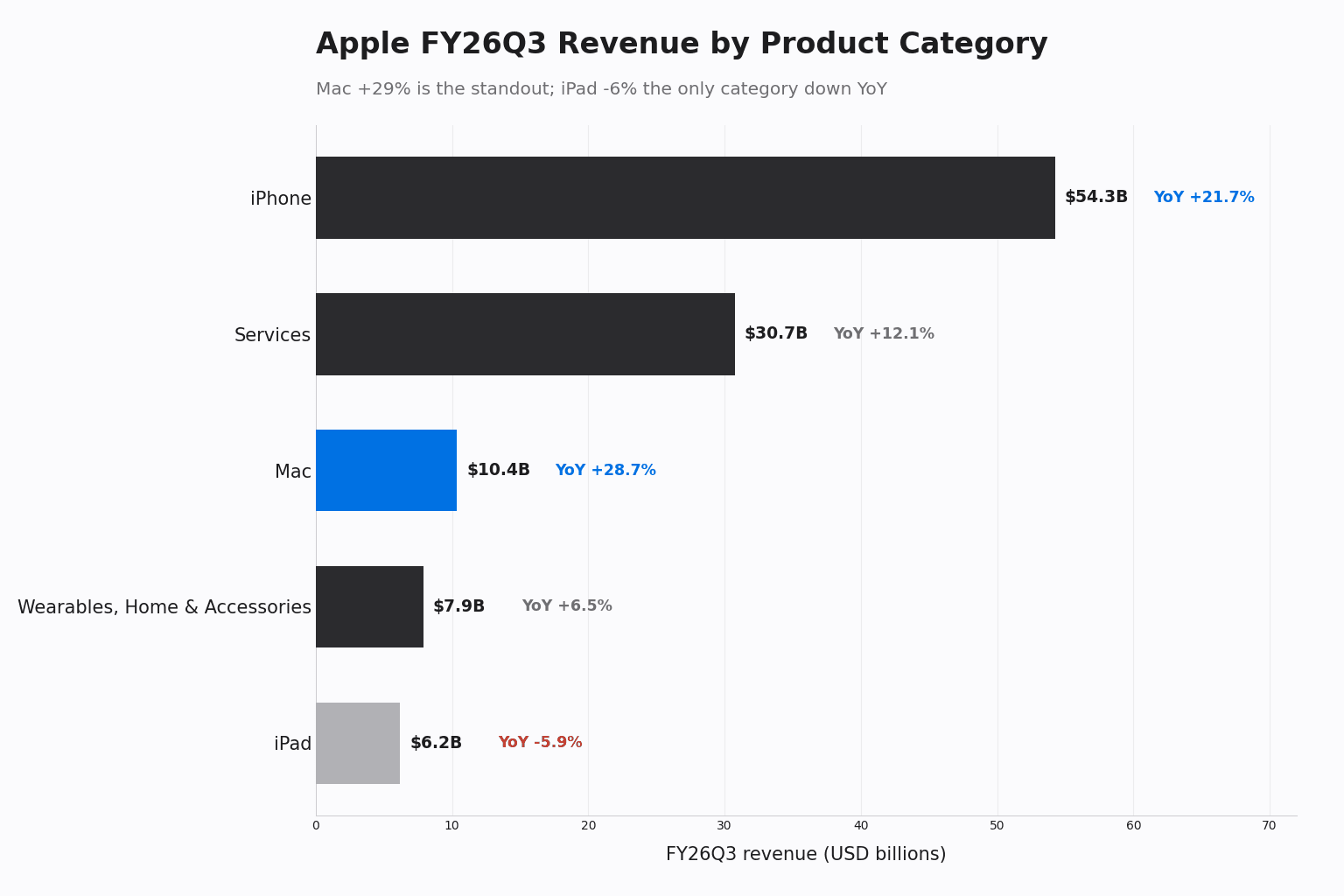
The clean beats were in hardware. iPhone at $54.3 billion topped the ~$53.6 billion estimate, helped by the current lineup. Mac was the real surprise: $10.4 billion, up 29% year over year and up 23% sequentially, against an estimate closer to $8.6 billion, driven by the latest MacBook refresh. Mac climbed to 9.5% of revenue, its highest mix in the set, which pushed iPhone's share down to 49.6% even as iPhone dollars grew more than 20%.
Not everything worked. iPad fell 6% year over year to $6.2 billion, lapping a strong prior-year refresh, and Wearables was a single-digit grower. Those are small lines. The bigger disappointment sat in Services.
Services and China: the demand-quality misses
Services set a June-quarter record at $30.7 billion, up 12%. But records are not the same as beats. The Street wanted something closer to $31.2 billion, and 12% growth is a step down from the mid-teens rates Apple posted earlier in the fiscal year. Management pointed to a gaming slowdown and App Store business-model changes as part of the drag. Services is the bull case's high-margin compounder, so any deceleration there gets scrutinized harder than a hardware line would.
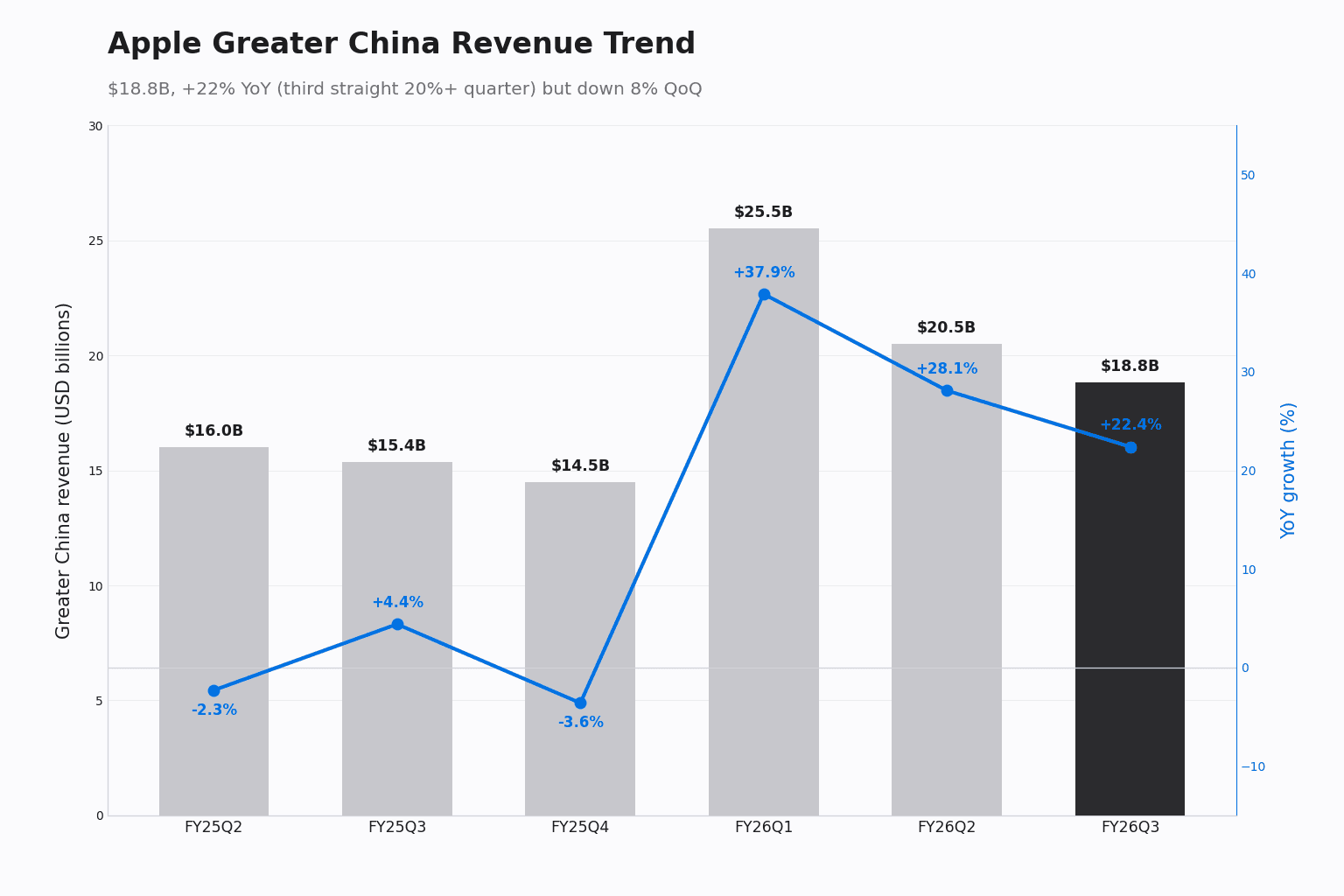
Greater China is the more interesting call. On paper it looks strong: $18.8 billion, up 22.4% year over year, a third consecutive quarter of 20%-plus growth, which is the best sustained China run Apple has managed since the iPhone 12 cycle. But the Street had penciled in roughly $19.6 billion, and the segment fell about 8% from the prior quarter. After two years of flat-to-negative China prints, expectations had reset upward, and this quarter cleared the year-ago bar without clearing the analyst bar.
The 50% margin comes with an asterisk
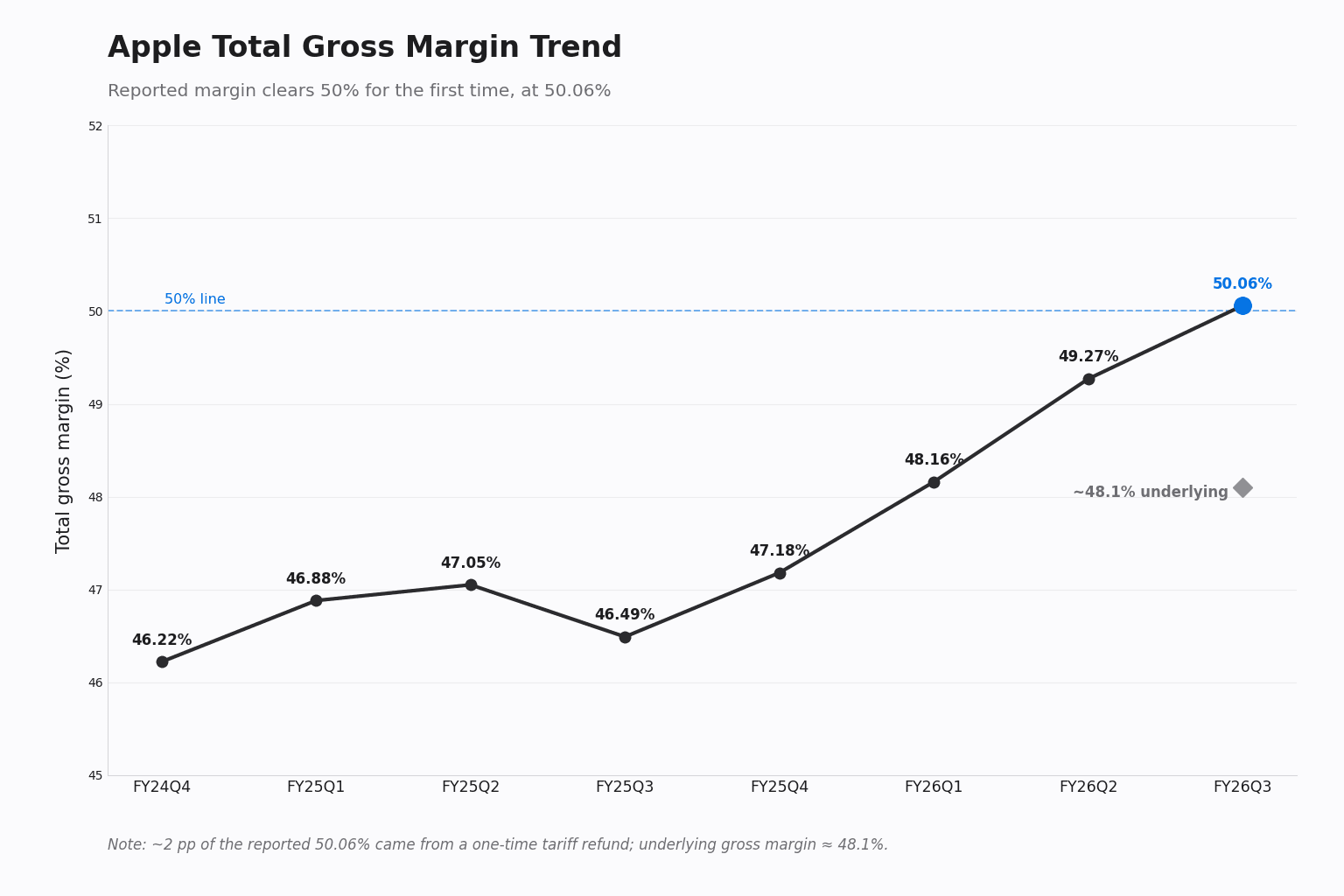
Here is the detail that got less airtime than it deserved. Apple's headline 50.06% gross margin and $2.02 EPS both include a one-time tariff refund worth roughly 2 percentage points of margin and about $0.11 of EPS. Strip that out and underlying gross margin was closer to 48.1%, with underlying EPS around $1.91. That benefit flows mostly through Products cost of sales, which is why Products gross margin jumped more than 5 points year over year.
To be clear, 48.1% underlying is still a record-high underlying June-quarter margin, and $1.91 is still up about 22% on a like-for-like basis. But it is not a recurring operating gain, and the reported "first time above 50%" headline reads better than the run-rate supports.
Why the stock actually fell
Records were priced in. AAPL went into the print near all-time highs, around $340, up roughly 22% on the year, so a clean beat was already in the number. The marginal news came from the outlook. Apple guided the September quarter to about +9-11% year-over-year growth, near $113 billion at the midpoint, below the ~$114.9 billion the Street wanted.
And the reason for the soft guide was the memorable line of the night. Cook described a "hundred-year flood" in memory pricing, a DRAM and NAND shortage — amplified by AI data-center demand — that is squeezing component costs and capping how much of strong iPhone demand Apple can actually supply into the September quarter. The company has been stockpiling inventory ahead of it; inventories on the balance sheet rose to about $11.1 billion from $5.7 billion at fiscal year-end. Memory suppliers like Micron and SK Hynix rallied after hours on the same commentary, since the cost pressure hurting Apple's margin is a tailwind for the chipmakers.
Put together, the report handed investors a soft guide, two demand-quality misses in Services and China, and a fresh margin risk from memory costs, all against a stock priced for a perfect print. The options market had implied a move of about 3.4%; the realized drop was nearly double that.
Cook's last call, Ternus's first problem
The timing gives the quarter an extra layer. This was Tim Cook's final earnings call as CEO. Under the transition announced in April, Cook becomes Executive Chairman and John Ternus takes over as CEO on September 1, 2026. Because the handover was pre-disclosed, it was not the sell-off catalyst, but it does frame the setup. R&D rose about 32% year over year to roughly $11.7 billion to fund the generative-AI roadmap, including the "all-new Siri AI" Cook highlighted from WWDC. Ternus inherits that spending, the memory-cost squeeze, and a Services line that needs to reaccelerate.
Analyst reaction: supply, not demand
The early sell-side verdict leaned toward "delay, not damage." JPMorgan's Samik Chatterjee was first out with a post-print move, trimming his target to $340 from $345 while keeping a Buy, arguing that supply constraints push revenue into later quarters rather than signaling weaker demand. Gene Munster of Deepwater made the same point more bluntly, estimating that without currency and supply constraints the September guide would have implied roughly 15% growth rather than about 12%. Into the print, targets ranged from JPMorgan near $340 up to Wedbush's Street-high $400. The bull rebuttal is coherent: if the constraint is memory supply, the demand is still there to be captured once the flood recedes.
What to watch
Three things define the next print, and it will be Ternus's first as CEO. First, whether Greater China holds above 20% once the sequential step-down is behind it, or slides back toward the flat prints of the prior two years. Second, whether Services can climb back toward mid-teens growth or whether the gaming and App Store drags persist. Third, and most important, how far the memory-cost "flood" actually cuts into gross margin now that the one-time tariff benefit rolls off. The operating company just posted its best June quarter ever. The market has already moved on to the September one.