Apple just had its best March quarter ever — and Tim Cook's last as CEO
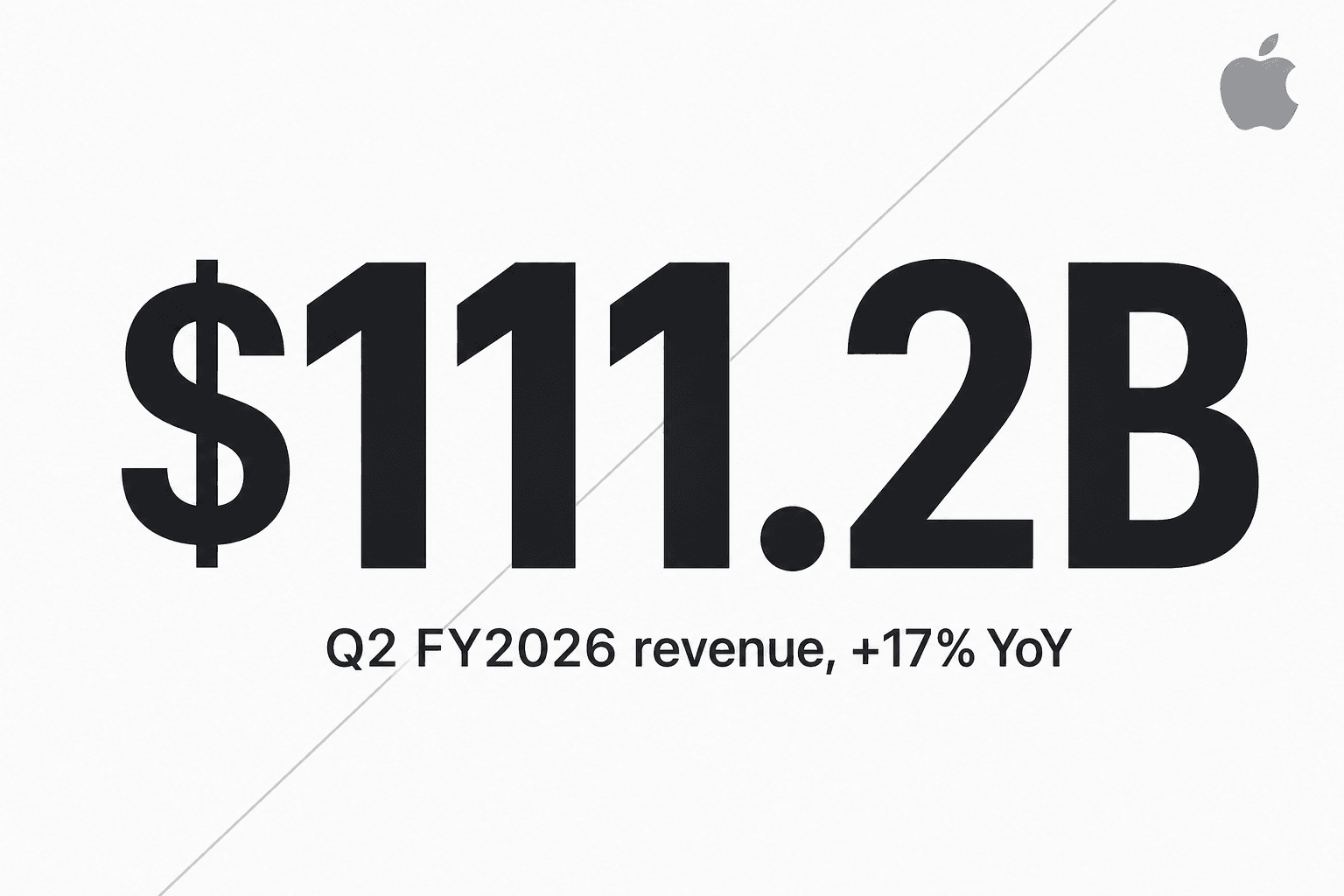
Two stories sit on top of Apple's FY2026 second-quarter print, and they pull in opposite directions.
The first is the numbers. Total revenue $111.2 billion, up 17% year over year. Diluted EPS $2.01, up 22%. Services hit a new all-time high. Greater China revenue rebounded to $20.5B, up 28% YoY. Gross margin printed 49.3%, the highest March-quarter figure Apple has ever reported. The Q3 FY26 guide came in at +14% to +17% YoY revenue growth — versus a Street modeling +9.5%. By every line of the press release, this is the cleanest Apple beat-and-raise of the last five years.
The second story is who delivers the next one. On April 20, ten days before this print, Apple announced that Tim Cook would become Executive Chairman effective September 1, 2026, and that Senior VP of Hardware Engineering John Ternus would take over as CEO. The April 30 call was Cook's first earnings appearance since the announcement and effectively his second-to-last as the operating CEO. Ternus did not appear on the call.
The market split the difference. AAPL closed +1.4% the next day. Options had priced an ~3.5% move. A textbook beat met a textbook unease.
The cleanest beat-and-raise in five years
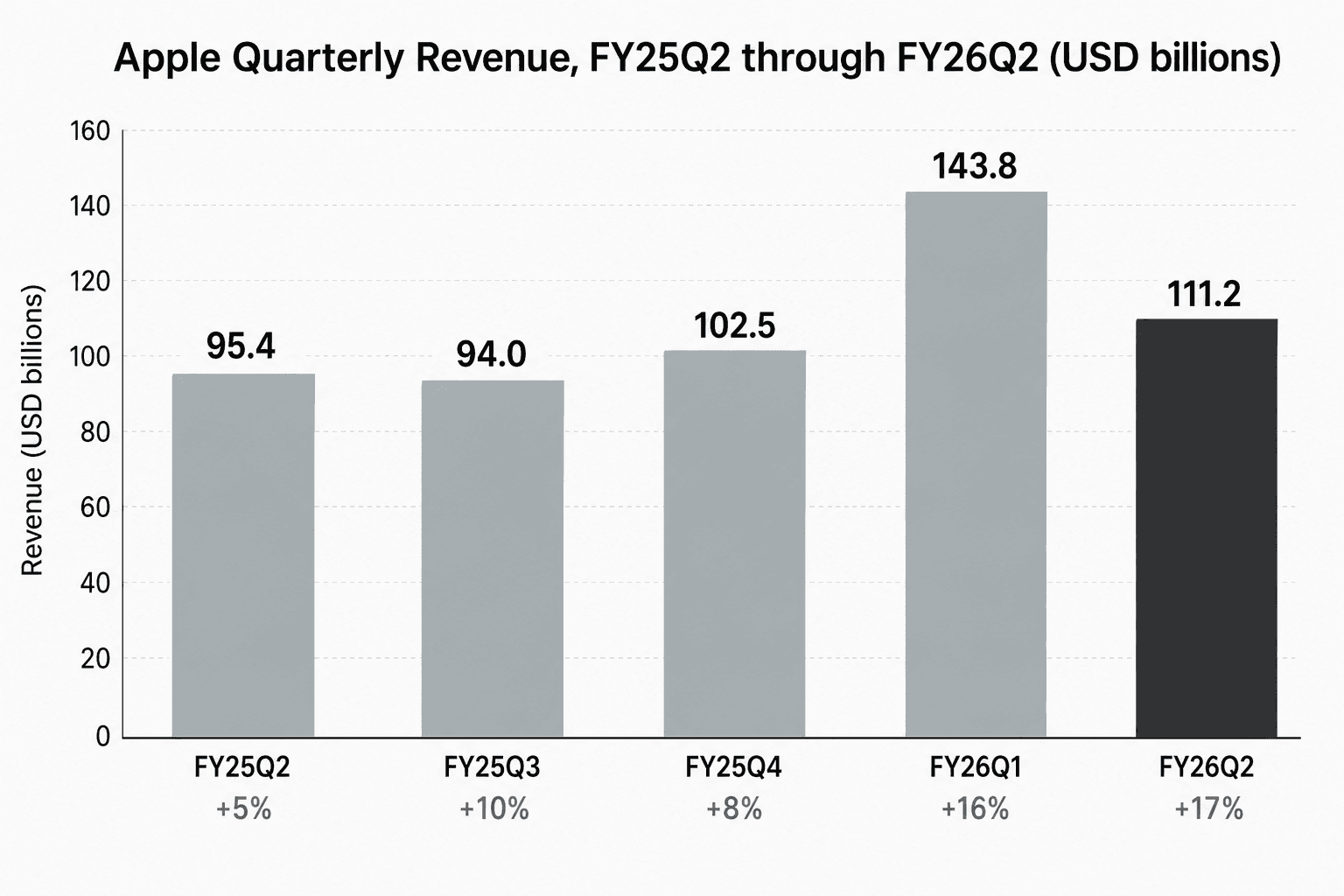
Apple's revenue sequencing is dominated by the December holiday quarter; comparing FY26Q2 to FY26Q1 will always look like a 23% sequential decline. The right comparison is YoY: $111.2B versus $95.4B in FY25Q2 is +16.6%.
That growth is not coming from one place. iPhone revenue of $57.0B is +21.7% YoY, the strongest March-quarter iPhone print on record, on what Cook called Apple's "most popular lineup ever" — the iPhone 17 family, expanded mid-quarter with the iPhone 17e. Mac revenue of $8.4B is +5.7% YoY, helped by the MacBook Neo launch. iPad of $6.9B is +8.0% YoY on the M4 iPad Air refresh. Wearables is a single-digit grower.
And Services hit $31.0B — a new all-time high, +16.3% YoY, with gross margin of 76.7% (+80 bps YoY). That margin compounds the entire P&L. Total gross margin came in at 49.3% (+280 bps YoY), the highest March-quarter gross margin Apple has ever reported. Operating income of $35.9B is +21.3% YoY.
Free cash flow for the first six months of FY26 was $78.3B, up 64% YoY against a much heavier capex comparable. Apple's cumulative capital return authorization picked up another $100B this quarter, on top of the still-running prior program.
China is back
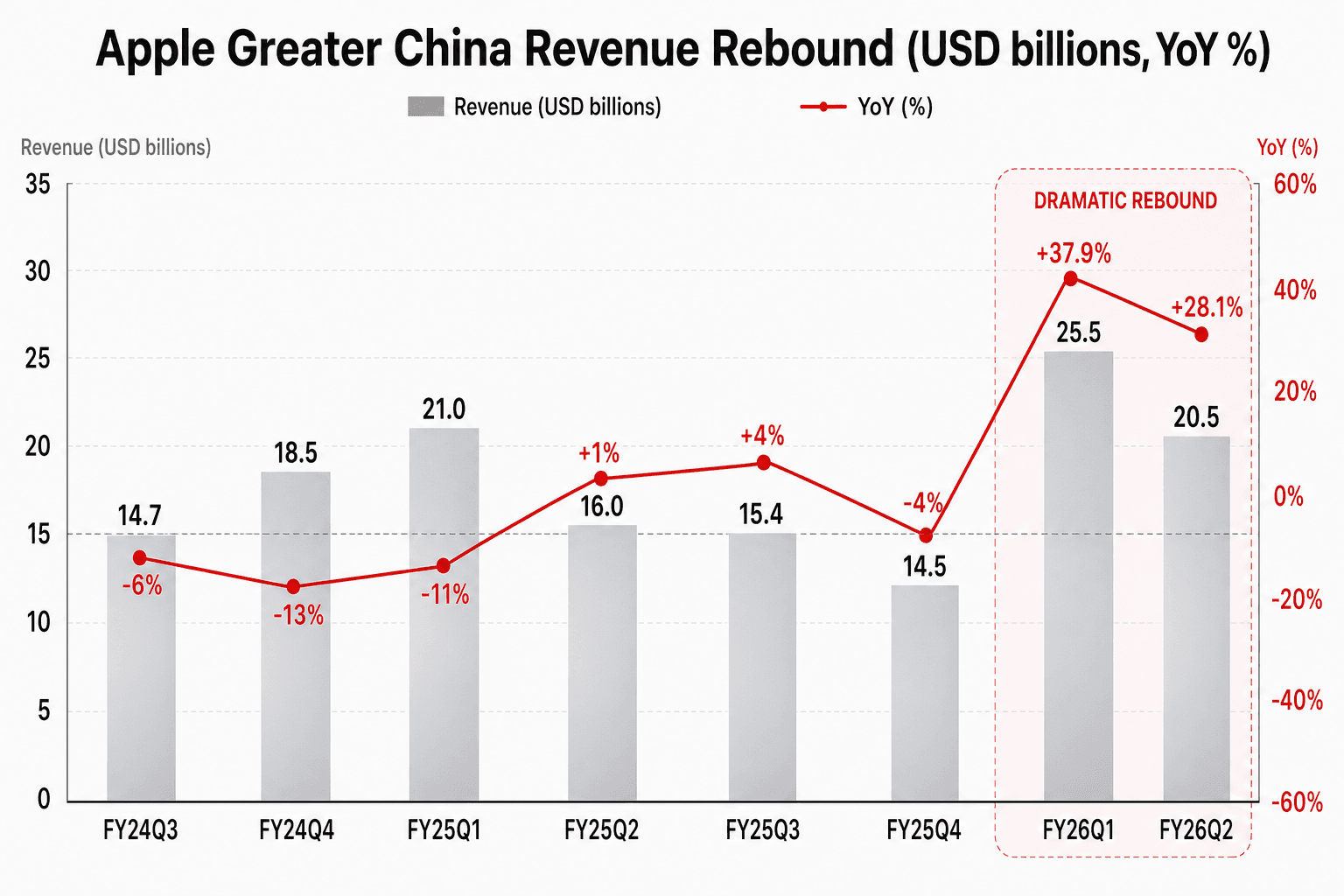
The single most-debated number in this print is the Greater China line: $20.5 billion, up 28.1% year over year. That is the segment's second consecutive quarter of +28%-or-better YoY growth, after a stretch from late FY23 through FY25Q4 in which the segment printed flat-to-down most quarters.
Two factors are operating here. China's local-government consumer-electronics subsidies remain in place through the back half of 2026 and have been particularly favorable for premium smartphones. And the iPhone 17 lineup — and especially the iPhone 17e — landed at price points that map cleanly onto the subsidy thresholds.
The bear case is straightforward: subsidies pull demand forward. Two strong quarters might be a band rather than a step-change. The bull case is that iPhone share in mainland China is at the highest level in more than two years, and that share gains, once made, are hard to give back.
Cook explicitly told the call that channel inventories in China are healthy and that days-of-supply is "within target range across all geographies." That language matters: China-specific demand pull-forward typically shows up first as channel inventory bleed.
The product mix shifts back to iPhone
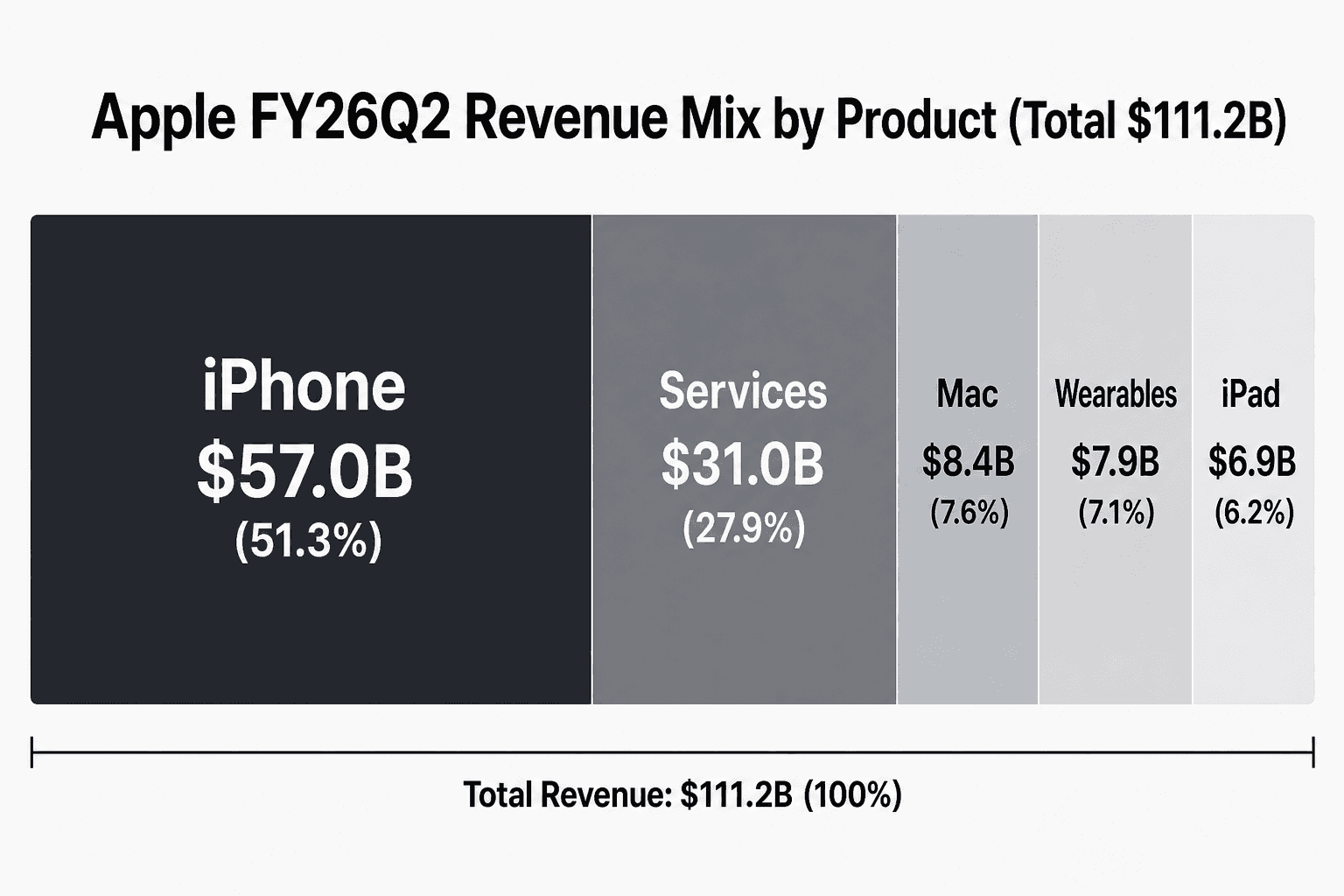
Apple's product mix oscillates with cycles. In FY26Q1, iPhone was 59% of revenue on the holiday cycle. In FY25Q3 — a quieter mid-year quarter — iPhone was 47%. FY26Q2 prints at 51.3%. That's elevated for a March quarter, and it's the cleanest signal in the segment data that the iPhone 17 cycle is real.
Services at 27.9% of revenue is roughly in line with last year's FY25Q2 (also 27.9%). What's different is the absolute base: $31.0B vs $26.6B a year ago. Services is now compounding off a $124B annualized run rate at +16% YoY — for context, Services alone is now larger than Mac + iPad + Wearables + Home & Accessories combined ($23.2B in FY26Q2).
The sum-of-parts arithmetic is starting to look genuinely different from the company narrative most investors have been carrying. iPhone is the cyclical engine; Services is the compounder; everything else rounds.
What the call said about Ternus
Cook devoted the first three minutes of his prepared remarks to the operating numbers. The succession question came in the second sentence of Q&A and consumed roughly a third of the call.
The headline from Cook: "I have full confidence in John. He has been a partner across every major product decision for more than a decade." Cook stays through WWDC (June 8, 2026) and the iPhone 18 launch as CEO; September 1 is the formal handover. Cook becomes Executive Chairman.
The headline from analysts: continuity is the base case, but the absence of Ternus on the call left every model with a free parameter. Wedbush's Daniel Ives raised the price target to $365 and called the succession "uncertainty, not a thesis change." Bernstein's Toni Sacconaghi reiterated Underperform at $235 and argued the AI-monetization question gets sharper with new leadership, not softer.
Two-thirds of the sell-side raised price targets after the print. Consensus PT moved to roughly $310 from $300. The dispersion (Wedbush $365 high to Bernstein $235 low) is the widest it has been in five years.
Q3 guide is the surprise
Apple guided FY26Q3 revenue to grow +14% to +17% YoY. Street consensus going into the print was +9.5%. The implied dollar revenue range is roughly $107.2B–$110.0B for the June quarter, against a base of $94.0B in FY25Q3.
The guide composition Parekh laid out: iPhone is the single largest YoY contributor; Services and Greater China are next; Wearables is expected to grow YoY for the first time in five quarters. Gross margin guide of 47.5%–48.5% is below this quarter's 49.3% but well above last year's FY25Q3 print of 46.5%.
A 9.5%-versus-15.5% midpoint guide gap is large by Apple standards. The last time Apple's revenue guide implied a similar magnitude of upside vs. consensus was the iPhone 12 cycle in FY21.
What to watch
The next print will be Cook's last earnings call as CEO. Three things will define it.
The first is whether China stays at +28%. If the rate sustains for a third consecutive quarter, the bear "subsidy pull-forward" thesis quietly dies. If it decelerates to single digits, that thesis gets reanimated.
The second is the Apple Intelligence economics question. WWDC on June 8 is the next major event; Cook said the rollout is "ahead of where we modeled it" but declined to quantify revenue contribution. Apple's H1 FY26 capex of $4.3B is dwarfed by hyperscaler peers — depending on your prior, that's discipline or under-investment.
The third is the handoff. Ternus has not yet appeared on a quarterly call. He will be CEO when the FY26Q4 print lands in late October.
For now, the line that fits the data is the simple one: the operating company is in the best shape in five years, just as the operator of the last fifteen years prepares to step back.