MediaTek Q2 2026: Smart Edge Platform Overtakes Mobile
This quarter, on paper, MediaTek is no longer a handset company
For more than a decade the market has understood MediaTek in a single line: one of the world's largest suppliers of Android handset chips. The Q2 2026 report takes that line apart.
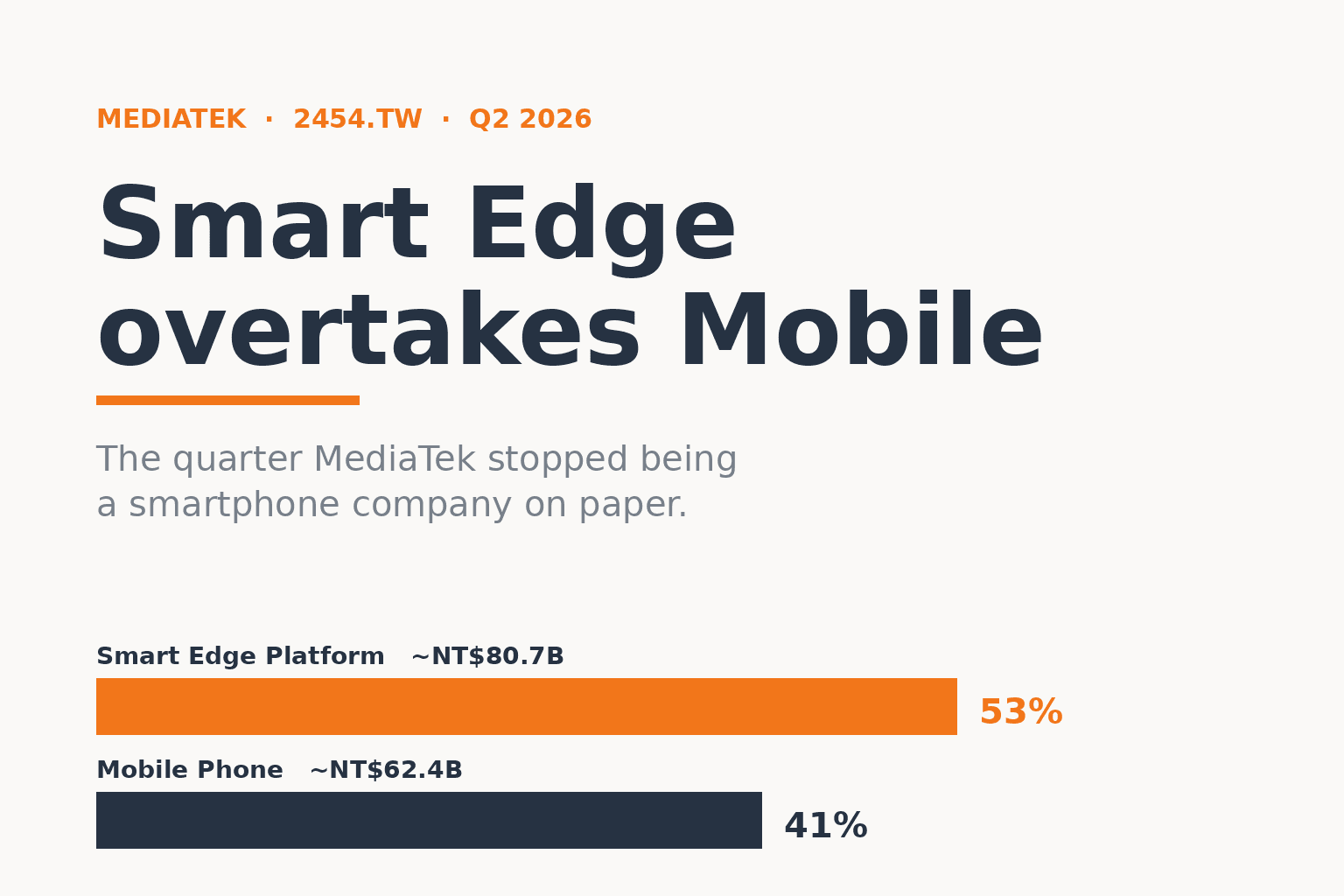
This quarter MediaTek's Smart Edge Platform (the connectivity, compute, automotive and TV chips outside of handsets) took 53% of revenue at roughly NT$80.7B, overtaking mobile chips at 41% and roughly NT$62.4B to become the company's single largest business for the first time. A year ago, Mobile was still firmly number one. The Smart Edge Platform grew 26% YoY while Mobile fell 20% YoY — four quarters flipped the entire revenue mix.
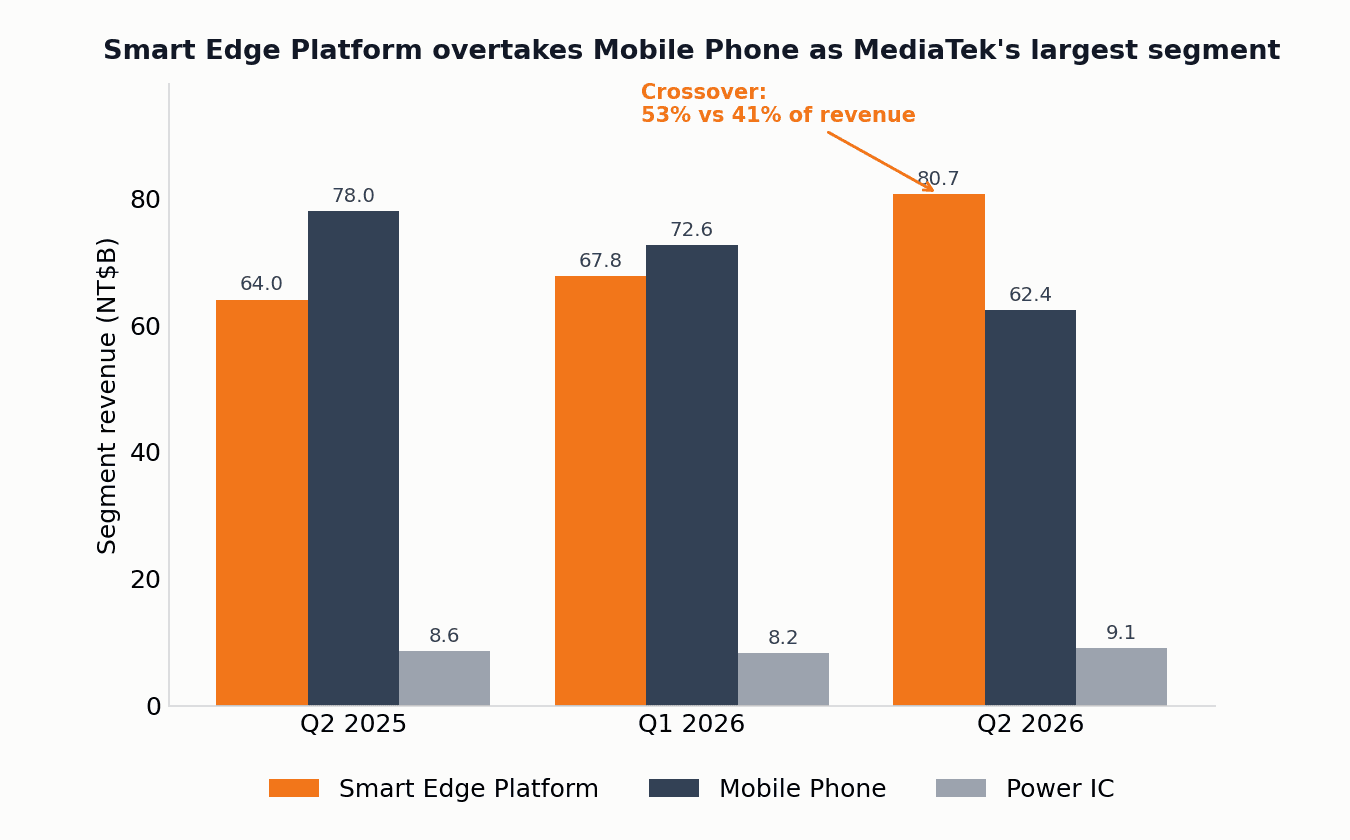
This is not an accounting reclassification. It is the result of demand structure genuinely moving: connectivity, compute and automotive chips keep gaining share; TV SoCs command higher unit prices as each carries more DRAM (memory); and data-center-related demand is beginning to seep into power management and compute products. With Mobile down from the main engine to one-third, the center of gravity of MediaTek's growth narrative has officially shifted from smartphones to the edge device and the data center.
Mobile is retreating, but not in disgrace
Look at the other side. Mobile chip revenue fell 14% QoQ and 20% YoY this quarter — the only one of the three businesses to shrink.
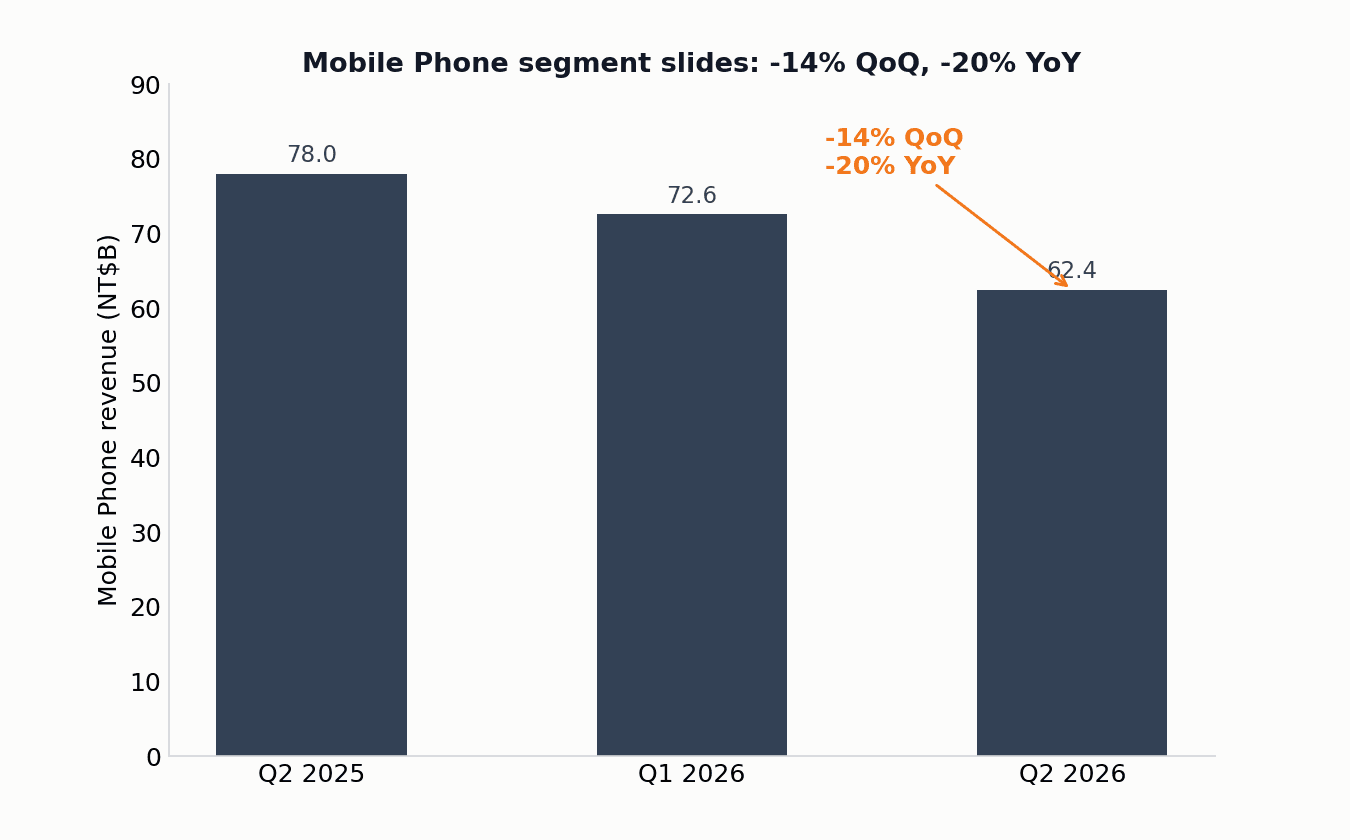
Management attributes the decline to higher handset materials costs and weak end demand, not lost share. MediaTek expects global handset shipments to shrink about 15% in 2026, with demand splitting to two poles: differentiated flagships at one end, price-sensitive entry models at the other. Its response is to lean into the high end — in Q3 it will launch a 2nm flagship handset SoC built around on-device "agentic AI" compute, and management expects the flagship ramp to offset weakness in other models, leaving Q3 mobile revenue flat to slightly down QoQ. Mobile is no longer the growth engine, but it remains a steady cash generator.
Revenue hit a five-quarter high; gross margin held at 46%
What the structural shift overshadowed is that this was, in fact, a "beat" of a report. Q2 2026 revenue was NT$152.2B, up 2.0% QoQ and 1.2% YoY — the highest in five quarters, and the first return to YoY growth since Q4 2025. The figure landed above the top of the guidance range (NT$140.2B to NT$149.2B), 2.0% above the high end, and about 4.6% above sell-side consensus (roughly NT$145.5B).
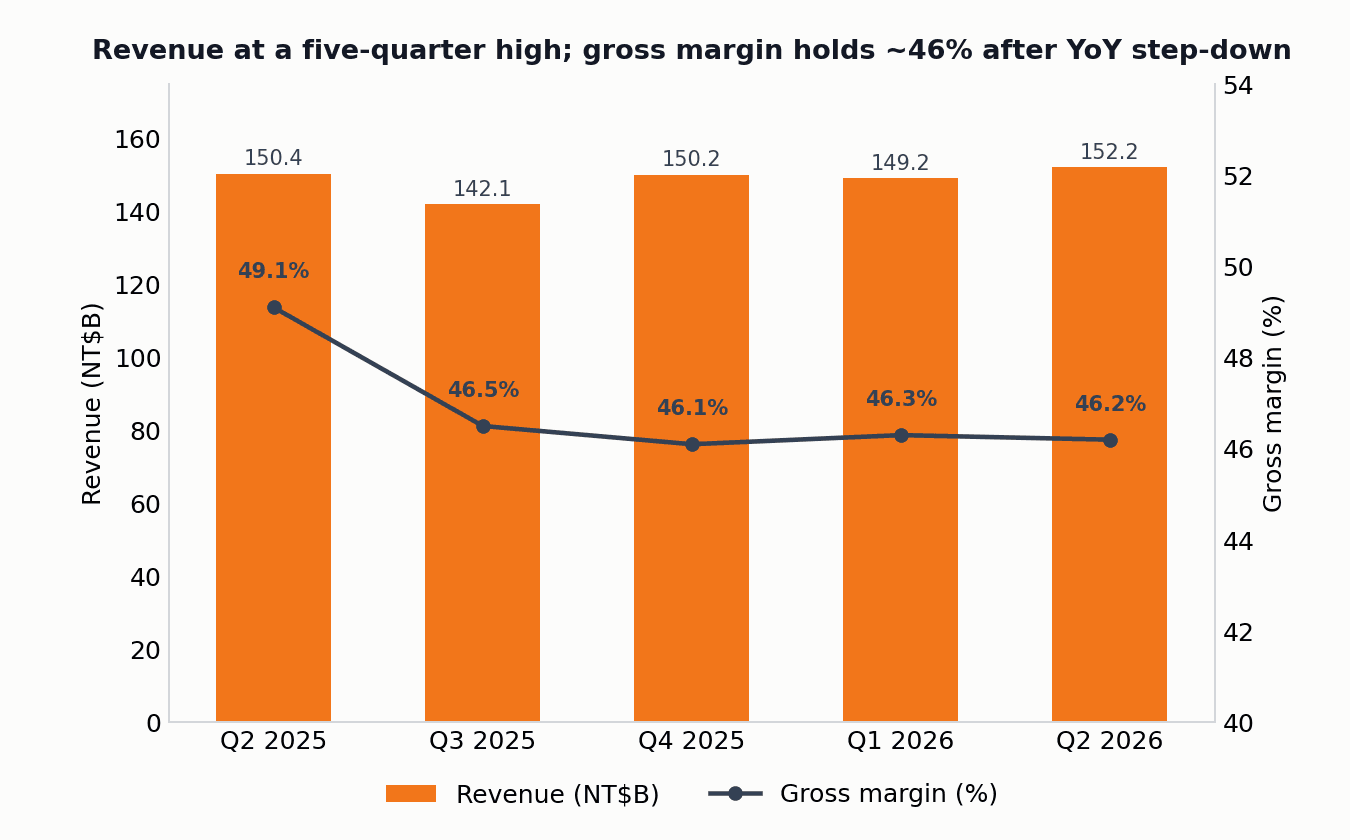
On profitability, watch the base. Gross margin was 46.2%, down 0.1 point QoQ and 2.9 points YoY; the YoY decline is chiefly because the year-ago quarter (Q2 2025) carried a one-off non-operating gain within its 49.1% margin, not a deterioration in the core business. Stripping out the base, gross margin has held in a narrow 46.1% to 46.5% band for four quarters. EPS was NT$15.28, up 0.7% QoQ and down 12.7% YoY; net income fell 12.3% YoY, again mostly a base effect. First-half EPS totaled NT$30.45, more than three times par value. Operating cash flow swung from a net outflow of NT$17.66B in Q1 to a net inflow of NT$24.25B.
The real headline: the AI numbers were revised up across the board
If the April call was the first time MediaTek put a dollar figure on its ASIC business, this July 31 call raised nearly every AI number. An ASIC is an application-specific integrated circuit, custom-built for a particular customer.
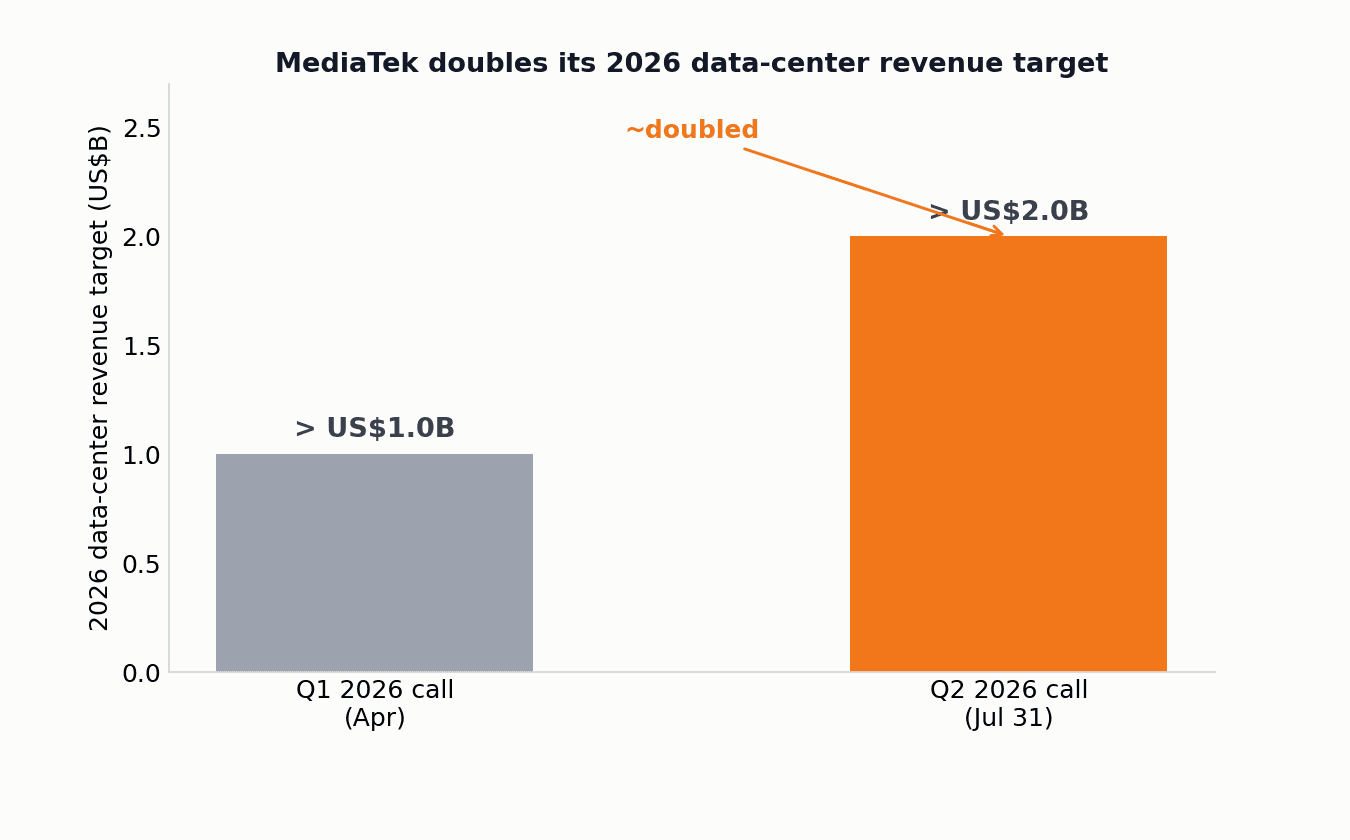
Here is the list. The 2026 data-center revenue target doubled from "over US$1B" to "over US$2B" (about NT$63.2B). The first AI accelerator ASIC is confirmed to enter mass production in Q4, co-developed with an unnamed large US cloud provider. The 2027 serviceable available market (SAM, counting only AI accelerator chips and excluding CPUs, networking switch chips and HBM) was raised from about US$50B to US$80B, and MediaTek's share target lifted in step from 10–15% to 15–20%. A second ASIC is targeted for mass production in early 2028, running in parallel with the first. Separately, the board approved a US$5B (about NT$158B) flexible financing facility to lock in supply-chain capacity and support the shift from selling chips to providing complete systems and platforms.
CEO Rick Tsai set the tone: "We have successfully built a performance-leading first AI accelerator ASIC, on track for mass production in Q4 this year." On the second chip, he said it would "very significantly lift our market share." Management also struck a humble tone, emphasizing the need to "stay grounded, deliver on customer commitments, and keep building trust," with a long-term goal of winning "more than its fair share." The sell-side links the first ASIC to Google's TPU program, and the market narrative is that MediaTek, on the strength of its 224G-to-448G SerDes (high-speed serial transmission) technology, picked up next-generation orders after Broadcom's 448G slipped — but MediaTek has not confirmed the customer's name.
Why the stock rose only 2.7%
A report with record revenue and an across-the-board upgrade to the AI targets, and yet the stock rose only 2.7% after the call to close at NT$3,235. The reason: the re-rating had already happened.
From May to July, MediaTek's stock went through a violent re-pricing: the shares ran from about NT$3,240 all the way to an all-time high of roughly NT$4,970 in June, with foreign-broker price targets ranging from NT$5,000 to NT$10,000 (Macquarie the Street high at NT$10,000, Goldman Sachs NT$6,800, UBS NT$6,500), then retraced about a third before this call. In other words, this call confirmed and extended the existing thesis rather than resetting it, so the market largely held its prior levels. From the start of the year through end-July, the stock is still up about 148.6%. This wave of AI ASIC re-rating is now largely reflected in the price; the next leg depends on execution — the Q4 ramp of the first ASIC and the handoff to the second in 2028 — rather than on a new narrative.
The other side: Mobile retreats, memory rises, and gross margin is capped at 46%
Bulls and bears actually share the same set of facts. The bulls are buying the end-state profitability of an AI ASIC ramp from 2028 onward — Goldman Sachs' model even puts 2028 EPS at around NT$422. The bears fix on the near term: Mobile is down 20% YoY at 40% of revenue, built on a handset market management itself expects to shrink about 15% a year; and memory costs have risen more than 90% since late 2025, which MediaTek can only pass on by raising prices on some chips. CFO David Ku put it bluntly: "the goal is to hold gross margin, not to lift it," so any margin recovery is capped near 46%.
Between the two cases sits one more signal worth watching: inventory days rose to 102, above 87 the prior quarter and 66 a year ago. Management frames this as deliberate stocking — pre-locking wafers, substrates and memory for the Q4 data-center ASIC ramp, the same logic as the US$5B financing facility — rather than softening demand. Whether it is positioning rather than inventory pressure, as management claims, will be the operating metric most worth tracking over the next two quarters.
Q3 2026 guidance keeps an expansionary tone: revenue of NT$152.2B to NT$159.8B (flat to up 5% QoQ, up 7% to 12% YoY), with gross margin of 46% plus or minus 1.5 points. The real answer this quarter is not in the current-quarter EPS, but in a more fundamental question: once Mobile is no longer the largest business, what multiple should the market use to price a MediaTek that is transforming into a data-center systems supplier.