MediaTek Q1 2026: Data Center ASIC Finally Has a Number — $1B in 2026, 'Multi-Billion' in 2027
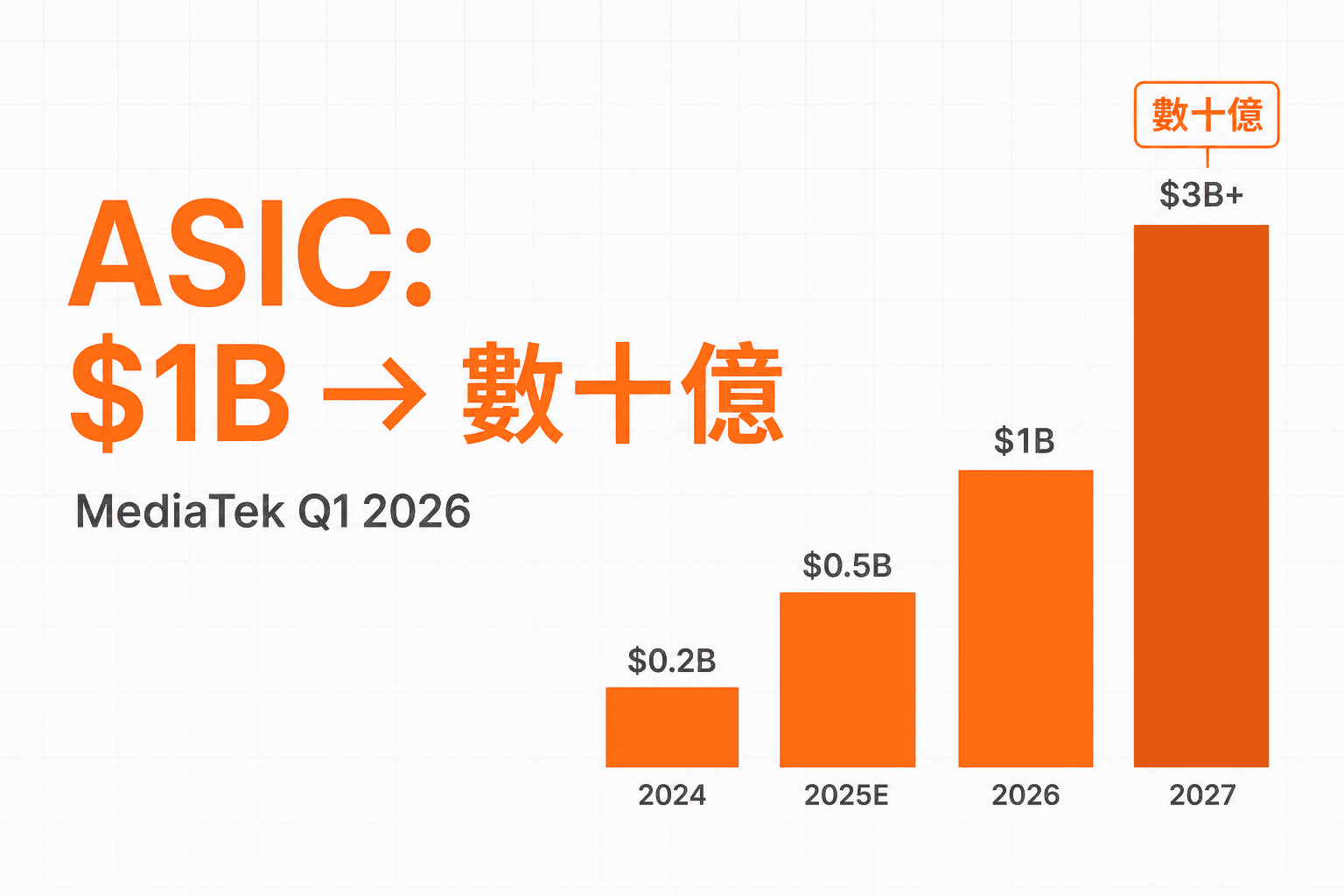
A "disappointing" quarter and a 67% rally in 11 days
Run MediaTek Q1 2026 through a traditional beat-the-consensus lens and it looks like a miss:
- Revenue NT$149.2B, -2.7% YoY — first negative YoY print in two years
- EPS NT$15.17, -17.7% YoY — largest YoY decline in eight quarters
- Q2 2026 mid-point guide NT$144.7B, another -3% sequential
But by April 30 (earnings call day, before the print), MediaTek was already at NT$1,725 — up +20% from NT$1,430 just two weeks earlier on a DigiTimes leak about a Google TPU partnership. On May 4 (the first session after the May 1 Labor Day holiday), the stock gapped open and locked at limit-up NT$1,897, with 23,000 lots queued at the bid and zero offers. Four more strong sessions followed; on May 8 the stock printed an intraday NT$2,400. Eleven trading days, +67%.
That's not a beat-the-consensus reaction. That's a re-pricing of the company itself.
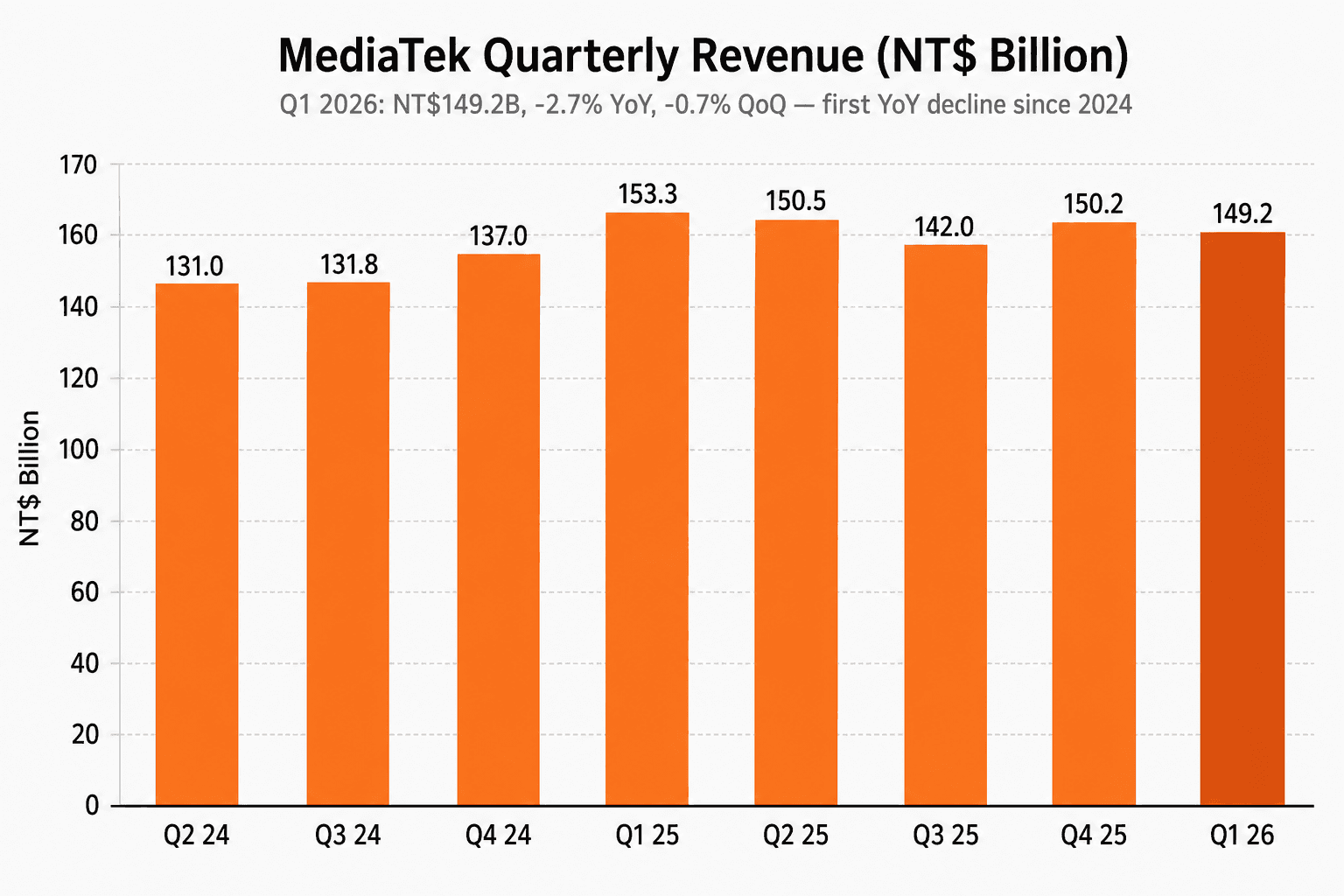
The headline numbers are pedestrian. The re-pricing trigger was two specific dollar figures that Rick Tsai gave in his prepared remarks.
Tsai gave the ASIC business actual numbers for the first time
For the past two years, MediaTek has talked about ASIC in vague terms — "we are engaged on programs," "we have multiple customer designs in progress." Q1 2026 was the first call where Tsai attached dollar figures to it:
We expect data center ASIC revenue to exceed US$1 billion in 2026. In 2027, we expect to reach the multi-billion-dollar (數十億美元) scale.
— Rick Tsai, MediaTek Q1 2026 earnings call, 2026/04/30
Aligned against history:
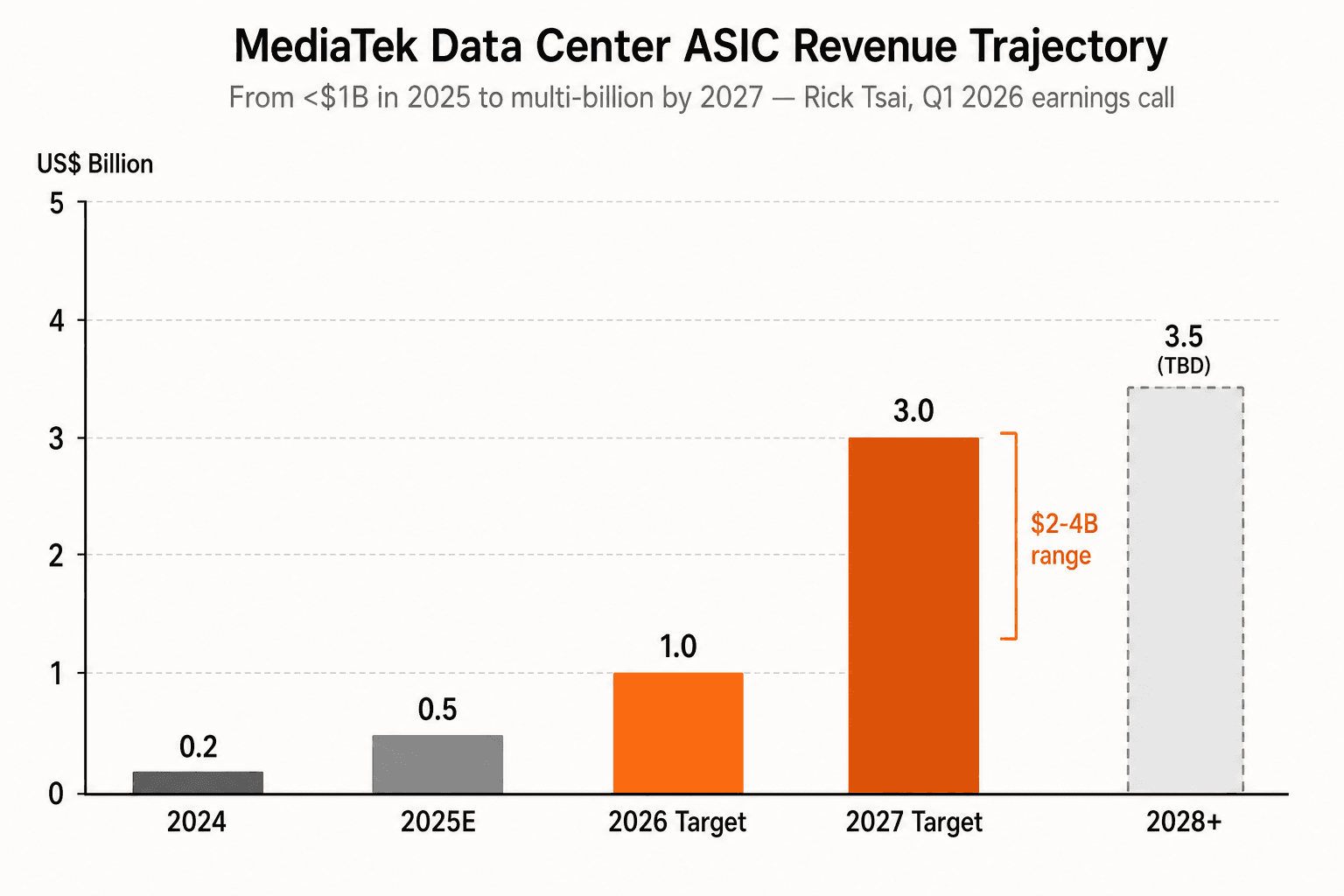
The implied math: 2026's $1B is roughly 5-6% of total revenue. 2027's $3B (sell-side mid-point) is 15-20%. In 18 months, ASIC goes from a sub-1% noise line to a quarter of the revenue base.
Three ASIC customers now publicly identified
Between the call and post-print press confirmation, the public ASIC customer roster is:
(1) NVIDIA GB10 (DGX Spark main chip) — already in volume production, Q1 2026 revenue recognized. MediaTek designed the CPU and handled system integration, including GPU chiplet integration. NVIDIA owns end-product DGX Spark sales and marketing. DGX Spark launched commercially in the US on May 5, 2026 — the day after the earnings call. The market timing was unusually clean.
(2) Google TPU collaboration — Tsai used "one of the largest cloud service providers globally" framing, but the partner was effectively confirmed when DigiTimes leaked it a week pre-print. The structural significance: Google's TPU work was historically done with Broadcom; the shift to MediaTek as primary partner implies both deal-size expansion and supply-chain diversification. Initial revenue 2H 2026, volume production 2027.
(3) Denso ADAS custom chip — partnership with the world's largest Tier-1 automotive technology supplier. MediaTek brings low-power AI compute; Denso brings automotive certification and deep system integration. First customer-facing chips in 2027-2028 production. Auto cycles are long, but a Denso design-in carries 5-7 years of product life.
A fourth program — the unnamed "global hyperscaler" (rumored Meta, unverified) — would round out the $3B 2027 base case if real.
Smartphone shrinks quietly in the background (but it's not bad news)
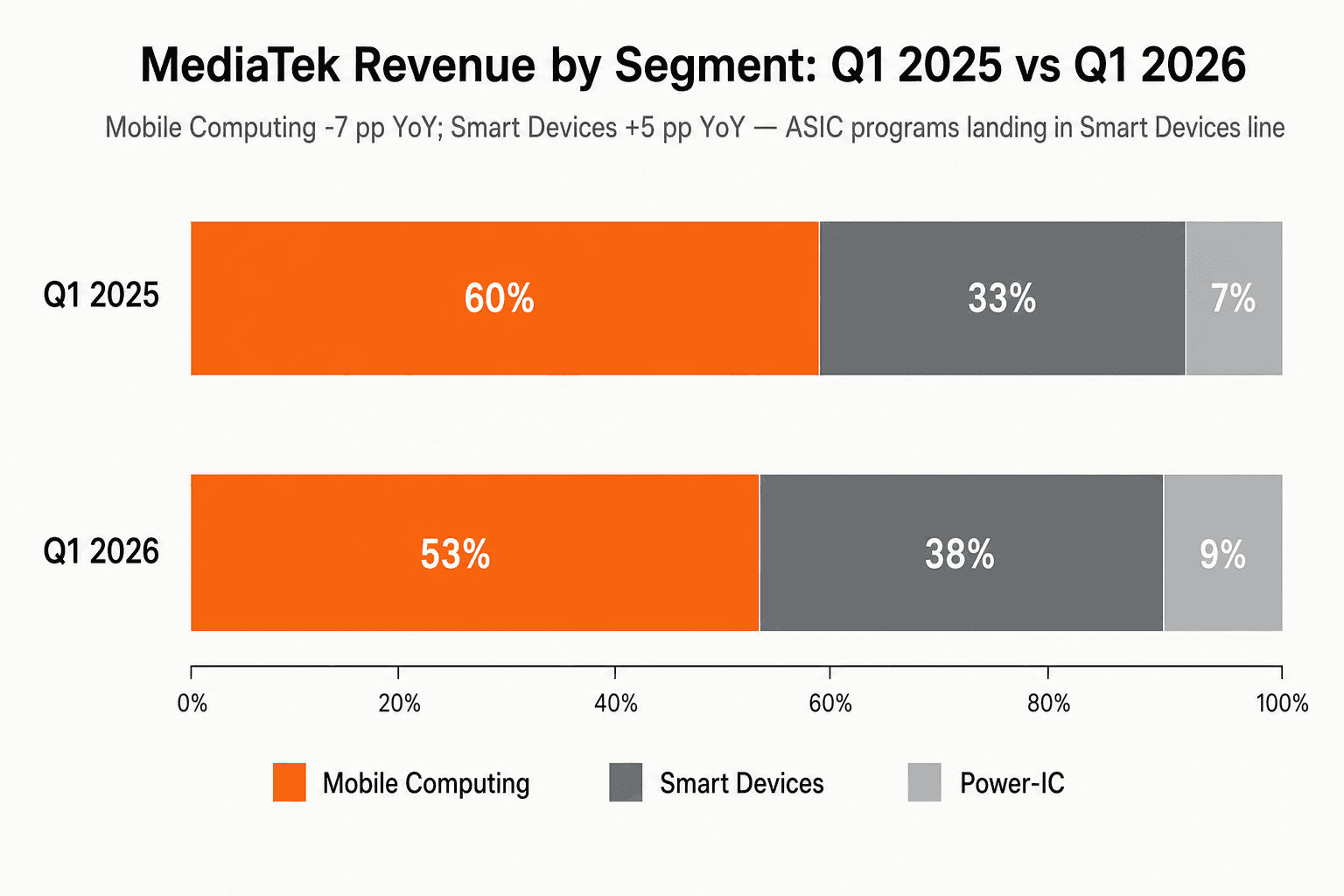
Mobile Computing (smartphone SoCs) dropped from 60% to 53% — that's the "smartphone is shrinking" datapoint. But Smart Devices (Wi-Fi, smart-TV, Chromebook, early ASIC engagements) climbed from 33% to 38%. ASIC program revenue is currently bundled inside Smart Devices rather than broken out as a separate line. Management hinted this changes in 2H 2026 — when ASIC crosses the 10% materiality threshold, MediaTek expects to carve it out as a standalone segment.
A subtle point: smartphone is shrinking, but flagship Dimensity ASP keeps improving (Tsai's wording on the call). Mobile Computing absolute revenue declined -4.3% QoQ and -14.1% YoY, but gross margin held — through better flagship mix and through pricing pass-through to customers. CFO David Ku was unusually direct: "We are discussing reflecting incremental supply chain cost in product pricing with customers." MediaTek rarely says this on the record.
Holding 46% gross margin is the hidden win
Gross margin printed 46.3%, up +0.2 pp from Q4 2025's 46.1%. Sounds boring. But combine that with the ASIC mix-shift trajectory and it becomes a non-trivial commitment.
ASIC carries structurally lower GM than smartphone SoCs (35-40% vs. 50%+, depending on NRE-vs-production mix). If ASIC scales from 5% of revenue in 2026 to 15-20% in 2027, static mix math compresses GM by 1.5-2 pp.
Tsai's full-year 2026 GM guide of "around 46%" therefore implies that smartphone ASP gains + customer pricing pass-through + ASIC production yield improvement together offset the dilution. In other words: MediaTek is asserting it has pricing power. That's the single most important moat for any fabless IC designer, and the company rarely makes the assertion this explicitly.
Why +67% in 11 days isn't a bubble — it's denominator re-pricing
Here's the counter-intuitive math. Q1 2026 EPS was -17.7% YoY, but the stock rallied +67% over the same 11-day window. Translated into P/E terms:
- April 21 NT$1,430 / 2026E EPS NT$60 = 23.8x P/E
- May 8 NT$2,400 / 2027E EPS NT$95-110 = 21.8x-25.3x P/E
The multiple barely moved. The denominator (EPS) grew 60-80%.
The market isn't paying for Q1 performance. The market is re-pricing 2027 terminal earnings, and the trigger was Tsai converting ASIC from "we are engaged" (no number) into "we have specific milestones" (specific number).
Narratively, this is the same pattern as NVIDIA's H100 visibility unlock in early 2023, or TSMC's first quantified AI accelerator 5-year CAGR in early 2024. Those were "market accepts a new fact" moments. MediaTek's version is quieter because the headline quarter is dull, but the structural-signal strength is comparable.
Risks
Three things in this report look bullish, but each carries an independent risk:
(1) Smartphone cycle worsens further. IDC and Counterpoint cut 2026 global smartphone shipment forecasts in March. If cuts deepen, even the Q2 2026 trough could undershoot. Mobile Computing is still 53% of revenue, so smartphone cyclicality dominates short-term EPS.
(2) Lumpy ASIC revenue recognition. ASIC NRE is booked against customer milestones; production is booked on wafer ship. A single program slip — even a quarter delay on Google TPU — would shift revenue non-linearly between Q4 2026 and Q1 2027. Daiwa's Rick Hsu specifically called this out.
(3) Wafer cost increases. N3/N2 wafer ASP could rise in 2H 2026 — TSMC explicitly hinted at this in its own Q1 2026 call. MediaTek's "GM around 46%" commitment is anchored to a cost baseline that may shift, weakening the credibility of the commitment.
Why this is the most important TW semis earnings print of 2026
TSMC Q1 2026 is the supply-side decisive print — it told the market AI semis supply remains accelerating.
MediaTek Q1 2026 is the demand-structure decisive print — it told the market AI ASIC order distribution is undergoing a step-change.
For the past 24 months, the AI ASIC story among Taiwan-listed names had a single pure-play (3661.TW Alchip). MediaTek's ASIC trajectory from noise to $1B → $3B scale doubles the investable AI ASIC universe in TW — and the second name's market cap (~NT$3.5T, roughly 8-10x Alchip) makes it large enough to absorb foreign large-cap AI allocation flows.
Goldman Sachs taking the PT from NT$2,800 to NT$5,000 — street-high and the largest single-name PT raise on TWSE in 2026 — is the market-cap proof of that re-categorization. Morgan Stanley using a NT$2,588-2,988 range (rather than a point estimate) reflects 2027 ASIC sizing uncertainty, but even the range mid-point is +25% above the pre-print PT. Eight covering firms raised; zero downgrades.
The right question in this report isn't "what did MediaTek earn in Q1?" It's "what should MediaTek's 2027 EPS be priced at?" Tsai, for the first time, gave the market the numbers to do that calculation.