Quanta Q1 2026: Record NT$809B Revenue, Gross Margin to a 15-Quarter Low
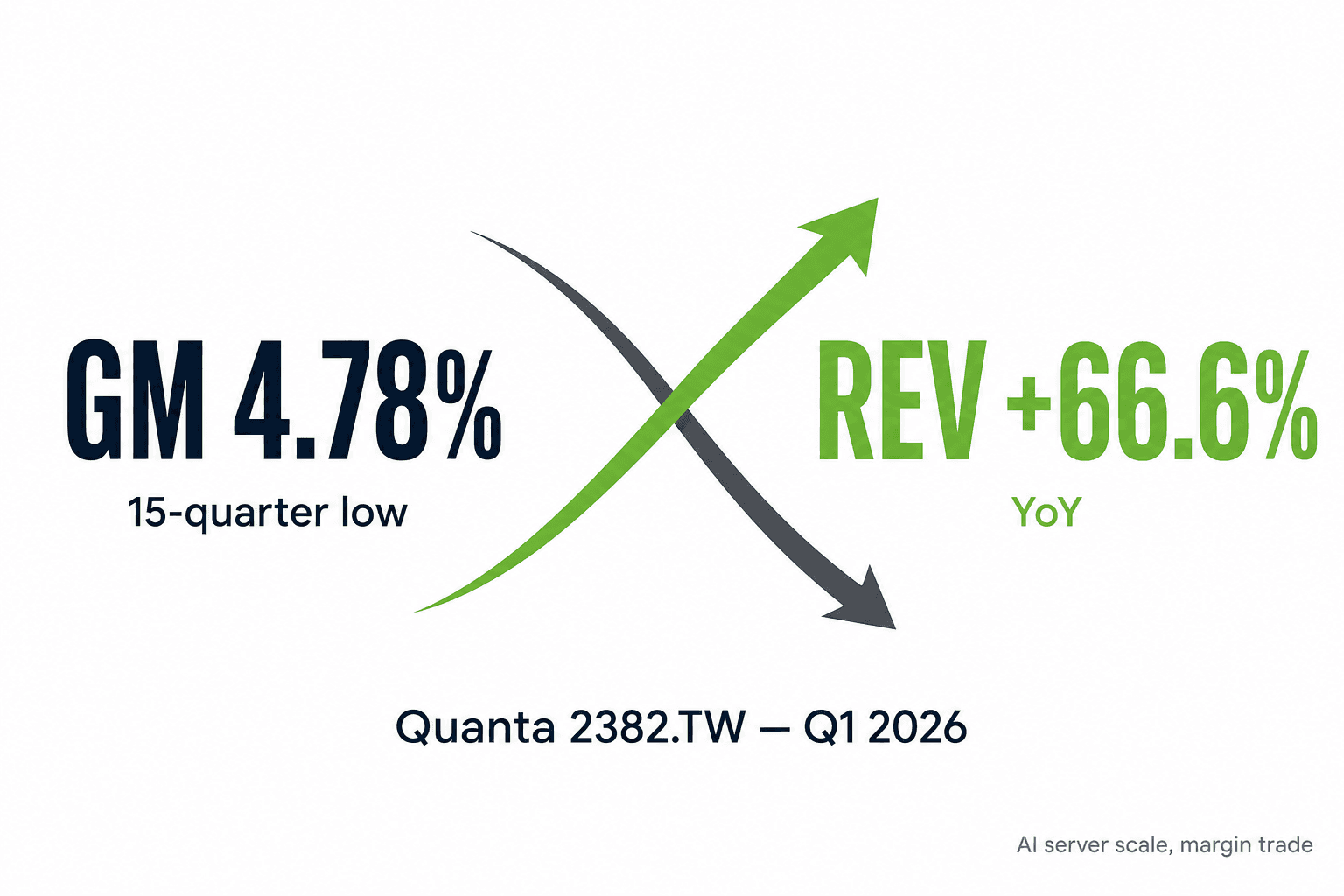
A quarter that traded gross margin for revenue scale on purpose
Quanta Computer's Q1 2026 print is, at its core, a deliberate trade: take a 314 bps YoY hit on gross margin in exchange for 66.6% YoY revenue growth.
This wasn't a surprise. Management telegraphed the AI rack margin dilution back at the 4Q25 call last November. But the actual reading — gross margin at 4.78% — still required investors to recalibrate. It's the lowest quarter in roughly four years (15 quarters), down from 6.33% the prior quarter and 7.92% the year-ago period.
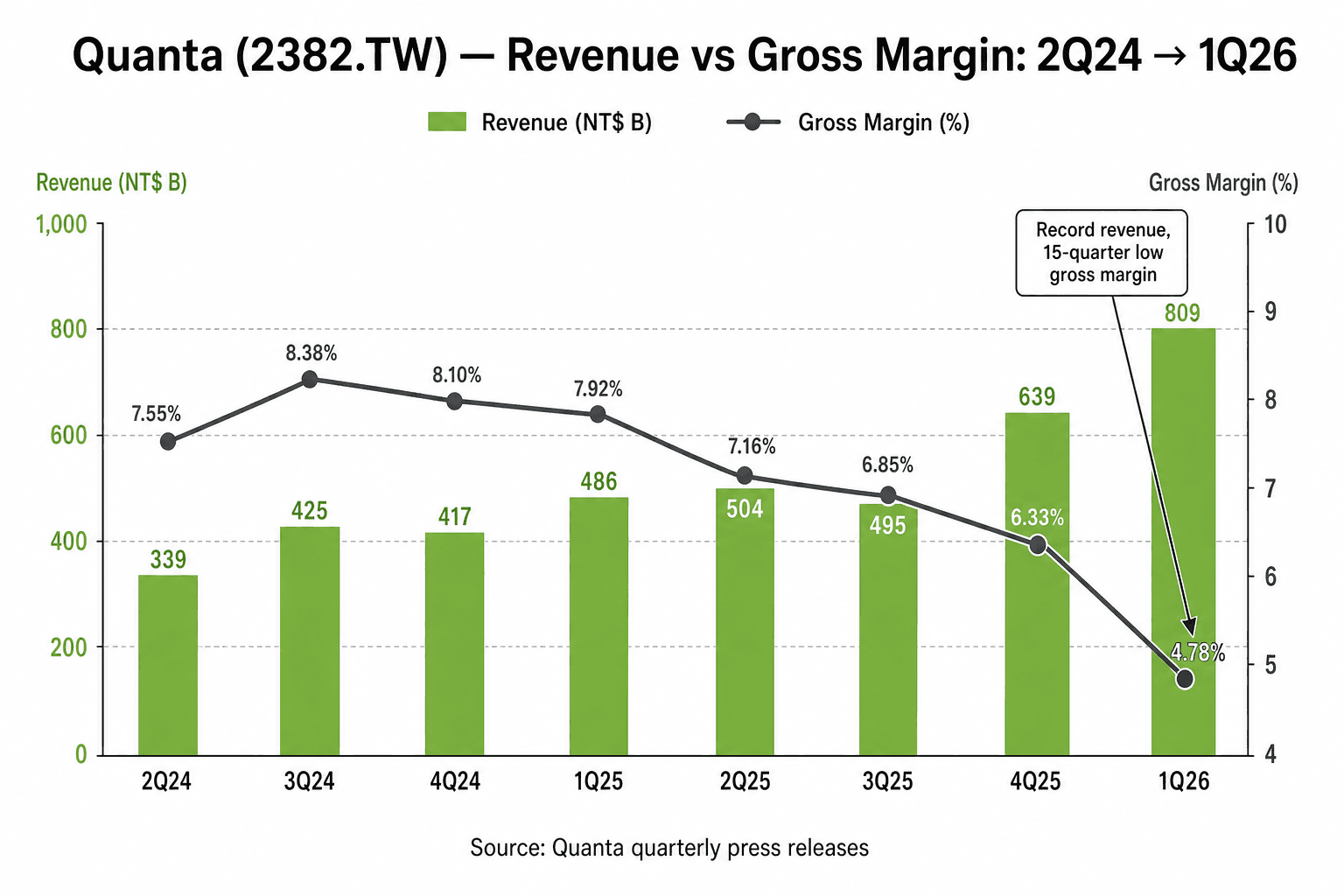
The same earnings release also has revenue at NT$809.2B (single-quarter all-time high), net income of NT$21.2B (+8.7% YoY), and EPS of NT$5.50 (record for any Q1 in company history). Which number you read first determines how you frame this report.
Server now >80% of revenue — Quanta is now an AI server ODM, period
The most consequential structural shift this quarter: server crossed 80% of total revenue for the first time, and notebook fell below 15%.
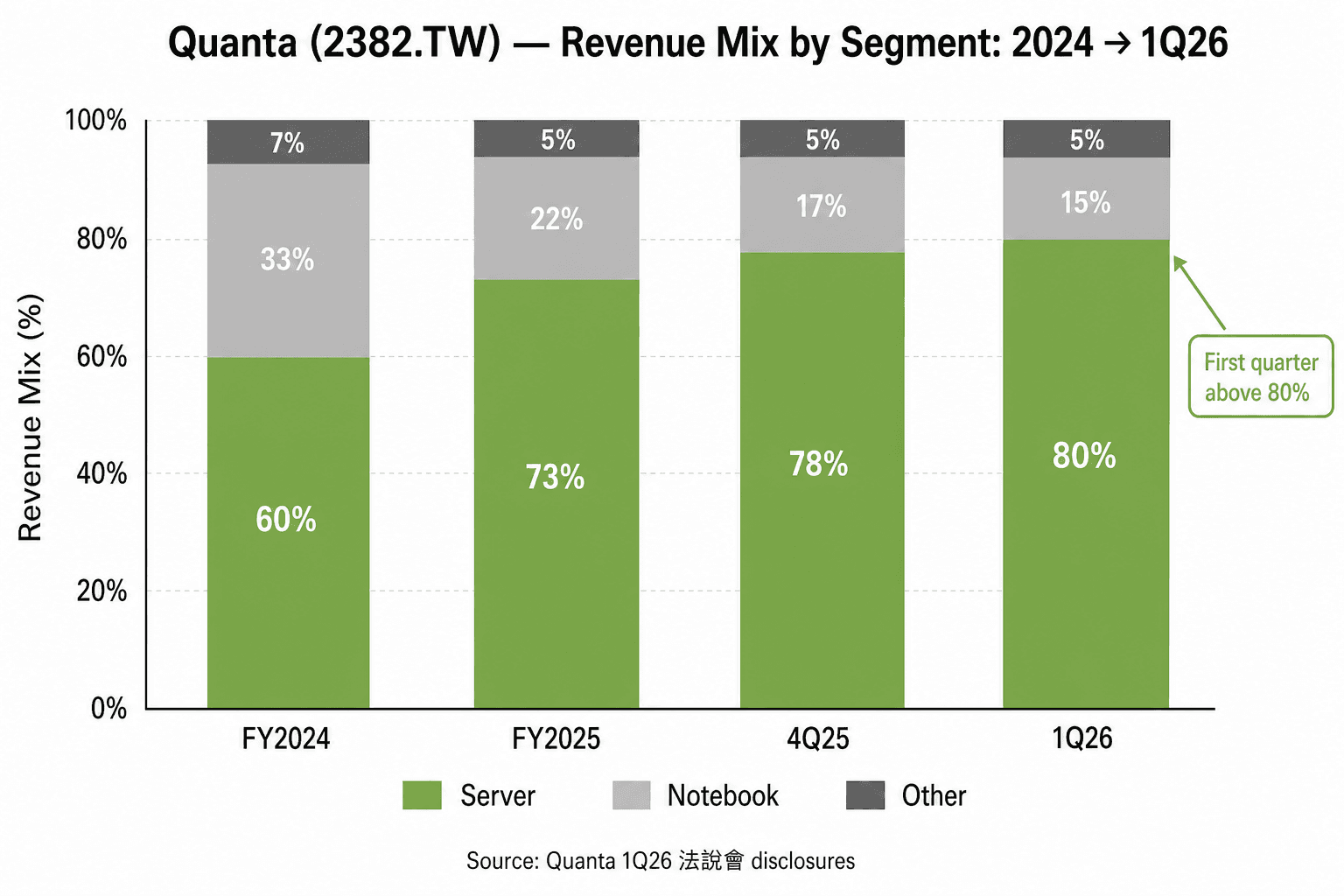
Two years ago, server and notebook were roughly even contributors. Today, server dollars are still expanding fast and notebook units are flat-to-down. This isn't notebook collapsing — it's server compounding at a pace notebook can't match. A one-way ratchet.
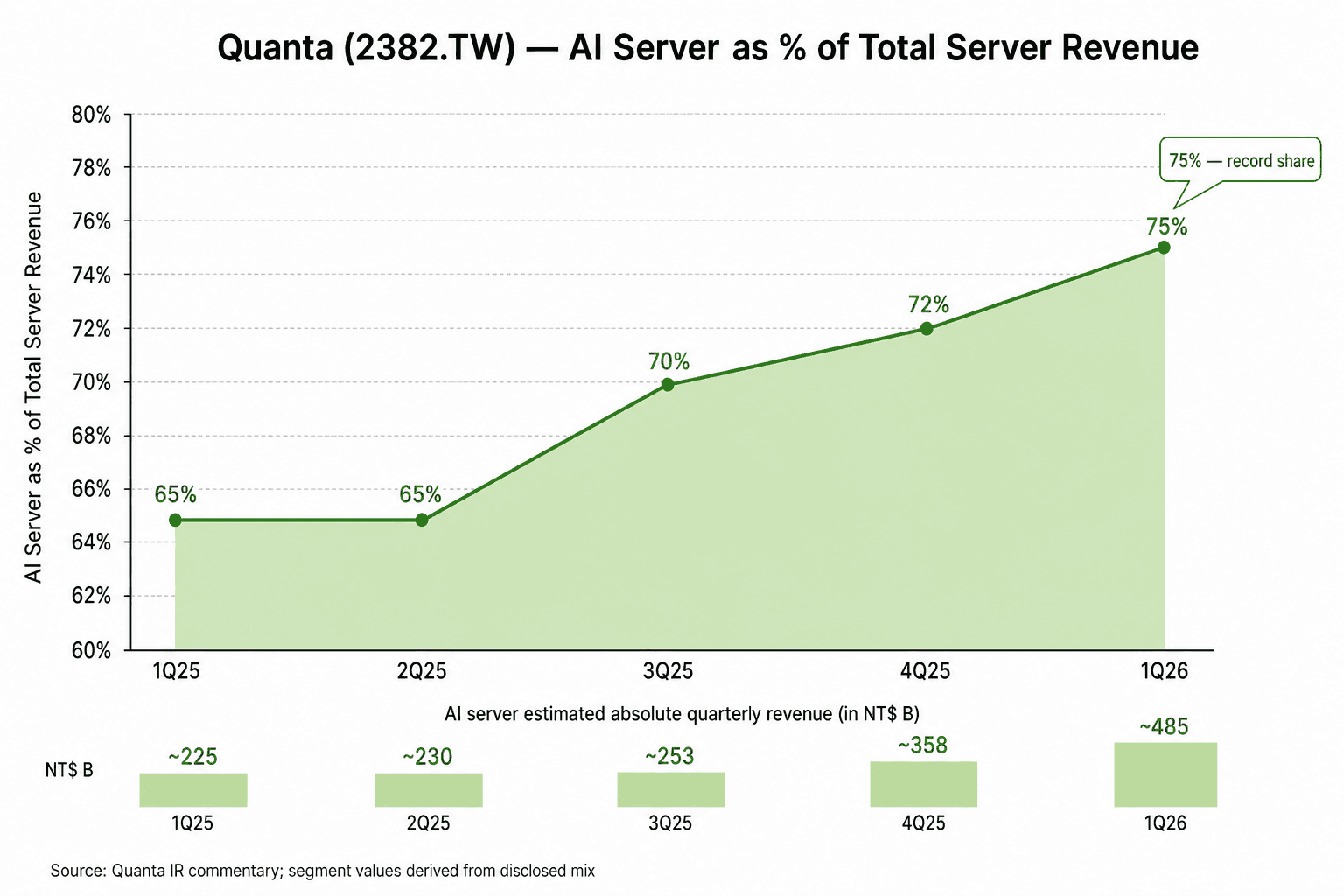
Inside server, AI is now 75% of the revenue (up from 65%+ a year ago). Math out: AI server revenue this quarter is roughly NT$485 billion. That single product line alone would rank among the larger Taiwan-listed companies by quarterly revenue.
High-density rack shipments doubled, GB300 already past GB200
The most direct cause of the margin compression: rack shipments at the >US$3M ASP tier (roughly NT$95M per unit) more than doubled this quarter.
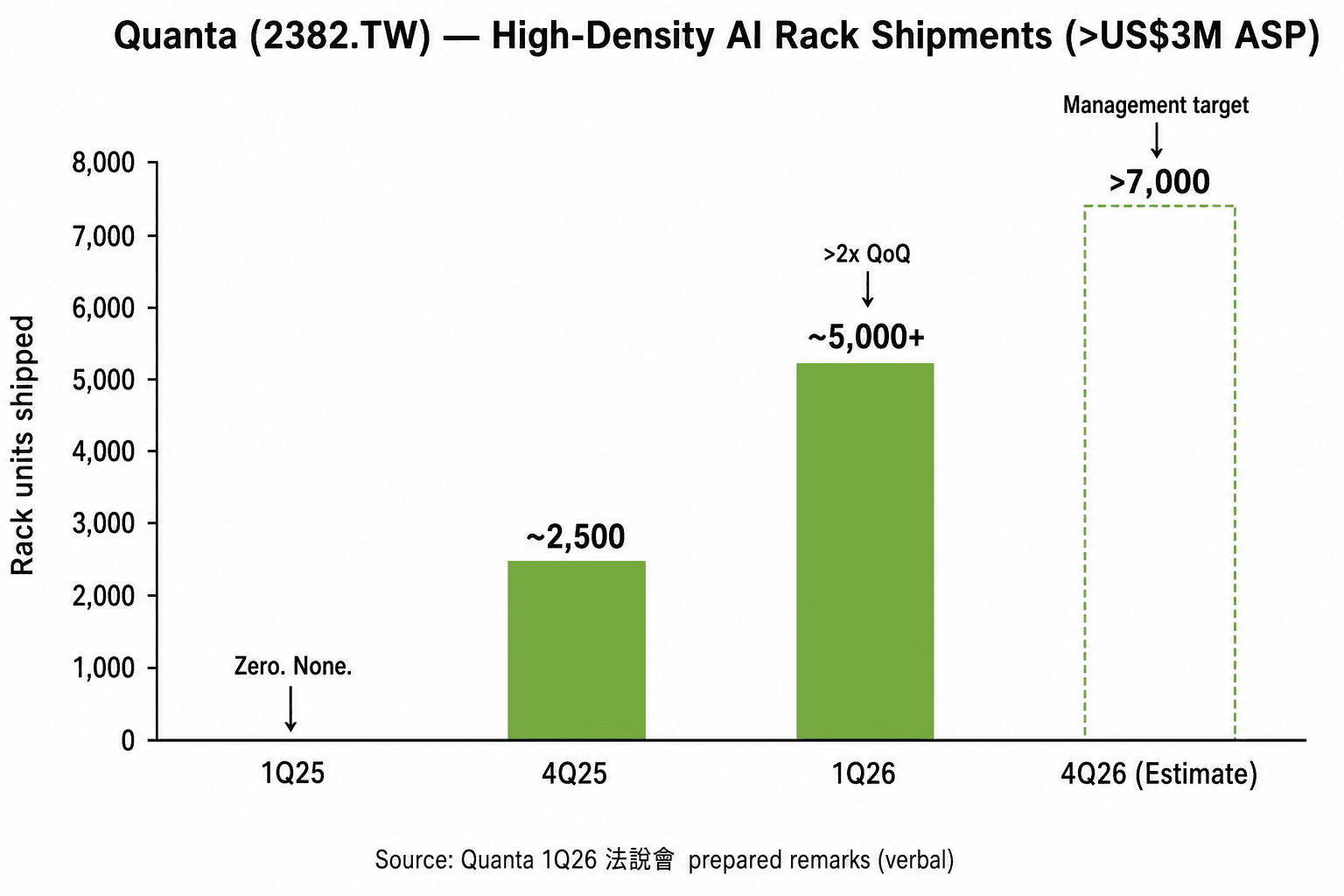
A year ago (1Q25), the count of >US$3M racks shipped was zero. One year later, that bucket is at the 5,000+ unit level. Each rack carries millions of dollars of GPU and HBM in its bill of materials — those dollars flow through COGS as material cost, the numerator (gross profit dollars) doesn't grow proportionally, but the denominator (revenue) does. So gross margin percentage gets compressed.
Even more important signal: GB300 unit volume already exceeds GB200. GB300 is NVIDIA's newest AI platform, only launched in Q4 2025, and by Q1 2026 it has already surpassed the GB200 in unit shipments — a faster crossover than the H200-to-GB200 transition was. NVIDIA's platform refresh cycle is compressing from roughly 6 quarters to roughly 3.
For Quanta this is both good news and bad. Good: newer platforms have higher ASPs and Quanta gets to ride the generation transition. Bad: every platform crossover brings pre-production charges and yield-learning-curve costs. Management's breakdown of the 1Q26 margin compression: 2/3 from server product mix shift, 1/3 from notebook mix and AI pre-production charges, with about 40% of that 1/3 being non-recurring and rolling off after Q2.
The cure: Consignment plus rising ASP
Management's response to the margin pressure is two-pronged:
Prong 1: keep raising AI rack ASP. The platform path is H200 → GB200 → GB300 → next-gen, with prices stepping up at each cross. As the same rack moves from US$2M to US$3M to US$4M+, gross profit dollars track upward and gross margin percentage becomes less sensitive to incremental price changes.
Prong 2: Consignment model. Starting H2 2026, select projects shift from Buy-and-Sell to Consignment — brand customers (NVIDIA or hyperscale CSPs) procure GPU/HBM materials directly; Quanta only assembles and tests. The effects:
- Reported revenue shrinks (GPU dollars no longer flow through Quanta's income statement)
- Gross margin percentage improves materially (smaller denominator, similar numerator)
- Working capital pressure drops significantly (no more fronting cash for GPU procurement)
- Trade some headline revenue for a much healthier P&L structure
This is a trade of nominal revenue for margin and cash flow. Management said "a small portion of projects" start under Consignment in H2 — keyword "small." Full transition probably takes into 2027. Short term, this is a "cure is coming" signal, not a "next quarter margin snaps back" commitment.
Cloud order visibility now reaches "beyond 2027"
The most consequential phrase from this earnings call: "beyond 2027" — large CSP customer order visibility now explicitly extends past 2027.
ODM industry norm: ~2-3 months of visibility on general server, ~6-12 months on high-end. Saying "beyond 2027" implies:
- Quanta has signed long-term framework agreements with CSP customers for 2027+ delivery
- NVIDIA's post-GB300 supply chain (management said the next platform "starts ramping at end of Q3, contributes Q4") has Quanta locked in
- NeoCloud customers (CoreWeave, Crusoe, Lambda, Nebius) get named for the first time as H2 2026 demand drivers — that customer category has gotten big enough to warrant separate mention
The execution backstop went out the same day: FY26 capex raised to ~NT$30B (vs. NT$15B-ish at 4Q25 update), and the board approved US$800M (~NT$25.2B) of capital injection into three overseas subsidiaries, primarily for US manufacturing capacity. AI server capacity target: roughly 2× FY25 by year-end 2026.
Why Foxconn's three-way margin lift contrasts with Quanta's compression
Hon Hai (2317.TW), reporting the same day, posted 三率三升 (gross, operating and net margins all up YoY). Quanta took a margin hit. Same end market, same demand wave — why the divergence?
It comes down to scale and revenue mix. Foxconn's total revenue base is 3-4× Quanta's, and it includes iPhone assembly, components and EVs alongside AI servers. The GPU pass-through dilution gets absorbed across a much larger denominator. Quanta is now 80% server, and 75% of that server is AI server — the entire revenue mix is concentrated in the high-material-cost AI rack line, so the dilution lands disproportionately hard.
Put differently: Quanta's margin compression isn't an operating execution issue. It's the price of business concentration. Same AI server tailwind, but Foxconn's deep pockets absorb it; Quanta's narrower mix pushes it straight onto the margin line.
Q1 looks like a floor — the floor isn't necessarily a launchpad
Sell-side consensus (21 analysts, 18 Buy / 3 Hold / 0 Sell) post-call has the average PT at ~NT$352, up from ~NT$331 entering the print. With the stock at NT$335, that's about 5% upside to the new average target. Morgan Stanley kept Overweight but barely nudged its PT to NT$330. Goldman, JPMorgan, BofA, Yuanta, KGI all raised PTs after the call, with the common thesis being "Q1 was the gross margin floor; the H2 Consignment lift is an unappreciated bullish catalyst."
Reading the print
Quanta's 1Q26 is a textbook example of the "ODM scale vs. margin" trade. Read just the gross margin and you'd assume this is a company in structural margin decline — 4.78% is unflattering by any ODM peer comparison. Read just the revenue and net income lines and you'd assume this is an AI server winner accelerating with order visibility extending past 2027 — also true.
Both readings are correct. They're two faces of the same fact: this is an ODM accepting short-term margin pressure at the most critical moment in the AI server supply chain, in exchange for scale and long-term customer lock-in. The H2 Consignment rollout and the steadily rising AI rack ASP are the other side of the trade — management is betting the margin gradually repairs through H2 while revenue dollars keep setting records.
The 2026 storyboard is set. The Q2 earnings call's gross margin reading will be the first verification point.