TSMC Q2 2026: Record Margins, Record CapEx, Record Selloff
A flawless report, and a crash
At 2 p.m. on 16 July 2026, TSMC (2330.TW) held the best-looking earnings call in its history.
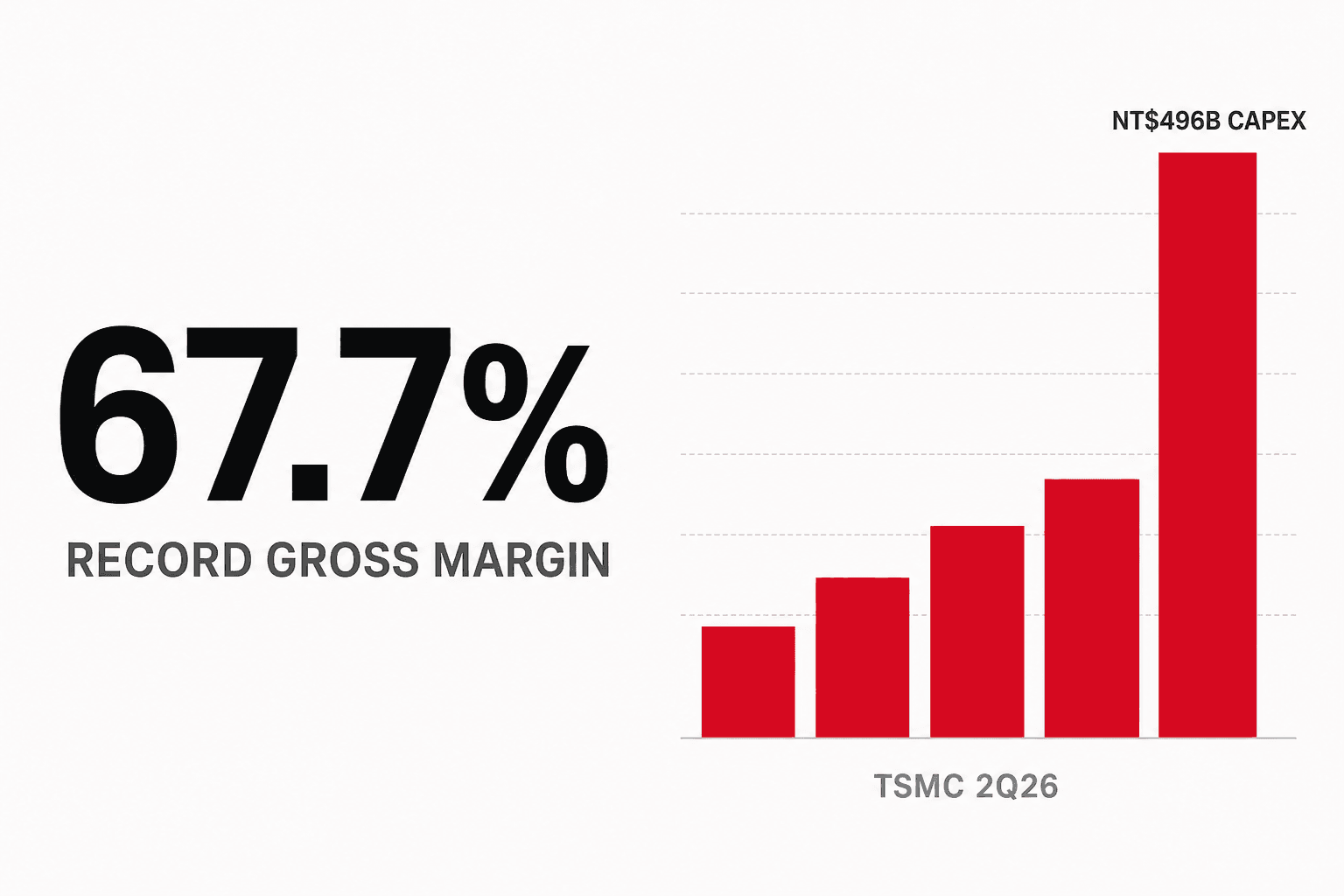
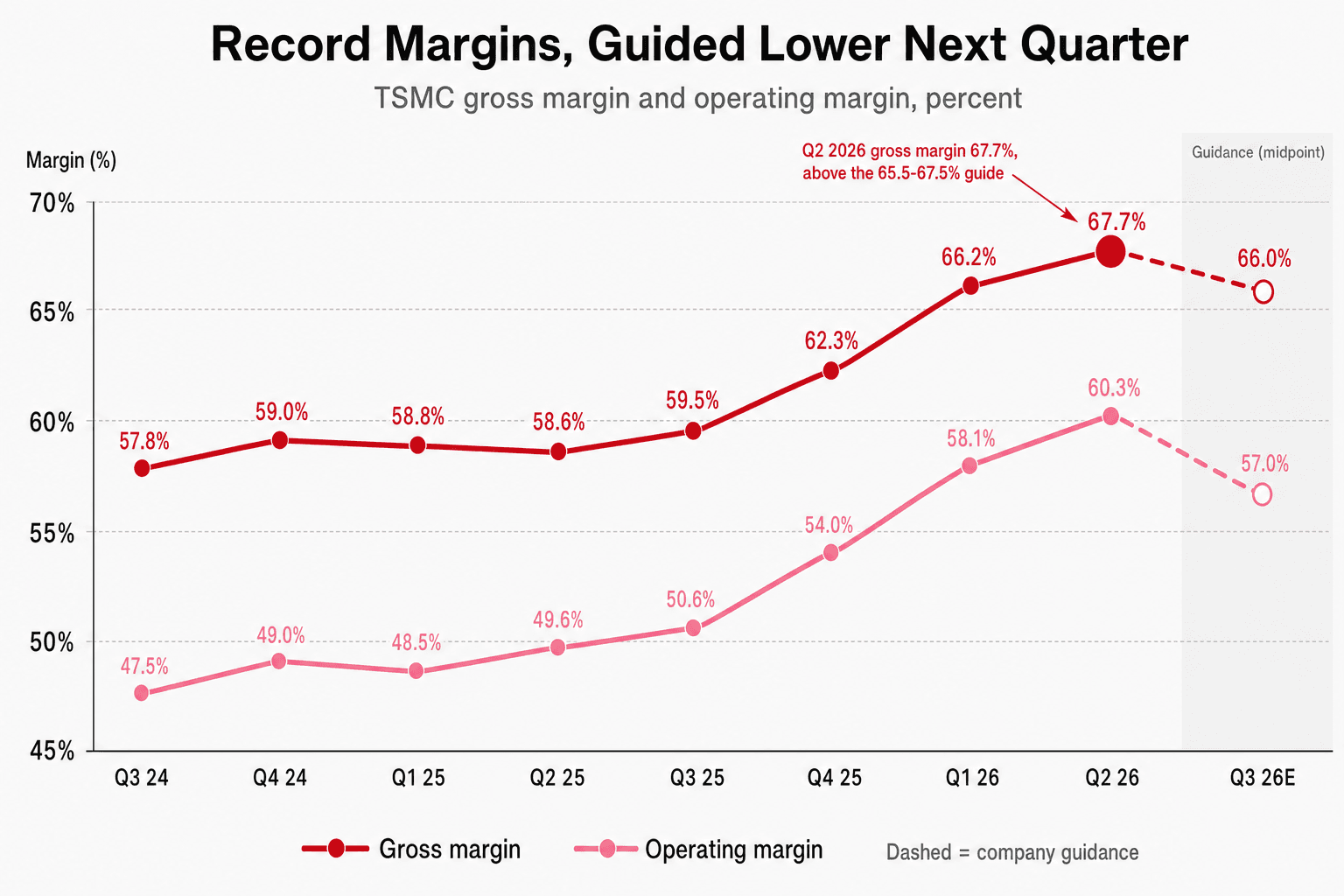
Revenue came in at NT$1,270.38B (all NT$ figures in billions), up 12.0% QoQ and 36.0% YoY, or US$40.20B, right at the top of its own US$39.0–40.2B guidance. Gross margin of 67.7% cleared the 65.5%–67.5% range. Operating margin of 60.3% cleared its 56.5%–58.5% range too. EPS NT$27.25. And full-year US-dollar revenue growth guidance was raised again, from April's "above 30%" to "slightly above 40%."
The next morning, 2330.TW opened down 3.85% and closed down 7.29% at NT$2,290, the low of the day. Volume was 97.36M shares, about 2.9x the July daily average, across 1.15 million transactions against a normal 100,000 or so. The TAIEX fell 2,953 points, the largest single-day point drop in the index's history; foreign investors sold a record NT$188.31B net. The Taiwanese press dubbed it Black Friday.
That same morning, 9 of 13 foreign brokers raised their price targets, into a range of NT$2,700 to NT$4,200 with a median around NT$3,150–3,200. Economic Daily News ran the headline "all 13 foreign brokers back TSMC." Even the one Asian house that downgraded kept a NT$2,700 target, 18% above the NT$2,290 close.
The sell-side spreadsheets and the tape moved in opposite directions on the same day. The explanation sits in three places: the composition of net income, the scale of CapEx, and one answer on the call that had almost nothing to do with TSMC.
Clean up the EPS line first
EPS grew 23.4% QoQ, nearly double the 12.0% revenue growth. Most of that gap was not earned in the fabs.
Non-operating income was NT$95.83B this quarter against NT$28.83B last quarter. Almost all of the difference traces to a single event: on 15 May, TSMC cut its stake in Vanguard (VIS) by 8.1% and booked NT$63.20B in disposal and revaluation gains. CFO Wendell Huang was explicit about the impact: NT$2.24 of EPS.
Take it out and you get net income of NT$648.47B, a 51.0% net margin, and EPS of NT$25.01, +13.3% QoQ.
13.3% against 12.0% revenue growth is still a good quarter: profit growing a little faster than the top line. But "a little faster" is not "twice as fast." Anyone anchoring on +23.4% is extrapolating Q3 off a base that contains a one-off.
The line that matters is the operating line. The 1.5 pp of gross margin expansion came from cost improvement and higher utilization, with overseas-fab dilution pulling the other way. The additional 0.7 pp further down is pure leverage: OpEx rose just 5.3% and fell to an all-time low of 7.8% of revenue. One comparison makes the point. TSMC's operating margin today, 60.3%, is higher than its gross margin was in Q2 2024, at 53.2%.
This quarter TSMC decided to spend what it earned
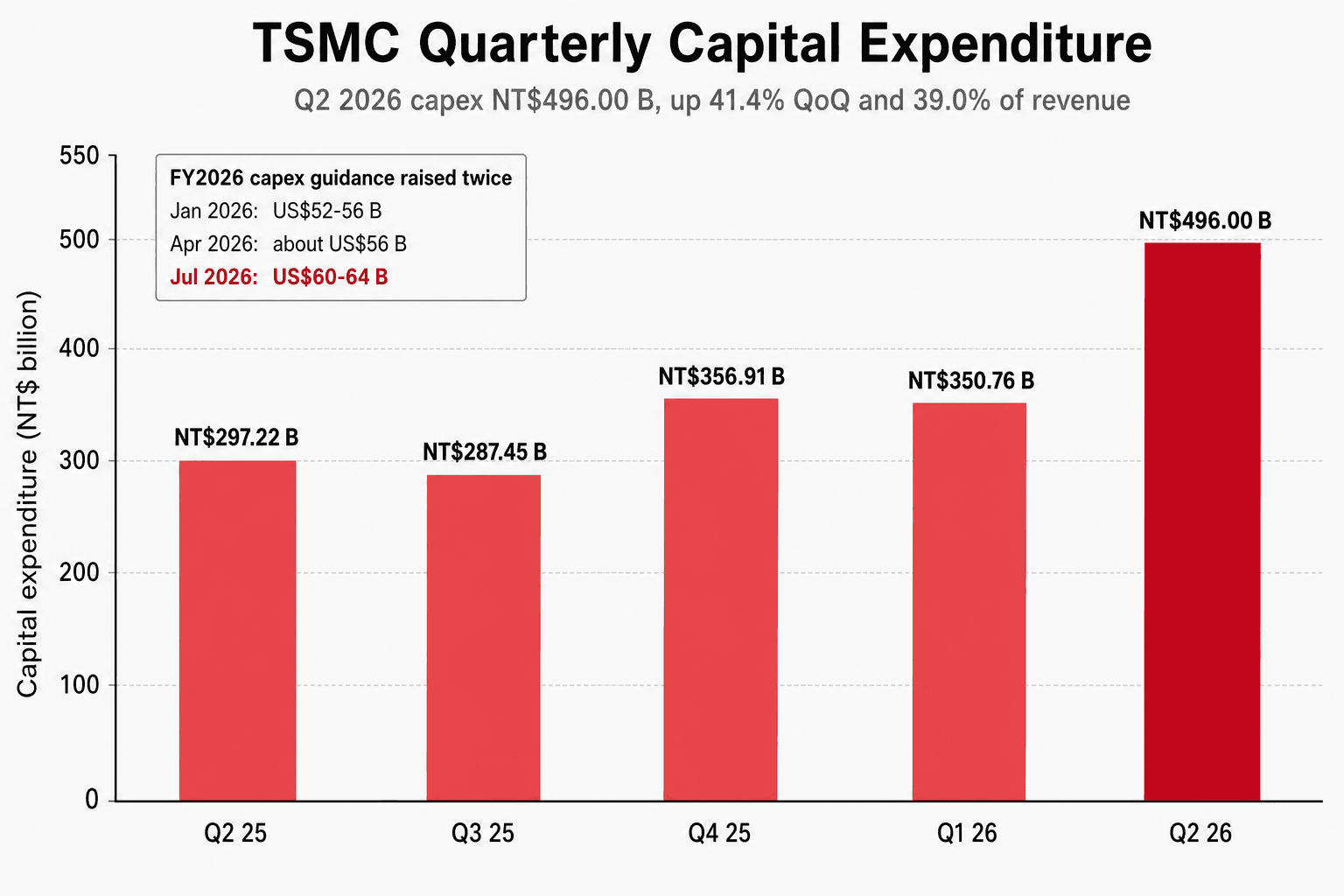
Quarterly CapEx came in at NT$496.00B (US$15.70B), +41.4% QoQ and +66.9% YoY, or 39.0% of revenue: the highest reading in the series, and 4.9 pp clear of the second-highest. Depreciation and amortization in the same quarter was NT$198.54B. TSMC spent roughly 2.5x its own depreciation on new capacity in three months.
The bill shows up in the cash flow statement. Operating cash flow was NT$783.36B, +12.1% QoQ. Free cash flow was NT$287.36B, -17.5% QoQ. CapEx is the entire reason.
The full-year trajectory tells the story better. January: US$52–56B. April: "close to US$56B." July: straight to US$60–64B. Against 2025 actuals of US$40.90B, the new US$62B midpoint is +51.6% YoY. Only US$26.80B was spent in the first half, leaving US$33.2–37.2B for the second. On the same call the company added another US$100B for Arizona, taking cumulative commitments there to US$265B, earmarked for "several more" sub-2nm logic fabs and advanced packaging facilities. No timeline was given.
Huang declined to put a three-year number on it and instead upgraded the adjective: last time, CapEx over the next three years would be significantly higher than the past three; this time, "even more significantly higher." Wei was blunter: "You can bet it will keep going up."
Asked where roughly US$10B of extra spending had come from in six months, Wei gave two reasons, and the second was not in most models: continued demand growth, and inflation. "We're buying tools at post-inflation prices now — you know what I mean." Which is to say part of the CapEx increase buys no additional wafers at all; the same wafers just cost more. Nobody on the sell-side has yet broken that piece out.
Who paid the bill
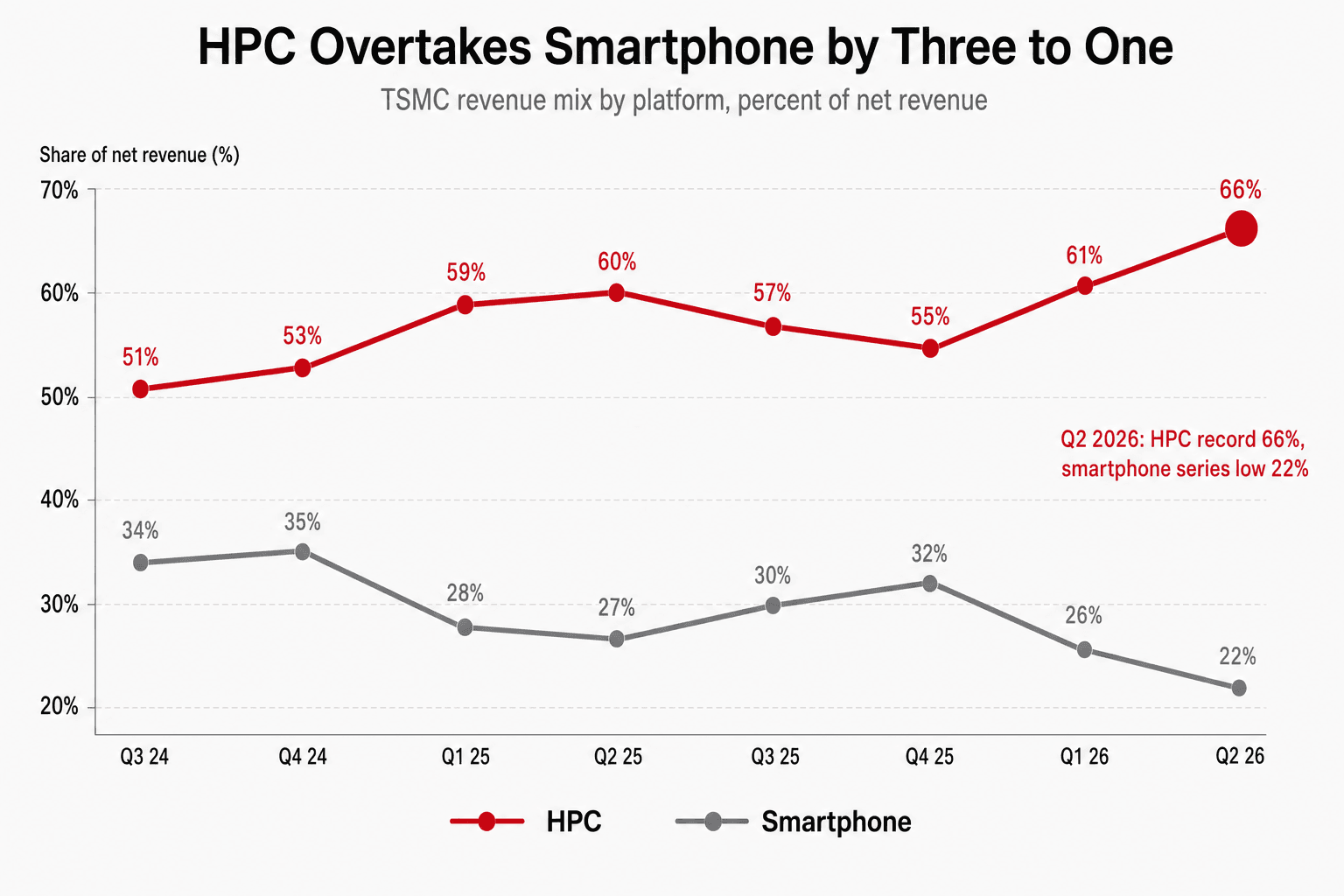
HPC, which at TSMC effectively means AI accelerators and data-center silicon, grew 20% QoQ to 66% of revenue, the highest since the company began disclosing the mix. Smartphone fell 4% QoQ to 22%, a series low. For the first time, HPC is three times smartphone.
In absolute terms HPC was roughly NT$838.5B this quarter. That is larger than TSMC's entire company revenue in Q3 2024 (NT$759.69B).
The driver is a shift in the process mix.
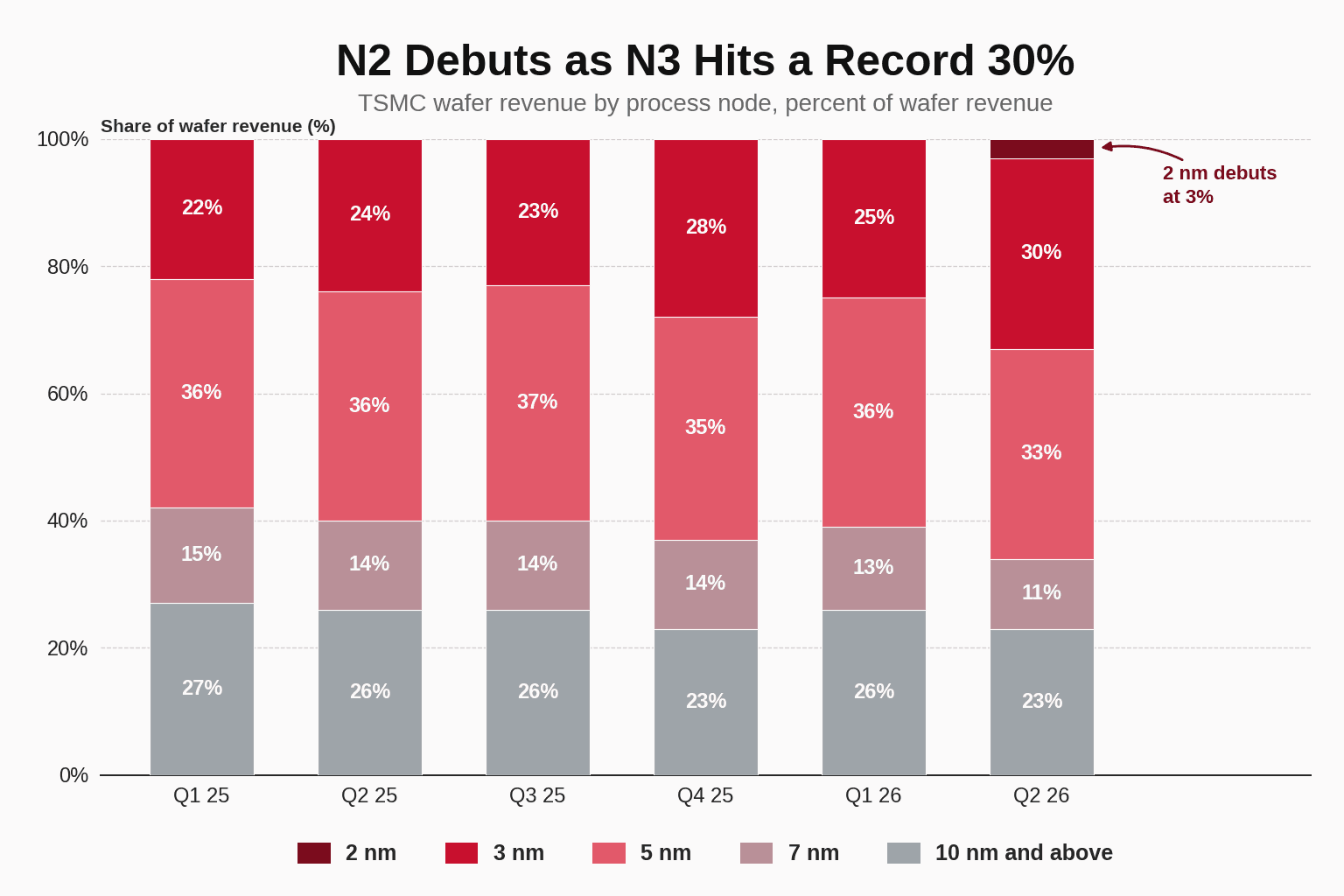
N2 took 3% of wafer revenue in its first quarter of volume production, the first time TSMC has broken the line out. For comparison, N3 took two years from launch to reach 15%. N3 itself jumped 5 pp to a record 30% this quarter, contributing about NT$98B of the sequential gain on its own, or 72% of the company's NT$136.3B revenue increase. N5 deliberately gave up 3 pp, because TSMC is converting 5 nm tooling in Taiwan into 3 nm capacity.
The quarter is best captured by a single piece of arithmetic. Wafer shipments rose 3.9%; revenue rose 12.0%. The gap is mix and price: blended ASP per 12-inch equivalent wafer rose 7.8% QoQ to a record NT$293,000. TSMC didn't make money this quarter by making more wafers. It made money by making more expensive ones.
Advanced packaging is a separate story. TSMC never discloses CoWoS capacity, but Wei offered a line that was almost uncomfortably candid: "Our packaging capacity is so tight it is now limiting our customers' growth." So when an analyst raised Intel's EMIB-T as a competitive threat, he welcomed it: more flexibility in the market helps TSMC's front-end wafer business grow, and that is the business that matters.
Asked whether AI demand is a bubble, he answered with neither a model nor a forecast, but with legwork. TSMC is auditing customers' data centers one by one, checking "progress, buildings, locations, demand, racks," all of it, to "make sure TSMC's chips do not end up sitting in inventory."
The trigger was a sentence that wasn't about TSMC
What actually got destroyed on 17 July was not TSMC.
| Stock | 7/17 move |
|---|---|
| UMC 2303.TW | -10.00% (limit down) |
| ASE 3711.TW | -9.97% |
| Powerchip 6770.TW | -9.93% |
| Vanguard 5347.TW | -9.87% |
| MediaTek 2454.TW | -8.92% |
| Alchip 3661.TW | -7.69% |
| TSMC 2330.TW | -7.29% |
TSMC fell the least on the list. Everything it dragged down fell harder, with the top four at or near limit down.
The cause was one Q&A exchange. Asked whether mature nodes were tight, Wei drew a hard line: the only genuine shortages are AI-related, power management ICs above all, because AI data centers require huge amounts of power conversion, and sensors after that. Beyond that, consumer demand is "not at all" tight.
Mature-node foundries had spent months raising quotes on a capacity-shortage narrative. Once that sentence was out, the trade was over in the next morning's opening auction.
The other three explanations circulating on institutional desks are more conventional. Gross margin hit a record but still fell short of the 70% in some buy-side models, and Q3 guidance takes it back down to 66%. CapEx was read as a liability rather than an asset, compressing near-term free cash flow and piling up future depreciation. And the extra US$100B for Arizona came without a timeline, which reads as cost rather than capacity. In a stock that has risen roughly 72% in a year, those three are enough for the market to re-rate the multiple rather than the earnings. Morgan Stanley's Charlie Chan concluded "buy the dip"; Anue's write-up of Vital Knowledge cast it as the reopening of the old cyclical-versus-structural argument in semiconductors. On 17 July, the tape traded the latter.
What to watch over the next three quarters
First, where gross margin settles. N2 dilution of 3–4 pp, overseas fabs another 2–3 pp, and not one sell-side model can say which year both drags disappear together. Asked about a memory company's 86% gross margin, Wei blurted out: "86? I'd be very happy with 68." That is the closest he has come to naming a ceiling, and this quarter printed 67.7%.
Second, the next CapEx raise. Yuanta models 2027 above US$70B and a three-year cumulative total above US$200B. Given how Huang and Wei are now phrasing it, the direction isn't in question, only the size, and how much of it is inflation.
Third, verification on the demand side. TSMC says visibility now extends to 2029 and 2030, and that the five-year AI revenue CAGR is "stronger, stronger, stronger" than the "mid-to-high 50s" given in January, but it declined to publish a new number. Wei's verdict on customer forecasts was the best line of the call: "I believe every customer is telling me the truth. But when you add up all the truths, it isn't the truth anymore."
The conclusion is simple enough. TSMC earned the highest margins in its history and chose not to bank them, putting the money back into fabs instead. The market isn't questioning the margins. It's questioning how many years of free cash flow the company is willing to trade for future capacity, and what multiple that decision deserves.